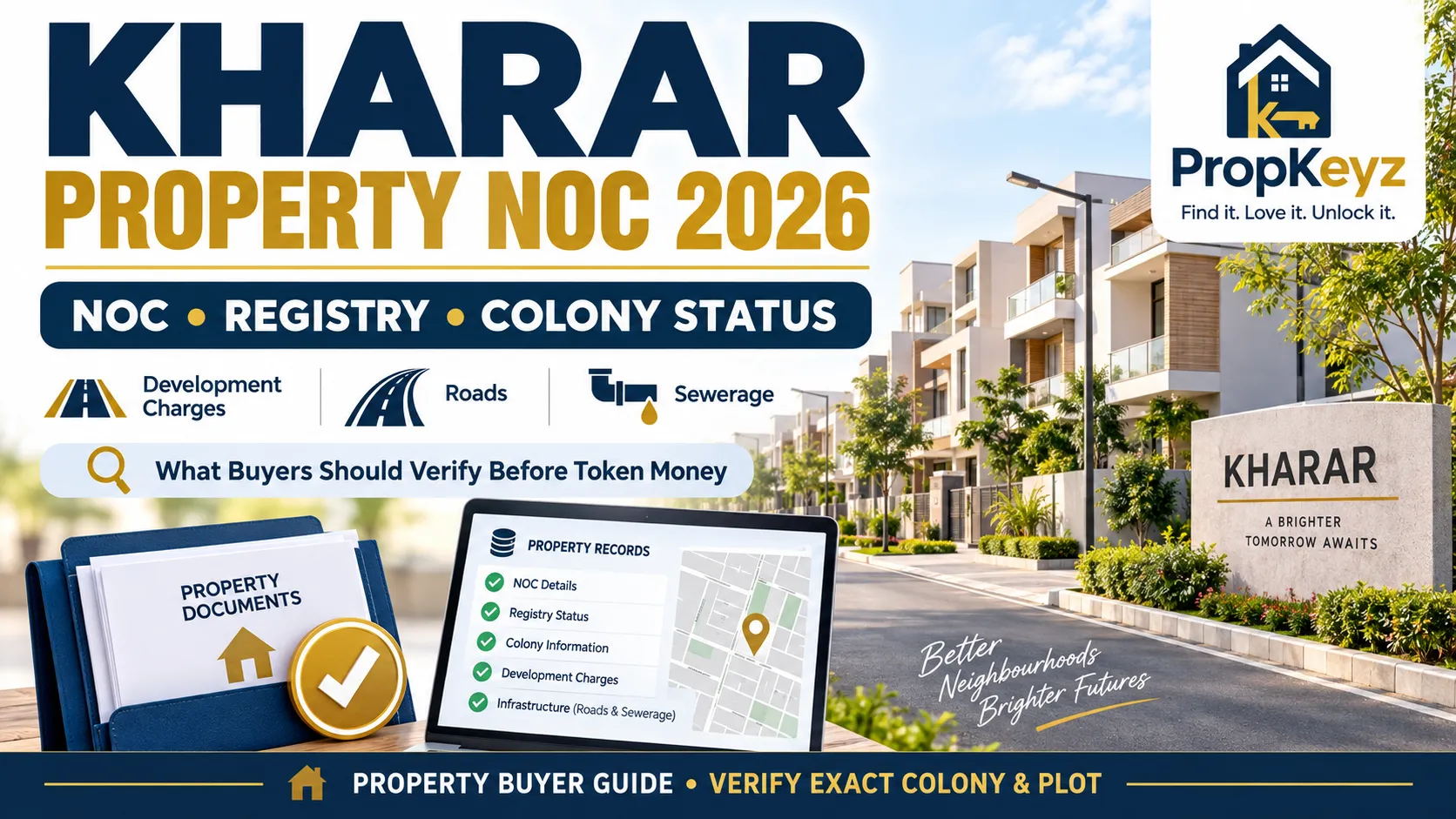
The Kharar property NOC 2026 issue has become more important after residents raised fresh questions over development charges, taxes, no-objection certificates, colony handovers, roads and sewerage in September 2026.
According to a report published on 11 September 2026, a group of Kharar residents requested a high-level inquiry and sought clarity over why charges and NOCs were being dealt with in colonies that, according to the residents, had not been formally handed over to the Municipal Council. They also raised concerns about roads and sewerage.
However, Kharar Municipal Council has disputed those allegations, describing claims of harassment and civic neglect as baseless and maintaining that responsibility must be determined according to the applicable rules and the administrative status of each colony.
That disagreement creates a much bigger question for property buyers:
What does an NOC actually prove about a Kharar property?
And equally important:
What does it not prove?
A property may have:
- registry eligibility,
- an NOC under a regularization policy,
- a licensed-colony record,
- a sanctioned layout,
- RERA registration,
- municipal services,
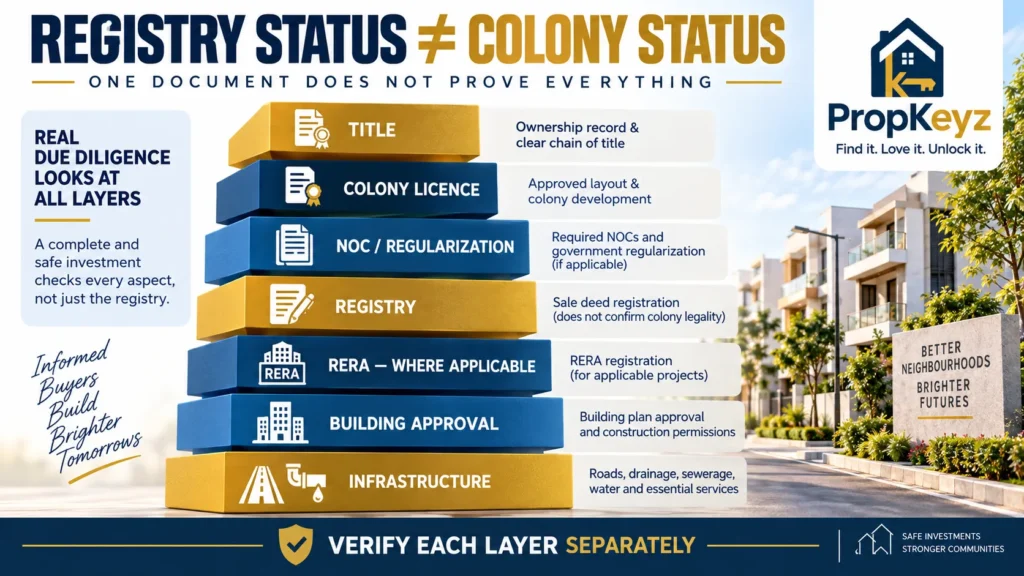
but these are different legal and administrative layers.
A buyer should therefore avoid reducing property due diligence to one sentence:
“Registry ho rahi hai, property legal hai.”
The real buyer question should be:
What is the exact status of this property, this plot, this colony and this infrastructure today?
This PropKeyz guide explains that difference.
Key Takeaways
- Kharar residents have sought an inquiry into development charges, NOCs, colony handovers and infrastructure; Kharar MC has denied the allegations.
- An NOC is not the same thing as a colony licence.
- Registry is not the same thing as complete project approval.
- GMADA separately maintains records for:
- licensed colonies,
- plots issued NOCs under regularization,
- unauthorized colonies.
- GMADA describes licensed colonies / mega projects as a category where NOC is not required for registry.
- Punjab’s 2024 special NOC exemption for certain unauthorized-colony plots had specific eligibility conditions and a notified registration window; it was not a blanket permanent approval of every unauthorized colony.
- Colony handover and municipal-service responsibility must be checked separately.
- Payment of development charges does not, by itself, prove that every promised road, drain or sewer is complete.
- Buyers should verify both documents and physical infrastructure before paying token money.
PropKeyz View
A property can be registrable without every other property question being resolved. Registry, approval, colony status and infrastructure should be verified separately.
Kharar Property NOC 2026: Quick Answer
The Kharar property NOC 2026 question cannot be answered with a simple:
NOC required
or:
NOC not required.
The correct answer depends on what type of property you are buying and what “NOC” you are talking about.
GMADA currently separates property information into categories including:
- plots to which NOCs have been issued under regularization policy,
- licensed colonies / mega projects where NOC is described as not required for registry,
- unauthorized colonies.
Punjab also created a specific NOC exemption in 2024 for certain qualifying plot holders in unauthorized colonies, subject to statutory eligibility criteria and a notified registration period.
Therefore:
Never decide a Kharar property’s status simply because somebody says “NOC hai” or “NOC nahi chahiye.”
Current Buyer Summary
| Question | Correct Buyer Interpretation |
|---|---|
| NOC available? | Ask what type of NOC |
| NOC not required? | Ask under which legal / colony category |
| Registry possible? | Does not alone prove full development approval |
| Colony licensed? | Verify GMADA / competent authority record |
| Plot regularized? | Verify exact plot-specific record |
| Colony unauthorized? | Additional caution required |
| Colony handed to MC? | Verify formal administrative status |
| Development charges paid? | Does not by itself prove infrastructure completion |
| Road available? | Inspect physically |
| Sewerage working? | Verify on ground |
| RERA required? | Check project applicability and Punjab RERA |
| Safe to buy? | Only after combined document + site due diligence |
PropKeyz View
NOC is one question. A safe property purchase requires several answers.
What Happened in Kharar in September 2026?
On 11 September 2026, residents of Kharar were reported to have submitted a representation seeking a high-level inquiry into civic charges and infrastructure.
The representation reportedly questioned:
- development charges,
- taxes,
- NOCs,
- colony handovers,
- road construction,
- sewerage projects.
Residents said some colonies had infrastructure problems and questioned civic charges in colonies which, according to their representation, had not formally been handed over to the Municipal Council.
Photographs of damaged roads and an open sewer near a municipal park were reportedly submitted as part of their complaint.
This does not establish that residents’ allegations have been legally proved.
It establishes that:
a formal demand for clarification and inquiry has been raised.
What Are Residents Asking Authorities to Clarify?
The fresh representation raises several property questions that are relevant far beyond the individual complaint.
According to the report, residents sought clarity over:
Colony Legal / Administrative Status
Who currently has administrative responsibility?
Development Charges
What has been collected and for what purpose?
NOCs
On what basis have NOCs been issued?
Roads
Who is responsible for construction and maintenance?
Sewerage
Who must provide and maintain the network?
Colony Handover
Has a particular colony formally transferred to the Municipal Council?
These questions matter because Kharar is not one homogeneous property market.
It contains a mix of:
- established colonies,
- licensed developments,
- extensions,
- apartments,
- builder floors,
- plots,
- regularization cases,
- older unauthorized development,
- village/revenue land,
- municipal areas.
The administrative route can therefore vary from property to property.
What Has Kharar Municipal Council Said?
Kharar Municipal Council has denied the allegations raised by residents.
The MC reportedly described the allegations of harassment and civic neglect as baseless.
It also disputed the residents’ contention regarding:
- collection of charges, and
- responsibility for infrastructure in colonies alleged not to have been handed over.
The council’s position, according to the report, is that the matter must be assessed according to:
the applicable rules and administrative status of the individual colony.
That final part is particularly useful for a property buyer.
PropKeyz Buyer Rule
Do not make a Kharar-wide assumption from the status of one colony. Verify the exact colony.
What Does “NOC” Mean in Kharar Property?
This is where considerable confusion begins.
NOC means:
No Objection Certificate
But real estate can involve more than one NOC.
Registry / Regularization NOC
This is the type most buyers mean when discussing whether a plot in a particular colony can be registered.
Sewerage NOC
A project may separately need permission relating to sewerage discharge or connection.
Historical Kharar project records themselves show separate Municipal Council sewerage-related NOCs for individual developments.
Fire NOC
A building may separately require a fire-safety NOC depending on its use and configuration.
Pollution / Environmental NOC
Certain projects may require approvals from environmental or pollution-control authorities.
Utility NOC
Electricity-related approvals may also exist separately.
Therefore
A seller saying:
“NOC approved hai.”
should trigger the next question:
“Kaunsa NOC?”
PropKeyz View
The document name matters more than the marketing phrase.
Registry NOC vs Colony Licence vs Regularization
These three concepts should not be confused.
Colony Licence
A licence concerns the developer/promoter’s authority to develop the colony under the relevant framework.
GMADA maintains a licensed-colony database containing fields such as:
- colony name,
- location,
- licence number,
- approval date,
- approved plan,
- promoter,
- licence validity.
Plot-Specific Regularization / NOC
An individual plot in an unauthorized or previously unapproved colony may have gone through a particular regularization/NOC route under an applicable government policy.
GMADA separately maintains:
List of Plots to whom N.O.C. have been issued under regularization policy.
Registry
Registry refers to execution/registration of the property transaction.
These should not be compressed into:
“Registry ho gayi = colony licensed.”
That is not a safe conclusion.
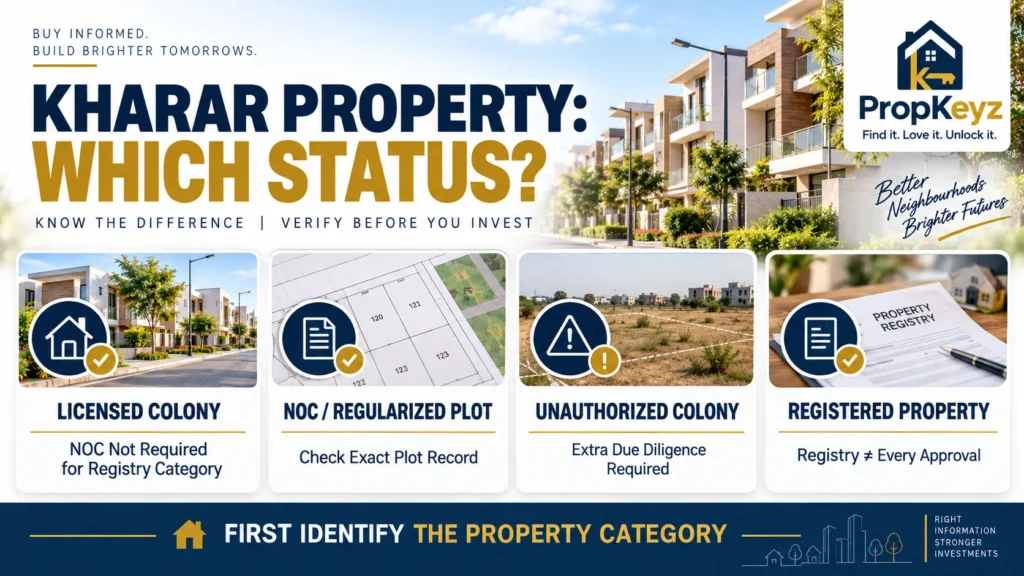
GMADA’s Three Most Important Property Categories for Kharar Buyers

GMADA’s current website provides three extremely useful categories.
Category 1 — Licensed Colonies / Mega Projects
GMADA labels this category:
Licensed Colonies/Mega Projects Residential / Industrial — NOC Not Required for Registry.
This is the strongest starting point where the property forms part of an applicable licensed development.
But even here, the buyer should check:
- exact phase / extension,
- approved plan,
- property number,
- seller title,
- dues,
- building legality,
- RERA where applicable.
Category 2 — Plots Issued NOC Under Regularization Policy
This means the individual plot may have received an applicable NOC / regularization treatment.
Buyer should match:
- owner’s name where relevant,
- plot,
- colony,
- dimensions,
- reference number,
- actual sale property.
Do not accept:
“Neighbour ke plot ka NOC hai, mera bhi same hai.”
Category 3 — Unauthorized Colonies
GMADA also publishes a separate:
List of Unauthorized Colonies.
This does not mean every transaction inside every listed colony has the same outcome.
It means additional caution is necessary.
PropKeyz Rule
Colony list + plot record + current policy + title documents must be read together.
Examples of Kharar Colonies in GMADA’s Licensed Records
GMADA’s official licensed-colony records contain multiple Kharar entries.
Examples visible in the database include developments such as:
- Sunny Enclave extensions,
- Shivalik Enclave extensions,
- Gillco Valley,
- Shivjot Enclave,
- Silver Oak Heights,
- Nav Enclave,
- Shivalik Estate,
- Skylark Apartments.
This list should not be read as:
PropKeyz recommending every property in these developments.
It demonstrates something else:
Kharar property verification can often be done more precisely than simply asking whether the location is “approved”.
The exact:
- phase,
- extension,
- licence,
- plan,
- plot,
should be checked.
Example
“Sunny Enclave” is a broad market name.
GMADA’s records show separate entries for different extensions.
Therefore:
Buyer should verify Sunny Enclave Extension X—not just Sunny Enclave.
What Does “NOC Not Required for Registry” Really Mean?
This phrase can sound stronger than it actually is.
If GMADA’s official record categorises a licensed colony as:
NOC not required for registry
the buyer does not need to manufacture a separate registry NOC requirement merely because somebody has heard that every Kharar property needs one.
But this statement does not mean:
- seller automatically has clean title,
- property is free from mortgage,
- all dues are paid,
- building is approved,
- plot has not been altered,
- promoter has completed every obligation,
- colony has been handed over to MC,
- RERA compliance is irrelevant.
PropKeyz View
“No NOC required” answers an NOC question. It does not answer the entire property question.
What Happened to Punjab’s NOC Rule in 2024?
This subject is frequently oversimplified.
Punjab enacted the Punjab Apartment and Property Regulation (Amendment) Act, 2024.
The new Section 20(5) created relief for certain plot holders in unauthorized colonies.
Broadly, the law applied to qualifying persons who, by 31 July 2024, had specified documentation relating to a plot of up to 500 sq yd in an unauthorized colony.
The Punjab Government subsequently notified an exemption window from:
1 December 2024
to:
28 February 2025
during which eligible registrations could occur without obtaining the relevant NOC.
Important
This does not responsibly translate into:
“Punjab mein NOC permanently khatam ho gaya.”
The law contains:
- eligibility conditions,
- dates,
- size conditions,
- documentation conditions,
- provisos regarding subsequent sale deeds.
Buyer Question in 2026
If somebody says:
“Is property ki registry NOC ke bina hui thi under government exemption.”
ask for:
- registered deed,
- date,
- previous qualifying document,
- property area,
- subdivision history,
- current revenue record.
Then obtain transaction-specific legal advice.
Does Registry Mean a Kharar Property Is Fully Legal?
No—not by itself.
A registry is important.
But a registered sale deed does not automatically prove every planning and development issue.
Registry Can Help Establish
- recorded transfer,
- buyer/seller transaction,
- consideration / document terms,
- property description.
Registry Does Not Automatically Establish
- colony licence,
- CLU,
- layout approval,
- RERA status,
- building-plan sanction,
- completion certificate,
- sewerage completion,
- road completion,
- all-clear title history.
Simple Buyer Framework
Registry
answers:
Was a transfer registered?
Title due diligence
asks:
Did the seller have valid transferable rights?
Colony licence
asks:
Was the development authorised?
Layout approval
asks:
Is this plot/unit part of an approved plan?
RERA
asks:
Does the applicable project have current statutory registration?
Infrastructure
asks:
Can you actually live there comfortably?
PropKeyz Rule
Registrable ≠ Fully Verified
What Is Colony Handover?
This is one of the most important ideas in the September Kharar dispute.
In a privately developed colony, the developer may initially carry obligations relating to infrastructure and maintenance under:
- licence conditions,
- sanctioned plan,
- development agreement,
- applicable rules.
At a later stage, certain public infrastructure or responsibilities may be transferred / handed over to the relevant local authority subject to applicable requirements.
However:
the exact handover process and responsibility depends on the specific colony and governing documents.
This is why Kharar buyers should not assume:
MC limit ke andar hai = colony formally taken over.
And equally should not assume:
Not handed over = MC can never have any service or tax role.
The fresh September dispute itself shows that the question can be more complicated, with residents and MC taking different positions.
Why Does Colony Handover Matter to a Property Buyer?
Because someone has to be responsible for:
- internal roads,
- stormwater drainage,
- sewerage,
- streetlights,
- water systems,
- public spaces,
- maintenance.
If the administrative status is unclear, residents can find themselves asking:
Developer karega?
MC karega?
GMADA karega?
Residents karein?
A buyer should investigate this before purchasing—not after moving in.
Ask the Seller / RWA / Developer
- Has the colony formally been handed over?
- Which authority maintains roads?
- Who collects sewerage charges?
- Who repairs internal drains?
- Who operates streetlights?
- Which roads are public?
- Are common services still developer-managed?
- Is there an RWA?
PropKeyz View
Administrative clarity is part of property quality.
Who Is Responsible for Roads and Sewerage?
There is no responsible one-line answer for every Kharar colony.
The September 2026 report itself records a disagreement over who is responsible in colonies whose formal handover status is contested.
Kharar MC’s position is that such questions have to be examined based on:
- applicable rules,
- administrative status of the individual colony.
Therefore, instead of asking:
“Kharar ki roads MC ki responsibility hain?”
ask:
“Is exact colony ki internal road kis authority/developer ke maintenance mein hai?”
That is a much better property question.
Why Roads and Sewerage Matter More Than Brochure Amenities
A property may be affordable and well located.
But poor local infrastructure affects:
- daily commute,
- monsoon access,
- vehicle wear,
- resale perception,
- tenant demand,
- sanitation,
- quality of life.
For Kharar, buyers should physically inspect:
Roads
- road width,
- broken surface,
- waterlogging marks,
- encroachment,
- parking pressure.
Sewerage
- open drains,
- smell,
- overflow,
- manholes,
- connection status.
Rainwater
Visit after rainfall if possible.
Plot Level
Check whether:
- plot sits below road level,
- drainage flows toward the property.
PropKeyz Rule
A legal document cannot tell you whether the street floods after heavy rain.
What Do Development Charges Prove?
The fresh resident representation questioned development charges and asked how collected amounts were being used.
But the news report does not establish:
- that a specific development charge was unlawful,
- a universal 2026 Kharar rate,
- that every charged colony was entitled to identical infrastructure.
Therefore buyers should avoid simple conclusions.
A Development-Charge Receipt Can Help Prove
that:
a specified charge was assessed / paid under a particular transaction or policy.
It Does Not Automatically Prove
- road completion,
- sewer completion,
- colony handover,
- project licence,
- legal title.
Buyer Check
If a seller says:
“Development charges paid hain.”
ask for:
- receipt,
- authority,
- date,
- property details,
- purpose of charge.
PropKeyz View
Paid receipt = evidence of payment. It is not a substitute for verifying what that payment legally covered.
Licensed Colony vs Regularized Plot vs Unauthorized Colony
| Property Status | What Buyer Should Understand |
|---|---|
| Licensed Colony | Development has a colony licence / approved framework; verify exact phase & plot |
| NOC / Regularized Plot | Individual property may have policy-based regularization/NOC; verify exact record |
| Unauthorized Colony | Development did not follow required approval route; check current status carefully |
| Registry Under Special Exemption | Registration eligibility may have arisen under specific law; does not automatically regularize entire colony |
| RERA Project | Applicable project registered with Punjab RERA; still verify title, approvals and construction status |
| Existing House | Verify land/plot status plus building plan / completion where applicable |
PropKeyz Buyer Rule
Do not compare these categories as if they are legally identical simply because all can contain houses.
How to Check a Kharar Colony Using GMADA Records
Step 1 — Get Exact Colony Name
Do not search only:
Kharar plot.
Ask for:
- project,
- phase,
- extension,
- sector,
- village.
Step 2 — Search Licensed Colonies
GMADA provides a searchable licensed-colony database.
Check:
- colony name,
- licence number,
- approved plan,
- promoter.
Step 3 — Check NOC-Issued Plot Records
Where applicable, check whether the exact plot appears under relevant regularization records.
Step 4 — Check Unauthorized-Colony List
GMADA separately publishes unauthorized-colony information.
Step 5 — Check Punjab RERA
If the property forms part of a project for which registration applies, verify directly on Punjab RERA.
Punjab RERA continues to maintain project-registration records and current public notices.
Step 6 — Match Documents to Property
Do not accept documents for:
- neighbouring phase,
- promoter’s other project,
- earlier extension.
Kharar NOC vs CLU
NOC and CLU are not the same.
CLU means:
Change of Land Use
It concerns the planning-use permission layer.
PropKeyz has already prepared a detailed explanation covering GMADA’s current CLU workflow, ownership records, planning checks, fees, licence and RERA distinctions.
Simple Difference
CLU
asks:
What can the land legally be used for?
NOC / registration status
asks a different administrative or transaction-specific question.
PropKeyz Rule
CLU approved ≠ NOC issued ≠ colony licensed ≠ RERA registered.
Kharar NOC vs RERA
RERA registration is another completely separate layer.
Punjab RERA regulates applicable real-estate projects and maintains a public project database.
A registry NOC does not replace:
project RERA registration where legally applicable.
Likewise:
RERA registration does not mean every individual title question should be skipped.
Before Buying a New / Under-Development Project
Check:
- RERA number,
- promoter name,
- project land,
- layout,
- registration validity,
- completion date,
- updates,
- orders/notices.
Why Sector 124’s Road Story Is Relevant to Kharar Buyers
PropKeyz’s Sector 124 Mohali 200-Ft Road Update 2026 has become one of the site’s strongest current infrastructure articles.
The reason is simple:
Property value depends on usable infrastructure—not only a map.
Read Sector 124 Mohali 200-Ft Road Update 2026
This lesson applies across Kharar.
A colony may have:
- approved map,
- registry,
- licence,
but the property’s practical quality still depends on:
- road access,
- drainage,
- sewerage,
- congestion,
- local maintenance.
PropKeyz View
Legal due diligence tells you whether you should buy. Infrastructure due diligence helps tell you whether you will enjoy owning it.
Kharar vs Kurali RERA Plots
If your objective is investment rather than immediate self-use, compare Kharar resale plots with currently identifiable plotted projects further toward Kurali.
Read Kurali RERA Plots Mohali 2026
Older Kharar Colony
Potential advantages:
- existing habitation,
- existing market,
- established shops/services.
But buyer must verify:
- phase,
- road,
- sewerage,
- colony status,
- house legality.
Newer RERA Plot Project
Potential advantages:
- clearer project-level documentation,
- planned layout,
- current promoter record.
But buyer must still check:
- delivery,
- infrastructure,
- location,
- resale,
- development stage.
PropKeyz View
“Old and occupied” is not automatically safer, and “new and RERA” is not automatically better. Compare documents, infrastructure and price together.
What Should a Kharar Buyer Check Before Paying Token Money?
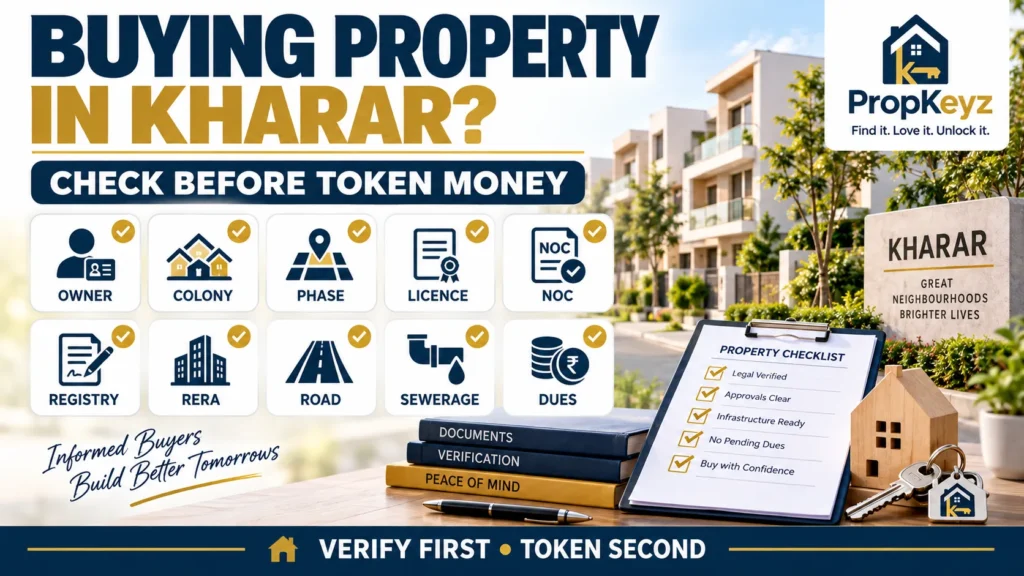
1. Exact Property Address
Collect:
- colony,
- phase,
- extension,
- plot/house number.
2. Seller Ownership
Check sale deeds and revenue/title chain.
3. Colony Status
Is it:
- licensed,
- regularized,
- unauthorized,
- other approved category?
4. Licence Number
Where marketed as licensed, verify it.
5. Approved Layout
Make sure the exact plot appears within the correct plan.
6. NOC
Ask:
Which NOC?
Then verify it.
7. Registry History
Check:
- previous deeds,
- current seller,
- subdivision.
8. PAPRA Exemption
If previous registry occurred under the special 2024–25 NOC exemption, verify eligibility documents.
9. CLU
Where applicable, verify the land-use/development position.
10. RERA
Where applicable.
11. Building Approval
For constructed property, check applicable plans and completion/occupation status.
12. Colony Handover
Ask for documentary evidence instead of assumptions.
13. Road Condition
Drive the exact approach.
14. Sewerage
Check actual connection and current condition.
15. Water Supply
Ask residents—not only seller.
16. Monsoon Condition
Look for waterlogging history.
17. Electricity
Verify sanctioned connection.
18. Property Tax / Dues
Check pending municipal and other liabilities.
19. Loan Eligibility
Ask lenders what documentation they require for the exact property.
20. Independent Legal Review
For a purchase involving significant money:
use an independent property lawyer before token / agreement.
PropKeyz Rule
Verify first. Token second.
High-Intent Buyer CTA — Comparing Property in Kharar or Mohali?
PropKeyz helps property seekers organise comparisons around:
- exact location,
- colony/project,
- property type,
- current asking price,
- road access,
- RERA/project information where applicable,
- end-use vs investment requirement.
Important Scope Note
PropKeyz can help organise property information and on-ground comparison.
For:
- legal title opinion,
- statutory interpretation,
- litigation,
- transaction-specific NOC eligibility,
use the competent authority and an independent property lawyer.
What Should an NRI or Outstation Kharar Buyer Do?
Remote buyers have additional risk because they may never personally see:
- broken approach road,
- sewer overflow,
- irregular plot shape,
- neighbouring construction,
- parking pressure.
Before buying remotely, ask for:
Documentation
- current sale deed,
- previous deed,
- property tax records,
- NOC/licence information,
- RERA details where applicable.
Physical Evidence
- continuous approach-road video,
- plot frontage,
- neighbouring houses,
- drain/sewer location,
- streetlights,
- monsoon condition where known.
Independent Verification
Do not rely entirely on:
- seller’s broker,
- developer sales team,
- relative already invested nearby.
If you already own property in Kharar or Mohali and need local coordination, PropKeyz supports selected NRI and outstation properties with inspection updates, tenant coordination and maintenance support.
Explore NRI Property Management
What Should a Kharar Property Owner Verify Before Selling?
The same issues matter to sellers.
Before marketing your property as:
“Approved property”
understand exactly what you can prove.
Collect:
- title deed,
- previous chain,
- colony licence where relevant,
- approved plan where relevant,
- NOC / regularization document where relevant,
- building-plan information,
- RERA record where applicable,
- tax receipts,
- no-dues information,
- utility information.
Why?
Because a buyer who reaches the bank/legal-verification stage will ask for these documents anyway.
A well-organised property file can reduce:
- confusion,
- repeated calls,
- buyer suspicion,
- transaction delay.
Development Charge Paid vs Infrastructure Delivered
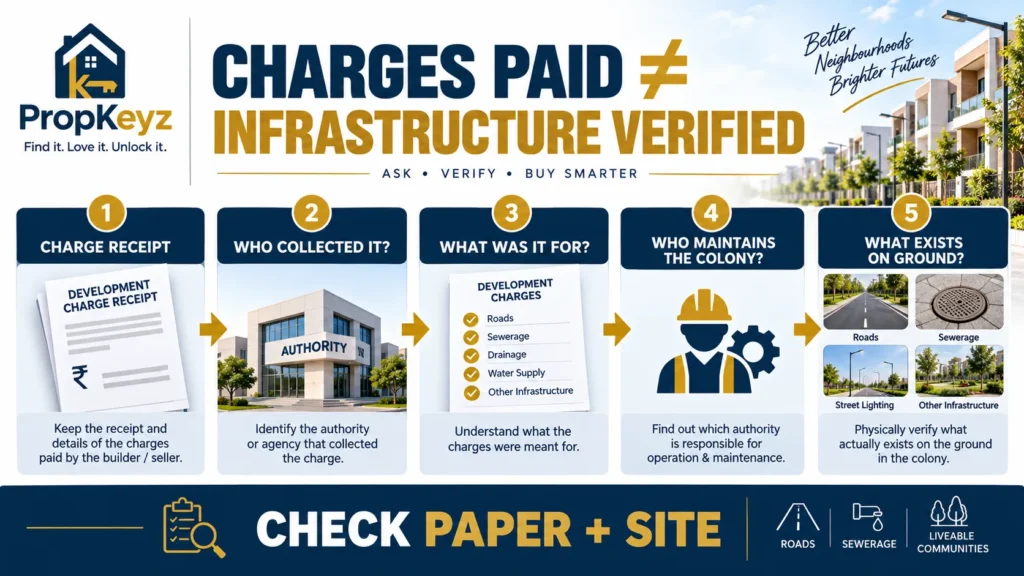
One of the central issues in the current Kharar debate is whether residents are receiving appropriate civic services relative to the charges they say they have paid.
But buyers should understand these as separate verification layers.
Layer 1
Was a charge paid?
Evidence:
- receipt,
- transaction record.
Layer 2
Who received it?
- MC,
- development authority,
- developer,
- another body.
Layer 3
What was it for?
- regularization,
- development,
- connection,
- property tax,
- another fee.
Layer 4
Who has infrastructure responsibility?
Depends on colony status and applicable rules.
Layer 5
What infrastructure actually exists?
Needs on-ground inspection.
PropKeyz View
Financial payment and physical delivery are related questions—but they are not the same question.
Confirmed Facts vs PropKeyz Interpretation
| Confirmed / Reported Fact | PropKeyz Interpretation |
|---|---|
| Residents sought inquiry into development charges, NOCs and infrastructure | Buyer concern is now a current local issue |
| MC denied resident allegations | Article must not presume wrongdoing |
| MC says administrative status of individual colony matters | Avoid Kharar-wide generalisations |
| GMADA keeps a licensed-colony database | Buyers can verify colony-specific information |
| GMADA separately lists NOC-issued plots | Plot-specific status matters |
| GMADA separately lists unauthorized colonies | Unauthorized and licensed property should not be treated equally |
| Licensed-colony category is labelled “NOC not required for registry” | NOC requirement depends on property category |
| PAPRA 2024 created a special exemption for qualifying plots | “NOC abolished for everyone” is inaccurate |
| Special exemption had eligibility criteria | Buyers should inspect previous deed history |
| Registry and project approval are separate concepts | Registry alone is insufficient buyer due diligence |
| Road/sewer issues were alleged by residents | Inspect physical infrastructure rather than assuming |
PropKeyz View
The fresh controversy does not prove that every Kharar property has a problem. It proves why property-specific verification matters.
The PropKeyz Kharar Property Verification Framework
[IMAGE 7 — DOCUMENT TO PROPERTY FRAMEWORK]
Stage 1 — Exact Property
Plot / House / Flat
↓
Stage 2 — Ownership
Seller + title chain
↓
Stage 3 — Colony Status
Licensed / NOC / Regularized / Unauthorized
↓
Stage 4 — Planning Approval
CLU / layout / building plan where applicable
↓
Stage 5 — RERA
Where applicable
↓
Stage 6 — Registry Eligibility
Current transaction
↓
Stage 7 — Colony Handover
Administrative responsibility
↓
Stage 8 — Physical Infrastructure
Road / sewer / water / drainage
↓
Stage 9 — Price
Does asking price justify condition?
↓
Stage 10 — Buyer Decision
PropKeyz Rule
Do not start at Stage 9.
Biggest Mistakes Kharar Buyers Should Avoid
Mistake 1 — “Registry Ho Rahi Hai, Sab Legal Hai”
Registry does not replace every other approval.
Mistake 2 — “NOC Hai”
Ask:
Which NOC?
Mistake 3 — “NOC Nahi Chahiye Punjab Mein”
The legal position depends on the property’s category and transaction history.
Mistake 4 — Checking Only the Colony Name
Check:
- phase,
- extension,
- exact plot.
Mistake 5 — Using a Neighbour’s NOC
Plot-specific documents should match the property being purchased.
Mistake 6 — Ignoring Colony Handover
Find out who maintains infrastructure.
Mistake 7 — Believing Development-Charge Receipt Proves Approval
A receipt proves payment, not every other compliance point.
Mistake 8 — Buying Without Seeing Sewerage
Site conditions matter.
Mistake 9 — Visiting Only in Good Weather
Waterlogging problems may remain invisible.
Mistake 10 — Paying Token Before Legal Verification
Never let:
“Kal koi aur le lega”
replace due diligence.
PropKeyz Analysis
The Kharar property NOC 2026 issue is important because it exposes one of the biggest misunderstandings in the local property market:
people often use “approved”, “NOC”, “registry” and “legal” as if they all mean the same thing.
They do not.
GMADA’s own current property-information structure proves that different categories exist.
It separately distinguishes between:
- licensed colonies,
- plots with NOCs under regularization policy,
- unauthorized colonies.
Punjab’s 2024 PAPRA amendment adds another layer because a defined class of qualifying plot holders in unauthorized colonies received a specific registration exemption without NOC during the notified period.
That means a buyer can encounter properties with very different histories.
Property A
Licensed colony.
Property B
Individual regularized/NOC-issued plot.
Property C
Older unauthorized-colony plot registered under a special legal exemption.
Property D
Unauthorized property without clear supporting records.
On a property portal, all four may look like:
100 sq yd Kharar plot
They are not necessarily equivalent.
The Second Lesson: Legal Status and Liveability Are Different
Even a property with stronger documentation can have:
- poor roads,
- sewer problems,
- congestion,
- waterlogging.
Conversely, a heavily occupied street may look fully developed on the ground while the documentation still requires deeper verification.
A serious buyer therefore needs two due-diligence tracks.
Track A — Legal / Documentary
Check:
- ownership,
- colony status,
- licences,
- NOCs,
- registry,
- RERA,
- building approvals.
Track B — Physical
Check:
- roads,
- sewerage,
- water,
- drainage,
- parking,
- neighbourhood.
PropKeyz View
Legal clarity tells you whether the asset makes sense on paper. Infrastructure tells you whether the property makes sense in real life.
PropKeyz Verdict: Kharar Property NOC 2026
The latest Kharar property NOC 2026 debate should not be reduced to:
“NOC scam”
or:
“NOC completely unnecessary.”
Neither is supported by the current facts.
What has actually happened is:
- residents have sought an inquiry into development charges, NOCs, colony handovers and civic infrastructure,
- Kharar Municipal Council has denied allegations of wrongdoing and maintains that responsibility depends on the rules and the administrative status of individual colonies.
For property buyers, that disagreement reinforces a more important rule:
Verify the exact property instead of trusting a Kharar-wide claim.
GMADA’s own official system provides separate categories for licensed colonies, NOC-issued regularized plots and unauthorized colonies.
Punjab’s earlier NOC-relief law also contains specific eligibility conditions instead of a universal rule for all properties.
Therefore, before purchasing a Kharar plot, floor, house or flat:
- verify the seller,
- verify the colony,
- verify the phase,
- verify the exact plot,
- understand the NOC,
- understand registry history,
- check RERA where applicable,
- inspect roads and sewerage,
- understand colony handover,
- obtain independent legal verification.
Final PropKeyz View
Do not ask only “Registry ho jayegi?” Ask “Exactly what is approved, who owns it, who maintains it and what works on the ground today?”
Frequently Asked Questions
What is the latest Kharar property NOC 2026 update?
In September 2026, Kharar residents sought a high-level inquiry into development charges, NOCs, colony handovers, roads and sewerage. Kharar Municipal Council denied the allegations and said issues should be examined based on applicable rules and the administrative status of each colony.
Is NOC required for property registry in Kharar?
There is no single answer for every Kharar property. GMADA separately lists licensed colonies / mega projects where NOC is not required for registry, NOC-issued plots under regularization policy and unauthorized colonies. The exact property category should therefore be verified.
Does registry mean a Kharar property is legal?
A registered transaction is important, but registry alone does not prove every issue such as colony licence, approved layout, RERA, building sanction, infrastructure or title history.
Is NOC permanently abolished in Punjab?
No such blanket statement should be used. Punjab’s 2024 PAPRA amendment provided defined NOC relief to qualifying plot holders in unauthorized colonies, and the state notified a specific exemption window from 1 December 2024 to 28 February 2025. The law also contains conditions and provisos relevant to subsequent transactions.
What does “NOC not required for registry” mean?
GMADA uses this wording for its licensed-colony / mega-project category. It addresses registry NOC requirements for that category; it does not automatically prove title, dues, building legality, RERA compliance or infrastructure condition.
How can I check if my Kharar colony is approved?
Search the exact colony, phase and extension in GMADA’s licensed-colony records. GMADA also publishes separate NOC-issued plot and unauthorized-colony records.
Is Sunny Enclave Kharar approved?
GMADA’s official records contain multiple Sunny Enclave extension entries. Buyers should verify the exact extension, licence, approved plan and individual property rather than relying only on the broad “Sunny Enclave” name.
What is a colony handover?
In general property terms, colony handover concerns transfer of relevant infrastructure/administrative responsibilities from the developer toward the competent local authority subject to applicable rules and approvals. Exact status must be checked for the particular colony.
If development charges are paid, does MC have to build my road?
A development-charge receipt alone does not establish the complete legal responsibility for every road. Responsibility can depend on the colony’s administrative status, developer obligations, handover and applicable rules.
Does an NOC guarantee sewerage?
No. Registry/property NOC and physical sewerage availability are separate issues.
Does RERA replace an NOC?
No. RERA registration and NOC / colony / registry requirements deal with different regulatory questions.
What should I check before buying property in Kharar?
Verify seller title, colony status, exact phase/extension, licence or NOC where applicable, approved layout, registry history, RERA where applicable, building approval, road condition, sewerage, water, dues and colony handover status.
Should I buy in an unauthorized colony if registry is possible?
Registry possibility alone should not determine the purchase. Understand why the colony is unauthorized, what plot-level documents exist, what the current law permits, infrastructure quality, financing/resale implications and obtain independent legal advice.
Continue Your Kharar & Mohali Property Research
CLU in Mohali 2026
Understand the difference between land-use approval, licence, RERA and registry.
Sector 124 Mohali 200-Ft Road Update 2026
Understand why actual road execution matters as much as property documentation.
Read Sector 124 Mohali 200-Ft Road Update 2026
Kurali RERA Plots Mohali 2026
Compare established Kharar properties with identifiable plotted projects toward the Kurali belt.
Read Kurali RERA Plots Mohali 2026
Property in Mohali
Explore PropKeyz’s wider Mohali buyer and property ecosystem.
Compare Kharar & Mohali Property With PropKeyz
If you are currently considering:
- Kharar plot,
- Kharar independent floor,
- Kharar house,
- Mohali apartment,
- RERA plotted project,
- resale investment,
share your:
- preferred location,
- property type,
- budget,
- self-use or investment objective,
- furnishing requirement where relevant,
- moving / investment timeline.
PropKeyz can help you shortlist and compare available property based on practical location, current asking price and property/project information.
Call / WhatsApp: +91 80534 69929
Suggested WhatsApp Message
Hi PropKeyz, I read your Kharar Property NOC 2026 guide. I am considering property in Kharar / Mohali. Please help me compare current property options, colony/project status, road access and asking price.
Your Property. Our Responsibility.
Sources & Verification
This article was last fact-checked on 13 September 2026.
Times of India — 11 September 2026
Used for the fresh resident representation, development-charge/NOC/colony-handover questions, road/sewerage allegations and Kharar Municipal Council’s response.
GMADA — Colonies Portal
Used to verify that GMADA separately maintains categories for:
- licensed colonies,
- plots issued NOCs under regularization,
- unauthorized colonies.
GMADA — Approved / Licensed Colonies
Used for licensed-colony records and Kharar examples such as Sunny Enclave extensions, Gillco Valley, Shivjot Enclave, Nav Enclave and Shivalik developments.
Punjab Apartment and Property Regulation (Amendment) Act, 2024
Used to explain the special statutory NOC exemption for qualifying plots in unauthorized colonies.
Punjab Government PAPRA Notification — 25 November 2024
Used to verify the notified 1 December 2024–28 February 2025 registration-relief period and qualifying conditions.
Punjab RERA
Used as the official reference point for applicable project registration and project verification.
Disclaimer
This article is for general property research and buyer education.
It does not constitute:
- legal advice,
- title opinion,
- municipal advice,
- statutory interpretation,
- financial advice,
- investment advice.
Property status can vary according to:
- colony,
- phase,
- plot,
- title history,
- registration history,
- applicable policy,
- administrative jurisdiction.
PropKeyz does not guarantee that:
- a property is registrable,
- a property is approved,
- an NOC is valid,
- a colony has been handed over,
- a road or sewer will be completed,
- property value will appreciate.
Buyers should independently verify the property with:
- competent authority,
- Punjab RERA where applicable,
- revenue/registration records,
- independent property lawyer,
- lender where applicable.
Your Property. Our Responsibility.