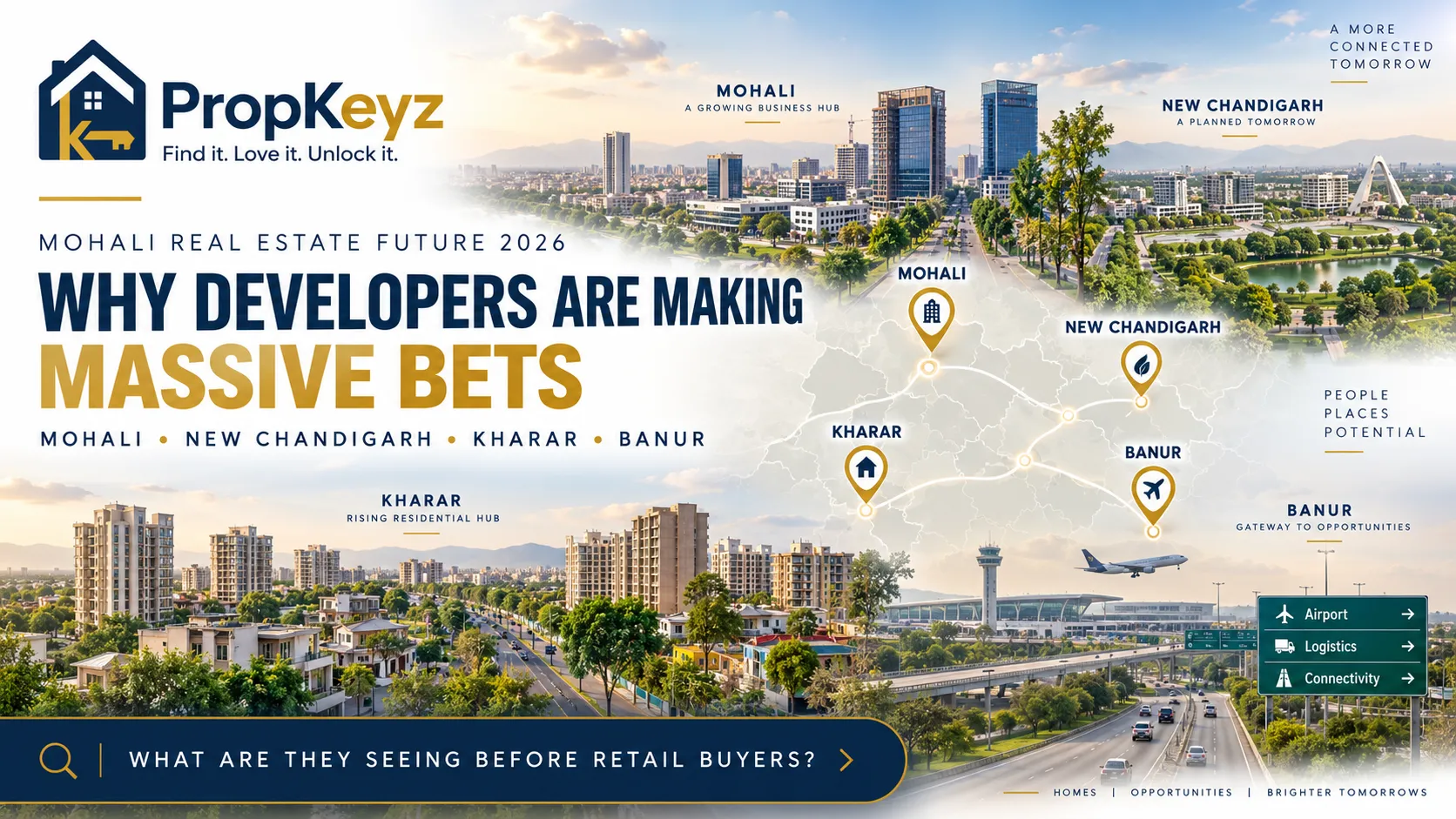
The Mohali Real Estate Future 2026 story is no longer about one new apartment project, one airport road or one GMADA auction.
Something much larger is happening across the wider Greater Mohali region.
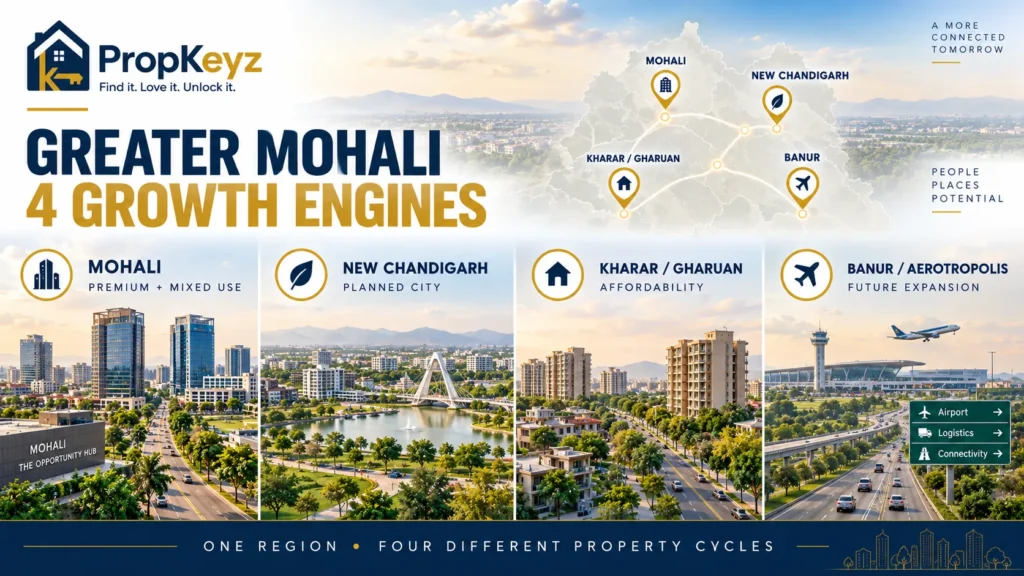
Development and investment activity is spreading across four different property markets:
Mohali proper → New Chandigarh → Kharar/Gharuan → Banur/Aerotropolis
But these areas are not growing for the same reason.
Central Mohali is increasingly becoming a:
high-value premium and mixed-use development market.
New Chandigarh is a:
planned city and long-duration land-development market.
Kharar and the emerging Gharuan belt represent a:
larger affordability and population-absorption market.
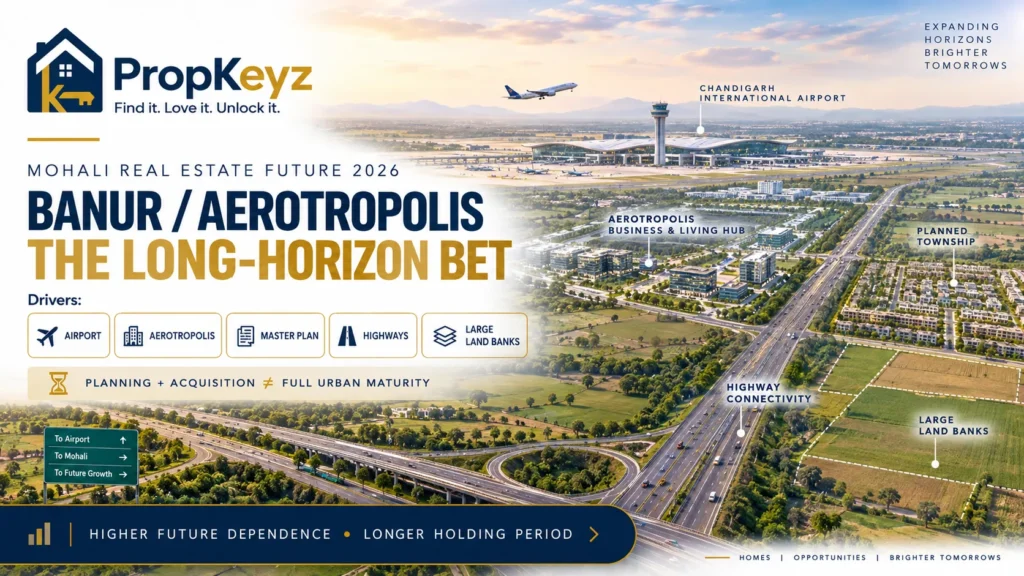
Banur and the wider Aerotropolis Extension represent a:
long-horizon airport, highway and future urban-expansion market.
That distinction is important because property buyers often make a major mistake:
“Developer yahan land le raha hai, matlab nearby property zaroor badhegi.”
That is not how property economics works.
A large developer can:
- buy hundreds of acres
- wait years for approvals
- phase construction
- hold land through multiple cycles
- build commercial and residential inventory
- absorb long development timelines.
A normal retail investor buying one:
- flat
- plot
- floor
- agricultural parcel
usually does not have the same capital structure or time horizon.
So the important question is not:
Where are developers investing?
It is:
Why are they investing there, what stage is the market at, and does the same logic make sense for a normal property buyer?
Current 2026 evidence shows substantial capital and planning activity across Greater Mohali.
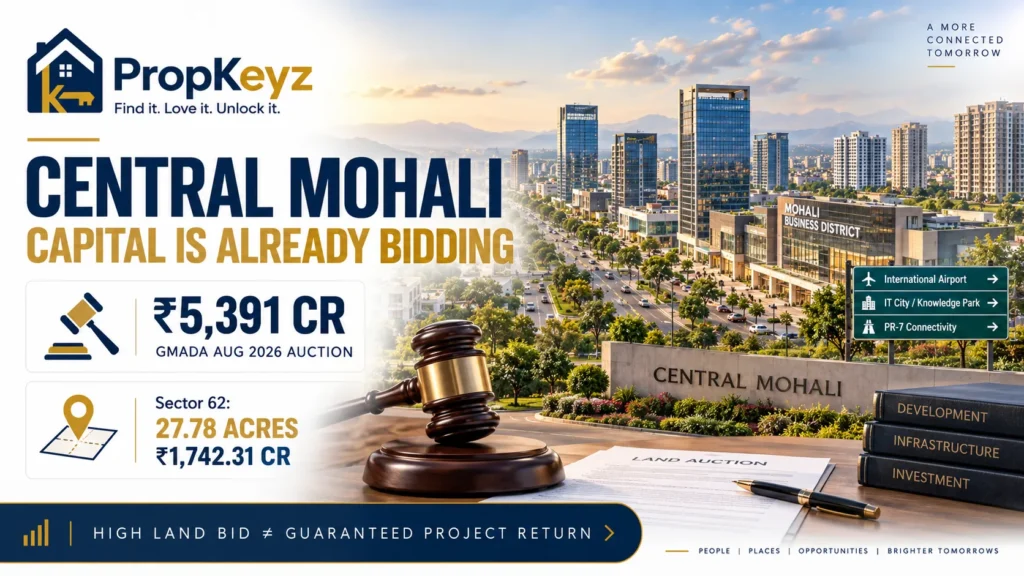
GMADA’s August e-auction generated approximately:
₹5,391 crore
from 27 sold properties against a combined reserve value of roughly ₹3,872 crore. One 27.78-acre mixed-use parcel in Sector 62 alone attracted a highest bid of:
₹1,742.31 crore.
At the same time:
- New Chandigarh is continuing to expand through Eco City, road acquisition and long-term institutional planning;
- Gharuan is undergoing a proposed planning transition across nearly 3,000 acres;
- GMADA is acquiring additional land for industrial development in Sectors 101 and 103;
- Aerotropolis acquisition continues deeper toward the Banur side;
- a fresh September hearing covers around 215 acres across Karala, Banur and Kijargadh.
The bigger picture is therefore:
Greater Mohali is expanding simultaneously in multiple directions—and each corridor is being built around a different demand engine.
This PropKeyz guide explains:
- why developers are deploying capital here
- why Chandigarh’s physical constraints matter
- where employment growth could come from
- why airport and highway infrastructure matters
- why developers prefer large outer land parcels
- why New Chandigarh, Kharar and Banur have different futures
- which areas could benefit most
- what could go wrong
- and how a retail property buyer should interpret developer activity.
Last fact-checked: 21 September 2026
Key Takeaways
- Greater Mohali should be understood as a regional urban-expansion market, not one homogeneous property market.
- GMADA’s August 2026 auction raised approximately ₹5,391 crore across 27 sold properties.
- Sector 62’s 27.78-acre mixed-use plot attracted a highest bid of ₹1,742.31 crore, showing strong current interest in prime central Mohali land.
- Central Mohali’s future is increasingly about premiumisation, commercial depth and mixed-use development.
- New Chandigarh was officially conceived by GMADA to absorb projected spillover growth from Chandigarh and Mohali.
- New Chandigarh’s plan includes residential, healthcare, education, recreation, mixed-use and employment-supporting zones.
- Eco City-4 covers approximately 526.03 acres, but remains an acquisition/development-stage project rather than a live public plot scheme.
- Kharar’s core development advantage is relative affordability and a large end-user buyer pool.
- Gharuan’s nearly 3,000-acre proposed planning amendment could extend organised industrial, commercial and residential planning farther beyond Kharar.
- GMADA’s 2026 acquisition activity includes new industrial land in Sectors 101 and 103.
- Banur’s longer-term thesis is linked to Aerotropolis expansion, regional highways, airport-led growth and relatively earlier-stage land values.
- A fresh Aerotropolis hearing covers approximately 215 acres across Karala, Banur and Kijargadh.
- A CII–Knight Frank study places Chandigarh Tricity among 11 emerging Indian real-estate markets expected to participate in the next growth cycle.
- The study’s 63% residential-price growth figure applies collectively to the 11 emerging markets, not Chandigarh Tricity alone.
- Developer investment is useful market evidence, but it is not a guarantee that nearby retail property is correctly priced.
- The strongest future locations will likely combine jobs + connectivity + civic infrastructure + actual occupancy + sensible entry price.
PropKeyz View
Developers are not betting on one “next hot sector.” They are betting on the gradual transformation of Greater Mohali into a larger multi-centre urban economy.
Mohali Real Estate Future 2026: Quick Answer
The Mohali Real Estate Future 2026 is being driven by a combination of:
Chandigarh scarcity + available outer land + government planning + airport/highway connectivity + new employment zones + affordability-driven population expansion.
Developers are therefore targeting different parts of Greater Mohali for different reasons.
Mohali Proper
Main thesis:
Premiumisation + mixed-use + commercial development
New Chandigarh
Main thesis:
Planned city + institutional growth + long-term residential expansion
Kharar / Gharuan
Main thesis:
Affordability + population absorption + future organised expansion
Banur / Aerotropolis
Main thesis:
Airport corridor + future land development + highways + long-duration urbanisation
The Important Difference
The same property strategy should not be used in all four markets.
Why Are Developers Investing in Greater Mohali Now?
The answer is not one single road or government scheme.
Large-scale property investment generally follows a chain:
Land Availability → Planning → Connectivity → Jobs → Population → Consumption → Property Demand
Greater Mohali currently has activity across almost every layer of that chain.
Land
Large developable parcels remain available outside mature Mohali.
Planning
GMADA maintains approved and evolving master plans covering:
- SAS Nagar
- Kharar
- Banur
- New Chandigarh
- surrounding regional areas.
Connectivity
The region has:
- Chandigarh adjacency
- international airport
- Airport Road
- new national-highway connectivity
- regional road expansion.
Employment
Current/planned economic zones include:
- IT City
- industrial Sectors 101 and 103
- Expo City
- commercial Sector 87
- mixed-use Sector 62.
Housing
Different price segments allow developers to target:
- premium buyers
- mid-market families
- first-time buyers
- plotted-property buyers
- NRIs
- long-horizon investors.
PropKeyz View
A developer prefers a market where several demand engines can eventually reinforce each other. Greater Mohali increasingly offers that possibility.
Chandigarh’s Physical Scarcity Is Part of the Story
Chandigarh remains the anchor city of the Tricity.
But it cannot expand indefinitely inside its existing physical structure.
That creates a natural regional question:
Where does future residential, office, healthcare, education and commercial demand go?
Some of it moves toward:
- Mohali
- New Chandigarh
- Zirakpur
- Panchkula extensions
- Kharar
- airport-side corridors.
GMADA explicitly says New Chandigarh was conceived as a self-sustaining city to absorb projected spillover growth from Chandigarh and Mohali over the long term.
The Basic Property Science
Scarce Core City
→ Higher Land Cost
→ Buyers/Businesses Search Nearby Alternatives
→ Infrastructure Extends Outward
→ New Urban Centres Develop
But
Spillover does not mean every outer area becomes premium.
The outer market still needs:
- infrastructure
- jobs
- social amenities
- occupancy.
What Does the Latest CII–Knight Frank Research Say?
A September 2026 CII–Knight Frank study identified Chandigarh Tricity among:
11 emerging Indian real-estate markets
expected to contribute to the next property-development cycle.
The report highlights factors such as:
- improving connectivity
- service-sector economy
- urban infrastructure
- education
- healthcare.
It cited residential pricing in the Chandigarh region at approximately:
₹7,500–₹10,500 per sq ft
within its emerging-market comparison.
Important Clarification
The widely reported:
63% residential price growth from 2021–2026
was the collective growth across the 11 emerging markets studied.
It is not evidence that Chandigarh Tricity alone appreciated 63%.
The same research also cautions that sustainable property growth ultimately requires:
economic activity and employment generation.
That may be the single most important point in the entire future-Mohali discussion.
Central Mohali: Why Developers Are Willing to Pay So Much
Central and established Mohali offers something outer corridors cannot immediately replicate:
existing demand.
The city already has:
- population
- offices
- healthcare
- schools
- retail
- roads
- premium housing
- Chandigarh connectivity.
This reduces one major developer risk:
waiting for an entire city ecosystem to appear.
The cost of land is much higher.
But the market is also more mature.
Sector 62: The Clearest 2026 Capital Signal
Sector 62 has become one of the strongest pieces of evidence that developers are willing to deploy large capital into central Mohali.
In August 2026, a 27.78-acre mixed-use site covering Plot Nos. 30–34 attracted a highest bid of:
₹1,742.31 crore
against a reserve price of:
₹1,214.16 crore.
The same wider GMADA auction generated:
₹5,391 crore
from 27 sold sites against total reserve value of approximately:
₹3,872 crore.
Commercial SCOs, a hotel site in Sector 66 Beta and a hospital site in Aerocity also found buyers.
What Does This Actually Prove?
It proves:
bidders were willing to pay substantial prices for scarce development land.
It does not yet prove:
- successful project launch
- full construction
- future sales
- guaranteed investor returns.
Developer Logic
A developer paying premium land value is betting that future:
sale value + commercial value + development density + brand value
can justify the acquisition.
For a detailed breakdown:
Read Sector 62 Mohali 2026 on PropKeyz
Mohali’s Next Phase Is Not Only Residential
This is important.
If Mohali growth consisted only of:
more apartments
the long-term thesis would be weaker.
A healthy urban market also needs:
- workplaces
- industries
- offices
- hospitals
- schools
- retail
- hospitality.
Several current GMADA initiatives are aimed at precisely this employment and commercial side.
Sector 101 & Sector 103 Industrial Parks
GMADA’s 2026 acquisition process includes new land for industrial development in:
Sector 101
and:
Sector 103.
A March acquisition notification covered approximately:
502 acres
across six villages for Sector 87 commercial expansion and industrial Sectors 101/103.
Within this, approximately:
129 acres in Durali
was identified for further Sector 101 industrial development, while separate Sector 103 acquisition was also progressing.
Existing acquisition history means the total planned industrial footprint is larger than this latest tranche.
Why Industrial Development Matters to Residential Property
The economic chain is:
Industrial Land
→ Roads & Utilities
→ Companies
→ Jobs
→ Worker/Professional Movement
→ Housing Demand
→ Retail & Services
But Current Stage Matters
Today:
land acquisition/planning ≠ operating factories.
Do not price nearby residential property as if thousands of new jobs already exist.
Expo City: Another Employment-Side Bet
PropKeyz is also tracking the proposed Expo City near:
- airport
- IT City
with approximately:
182.88 acres
in current acquisition-related planning.
Reported components include:
- AI/technology activity
- convention infrastructure
- hospitality
- exhibition facilities.
But these remain proposed/development-stage elements.
Why It Matters to the Big Picture
Sector 62
- Sector 87
- IT City
- Expo City
- Industrial Sectors 101/103
could gradually create something far more important than residential supply:
multiple employment centres.
PropKeyz Rule
Planned jobs matter only after businesses actually occupy the development.
Why the Airport Matters
Airports often influence development indirectly.
They support:
- corporate travel
- business location decisions
- hospitality
- logistics
- high-value residential perception.
Mohali’s airport-side development already includes:
- Aerocity
- IT City
- Aerotropolis
- Expo City planning.
This creates a multi-use growth corridor.
But Be Careful
Airport proximity ≠ automatic premium.
A strong property still needs:
- legal approval
- good access
- local roads
- utilities
- realistic price.
Mohali–Sirhind Highway Adds Another Regional Connection
The new 27.37-km NH-205AG corridor connects the Sector 110/Bhagomajra side of Mohali toward NH-44 near Sirhind.
Physical construction has been reported complete, with formal opening approaching in September 2026.
This can improve:
- regional access
- Sirhind connectivity
- wider Punjab movement
- bypassing of some Landran-side congestion.
Read Mohali–Sirhind Greenfield Highway 2026
Why Developers Care About Roads
Roads do not directly create demand.
They reduce:
friction.
Reduced travel friction can enlarge:
- employment catchment
- buyer catchment
- logistics radius
- commercial accessibility.
That makes more distant land economically usable.
New Chandigarh: Why Developers See a Different Opportunity
New Chandigarh should not be analysed using central Mohali’s logic.
The area was formally conceived as a:
self-sustaining planned urban extension
to absorb long-term spillover from Chandigarh and Mohali.
GMADA’s development plan states that approximately:
27% of the area
is allocated for residential use.
Private developers identified by GMADA include:
- DLF
- Omaxe
- Altus Space Builders
- Innovative Housing Infrastructure.
The New Chandigarh Thesis
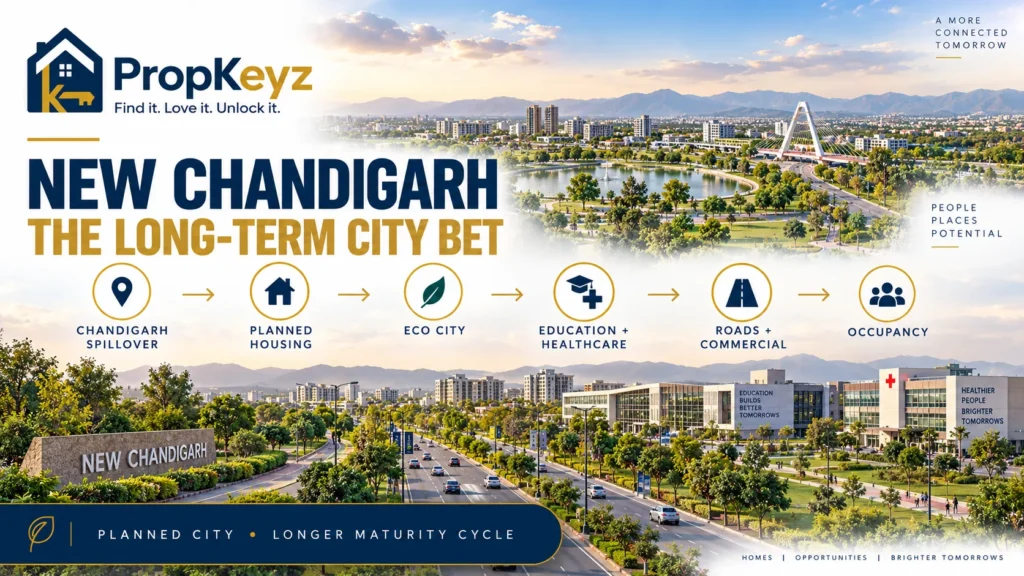
Chandigarh scarcity
→ Planned Mullanpur/New Chandigarh supply
→ Roads
→ Healthcare
→ Education
→ Housing
→ Commercial ecosystem
→ Longer-term self-sustaining city
This Is a Long Cycle
New Chandigarh is not a quick:
“one project launches, area doubles.”
Its success depends on gradual urban maturity.
Education City & Medicity Are Central to the Plan
New Chandigarh’s master planning includes:
- Medicity
- Education City
- recreation/sports
- mixed-use activity
- employment-supporting areas.
GMADA describes Education City as a proposed approximately:
1,700-acre
education-focused zone.
The development plan also positions Medicity and Education City at opposite sides of the township to distribute jobs and housing.
Why Institutions Matter
A successful:
- university
- hospital
- research centre
creates repeated daily demand.
That can generate:
- housing
- rentals
- retail
- transport
- services.
But
Planned institution ≠ operating employment centre.
Always check current operational reality.
Eco City-4 Shows New Chandigarh Is Still Expanding
Eco City-4 is one of the clearest current government-led expansion signals.
The notified project covers approximately:
526.03 acres
across:
- Kansala
- Kartarpur
- Boothgarh
- Rajgarh.
GMADA’s official notification is dated:
2 June 2026.
However, the project remains at a development/acquisition stage.
There is no basis to treat it today as:
a fully developed ready-to-buy GMADA township.
Read Eco City-4 New Chandigarh Plots 2026
Developer Lesson
New Chandigarh still has:
new future supply.
So investors should not assume permanent artificial scarcity.
New Chandigarh Roads Matter Just as Much as New Plots
A planned township needs a complete network:
Housing + Roads + Jobs + Schools + Healthcare + Retail
GMADA’s New Chandigarh plan contains arterial road hierarchy and long-term transport planning.
PropKeyz is separately tracking current HR-4 land acquisition.
Read New Chandigarh HR-4 Road 2026
Important
Road acquisition today is not the same as:
a fully constructed road.
Kharar: Why Developers Keep Building Despite Infrastructure Problems
Kharar’s economics are very different.
Its biggest advantage is not scarcity.
It is:
affordability.
A family priced out of:
- central Chandigarh
- premium Mohali sectors
- high-ticket Airport Road projects
may still be able to buy in:
- Kharar
- Sector 115
- Sector 116
- Landran-side areas
- adjoining growth belts.
This gives developers access to a much larger:
middle-income buyer pool.
The Kharar Developer Model
Central Mohali:
expensive land → premium product → smaller high-income buyer pool
Kharar:
relatively cheaper land → more housing units → wider affordability base
This is why a market can experience:
very strong construction activity
without becoming uniformly premium.
Population Absorption
Kharar serves people working/studying across:
- Mohali
- Chandigarh
- universities
- local businesses
- Tricity.
That creates practical housing demand.
But Kharar’s Future Depends Heavily on Civic Infrastructure
Rapid construction can move faster than infrastructure.
Typical pressure points include:
- traffic
- sewerage
- drainage
- water
- local road capacity.
This matters because:
Housing supply without civic capacity can cap premiumisation.
Property Rule
A project in Kharar can perform well.
That does not mean:
every Kharar micro-market will converge with central Mohali pricing.
Gharuan Could Become Kharar’s Next Organised Expansion Layer
One of the most important 2026 planning stories is around:
Gharuan
and surrounding villages.
Punjab planning authorities are considering changes across nearly:
3,000 acres
to introduce organised:
- residential
- industrial
- commercial
development into the wider Gharuan belt.
The area has faced growing development pressure partly because of its proximity to Kharar.
Important Status
There is not yet a separately notified final Gharuan Master Plan.
The current story is a proposed amendment to the GMADA Regional Plan.
Why Developers May Care
The Kharar market already proves there is residential demand.
Gharuan potentially offers:
more land + lower entry basis + future organised planning.
But
The risk is:
buying future-plan expectations before legal land use and infrastructure are actually established.

Banur: Why It May Be the Most Interesting Long-Horizon Market
Banur is perhaps the area where today’s appearance and future planning are most different.
Historically, many buyers see Banur primarily as:
the Chandigarh–Patiala Road belt.
But the longer-term development story now also involves:
- Banur Master Plan
- Aerotropolis Extension
- airport-linked development
- highway connectivity
- institutional growth
- relatively larger land availability.
GMADA maintains an approved Banur Master Plan 2031.
Aerotropolis Is Pulling Urbanisation Toward the Banur Side
Aerotropolis is one of Greater Mohali’s largest future urban-expansion stories.
PropKeyz has previously tracked:
- airport-side expansion
- Pockets E–J
- land acquisition
- land pooling
- future residential plots.
Read Aerotropolis Extension Plots Mohali 2026
A fresh September 2026 notice schedules a hearing for approximately:
- 164.5208 acres in Karala
- 27.0208 acres in Banur
- 23.6667 acres in Kijargadh
for a combined area of roughly:
215.21 acres.
The hearing is scheduled for:
9 October 2026.
What Does This Prove?
It proves:
expansion/acquisition activity is continuing toward the Banur-side belt.
It does not prove:
every nearby private plot is part of Aerotropolis.
Aerotropolis Extension Is Much Larger Than One Acquisition Notice
PropKeyz’s research tracks the wider Aerotropolis Extension planning story at approximately:
2,490 acres
with roughly:
8,600 residential plots planned
in the broader proposal.
But it remains a future-development story with multiple acquisition and planning stages.
Read Aerotropolis Extension Plots Mohali 2026
Why This Matters to Banur
Large-scale planned urbanisation changes the economic geography around a town.
It can eventually create demand for:
- housing
- retail
- schools
- services
- warehouses
- offices.
But the word is:
eventually.
Banur Also Has the Highway Story
Banur is influenced by multiple road narratives, including Bharatmala-linked infrastructure and upgrades on the Kharar–Banur–Tepla corridor.
Read Banur Bharatmala Road 2026
For buyers, one principle matters:
Highway proximity ≠ legal highway access.
A property can be very close to a major road but still have poor entry/exit.
Why Banur Has Higher Upside Potential—and Higher Timing Risk
Earlier-stage markets can offer lower entry pricing.
But the lower price often exists because:
- infrastructure is less mature
- occupancy is lower
- demand is less proven
- exit liquidity is weaker.
Development Logic
Cheap/Earlier Land
→ Government Planning
→ Roads
→ Acquisition
→ Infrastructure
→ Projects
→ Occupancy
→ Commercial Demand
A buyer entering at the first stage may gain if everything progresses.
But they also absorb the longest waiting period.
PropKeyz Rule
Early-stage upside is compensation for early-stage risk.
Mohali vs New Chandigarh vs Kharar vs Banur
| Market | Main Growth Engine | Current Maturity | Typical Property Thesis | Biggest Opportunity | Biggest Risk |
|---|---|---|---|---|---|
| Mohali Proper | Existing city + jobs + premium development | High | Premium/mixed-use | Strong existing demand | High entry price |
| New Chandigarh | Planned city + institutions + Chandigarh spillover | Medium | Long-term planned growth | Large organised urban ecosystem | Slow maturity / future supply |
| Kharar/Gharuan | Affordability + population | Medium/high occupancy, uneven civic quality | Volume housing | Large end-user base | Infrastructure pressure |
| Banur/Aerotropolis | Airport + future planning + land + highways | Early | Long-horizon development | Earlier entry into expansion belt | Execution/timing/exit risk |
PropKeyz View
The “best” market depends on what you are buying, at what price and for how long—not which location has the biggest future headline.
How Do Property Prices Actually Rise?
This is the most important science behind the entire article.
Property does not sustainably appreciate just because:
developer aa gaya.
The stronger chain is:
Jobs / Accessibility / Liveability Improve
↓
More People Want to Live or Work There
↓
Demand Increases
↓
Good Property Supply Is Limited Relative to Demand
↓
Rents / Transaction Values Can Strengthen
Developers Can Accelerate the Process
A strong developer can add:
- product quality
- brand
- amenities
- marketing
- construction.
But developers cannot permanently manufacture:
real end-user demand
where none exists.
Infrastructure Changes the Economic Distance
Imagine a location 20 km away.
If the journey takes:
55 minutes
it feels far.
If a new road reduces it to:
25 minutes
the physical distance did not change.
But the:
economic distance
changed.
That can enlarge the buyer and employment catchment.
This is why PropKeyz tracks:
- PR-6
- Sector 124 road
- HR-4
- NH-205AG
- Bharatmala.
Jobs Matter More Than Brochures
Long-term residential demand needs people who can:
pay rent or EMIs.
That ultimately comes from:
- employment
- business income
- institutions
- government activity
- services.
That is why Mohali’s industrial/commercial pipeline matters.
A market with:
50 new housing projects
but very little employment creation can become overly dependent on investor-to-investor resale.
A healthier market has:
end users + renters + employees + businesses.
Civic Infrastructure Is the Hidden Growth Test
Property markets usually advertise:
- highways
- airports
- malls.
But long-term urban value depends equally on:
- water
- sewerage
- drainage
- electricity
- waste management.
PropKeyz is tracking these separately.
Read Mohali Water Infrastructure 2026
Why This Matters
A location can experience:
property construction faster than infrastructure construction.
When that happens, growth can create:
- congestion
- water pressure
- sewerage stress
- poor liveability.
PropKeyz Rule
Buildings create population. Infrastructure determines whether that population stays satisfied.
Which Areas Could Benefit the Most?
There is no credible basis for saying one sector will definitely give the highest appreciation.
But based on current development structure, the strongest types of locations are easier to identify.
1. Mature Mohali Locations Near Employment & Commercial Activity
Potential advantage:
- existing demand
- better liquidity
- lower future dependency.
Trade-off:
- higher price.
2. Airport / IT City / Aerotropolis Transition Belt
Potential advantage:
- airport
- technology
- roads
- large-scale planning.
Trade-off:
- different pockets have very different development stages.
3. New Chandigarh Pockets With Existing Access + Real Habitation
Potential advantage:
- planned environment
- Chandigarh adjacency
- future institutional growth.
Trade-off:
- long maturity and additional supply.
4. Kharar Pockets With Strong Civic Infrastructure
Potential advantage:
- affordability
- huge buyer pool.
Trade-off:
- weak infrastructure can destroy the benefit of low entry price.
5. Banur Pockets With Legal Land Use + Practical Connectivity
Potential advantage:
- earlier-stage pricing
- future expansion.
Trade-off:
- longest dependence on future execution.
The Most Important Investment Rule: Entry Price
Even the best location can become a bad investment if bought too expensive.
Suppose fair comparable value is:
₹1 crore
but a seller asks:
₹1.50 crore
because of:
- future highway
- future metro
- future Aerotropolis
- future IT company.
You may be paying today for:
years of future development.
Then even if development happens, your return can remain weak.
PropKeyz Rule
Future infrastructure is valuable only if the future has not already been fully priced into today’s property.
Developer Investment vs Retail Investment
This distinction is crucial.
Developer
Can buy:
50 acres.
Wait:
8 years.
Then develop:
multiple phases.
Has potential control over:
- planning
- roads
- marketing
- product.
Retail Buyer
Usually buys:
one asset.
Has no control over:
- government timeline
- surrounding infrastructure
- neighbouring development.
Therefore
A statement like:
“Big developer bought land here”
is useful evidence.
But the retail buyer must still ask:
- At what price am I buying?
- What exactly is my legal asset?
- Is access available?
- Is demand real?
- Can I exit?
- How long can I hold?
What Developers See That Retail Buyers Often Miss
Developers often study:
Catchment
How many future consumers can live/work nearby?
Land Assembly
Can they acquire enough contiguous land?
FAR / Development Potential
How much buildable space can the site support?
Future Infrastructure
Which roads/utilities are planned?
Competition
How much competing supply exists?
Product Gap
Does the market need:
- plots
- luxury apartments
- offices
- retail
- warehouses?
Exit Price
What can the finished product realistically sell for?
Time
Can capital survive the project cycle?
Retail buyers often focus mainly on:
“Rate kya hai?”
The better question is:
“Demand ka engine kya hai?”
What Could Go Wrong With the Greater Mohali Growth Story?
A strong future thesis still has risks.
1. Too Much Future Supply
Aerotropolis, Eco City, private projects and expansion belts can create large new inventory.
If supply grows faster than genuine population demand:
appreciation can slow.
2. Infrastructure Delays
Master-plan roads can take years.
3. Employment Lags Housing
Residential construction can arrive before jobs.
4. Civic Infrastructure Stress
Kharar already demonstrates why rapid population growth needs matching urban infrastructure.
5. Speculative Land Pricing
Agricultural land can be priced today as though future conversion is guaranteed.
6. Access-Controlled Highways
Highway nearby does not mean access.
7. Project Execution
Developer financial stress or delays can affect buyer outcomes.
8. Overpaying
The most common risk.
Greater Mohali 2030–2035: What Could the Region Look Like?
The following is analysis—not a guaranteed forecast.
If current major projects materially progress, Greater Mohali could become more:
Multi-Centre
Instead of everything depending on old Mohali sectors, economic activity may spread across:
- central Mohali
- IT City
- Airport Road
- Aerotropolis
- New Chandigarh
- industrial corridors.
Employment-Led
Industrial Sectors 101/103, IT City, Expo City and new commercial centres could deepen the employment base if occupied successfully.
Regionally Connected
New national highways and arterial roads can improve connectivity across Punjab.
More Segmented by Price
Central locations may remain premium.
Outer belts may provide:
- affordability
- land
- future growth.
More Institutional
Schools, hospitals, universities and research hubs can make outer areas more self-sufficient.
Which Market Has the Shortest vs Longest Development Dependency?
Lowest Future Dependency
Established Mohali
Much of the city already exists.
Medium Future Dependency
Kharar
Population exists, but infrastructure quality varies.
Higher Future Dependency
New Chandigarh
Strong planning but continued maturation required.
Highest Future Dependency
Banur / emerging Aerotropolis belt
Large potential, but more future milestones must materialise.
Property Principle
Generally:
lower development dependency = lower uncertainty
while:
higher development dependency = potentially higher upside + higher risk.
Mohali Real Estate Future 2026: PropKeyz Analysis
The Mohali Real Estate Future 2026 is best understood as a regional capital-allocation story.
1. Central Mohali Has Proven Land Demand
The ₹5,391-crore GMADA auction and Sector 62 bidding show real willingness to pay for prime development land.
2. The Region Is Moving Beyond Housing Alone
Industrial, commercial, hospitality, healthcare and technology-linked land uses are increasingly part of the development pipeline.
3. Chandigarh Scarcity Helps Outer Markets
There is limited ability to create entirely new large residential districts inside Chandigarh.
That supports nearby alternatives.
4. New Chandigarh Has the Strongest Formal Planned-City Logic
GMADA explicitly designed it as a self-sustaining city for future spillover.
5. Kharar Has Proven the Affordability Model
It attracts buyers who need lower entry prices than established Mohali.
6. Gharuan Shows Outward Pressure Continuing
The nearly 3,000-acre draft planning story signals that urban pressure is extending farther out.
7. Banur Is Moving Into the Urban Expansion Map
Current Aerotropolis acquisition activity reaches Banur-side villages.
8. Airport-Led Development Is Becoming a Major Axis
Aerocity, IT City, Expo City and Aerotropolis form a larger airport-oriented development belt.
9. Roads Make More Land Economically Usable
NH-205AG and other corridors can reduce effective travel distance.
10. Utilities Will Decide Whether Growth Remains Sustainable
Water, sewerage, drainage, power and waste management matter as much as new towers.
Biggest Positive
Greater Mohali has multiple growth engines rather than dependence on one project.
Biggest Risk
Investors paying mature-city prices for locations that still depend heavily on future development.
PropKeyz View
The strongest Greater Mohali opportunity is not simply the cheapest land or the newest project. It is a legally clear property where infrastructure, demand and price are at compatible stages.
Mohali Real Estate Future 2026: Final Verdict
The Mohali Real Estate Future 2026 story is fundamentally about the geographical expansion of the Chandigarh–Mohali economy.
Developers are not all making the same bet.
In Mohali Proper
They are betting on:
existing demand + premiumisation + commercial depth.
In New Chandigarh
They are betting on:
planned city development + Chandigarh spillover + institutional growth.
In Kharar / Gharuan
They are betting on:
affordability + population expansion + new planning.
In Banur / Aerotropolis
They are betting on:
airport-led expansion + highways + future urbanisation + large land availability.
That explains why so much development appears to be happening simultaneously.
But the future will not reward every location equally.
The eventual winners are more likely to be areas where:
planning becomes infrastructure
then:
infrastructure attracts jobs and residents
then:
real occupancy creates rental, retail and resale demand.
For Buyers
Don’t ask only:
“Developer kaun aa raha hai?”
Ask:
“Developer kis demand engine par bet laga raha hai—and does my property benefit from that same engine?”
Final PropKeyz Rule
Follow developer capital for clues. Follow real demand before you invest.
Frequently Asked Questions
What is the future of Mohali real estate in 2026?
Greater Mohali is expanding through a combination of premium central development, industrial and commercial land, Airport Road growth, Aerotropolis, New Chandigarh expansion, Kharar affordability and Banur-side planning. The long-term potential is meaningful, but different micro-markets have very different development stages and risks.
Why are developers investing so much in Mohali?
Key reasons include Chandigarh adjacency, limited core-city land, airport connectivity, large development parcels, government planning, new industrial/commercial areas and a large housing market.
Is Mohali becoming expensive?
Prime Mohali development land has attracted very high bids in 2026, including ₹1,742.31 crore for a 27.78-acre Sector 62 site. That demonstrates high land values in select prime locations, not one uniform Mohali rate.
Is New Chandigarh good for the future?
New Chandigarh has a strong planned-city framework involving residential development, Education City, Medicity, green areas and infrastructure. Its main risk is the time required for full urban maturity.
Why is Kharar still attracting developers?
Kharar offers a much larger affordability-driven buyer pool compared with premium central Mohali. Its challenge is ensuring civic infrastructure keeps pace with residential growth.
What is the future of Gharuan property?
Gharuan is experiencing development pressure and nearly 3,000 acres are part of a proposed regional-plan amendment involving future residential, industrial and other land uses. The plan remains a draft/planning story rather than proof that every local parcel is developable.
Why is Banur becoming important?
Banur is increasingly connected with the Aerotropolis Extension, its own master plan, airport-side growth and regional road infrastructure. Current acquisition activity includes Banur and nearby villages.
Will Banur property prices definitely rise?
No. Banur has a strong long-term infrastructure narrative, but appreciation depends on execution, access, land use, genuine demand and entry price.
Is Aerotropolis the future of Mohali?
Aerotropolis is one of Greater Mohali’s largest future expansion projects, but it is only one part of the broader regional story.
Will Sector 101 and Sector 103 create jobs?
They are planned as industrial areas, and land acquisition is progressing. Actual employment will depend on industrial development, allotment, construction and company occupancy.
Does a developer buying land mean I should buy nearby?
No. A developer’s time horizon, capital and control are very different from a retail buyer’s.
Which area has the most future potential?
There is no responsible one-area answer. Established Mohali has lower development risk; New Chandigarh has planned-city potential; Kharar has affordability demand; Banur/Aerotropolis has earlier-stage long-term potential.
What is the biggest risk in Mohali property investment?
One of the biggest risks is paying today’s price for infrastructure, jobs or urbanisation that may take many years to materialise.
What should I check before investing?
Verify:
- legal title
- RERA/project status where applicable
- current land use
- actual road access
- present infrastructure
- nearby employment
- comparable resale
- expected holding period.
Continue Your Greater Mohali Research
Sector 62 Mohali 2026
Understand why developers have already bid more than ₹3,300 crore across reported Sector 62 parcels:
Eco City-4 New Chandigarh
Track the 526.03-acre future GMADA residential project:
Read Eco City-4 New Chandigarh 2026
New Chandigarh HR-4 Road
Track one of the current road-acquisition stories supporting the planned city:
Read New Chandigarh HR-4 Road 2026
Gharuan Master Plan 2026
Understand the proposed nearly 3,000-acre regional-plan amendment beyond Kharar:
Aerotropolis Extension
Understand the wider 2,490-acre future expansion:
Read Aerotropolis Extension Plots Mohali 2026
Aerotropolis Land Pooling
Understand the latest GMADA landowner entitlement changes:
Read Aerotropolis Land Pooling 2026
Banur Bharatmala Road
Understand access, highway and Banur property risks:
Read Banur Bharatmala Road 2026
Mohali–Sirhind Greenfield Highway
Understand the new NH-205AG connectivity story:
Read Mohali–Sirhind Greenfield Highway 2026
Mohali Expo City
Understand the airport/IT City-side business and technology-development proposal:
Mohali Water Infrastructure
Understand why property expansion ultimately depends on utilities:
Read Mohali Water Infrastructure 2026
Planning to Buy in Mohali, New Chandigarh, Kharar or Banur?
If you are comparing:
- residential plots
- apartments
- independent floors
- commercial property
- agricultural land
- future development locations
send PropKeyz:
Location:
Sector / Village:
Property Type:
Size:
Quoted Price:
Project / Developer:
Current Infrastructure:
Seller’s Future Claims:
Investment Horizon:
Self-Use / Investment:
PropKeyz can help you organise the decision around:
- current development stage
- infrastructure
- demand engine
- legal/property checks
- comparable locations
- future dependency
- buyer risk.
Call / WhatsApp
+91 80534 69929
Suggested WhatsApp Message
Hi PropKeyz, I read your Mohali Real Estate Future 2026 guide. I am comparing property in ________ and . My budget is ₹ and my holding period is approximately ________. Please help me understand which location’s development stage and risk profile fits my requirement.
Find it. Love it. Unlock it.
Your Property. Our Responsibility.
External Sources & Verification
Last fact-checked: 21 September 2026
GMADA — New Chandigarh Development Plans
Used to verify:
- long-term spillover logic
- residential allocation
- road hierarchy
- Education City / Medicity
- private developers
- planned employment and mixed-use framework.
GMADA — New Chandigarh Development Plans
GMADA — About New Chandigarh
Used to verify New Chandigarh’s role in absorbing long-term growth from Chandigarh and Mohali.
GMADA — Education City
Used to verify the approximately 1,700-acre proposed Education City framework.
GMADA — Eco City-4 Notification
Used to verify the official June 2026 project notification.
GMADA — Eco City-4 Notification
GMADA — Approved Master Plans
Used to verify planning frameworks for Kharar, Banur, New Chandigarh and other Greater Mohali areas.
The Tribune — GMADA Auction
Used to verify:
- ₹5,391 crore auction proceeds
- ₹3,872 crore reserve
- ₹1,742.31 crore Sector 62 bid
- commercial, hotel and hospital transactions.
The Tribune — GMADA August 2026 Auction
The Tribune — Industrial Expansion
Used to verify the 502-acre acquisition package connected with Sector 87 and Sectors 101/103.
The Tribune — GMADA 502-Acre Acquisition Update
The Tribune — Gharuan Planning
Used to verify the nearly 3,000-acre draft planning changes around Gharuan and 16 surrounding villages.
The Tribune — Gharuan Development Plan Update
Current Aerotropolis Land-Acquisition Notice
Used to verify the September 2026 hearing involving Karala, Banur and Kijargadh.
Aerotropolis — Karala, Banur & Kijargadh Acquisition Hearing
CII–Knight Frank Emerging Markets Study
Used to establish Chandigarh Tricity’s inclusion among 11 emerging markets and the broader 2021–2026 market comparison.
Indian Express — CII–Knight Frank Tricity Report
Disclaimer
This article is intended for:
- property research
- market education
- infrastructure analysis
- buyer awareness.
It is not:
- investment advice
- legal advice
- financial advice
- property valuation
- guaranteed future forecast.
Statements about the future of:
- Mohali
- New Chandigarh
- Kharar
- Gharuan
- Banur
- Aerotropolis
are based on current:
- government planning
- infrastructure activity
- auctions
- acquisition
- market evidence.
Future outcomes may change because of:
- delays
- approvals
- economic conditions
- interest rates
- supply
- buyer demand
- regulatory changes.
Developer land purchase does not guarantee:
- successful project execution
- property appreciation
- rental yield
- resale liquidity.
Before purchasing property, independently verify:
- title
- RERA status where applicable
- approvals
- land use
- access
- current infrastructure
- actual development stage.
About PropKeyz
PropKeyz Editorial Team
PropKeyz researches property, infrastructure and planning developments across:
- Mohali
- New Chandigarh
- Kharar
- Gharuan
- Banur
- Aerocity
- IT City
- Aerotropolis
- Chandigarh Tricity.
Our research follows three core rules:
Master Plan ≠ Developed Infrastructure
Developer Investment ≠ Guaranteed Retail Return
Future Story ≠ Today’s Property Value
Find it. Love it. Unlock it.
Your Property. Our Responsibility.