
A fresh Aerotropolis Property Supply 2026 update has added an important new dimension to Greater Mohali’s airport-side property story.
According to the latest Punjab Urban Development Authority data reported on 22 September 2026, a large majority of applicants whose compensation preference had been recorded chose:
developed land through land pooling
rather than:
cash compensation.
The headline number is striking.
Among 2,281 applications where the compensation choice had been recorded:
1,896 applications — approximately 83% — selected land pooling.
Those applications cover around:
1,102 acres.
A further:
382 applications — around 16% — covering 192 acres
chose the clubbing option.
Only:
3 applications — approximately 0.1% — covering 0.2 acre
had selected cash compensation in the reported dataset.
At first glance, this can look like a simple bullish property headline:
“83% landowners want plots, so Aerotropolis prices must rise.”
That conclusion would be too simplistic.
The real story is much more interesting.
Land pooling can be a sign that landowners prefer to remain connected to the future urban value of the area rather than exit completely for immediate cash.
But it can also create something that many investors forget to analyse:
future property supply.
If thousands of landowners eventually receive developed residential and commercial entitlements, some will:
- build homes
- hold plots
- transfer rights
- sell after possession
- sell through the secondary market.
That can create both:
urban growth
and:
future resale competition.
This means the real Aerotropolis question is not simply:
“Land pooling successful hai?”
It is:
How much developed property supply can eventually reach the market—and will genuine buyer demand grow fast enough to absorb it?
That question becomes even more important because Aerotropolis is expanding at multiple levels.
Current land pooling is connected with:
Pockets E, F, G, H, I and J
while a separate approximately:
2,490-acre Aerotropolis Extension
has also been approved/planned farther into the Banur-side growth belt, with around:
8,600 residential plots
reported in the wider extension concept.
These are related Greater Mohali growth stories.
But they are not the same project stage.
This PropKeyz guide explains:
- what today’s 83% figure actually means
- why owners may prefer land pooling over cash
- what clubbing means
- why residential plots are the preferred option
- how pooling can create future property supply
- why supply can be both positive and negative for prices
- why LOI and possession must be separated
- how the current E–J pockets differ from the Aerotropolis Extension
- why Banur is becoming increasingly relevant
- and what retail buyers should verify before investing in Aerotropolis-related property.
Last fact-checked: 22 September 2026
Key Takeaways
- PUDA had received 2,468 online applications for the Aerotropolis process by the reported cut-off.
- 2,206 were under process and 262 had been completed/closed.
- Compensation choice had been recorded for 2,281 applications.
- 1,896 applications — 83% — chose land pooling, covering around 1,102 acres.
- 382 applications — 16% — chose clubbing, covering around 192 acres.
- Only 3 applications — 0.1% — chose cash compensation, covering approximately 0.2 acre.
- The 83% figure is not 83% of every Aerotropolis landowner; it relates to applications with recorded compensation choice.
- Residential plots are the most popular entitlement preference among pooling applicants.
- Land pooling allows owners to participate in future developed land value rather than exit completely for cash.
- Strong land pooling participation can support future urban development.
- It can also create a large future pool of residential and commercial property owners.
- More owners and more plots can mean more construction and habitation.
- But excessive resale supply relative to buyer demand can also slow price appreciation.
- LOI ≠ possession.
- First-phase Aerotropolis landowners have reported long waits for actual developed-plot possession.
- Current Pockets E–J should not be confused with the separate approximately 2,490-acre Aerotropolis Extension.
- The Extension has around 8,600 residential plots reported in the wider proposal, but no live retail scheme should be assumed merely from that planning figure.
- Banur-side land acquisition activity continues, including a 9 October hearing affecting around 215 acres across Karala, Banur and Kijargadh.
- Land pooling participation is a useful confidence signal—but it is not a guarantee of property-price appreciation.
PropKeyz View
Land pooling converts some landowners from sellers of raw land into future owners of developed urban property. That can accelerate urbanisation—but it can also create a much deeper future resale market.
Aerotropolis Property Supply 2026: Quick Answer
The Aerotropolis Property Supply 2026 story has changed after fresh PUDA data showed that approximately 83% of applications with a recorded compensation choice chose land pooling rather than cash compensation.
Those 1,896 pooling applications represent roughly:
1,102 acres of land.
This matters because land pooling does not simply compensate the owner and remove them from the future urban market.
Instead, eligible landowners receive rights to developed:
- residential plots
- commercial plots
- or scheme-specific combinations.
That can eventually create:
a large new class of developed-plot owners.
For Greater Mohali, this can support:
- plotted development
- construction
- population growth
- new commercial activity.
But for investors, it creates an equally important question:
Will future buyer demand grow faster than future resale supply?
That equation—not the 83% headline alone—will matter most for long-term prices.
Latest Aerotropolis Land-Pooling Data — 22 September 2026
| Metric | Latest Reported Figure |
|---|---|
| Total online applications | 2,468 |
| Currently under process | 2,206 |
| Completed / closed | 262 |
| Applications with compensation choice recorded | 2,281 |
| Land-pooling applications | 1,896 |
| Land-pooling share | 83% |
| Land under pooling choices | Approx. 1,102 acres |
| Clubbing applications | 382 |
| Clubbing share | 16% |
| Land under clubbing | Approx. 192 acres |
| Cash compensation applications | 3 |
| Cash share | 0.1% |
| Cash-linked land | Approx. 0.2 acre |
The figures come from the latest PUDA data reported on 22 September 2026.

What Does “83% Chose Land Pooling” Actually Mean?
This number needs to be understood carefully.
It does not mean:
83% of every person who owns land anywhere in Aerotropolis has chosen pooling.
It means:
of the 2,281 applications where compensation choice had been recorded, 1,896 applications selected land pooling.
This distinction matters because:
- applications were still being processed
- the total application pool was larger
- future recorded choices could alter the final mix.
PropKeyz Rule
Always understand the denominator before turning a percentage into a market conclusion.
Why Are So Many Owners Choosing Land Pooling?
There can be several reasons.
It would be wrong to reduce all 1,896 applicants to:
“They all believe prices will rise.”
Landowner decisions can involve:
- future land-value expectations
- preference for property over cash
- family wealth planning
- long-term holding
- plot utility
- commercial opportunity
- compensation economics.
But land pooling has one major structural feature:
The owner remains economically connected to the future planned development.
What Is Land Pooling?
GMADA’s official policy says land pooling is designed to support planned urban development while giving landowners a share in developed land.
Its stated objectives include:
- planned urban estates
- consolidation of fragmented parcels
- reducing dependence on compulsory acquisition
- allowing landowners to participate in developed property
- making landowners partners in development.
Basic Model
Landowner gives:
raw/acquired land
to the authority.
Authority develops:
- roads
- utilities
- residential areas
- commercial areas
- public facilities.
Landowner receives:
specified developed-plot entitlement.
Simple Difference
Cash compensation:
Land → Cash → Owner exits future land-value exposure.
Land pooling:
Land → Future developed plot rights → Owner remains exposed to future urban value.
What Is the Clubbing Option?
Clubbing broadly allows multiple eligible landholdings or entitlements to be combined so that the resulting plot entitlement can be accommodated differently or at a larger configuration.
Fresh data shows:
382 applications covering around 192 acres
had opted for clubbing.
This is meaningful because not every landowner’s original holding naturally converts into one desired future plot size.
Clubbing can give owners more flexibility in how their combined entitlement is structured.
Residential Plots Are the Clear Favourite
The fresh application breakdown contains another important signal.
Within land-pooling applications:
1,661 applicants
selected residential plots.
Another:
176
selected residential-cum-commercial plots.
A further:
59
selected part-residential / mixed residential-commercial options.
Under clubbing:
- 315 selected residential
- 67 selected residential-cum-commercial.
Why Is This Important?
This tells us the landowner preference is heavily tilted toward:
residential developed property.
That potentially matters for future:
- plot ownership
- construction
- self-use
- resale listings.
But
Preference today does not mean plots physically exist today.
That distinction is critical.
How Can Land Pooling Create Future Property Supply?
Suppose hundreds or thousands of landowners eventually receive developed plots.
Those owners can make different decisions.
Owner A
Builds a home.
Owner B
Holds the plot.
Owner C
Sells the entitlement/right.
Owner D
Waits for possession and then sells.
Owner E
Develops commercial property.
Together, these choices create:
future market supply.
Supply Does Not Only Come From GMADA Auctions
It can come from:
- original landowners
- LOI holders
- secondary-market buyers
- private developers
- future official schemes.
That is why Aerotropolis needs to be analysed as an:
ownership ecosystem
not just one government plot scheme.
The Future Supply Chain
Raw Acquired Land
↓
Pooling Choice
↓
LOI / Entitlement
↓
Layout / Infrastructure
↓
Plot Identification
↓
Possession
↓
Construction / Holding
↓
Secondary Sale / Self-Use
Property Buyer Mistake
Many people mentally jump directly from:
Pooling Selected
to:
Ready Developed Plot.
There can be several major stages in between.
Will More Plot Supply Increase or Reduce Aerotropolis Prices?
It can do either.
The answer depends on:
Demand vs Supply.
Scenario 1 — Demand Grows Faster Than Supply
Airport-side jobs increase.
Roads improve.
Population shifts toward the corridor.
More businesses open.
Plots get absorbed.
Then:
strong demand + limited available resale supply
can support prices.
Scenario 2 — Supply Grows Faster Than Demand
Thousands of plot owners become eligible.
Many want to sell.
Developers also launch new inventory.
Aerotropolis Extension adds more future plots.
Then:
buyers have more choice
and sellers compete with one another.
That can reduce the speed of price growth.
Scenario 3 — Supply Exists on Paper, Not on Ground
Many LOIs exist.
Physical possession is delayed.
Infrastructure remains incomplete.
Then the market can become heavily:
expectation-driven
rather than end-user driven.
PropKeyz Rule
More plots do not automatically mean cheaper property—and more development does not automatically mean faster appreciation. Demand must absorb the supply.
The Real Price Science: Absorption
A useful property concept is:
absorption.
It means how quickly genuine market demand takes up available property supply.
If 1,000 plots become available and 1,500 genuine buyers want them:
supply is tight.
If 10,000 plots become available but only 2,000 serious buyers exist:
supply is heavy.
Aerotropolis Long-Term Value Will Depend On
- actual habitation
- jobs
- airport economy
- road connectivity
- schools
- healthcare
- commercial activity
- civic infrastructure
- holding behaviour of landowners.
Not only:
the number of plots planned.
What Are Aerotropolis Pockets E–J?
The current land-pooling discussion relates to Aerotropolis:
- Pocket E
- Pocket F
- Pocket G
- Pocket H
- Pocket I
- Pocket J.
These form part of GMADA’s airport-side urban expansion.
Current acquisition processes across this second-phase development involve thousands of acres.
A July 2026 compensation announcement concerned:
3,522.98 acres
across eight villages, with compensation awards reported at approximately:
₹23,457 crore.
Important
₹23,457 crore is:
reported compensation award value
—not:
construction investment into houses, roads or commercial buildings.
How Does the Option B Change Fit Into This?
PropKeyz has already covered a recent GMADA-linked change to the Aerotropolis land-pooling configuration.
For the specified category of landowners with:
7 Kanal or more
choosing:
Option B — Residential + Commercial
the revised reported entitlement is:
- 600 sq yd residential
- 300 sq yd residential
- 300 sq yd residential
- 100 sq yd commercial.
Total:
1,200 sq yd residential + 100 sq yd commercial.
The earlier combination had provided:
1,000 sq yd residential + 100 sq yd commercial.
For the detailed entitlement analysis:
Aerotropolis Land Pooling 2026
Why We Are Not Repeating That Article
That page answers:
What land-pooling entitlement does an affected owner get?
This article answers:
What happens to the wider property market when so many owners choose developed plots?
Different search intent.
LOI Is Not the Same as a Developed Plot
This is one of the biggest points for buyers.
A Letter of Intent can represent an allotment/entitlement right.
But it should not automatically be treated as:
physical possession of a fully serviced plot.
First-Phase Experience Matters
In July 2026, landowners from the earlier Aerotropolis phase said around:
6,500–7,000 landowners
whose land had been acquired for Pockets A–D were still waiting for clarity on:
- plot possession
- exact plot location
- infrastructure.
They said LOIs had been issued years earlier.
Property Lesson
LOI market value can exist.
But:
LOI Price ≠ Ready Plot Price
and:
LOI Ownership ≠ Physical Possession.
Why This Matters for Pockets E–J
If 83% of recorded applicants want land pooling, a large future entitlement pipeline can emerge.
But its timing depends on:
- processing applications
- issuing LOIs
- final layouts
- infrastructure
- plot identification
- development
- possession.
Current Processing Load
Of 2,468 applications received, the latest report said:
2,206 were still under process.
Authorities were also reportedly moving to deploy additional revenue officials to speed up LOI work.
PropKeyz View
High participation is positive for scheme acceptance. Fast and transparent delivery will determine whether that participation converts into a healthy property market.
Current Pockets E–J vs Aerotropolis Extension — Do Not Confuse Them
This distinction is essential.
Pockets E–J
These are part of the current Aerotropolis residential project and acquisition/land-pooling process.
Aerotropolis Extension
This is a separate future expansion farther into the Banur-side planning belt.
The Extension has been reported at approximately:
2,489.581 acres
across eight villages.
The larger planned township concept has been reported to contain around:
8,600 residential plots.
Important
8,600 plots are:
planned future plots
—not:
- launched plots
- bookable plots
- immediately available plots
- possession-ready plots.
For the complete breakdown:
Aerotropolis Extension Residential Plots Mohali 2026
Existing Supply + Future Supply: The Big Market Question
Aerotropolis therefore potentially has several layers of future supply.
Layer 1
Existing A–D secondary market.
Layer 2
Future E–J land-pooling entitlements.
Layer 3
Future official/developed inventory.
Layer 4
Separate Aerotropolis Extension planning.
Layer 5
Private developments around the broader Banur/Airport corridor.
Why This Matters
An investor cannot evaluate future appreciation simply from:
“Aerotropolis me development bahut ho rahi hai.”
You need to ask:
How much supply will exist when I want to sell?
Why Banur Is Becoming More Important
Aerotropolis expansion is gradually pulling Greater Mohali’s development narrative farther toward the Banur side.
Banur already has:
- an approved master-plan framework
- Chandigarh–Patiala Road connectivity
- institutional activity
- future Aerotropolis influence
- wider regional-road infrastructure.
PropKeyz already tracks the Banur investment story separately:
Banur Property Investment 2026
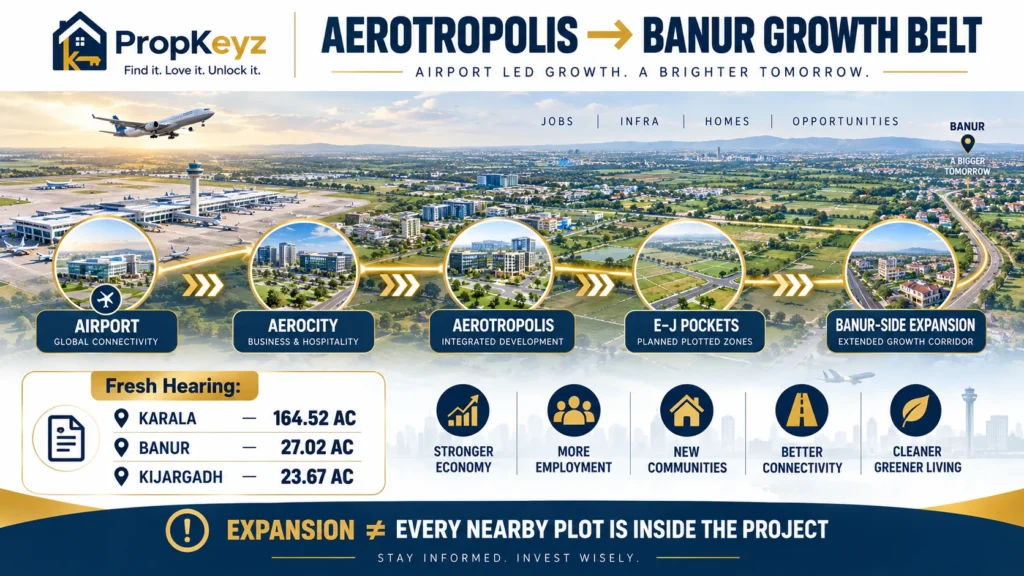
Fresh 9 October Hearing: Karala, Banur & Kijargadh
Current acquisition activity reinforces the Banur-side expansion story.
A Section 16(5) hearing has been scheduled for:
9 October 2026
covering:
- Karala — 164.5208 acres
- Banur — 27.0208 acres
- Kijargadh — 23.6667 acres.
Combined:
approximately 215.21 acres.
What Does This Mean?
It confirms continuing government acquisition activity in the wider Aerotropolis/Aerocity development belt.
What Does It Not Mean?
It does not mean:
every Banur property will become Aerotropolis.
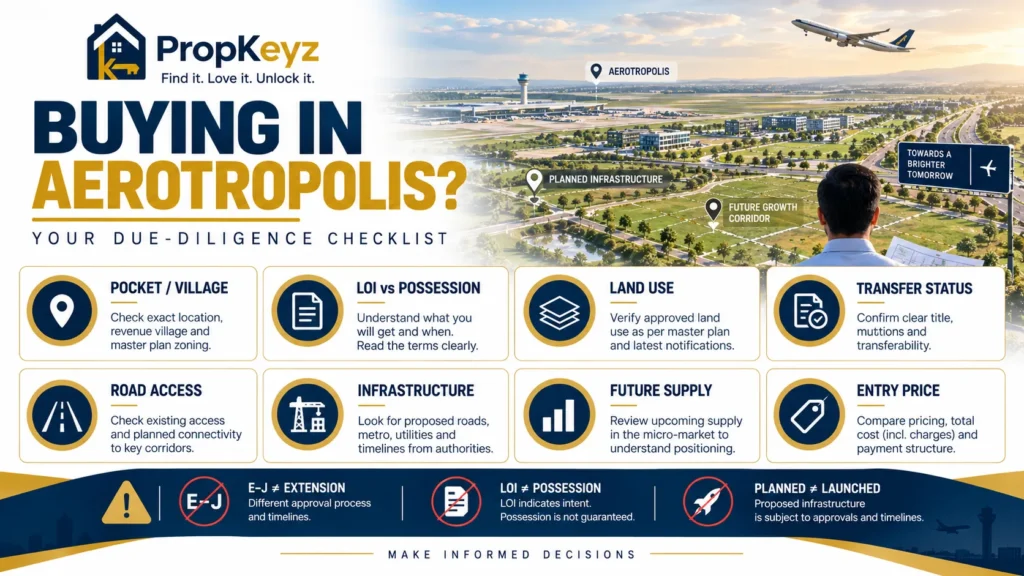
Always verify:
- village
- khasra
- acquisition notification
- master-plan use
- exact project boundary.

Airport Connectivity Is Still a Major Demand Driver
The broader Aerotropolis concept sits around the Mohali international-airport ecosystem.
Airport corridors can attract:
- residential buyers
- offices
- hospitality
- logistics
- business travel
- commercial demand.
But airport proximity is only one piece of the puzzle.
Successful residential absorption still requires:
- internal roads
- water
- sewerage
- power
- schools
- healthcare
- neighbourhood retail.
PropKeyz Rule
Airport proximity creates location visibility. Habitation creates property demand.
Airport Road & Aerotropolis Are Different Markets
Aerocity/Airport Road already has stronger existing habitation and resale activity.
Aerotropolis has more:
future-development dependence.
For current Airport Road infrastructure:
Mohali Airport Road Latest Update 2026
For existing Aerocity plotted-market context:
Aerotropolis vs Aerocity: Why the Comparison Matters
Aerocity demonstrates what happens after a planned plotted area begins maturing.
Aerotropolis is still going through a much larger land, entitlement and infrastructure cycle.
PropKeyz has already analysed that comparison in detail:
Is Mohali Aerotropolis the Next Aerocity?
Key Difference
Aerocity:
stronger current ground-market evidence.
Aerotropolis:
larger future-development story.
Buyer Lesson
Do not price:
future maturity
as if it already exists today.
What Does 83% Pooling Mean for Existing Aerotropolis Plot Owners?
Potentially two opposite things.
Positive
More landowner participation can support:
- coherent development
- larger planned township
- roads
- amenities
- habitation.
Competitive
Future owners may also become:
future sellers.
If many developed plots reach the resale market at the same time:
- listing supply can increase
- buyers gain negotiation power
- appreciation may become uneven.
Most Important Variable
How quickly population and jobs grow relative to plot supply.
What Does It Mean for LOI Buyers?
An LOI buyer should understand:
- exact pocket
- original entitlement
- transferability
- owner chain
- current authority status
- physical possession status
- infrastructure stage.
Never Assume
“LOI hai to plot ready hai.”
Check with the relevant authority and legal/documentation professionals where needed.
What Does It Mean for a New Retail Investor?
Do not buy because:
“83% farmers ne plots choose kiye hain.”
Instead ask:
1. What Exactly Am I Buying?
- LOI?
- allotment?
- possession plot?
- private project plot?
- agricultural land?
2. Which Pocket?
A–D?
E–J?
Extension?
Nearby private land?
3. Development Stage?
- acquisition
- LOI
- roads
- possession
- habitation.
4. Supply Risk?
How much competing inventory may exist by your exit date?
5. Entry Price?
Has the seller already priced five years of future development into today’s rate?
What Does This Mean for Banur Investors?
Banur is increasingly part of the wider Greater Mohali future narrative.
But its investment economics remain different from:
- Aerocity
- central Mohali
- established Airport Road.
Potential Positive Drivers
- Aerotropolis expansion
- master-plan development
- roads
- airport corridor
- relatively larger land availability.
Main Risks
- long holding periods
- land-use uncertainty
- acquisition
- infrastructure timing
- lower current liquidity.
For detailed Banur analysis:
Banur Property Investment 2026
Banur’s Road Network Is Also Changing
Banur has separate infrastructure stories that should not be confused with Aerotropolis.
Read:
and:
Banur Road Update 2026: Kharar–Banur–Tepla
Why This Matters
Aerotropolis growth becomes stronger when supported by:
multiple functioning transport connections
rather than one project alone.
Regional Employment Can Decide Whether Supply Gets Absorbed
Plots are ultimately consumed by:
- families
- builders
- investors
- businesses.
Long-term residential demand requires economic activity.
Greater Mohali’s wider employment story includes:
- IT City
- industrial sectors
- Airport Road
- logistics
- Rajpura/Patiala industrial influence.
PropKeyz also tracks:
Rajpura–Patiala IMC 2026 & Banur Property
and:
Property Science
Future Plot Supply
- Jobs
- Roads
- Occupancy
= healthier absorption.
Future Plot Supply
without enough Jobs / Occupancy
= slower absorption.
How Should Buyers Evaluate Aerotropolis Property Prices?
Do not only ask:
“Current rate kya chal raha hai?”
Ask four deeper questions.
Supply
How much comparable property may come to market?
Demand
Who will actually buy/use it?
Timeline
When will roads and possession arrive?
Entry Price
How much future development is already reflected in today’s price?
PropKeyz Rule
Price tells you what the seller wants today. Supply and demand tell you whether that price can survive tomorrow.
Future Plot Supply Is Not Automatically Negative
Large supply sounds scary.
But new cities require supply.
Without:
- plots
- apartments
- shops
- institutions
there is no urbanisation.
The positive outcome is:
More Plots
→ More Construction
→ More Families
→ More Shops
→ More Schools
→ More Services
→ Stronger City
The Risk
This works only when:
real demand arrives alongside the supply.
When Does Extra Supply Become a Problem?
Extra supply can become a problem when:
- many sellers enter together
- too many projects launch
- infrastructure is delayed
- end-user demand stays weak
- resale buyers remain mostly speculative.
Then owners begin competing through:
- lower asking prices
- longer selling time
- broker incentives.
This Is Why “More Development” and “Higher Prices” Are Not Synonyms
More development can create:
better city infrastructure
while simultaneously creating:
more property competition.
Both can happen together.
What Role Does Land Use Play?
A property marketed as:
“Aerotropolis ke paas”
can be:
- inside an acquisition area
- inside a planned zone
- outside the project
- private RERA project
- agricultural land.
These have completely different legal/property profiles.
For land-use research:
PropKeyz Rule
Nearby location ≠ same legal property category.
GMADA Residential Plots vs Land-Pooling Plots
A normal buyer may also confuse:
official GMADA residential plot schemes
with:
plots originating through land pooling.
For wider government-plot context:
GMADA Residential Plots Mohali 2026
Key Difference
Land-pooling plot:
entitlement emerges from acquired land compensation structure.
Public plot scheme:
plot offered through a separate authority sales/allotment process.
These should not be treated as identical supply.
Aerotropolis Extension Is a Second Supply Story
The approximately 2,490-acre Extension adds another long-term dimension.
Around:
8,600 residential plots
have been reported in the wider future concept.
But PropKeyz has already highlighted a critical distinction:
8,600 planned plots ≠ 8,600 plots launched.
There is currently no basis to turn that planning number automatically into:
- current bookings
- current official rates
- current possession.
Read:
Aerotropolis Extension Residential Plots Mohali 2026

Confirmed vs Market Assumption
| Claim | Current Position |
|---|---|
| 2,468 applications received | Reported PUDA data |
| 2,281 compensation choices recorded | Reported |
| 83% chose land pooling | Confirmed for recorded-choice applications |
| 1,896 pooling applications | Reported |
| Pooling applications cover 1,102 acres | Reported |
| 382 clubbing applications | Reported |
| Only 3 cash applications | Reported |
| Residential plots most popular | Reported |
| Pockets E–J are current pooling/acquisition focus | Confirmed |
| Pooling means physical plot possession today | No |
| LOI means possession | No |
| First phase has had possession delays | Reported |
| Aerotropolis Extension approx. 2,490 acres | Reported / planning |
| Around 8,600 Extension plots | Planned/reported |
| 8,600 plots currently launched | No |
| Banur-side acquisition activity is continuing | Confirmed |
| 83% pooling means prices will rise | Not established |
| Extra supply means prices will fall | Not established |
| Every nearby Banur plot benefits equally | Incorrect assumption |
Aerotropolis Property Supply 2026: PropKeyz Analysis
The Aerotropolis Property Supply 2026 data gives us a rare look at how landowners themselves are responding to one of Greater Mohali’s largest urban-expansion projects.
1. The 83% Figure Is a Strong Participation Signal
When a large majority of recorded applicants choose developed property rather than cash, it shows strong willingness to remain connected to the scheme.
2. But It Is Not Purely an Investment Poll
Landowners can choose pooling for:
- family
- taxation
- inheritance
- utility
- entitlement
- long-term planning
reasons.
Do not label 83% as:
“83% bullish vote on Aerotropolis prices.”
3. Residential Preference Matters
Most pooling applicants selected residential plots.
That means future Aerotropolis supply may be heavily:
residential plot-led.
4. More Landowners Can Mean Stronger Urbanisation
Distributed ownership can produce:
- houses
- builders
- shops
- local activity.
5. More Owners Can Also Mean More Resale Competition
Every future owner is also a potential:
future seller.
6. LOI Delivery Is the Crucial Execution Risk
Earlier-phase experience shows that entitlement paperwork and physical possession can be separated by a significant period.
7. Pockets E–J and the Extension Should Not Be Merged
This is probably the most common future market confusion.
E–J represents one current supply pipeline.
The separate 2,490-acre Extension represents another future planning pipeline.
8. Banur Is Becoming Part of Greater Mohali’s Property Geography
The Banur-side belt is moving from:
peripheral town
toward:
strategic expansion corridor.
But it remains more future-dependent than central Mohali or established Aerocity.
9. Supply Is Not the Enemy
A city needs property supply to grow.
The real question is:
whether jobs, connectivity and habitation grow alongside it.
10. Entry Price Still Decides the Investment
Even a successful future city can produce weak investment returns if someone buys too early at an excessively inflated price.
Biggest Positive
Landowners are showing strong participation in the developed-land model rather than overwhelmingly exiting for cash.
Biggest Risk
Investors confusing future entitlement supply with immediate ready-property scarcity.
PropKeyz View
The 83% pooling figure strengthens the Aerotropolis development story, but the next major test is delivery: LOIs, roads, serviced plots, possession and real end-user absorption.
Aerotropolis Property Supply 2026: Final Verdict
The Aerotropolis Property Supply 2026 story is bigger than one percentage.
Fresh PUDA data shows that among applications where compensation preference had been recorded:
83% selected land pooling.
This suggests strong acceptance of the idea that landowners remain part of the future planned urban development rather than simply exit for cash.
But from a property-investment perspective, the most important effect comes later.
Pooling can eventually convert:
raw rural land
into:
multiple developed-property ownership interests.
That can create:
- more construction
- more habitation
- more commerce
- stronger city formation.
It can also create:
- more resale listings
- more competition
- greater future plot supply.
So Will Prices Rise?
Maybe.
But not because:
83% selected pooling.
Prices will ultimately depend on:
Real Demand vs Available Serviced Supply
supported by:
- roads
- airport connectivity
- jobs
- schools
- healthcare
- utilities
- actual possession
- habitation.
And Banur?
Banur’s relevance is clearly growing as the Aerotropolis development footprint and related acquisition activity move farther into its planning belt.
But:
Banur remains a longer-horizon property story than established Mohali.
Most Important Buyer Rule
Do not buy:
“Aerotropolis story.”
Buy a clearly understood asset:
- correct pocket
- correct legal status
- correct development stage
- correct access
- correct entry price.
Final PropKeyz Rule
Land pooling can create the city. Demand decides what the city’s plots are worth.
Frequently Asked Questions
What is the latest Aerotropolis Property Supply 2026 update?
Fresh PUDA data reported on 22 September 2026 shows that 1,896 of 2,281 applications with a recorded compensation choice opted for land pooling, equal to approximately 83%. Those applications cover around 1,102 acres.
Does 83% mean 83% of all Aerotropolis landowners chose pooling?
No. It refers specifically to the applications where compensation choice had been recorded in the reported dataset.
How many total applications were received?
The latest reported figure is:
2,468 applications.
Of these, 2,206 were under process and 262 completed/closed.
How many owners chose cash compensation?
Only three recorded applications in the latest dataset had chosen cash compensation, covering approximately 0.2 acre.
What is land pooling?
Land pooling allows eligible landowners to contribute acquired land toward planned development and receive specified developed residential/commercial property entitlement instead of only cash compensation.
What is clubbing?
Clubbing allows eligible landholdings/entitlements to be combined to create a larger or different plot entitlement structure.
Why are most owners choosing residential plots?
Residential property offers self-use, family holding, construction and resale possibilities. Fresh data shows residential entitlement is currently the dominant preference, but individual reasons can vary.
Does pooling mean landowners already have plots?
No. Pooling selection, LOI, plot identification, infrastructure and physical possession are different stages.
What is an Aerotropolis LOI?
A Letter of Intent represents an entitlement/allotment-related right within the authority process. It should not be treated as physical possession of a completed serviced plot.
Have first-phase Aerotropolis owners received all plots?
Not according to July 2026 reporting. Thousands of first-phase landowners said they were still waiting for clarity on physical possession and infrastructure despite earlier LOIs.
What are Pockets E–J?
They are the current second-phase Aerotropolis residential pockets involved in major land acquisition and land-pooling processes around the Mohali airport-side growth belt.
Is Aerotropolis Extension the same as Pockets E–J?
No. The separate Extension is a wider future expansion of approximately 2,490 acres in the Banur-side planning belt.
Are 8,600 Aerotropolis Extension plots available for booking?
No current evidence establishes a live public booking scheme simply from the reported 8,600 planned-plot figure.
Will 83% land pooling increase Aerotropolis prices?
Not automatically. Price behaviour will depend on the relationship between genuine demand and future serviced/resale supply.
Can extra plots reduce prices?
Large resale supply can create more buyer choice and moderate price growth if demand does not expand at the same pace.
Why is Banur important to Aerotropolis?
Current expansion and acquisition activity is extending farther into the Banur-side planning corridor, making Banur more relevant to Greater Mohali’s long-term urban-growth story.
When is the next Banur-side acquisition hearing?
A Section 16(5) hearing for Karala, Banur and Kijargadh is scheduled for 9 October 2026.
Is Aerotropolis a good investment?
Its long-term case depends on infrastructure, possession, demand, jobs and entry price. Buyers should evaluate the specific asset rather than treating the entire Aerotropolis region as one uniform investment.
Continue Your Aerotropolis & Banur Research
Aerotropolis Land Pooling 2026
Understand the latest Option B entitlement change for eligible Pockets E–J landowners:
Aerotropolis Land Pooling 2026
Aerotropolis Extension Residential Plots Mohali 2026
Understand the separate 2,490-acre Extension and reported 8,600 future plots:
Aerotropolis Extension Plots Mohali 2026
Mohali Aerotropolis Land Acquisition 2026
Understand the acquisition process and what it means for property investors:
Mohali Aerotropolis Land Acquisition 2026
Is Mohali Aerotropolis the Next Aerocity?
Compare development maturity, connectivity and investment risks:
Read the Aerotropolis vs Aerocity Analysis
Banur Property Investment 2026
Understand the broader Banur investment thesis:
Banur Property Investment 2026
Banur Bharatmala Road 2026
Understand highway connectivity and access risk:
Kharar–Banur–Tepla Road Update
Track the separate ₹40.82-crore road-improvement story:
Rajpura–Mohali Rail Link 2026
Understand the separate regional-connectivity story affecting Banur’s future:
Rajpura–Patiala IMC 2026
Understand the industrial/employment context east of the Banur belt:
Mohali Airport Road Update 2026
Track Airport Road connectivity, delays and property impact:
Mohali Airport Road Latest Update 2026
Aerocity Plots Mohali 2026
Compare future Aerotropolis supply with an established GMADA plotted market:
GMADA Residential Plots Mohali 2026
Understand how official authority plot schemes differ from land-pooling entitlements:
GMADA Residential Plots Mohali 2026
CLU in Mohali 2026
For land-use and conversion due diligence:
Evaluating an Aerotropolis, LOI or Banur Property?
If you are considering:
- Aerotropolis LOI
- residential plot
- commercial plot
- Banur property
- agricultural land
- private RERA plot
- future Aerotropolis-linked property
send PropKeyz:
Pocket / Village:
Property Type:
Plot Size:
LOI / Allotment / Possession:
Quoted Rate:
Total Price:
Current Road Access:
Seller’s Future Claim:
Self-Use / Investment:
Expected Holding Period:
PropKeyz can help you organise the comparison around:
- exact property type
- current development stage
- authority status
- infrastructure
- future supply
- comparable market
- buyer risks.
Call / WhatsApp
+91 80534 69929
Suggested WhatsApp Message
Hi PropKeyz, I read your Aerotropolis Property Supply 2026 guide. I am evaluating a ______ sq yd property/LOI in Pocket/Village . The quoted rate is ₹ per sq yd. Please help me understand the current development stage, future competing supply and key checks before I proceed.
Find it. Love it. Unlock it.
Your Property. Our Responsibility.
EXTERNAL SOURCES & VERIFICATION
Last fact-checked: 22 September 2026
Latest 83% Land-Pooling Data
Used to verify:
- 2,468 applications
- 2,281 recorded choices
- 1,896 pooling applications
- 1,102 acres
- clubbing/cash figures
- residential preference.
Hindustan Times — Aerotropolis project: 83% owners opt for land pooling
Official GMADA Land-Pooling Policy
Used to verify:
- policy objectives
- developed-land concept
- general entitlement framework.
Aerotropolis E–J Option B Corrigendum
Used for the latest 7-kanal-plus Option B configuration.
GMADA-linked Aerotropolis E–J Option B update
Aerotropolis Extension Scale
Used to verify the separate approximately 2,490-acre Extension and reported approximately 8,600 future residential plots.
Indian Express — Aerotropolis Extension 2,490 Acres & 8,600 Planned Plots
First-Phase Possession Risk
Used for earlier landowner concerns about LOIs and delayed physical possession.
Hindustan Times — First-phase Aerotropolis landowners await developed plots
Current Banur-Side Acquisition
Used to verify the 9 October hearing and Karala/Banur/Kijargadh acreage.
Aerotropolis — Karala, Banur & Kijargadh Hearing Notice
DISCLAIMER
This article is intended for:
- property research
- market education
- infrastructure analysis
- buyer awareness.
It is not:
- investment advice
- legal advice
- land-title verification
- valuation advice
- government allotment confirmation.
Land pooling:
- applications
- entitlement
- LOIs
- plot configuration
- possession
- infrastructure
can remain at different stages.
The reported 83% figure applies to the latest dataset of applications where compensation preference had been recorded and should not be interpreted as 83% of all landowners in every Aerotropolis phase.
PropKeyz does not guarantee:
- Aerotropolis appreciation
- Banur appreciation
- LOI resale gains
- plot possession date
- infrastructure-completion date.
Before purchasing, independently verify:
- seller ownership
- authority record
- entitlement
- land use
- acquisition status
- transfer process
- actual access
- possession stage.
About PropKeyz
PropKeyz Editorial Team
PropKeyz tracks property, infrastructure, land acquisition and planning developments across:
- Mohali
- Aerocity
- Aerotropolis
- Airport Road
- Banur
- Kharar
- Gharuan
- New Chandigarh
- Chandigarh Tricity.
Our research follows four core rules:
Land Pooling Choice ≠ Developed Plot
LOI ≠ Possession
Planned Supply ≠ Launched Supply
More Development ≠ Guaranteed Appreciation
Find it. Love it. Unlock it.
Your Property. Our Responsibility.