

The Punjab Unauthorized Colony Regularisation 2026 story is important for thousands of residents, plot holders and property buyers because Punjab has opened a fresh regularisation route for eligible unauthorised colonies—but the relief is not a blanket legalisation of every unapproved colony in the state.
The Punjab Cabinet approved an amendment to Rule 31 of the Punjab Apartment and Property Regulation Rules in July 2026.
Under the announced framework, an unauthorised colony may become eligible for regularisation where:
at least 25% of the plots have already been built upon.
Applications may be submitted by:
- the colony promoter; or
- the Resident Welfare Association — RWA.
The current announced last date for filing applications is:
30 September 2026.
As of 23 September 2026, that deadline is only one week away.
At first glance, this sounds like very good news for buyers living in or evaluating an unauthorised colony.
But for Mohali, Kharar, Banur, Zirakpur, Dera Bassi and New Chandigarh-side property buyers, there is a major qualification.
The amended provisions were announced as applying to eligible colonies inside notified Local Planning Areas and on agricultural land earmarked under Master Plans:
except colonies falling under the GMADA Regional Plan.
That single exclusion changes how Greater Mohali buyers should interpret the policy.
GMADA’s official Regional Plan covers approximately:
1,190 sq km
across six Local Planning Areas:
- SAS Nagar
- Kharar
- Banur
- Zirakpur
- Dera Bassi
- Mullanpur.
Therefore, a property dealer saying:
“Punjab ne illegal colonies regularise kar di hain, aapka plot safe hai”
is not enough.
The correct questions are:
Which colony?
Which authority?
Which Master Plan / Regional Plan?
Has the colony actually applied?
Has provisional regularisation been issued?
Has this exact plot received plot-level regularisation/NOC where required?
This PropKeyz guide explains the complete buyer-side picture.
Last fact-checked: 23 September 2026
Key Takeaways
- Punjab Cabinet approved changes to Rule 31 to simplify regularisation for eligible unauthorised colonies.
- The core eligibility trigger announced for the new route is at least 25% of plots built upon.
- A promoter or RWA can apply.
- The current announced application deadline is 30 September 2026.
- Previously rejected colonies can reportedly apply again.
- Residential and industrial colonies face a compounding fee equal to 5% of prevailing collector rate on gross area.
- Commercial colonies face 10% of prevailing commercial collector rate on gross area.
- Complete applications are intended to receive provisional certificates within 30 days.
- Applications are intended to be disposed of within six months.
- Individual plots are not automatically regularised simply because the colony applies.
- Plot holders move into their own regularisation/approval stage after colony-level provisional approval and fee compliance.
- Where an RWA applies, the announced framework provides a specific RERA exemption for that route.
- RWA/promoter still remains responsible for approvals, NOCs and pending development works.
- The biggest Greater Mohali caveat is the GMADA Regional Plan exclusion.
- GMADA’s Regional Plan covers SAS Nagar, Kharar, Banur, Zirakpur, Dera Bassi and Mullanpur planning areas.
- Therefore Mohali/Kharar buyers must verify exact jurisdiction instead of assuming statewide eligibility.
- Regularisation can improve legal/planning certainty and resale liquidity.
- Regularisation does not automatically guarantee clear title, bank finance or property-price appreciation.
PropKeyz View
Regularisation can reduce one layer of property risk. It does not replace complete property due diligence.
Punjab Unauthorized Colony Regularisation 2026: Quick Answer
The Punjab Unauthorized Colony Regularisation 2026 framework gives certain eligible unauthorised colonies a fresh route to apply for regularisation where at least:
25% of plots are built upon.
Applications can be made by:
- promoter
- RWA.
The current announced deadline is:
30 September 2026.
Residential and industrial colonies face a reported compounding fee of:
5% of prevailing collector rate on gross colony area
while commercial colonies face:
10%.
However, the biggest Greater Mohali warning is:
colonies falling under the GMADA Regional Plan are excluded from this specific amended route.
So:
Punjab-wide regularisation announcement ≠ every Kharar/Mohali colony automatically qualifies.
Latest Status — 23 September 2026
| Issue | Current Reported Position |
|---|---|
| Rule | Rule 31, PAPR Rules |
| Cabinet approval | July 2026 |
| Basic built-up eligibility | At least 25% plots built upon |
| Who can apply | Promoter or RWA |
| Deadline | 30 September 2026 |
| Previously rejected cases | Can reportedly reapply |
| Residential/industrial fee | 5% of collector rate on gross area |
| Commercial fee | 10% of commercial collector rate |
| Provisional certificate | Within 30 days for complete application |
| Application disposal | Within six months |
| RWA route | Specific RERA exemption announced |
| GMADA Regional Plan | Excluded from this amended route |
| Individual plot automatically regularised? | No |

What Is an Unauthorized Colony?
In simple property language, an unauthorised colony is a plotted or developed colony created without completing the required statutory approval/licensing framework applicable to that development.
Punjab’s PAPR framework deals with:
- promoters
- colony licences
- planning compliance
- development works
- approvals.
The base Rule 31 mechanism deals with compounding the offence of developing an unauthorised colony.
Why Is This a Property Problem?
Because a buyer may have:
- a sale deed
- possession
- a house
but still live in a colony that has planning/legal deficiencies.
This can create problems around:
- NOC
- building approval
- infrastructure
- registry
- resale
- buyer confidence.
What Changed in 2026?
Punjab Cabinet approved a simplified route for eligible colonies.
The headline change is:
25% built-up threshold.
Earlier frameworks had different conditions and categories.
The new announcement is intended to give more existing colonies a route into the formal planning framework.
Important
This is not permission to:
create a new illegal colony today and regularise it later.
The policy should be understood as a regularisation mechanism for eligible existing development—not as an alternative to proper licensing.
What Does the 25% Built-Up Rule Mean?
The announced condition says at least:
25% of plots
should already have been built upon.
Simple Example
If a colony contains:
100 plots
then at least:
25 plots
would need to satisfy the applicable built-up condition for the colony to potentially meet this threshold.
But 25% Is Not the Only Question
A colony still needs to go through:
- application
- authority scrutiny
- applicable planning checks
- payments
- approvals
- development obligations.
PropKeyz Rule
25% built-up creates possible eligibility—not automatic approval.
Who Can Apply?
The announced framework allows application by:
Promoter
The person/entity responsible for developing the colony.
Resident Welfare Association
The RWA may apply where the promoter:
- is unavailable
- is inactive
- does not pursue the process.
Why the RWA Option Matters
Many older unauthorised colonies have:
- hundreds of residents
- homes already constructed
but limited cooperation from the original coloniser.
Allowing an RWA route can potentially enable residents to pursue regularisation collectively.
Can a Previously Rejected Colony Apply Again?
Yes, according to the Cabinet-announced framework.
Unauthorised colonies whose applications had been rejected under previous regularisation policies were given another opportunity to apply under the amended rule.
But
Reapplication does not mean:
previous rejection automatically disappears.
The new application still needs to satisfy the current applicable framework.
What Is the September 30 Deadline?
The current last date announced for submitting applications is:
30 September 2026.
For residents and RWAs, the practical point is:
application should not be confused with final regularisation.
September 30 is the:
application deadline
not the date every colony becomes legal.
How Much Is the Regularisation Fee?
The announced fee structure is:
Residential Colony
5% of prevailing collector rate on gross colony area
Industrial Colony
5% of prevailing collector rate on gross colony area
Commercial Colony
10% of prevailing commercial collector rate on gross colony area
Why Gross Area Matters
The fee is not simply:
5% of one buyer’s plot price.
It is linked to:
gross colony area
and the relevant collector-rate basis.
Do Not Guess the Fee
Actual liability requires:
- colony area
- category
- collector rate
- competent authority calculation.
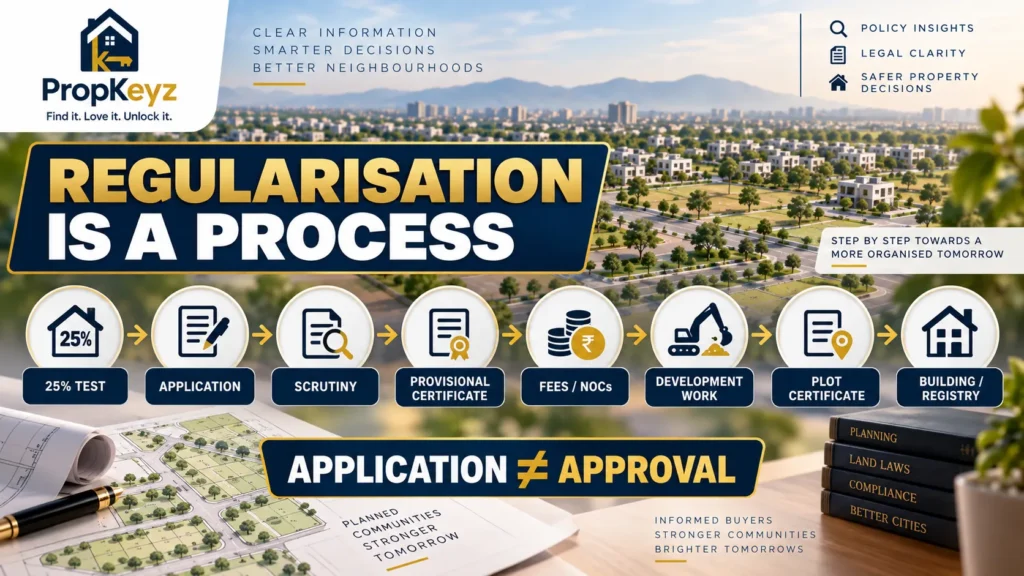
What Happens After the Application?
Under the Cabinet-announced framework, a:
complete application
is intended to receive a provisional regularisation certificate within:
30 days.
Applications received under the amended route are intended to be disposed of within:
six months.
Important
A provisional certificate is still:
provisional.
Buyers should verify the latest final status rather than relying on a:
- receipt
- application number
- submitted file.
Colony Regularisation vs Individual Plot Regularisation
This is one of the most important distinctions.
Stage 1 — Colony
The promoter/RWA seeks regularisation of:
the colony.
Stage 2 — Individual Plot
After provisional regularisation and payment of the prescribed fee, individual plot holders can become eligible to obtain regularisation certificates and proceed under applicable building/registration rules.
Therefore
Colony has applied
does not mean:
your individual plot is already regularised.
Can the Plot Be Registered After Regularisation?
The Cabinet-announced framework says that after the provisional certificate and prescribed payments, individual plot holders can become eligible to:
- obtain plot regularisation certificates
- secure applicable approvals
- register their plots after prescribed fee compliance.
Buyer Warning
Ask the seller:
“Colony ka certificate dikhao.”
Then separately ask:
“Is exact plot ka certificate/NOC/status dikhao.”
Do not stop at colony-level paperwork.
What About Building Plans?
Regularisation of the colony does not mean:
any building design becomes automatically legal.
Building plans remain subject to applicable building rules and authority procedures.
GMADA itself separately provides building-plan approval processes for properties under its jurisdiction.
For broader building-rule context, read:
Punjab Building Rules 2026 — PropKeyz
The Biggest Mohali Issue: GMADA Regional Plan Exclusion
This is where the article becomes especially relevant to PropKeyz readers.
The new amended provisions were announced as extending to eligible colonies:
- in notified Local Planning Areas
- on agricultural land earmarked under Master Plans
except those falling under the GMADA Regional Plan.
This means the statewide headline cannot be applied blindly to:
- Mohali
- Kharar
- Banur
- Zirakpur
- Dera Bassi
- Mullanpur/New Chandigarh.
What Is the GMADA Regional Plan?
GMADA’s official Regional Plan covers a Greater Mohali Region of approximately:
1,190 sq km.
It identifies six Local Planning Areas:
- SAS Nagar
- Kharar
- Banur
- Zirakpur
- Dera Bassi
- Mullanpur.
GMADA also maintains separate approved Master Plans for these locations.
The Practical Buyer Lesson
Do not ask:
“Kharar me regularisation policy hai?”
Ask:
“Meri exact colony kis planning jurisdiction aur plan boundary me aati hai?”
That is a much stronger question.

Why Is This Important for Kharar?
Kharar has experienced decades of:
- rapid plotted development
- colony expansion
- builder activity
- population growth.
GMADA currently lists numerous licensed/approved Kharar colonies, including multiple established projects.
It also maintains an:
unauthorised colonies section
and NOC-related records.
Therefore Two Colonies 1 km Apart Can Have Very Different Legal Status
Colony A:
- licensed
- approved.
Colony B:
- unauthorised
- pending regularisation.
Colony C:
- older regularisation/NOC status.
Do Not Buy Based on Area Name
“Sunny Enclave side”
or:
“Kharar side”
is not a legal status.
Verify the exact:
- colony name
- promoter
- licence
- khasra
- authority record.
Read Our Kharar Legal Guides
For the separate property-NOC issue:
For colony-level NOC context:
For local property options:
What Does This Mean for Mohali Buyers?
Established GMADA sectors have a very different planning profile from unauthorised peripheral colonies.
A buyer comparing:
- authorised plotted sector
- licensed private colony
- unauthorised colony
should not compare only:
₹ per sq yd.
Cheap Price Often Contains Legal Risk
A cheaper unauthorised plot may reflect:
- weaker documentation
- NOC uncertainty
- infrastructure gaps
- registry concerns
- lower bankability.
That discount exists for a reason.
If Legal Risk Reduces
The price gap can potentially narrow.
But only if:
actual legal/planning status improves.
Read the Mohali Due-Diligence Cluster
Regularisation vs NOC — They Are Not the Same
Many property sellers use these words interchangeably:
- regular
- approved
- NOC
- registry open.
That creates confusion.
Colony Regularisation
Deals with colony’s unauthorised development/planning status.
NOC
Can be a separate property/authority documentation requirement depending on the relevant policy and transaction.
Registry
A registered transfer document records a transaction.
It does not independently prove:
the colony had every required planning approval.
PropKeyz Rule
Registry ≠ Colony Approval ≠ NOC ≠ Clear Title.
Each should be verified separately.
Regularisation vs CLU
CLU means:
Change of Land Use.
If agricultural land is being used for another purpose, CLU can become relevant depending on:
- planning zone
- project type
- applicable law/policy.
Regularisation of an unauthorised colony should not be casually interpreted as:
“CLU ki need kabhi nahi thi.”
For detailed context:
Regularisation vs Title
This distinction is critical.
Suppose a colony receives regularisation.
A buyer still needs to check:
- seller owns the plot?
- sale deed chain correct?
- mutation/revenue records?
- mortgage?
- dispute?
- acquisition?
- court case?
- access rights?
Why?
Regularisation deals primarily with:
development/planning status.
Title deals with:
ownership rights.
PropKeyz Rule
A regular colony can still contain a problematic individual property.
RWA Route: Why It Matters
The amended framework allows RWA applications.
Where the RWA applies, the announced framework provides that RERA provisions will not apply to that application route.
However, the RWA/promoter remains responsible for:
- statutory approvals
- NOCs
- development works.
What This Does NOT Mean
It does not mean:
every property in the colony becomes exempt from every property law.
The exemption should be read narrowly in the context of this RWA regularisation mechanism.
What Infrastructure Work May Still Be Required?
Regularisation does not magically construct:
- roads
- drainage
- sewerage
- water supply
- parks.
The promoter/RWA can remain responsible for pending development works within the prescribed process.
This Is Important for Property Value
A colony can become:
more legally certain
before becoming:
fully infrastructure-complete.
These are different milestones.
How Can Regularisation Affect Property Prices?
This is the main property-market question.
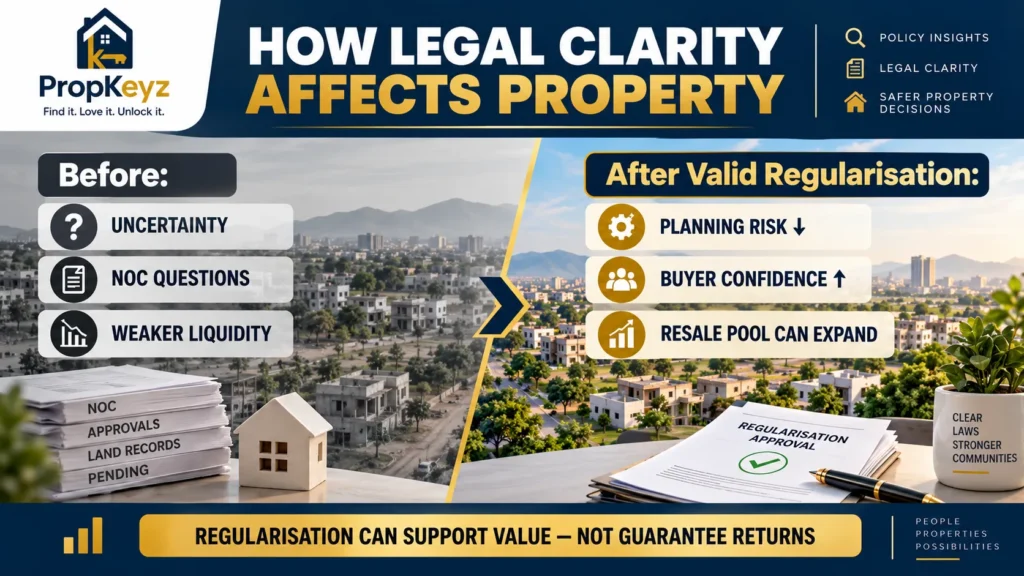
Legal uncertainty creates what we can call:
risk discount.
Before Regularisation
A buyer may worry about:
- NOC
- registry
- building approval
- bank loan
- resale.
So the buyer may demand:
a lower price.
After Genuine Legal Improvement
If the colony and plot achieve the required legal status:
Legal Risk ↓
→ Buyer Confidence ↑
→ Buyer Pool Can Expand
→ Resale Liquidity Can Improve
→ Price Discount Can Narrow
But
This does not mean:
regularisation = 20% price increase.
Property price also depends on:
- location
- road
- water
- sewerage
- neighbourhood
- construction
- market demand.
Which Properties Could Benefit the Most?
Not one city.
The biggest benefit can theoretically go to properties where:
1. Existing Demand Already Exists
People already live there.
2. Legal Uncertainty Is the Main Problem
Location itself is good.
3. Infrastructure Is Reasonable
Roads/utilities exist.
4. Regularisation Is Actually Completed
Not only applied.
5. Current Price Still Reflects a Legal Discount
If seller already charges:
fully approved-colony price
before regularisation is complete, upside can be limited.
Bank Finance: Can It Improve?
Potentially.
Banks usually prefer:
- clearer title
- recognised planning status
- acceptable property documentation.
Improved regularisation can therefore potentially strengthen financeability.
But
Bank approval is:
lender-specific.
Do not tell a buyer:
“Regularised colony hai, loan pakka milega.”
The bank may still evaluate:
- title
- property
- construction
- valuation
- borrower profile.
Resale Liquidity May Matter More Than Appreciation
Suppose your plot value rises only modestly.
But before regularisation:
3 buyers were willing to consider it.
After documentation improves:
15 buyers consider it.
That is:
liquidity improvement.
For many property owners, this can be as important as nominal price appreciation.
Beware of This Seller Claim
“Application lag gayi hai, colony regular ho gayi.”
Wrong.
Application means:
application submitted.
It does not equal:
approval.
Beware of This Claim Too
“25% construction hai, automatic regularisation hai.”
Wrong.
The 25% built-up condition is an:
eligibility threshold.
The authority still has to process the case.
And This Claim Is Especially Dangerous in Mohali/Kharar
“Punjab policy sab jagah applicable hai.”
No.
The announced amendment specifically contains a:
GMADA Regional Plan exclusion.
This is why Greater Mohali buyers must be more careful than someone reading only the statewide headline.
What Should a Buyer Verify on GMADA’s Website?
GMADA currently provides separate resources for:
- approved colonies
- unauthorised colonies
- NOC-related plots
- regularisation services.
Buyer Workflow
Search the:
exact colony name.
Then verify:
- promoter
- licence/approval record
- regularisation status
- individual plot documentation.
Do Not Confuse an Approved Colony With an Unauthorized Colony
GMADA’s approved-colony database contains multiple Kharar developments, showing that the authority distinguishes:
licensed/approved colony
from:
unauthorised colony.
That distinction should exist in your property comparison too.
What About Gharuan?
Gharuan is currently undergoing a separate planning story involving a proposed large-scale regional-plan amendment.
That has nothing to do with assuming an old unauthorised colony is automatically regularised.
For the planning context:
Key Rule
Future planning proposal ≠ present colony approval.
What About Banur?
Banur is part of the wider GMADA planning geography.
It also has:
- its own approved Master Plan
- major future infrastructure
- Aerotropolis influence.
But again:
future development does not cure existing plot-level legal problems.
For broader Banur market research:
Banur Property Investment 2026
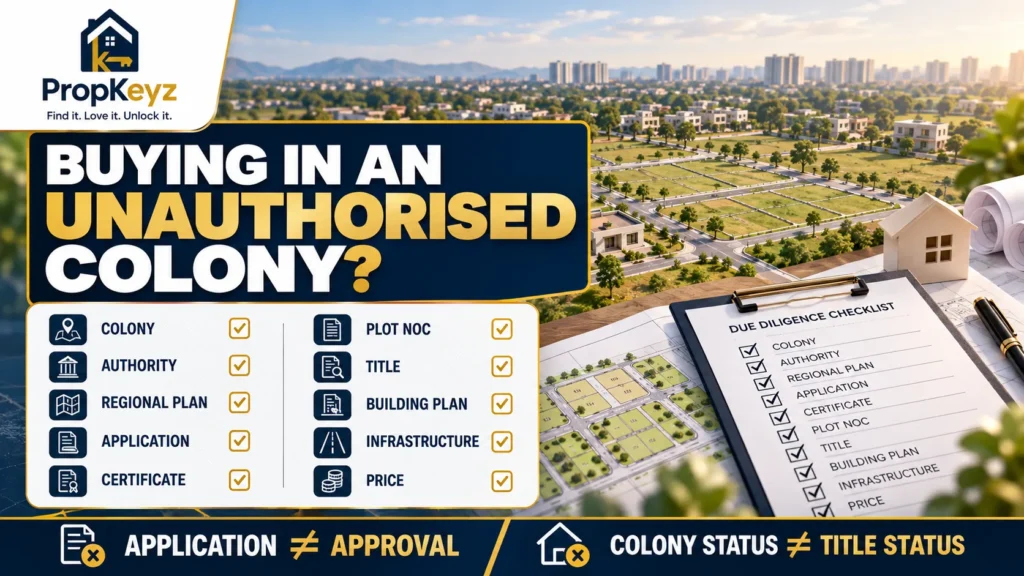
Buyer Due-Diligence Checklist
Before buying a plot in a colony marketed as:
“regularisation under process”
verify:
Colony
- exact colony name
- promoter
- RWA
- approved or unauthorised status.
Jurisdiction
- municipal limit?
- GMADA?
- other development authority?
- exact Local Planning Area?
Plan
- Master Plan
- GMADA Regional Plan
- applicable land use.
Regularisation
- application submitted?
- date?
- acknowledgement?
- provisional certificate?
- final certificate?
Plot
- plot number
- area
- regularisation certificate
- NOC if applicable.
Title
- sale deed
- previous chain
- mutation/revenue record
- encumbrance.
Infrastructure
- road
- sewerage
- water
- drainage
- electricity.
Building
- sanctioned plan
- building-rule compliance.
Finance
- bank willingness.
Price
Compare with:
- fully approved colony
- similar unauthorised colony
- nearby GMADA/licensed property.
Confirmed vs Assumed
| Claim | Current Position |
|---|---|
| Punjab approved Rule 31 amendment in July 2026 | Confirmed in Cabinet announcement |
| 25% plots built upon can create eligibility | Confirmed |
| Promoter can apply | Confirmed |
| RWA can apply | Confirmed |
| Deadline September 30, 2026 | Confirmed in announcement |
| Previously rejected colonies can reapply | Reported |
| Residential/industrial fee 5% | Confirmed in announcement |
| Commercial fee 10% | Confirmed in announcement |
| Complete applications: provisional certificate in 30 days | Announced |
| Applications to be disposed within six months | Announced |
| RWA route gets specific RERA exemption | Announced |
| GMADA Regional Plan excluded | Confirmed |
| GMADA region includes Kharar/SAS Nagar/Banur etc. | Official Regional Plan |
| Every Kharar colony excluded automatically | Must verify exact plan/jurisdiction |
| Application means colony regularised | No |
| Colony certificate means plot title is clear | No |
| Regularisation guarantees bank loan | No |
| Regularisation guarantees appreciation | No |
Punjab Unauthorized Colony Regularisation 2026: PropKeyz Analysis
The Punjab Unauthorized Colony Regularisation 2026 policy story is important because legal uncertainty has been one of the biggest problems in Punjab’s low-cost plotted property market.
1. The 25% Threshold Opens the Door Wider
The new framework reduces one major barrier for established colonies where substantial construction already exists.
2. RWA Applications Are Important
Residents are not necessarily dependent entirely on an inactive original promoter.
3. September 30 Creates Real Urgency
The filing window is close to closing.
But urgency should apply to:
eligible applicants
—not to buyers rushing into purchases because a broker says the colony will soon be regularised.
4. The GMADA Exclusion Changes the Mohali Story
This is the article’s biggest Greater Mohali point.
Punjab’s statewide announcement cannot be copied directly onto every:
- Kharar
- Mohali
- Banur
- Zirakpur
colony.
5. Colony and Plot Are Separate Layers
A colony-level approval is not the end of individual property due diligence.
6. Title Remains Separate
Planning regularisation does not replace ownership verification.
7. Infrastructure Still Matters
A legally improved colony with:
- narrow roads
- weak drainage
- poor sewerage
may still trade at a discount to a better planned location.
8. The Biggest Immediate Property Benefit May Be Liquidity
More buyers may consider a property once documentation becomes clearer.
9. Regularisation Can Narrow a Legal-Risk Discount
But only if the original property was discounted because of that uncertainty.
10. Overpaying Remains Possible
A seller can price:
future regularisation
into today’s price before final approval.
That transfers the remaining risk to the buyer.
Biggest Positive
Eligible long-established colonies now have a clearer announced route to enter the formal framework.
Biggest Risk for Greater Mohali Buyers
Assuming the new Punjab route applies automatically inside the GMADA Regional Plan.
PropKeyz View
Don’t buy the word “regularisation.” Buy only after you understand the colony, jurisdiction, certificate stage and exact plot.
Punjab Unauthorized Colony Regularisation 2026: Final Verdict
The Punjab Unauthorized Colony Regularisation 2026 framework creates an important opportunity for eligible unauthorised colonies.
The most important headline rules are:
25% built-up threshold
and:
30 September 2026 application deadline.
But Greater Mohali buyers have an extra layer of complexity.
The announced amendment specifically excludes:
colonies falling under the GMADA Regional Plan.
That matters because GMADA’s Regional Plan covers the wider:
- SAS Nagar
- Kharar
- Banur
- Zirakpur
- Dera Bassi
- Mullanpur
planning region.
Therefore
Do not ask:
“Punjab regularisation open hai?”
Ask:
“Is exact colony par kaunsi authority aur kaunsa rule apply karta hai?”
For Existing Residents
If the colony appears eligible:
- speak with RWA/promoter
- verify filing status
- verify authority
- track provisional/final certificate.
For New Buyers
Never pay because:
“regularisation hone wali hai.”
Pay according to:
- today’s legal status
- today’s infrastructure
- today’s documentation
- today’s price.
Final PropKeyz Rule
Regularisation can reduce a planning problem. It cannot replace complete property verification.
Frequently Asked Questions
What is the Punjab Unauthorized Colony Regularisation 2026 deadline?
The current announced last date for eligible applications is 30 September 2026.
What is the 25% built-up rule?
An unauthorised colony may become eligible under the announced 2026 route where at least 25% of plots have been built upon.
Who can apply for colony regularisation?
The promoter or Resident Welfare Association can apply under the announced framework.
Can previously rejected colonies apply again?
Yes, the Cabinet announcement states that previously rejected colonies may apply again under the amended route.
What is the fee for residential colonies?
The announced compounding fee is 5% of the prevailing collector rate on the gross area for residential colonies.
What is the commercial-colony fee?
The announced rate is 10% of the prevailing commercial collector rate on gross colony area.
How quickly will a provisional certificate be issued?
The announced framework says a complete application should receive a provisional certificate within 30 days.
Is the individual plot automatically regularised when the colony applies?
No.
Colony application and individual plot regularisation are separate stages.
Can a plot be registered after regularisation?
Under the announced process, individual plot holders can become eligible for plot-level regularisation and registration after the required colony-level provisional approval and prescribed fee compliance.
Does RERA apply when an RWA files the application?
The announced amended framework provides that RERA provisions will not apply where the regularisation application is filed by an RWA. Other statutory approvals and development responsibilities remain.
Does the 2026 policy apply to Mohali?
Not automatically. The announced amendment specifically excludes colonies falling under the GMADA Regional Plan.
Does it apply to Kharar?
A Kharar buyer should verify the exact colony’s planning jurisdiction and Regional Plan status. GMADA’s wider Regional Plan includes the Kharar Local Planning Area.
Does it apply to Banur?
Do not assume so. Banur is also one of the Local Planning Areas within GMADA’s wider regional framework.
Is an unauthorized colony with a registry safe to buy?
A registered sale deed alone does not prove that the colony is approved or that all property-level requirements are satisfied.
Is regularisation the same as NOC?
No. They are separate concepts and may involve different authority requirements.
Is regularisation the same as CLU?
No. CLU concerns permitted land use, while regularisation addresses an existing unauthorised development through the applicable legal mechanism.
Will regularisation increase plot prices?
It can improve buyer confidence and liquidity by reducing planning uncertainty, but appreciation depends on location, infrastructure, supply, demand and entry price.
Continue Your Property Legal Research
Kharar Property NOC 2026
Kharar Colony NOC 2026
CLU in Mohali 2026
Punjab Building Rules 2026
Read Punjab Building Rules 2026
Gharuan Master Plan 2026
Property in Kharar
Property in Mohali
Buying a Plot in an Unauthorised / Regularisation-Pending Colony?
Before paying a:
- token
- advance
- booking amount
send PropKeyz:
Colony Name:
Location / Village:
Plot Number:
Plot Size:
Seller:
Sale Deed Available?:
NOC Status:
Regularisation Status:
Colony Certificate Available?:
Plot Certificate Available?:
Quoted Rate:
Total Price:
Self-Use / Investment:
PropKeyz can help you organise your research around:
- colony status
- GMADA/authority jurisdiction
- Master Plan/Regional Plan
- NOC
- CLU
- plot documentation
- current infrastructure
- comparable price
- buyer risks.
Call / WhatsApp
+91 80534 69929
Suggested WhatsApp Message
Hi PropKeyz, I read your Punjab Unauthorized Colony Regularisation 2026 guide. I am evaluating a ______ sq yd plot in ______ colony, Kharar/Mohali. The seller says the colony is regularised / regularisation is under process. The quoted price is ₹________. Please help me understand what documents and authority status I should verify before proceeding.
Find it. Love it. Unlock it.
Your Property. Our Responsibility.
EXTERNAL SOURCES & VERIFICATION
Last fact-checked: 23 September 2026
Punjab Cabinet / Rule 31 Regularisation Announcement
Used for:
- 25% built-up rule
- promoter/RWA application
- September 30 deadline
- 5% / 10% fees
- provisional certificate timeline
- GMADA exclusion.
Indian Express — Punjab Unauthorized Colony Rule 31 Update
The Tribune — Punjab Cabinet Regularisation Rules
Punjab Apartment and Property Regulation Rules — Rule 31
Used for the underlying statutory compounding mechanism.
India Code — Punjab Apartment and Property Regulation Amendment Rules 2022
GMADA Regional Plan
Used to verify:
- Greater Mohali Region
- 1,190 sq km planning area
- SAS Nagar
- Kharar
- Banur
- Zirakpur
- Dera Bassi
- Mullanpur.
GMADA Master Plans
Used for buyer verification of:
- Kharar
- SAS Nagar
- Banur
- Mullanpur
- Zirakpur
- Dera Bassi.
GMADA Unauthorized Colonies
Used to verify that GMADA maintains an official unauthorised-colony resource.
GMADA Approved Colonies
Used for comparison against licensed/approved colonies.
GMADA — Approved Colonies Database
GMADA Colony / Plot Verification Resources
DISCLAIMER
This article is for:
- property education
- buyer due diligence
- legal-status awareness
only.
It is not:
- legal advice
- title certification
- NOC confirmation
- regularisation approval
- investment advice
- valuation advice.
The July 2026 changes discussed above were announced through the Punjab Cabinet’s amendment to the Rule 31 regularisation framework. Buyers, promoters and RWAs should verify the latest:
- notified rules
- application portal
- authority instructions
- deadlines
before filing or purchasing.
The status of a particular colony depends on:
- exact location
- jurisdiction
- planning boundary
- application status
- authority decision.
PropKeyz does not guarantee:
- eligibility
- regularisation
- registry
- bank loan
- building approval
- appreciation.
About PropKeyz
PropKeyz Editorial Team
PropKeyz researches:
- Mohali
- Kharar
- New Chandigarh
- Banur
- GMADA
- property legality
- NOC
- CLU
- infrastructure
- buyer due diligence
- rentals
- property management.
Our legal-property research follows these core rules:
Application ≠ Approval
Colony Regularisation ≠ Individual Plot Clearance
Registry ≠ Approved Colony
Regularisation ≠ Clear Title
Future Legal Improvement ≠ Guaranteed Appreciation
Find it. Love it. Unlock it.
Your Property. Our Responsibility.