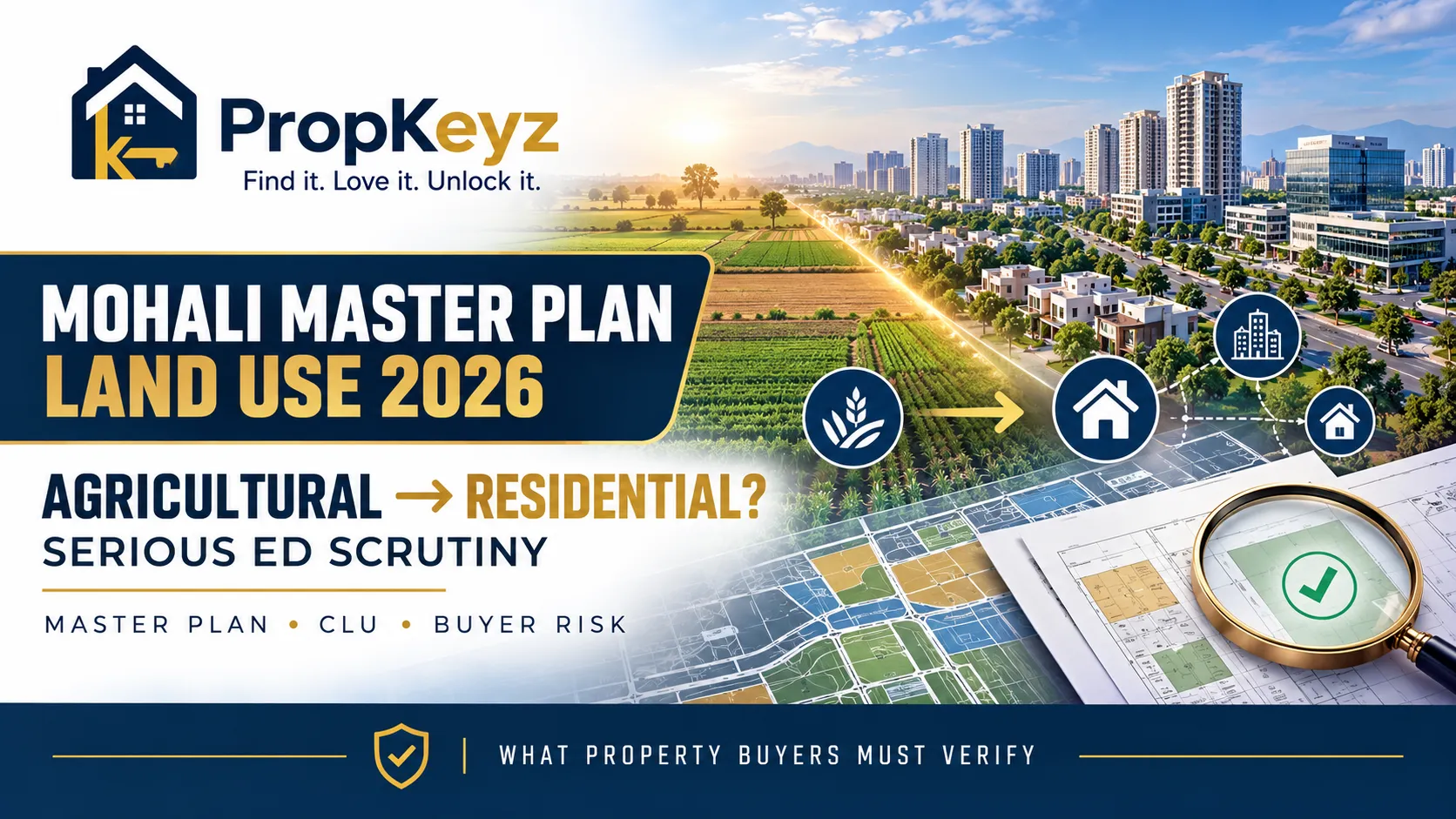
The Mohali Master Plan Land Use Change 2026 story has suddenly become much more important for property buyers after fresh Enforcement Directorate scrutiny reportedly expanded into decisions involving land-use changes, land acquisition and authority-level planning decisions in Mohali and New Chandigarh.
A fresh 23 September 2026 Tribune report, citing ED sources, says investigators are examining decisions relating to the conversion of land designated for agricultural use into:
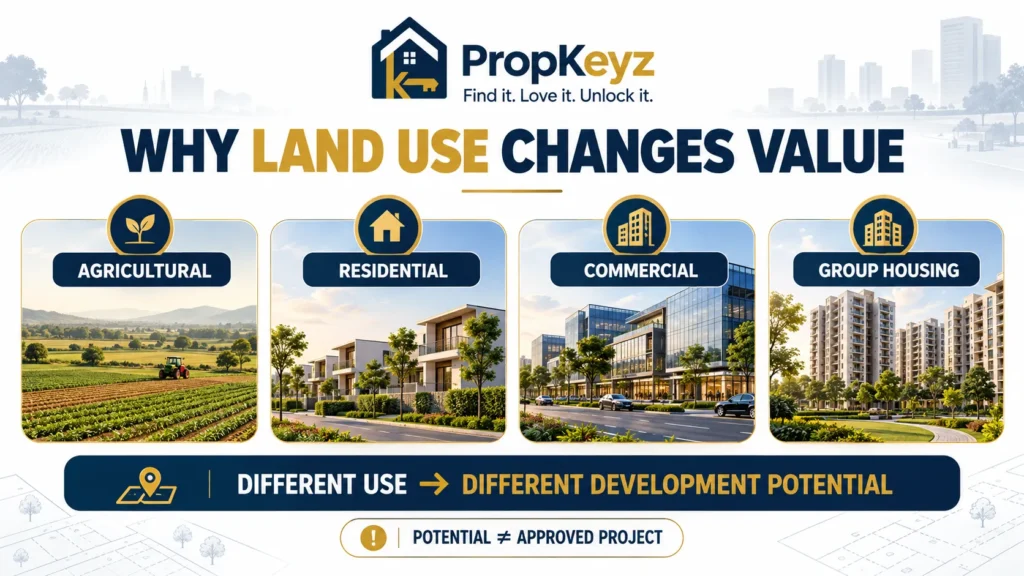
- residential use
- commercial / mixed use
- group housing
along with the acquisition of more than 5,000 acres across Mohali and New Chandigarh.
The same report says investigators are examining allegations that, in some instances, agricultural or waste land may have been aggregated before subsequent planning changes increased its permitted development potential.
Those are:
investigative allegations.
They are not final findings that every Master Plan amendment, land acquisition or development-authority decision was improper.
For property buyers, however, the story exposes something far more important than the raid itself:
A change in a Master Plan can materially change what land may eventually be capable of becoming—but it does not instantly turn agricultural land into a legally saleable residential or commercial project.
That distinction matters across:
- Mohali
- Kharar
- Gharuan
- New Chandigarh
- Banur
- Aerotropolis
- emerging GMADA sectors.
The biggest mistake a buyer can make is hearing:
“Master Plan me residential aa gaya.”
and translating that into:
“Residential plot approved hai.”
Those are not the same thing.
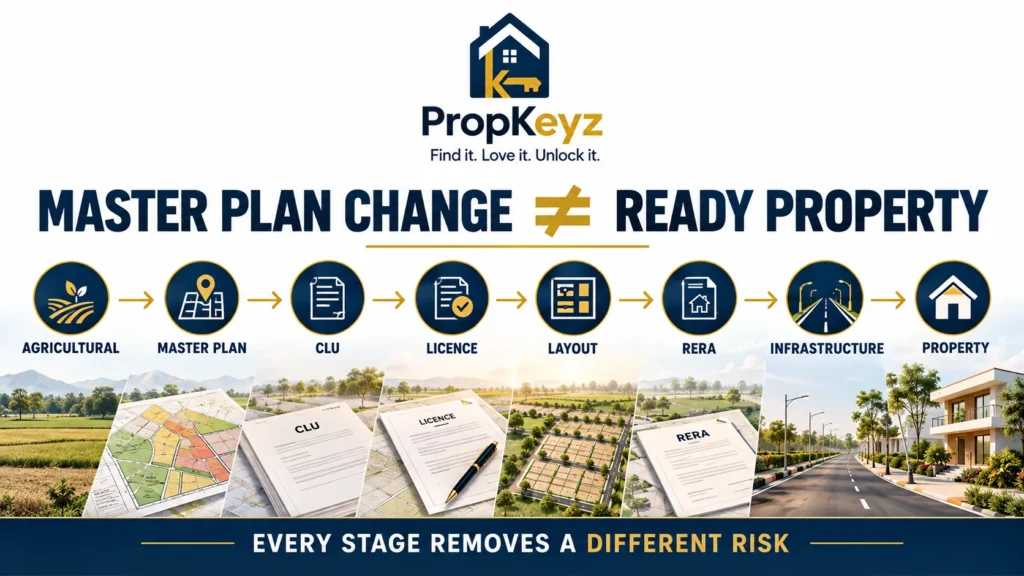
A more accurate development chain is:
Original Land → Master Plan / Zoning → CLU where applicable → Licence → Layout / Building Approval → RERA where applicable → Infrastructure → Sale / Construction → Possession
Every stage removes a different type of risk.
This PropKeyz guide explains the chain from agricultural land to urban property, what the current ED scrutiny actually means, why planning-map changes can create significant economic value, and what buyers should verify before paying a residential or commercial premium for land that is still several approvals away from usable property.
Last fact-checked: 23 September 2026
Key Takeaways
- ED investigators are reportedly examining development-authority decisions relating to land-use changes and more than 5,000 acres of acquisition in Mohali and New Chandigarh.
- Current reporting refers to scrutiny of changes involving agricultural land and later residential, commercial/mixed-use or group-housing potential.
- These are investigation claims—not findings of guilt or illegality.
- Punjab planning law gives the Master Plan legal significance for the use and development of land.
- A Master Plan can be amended through the statutory planning framework.
- GMADA’s own website lists a 11 March 2026 Notification No. 844 concerning villages being changed from Rural and Agriculture Zone to Residential Zone in the SAS Nagar Master Plan.
- Master Plan residential zoning does not automatically mean a ready residential colony.
- Master Plan ≠ CLU.
- CLU ≠ Colony Licence.
- Colony Licence ≠ RERA.
- RERA ≠ clear title to every individual property.
- Draft planning proposal ≠ final notified planning change.
- Exact khasra-level verification is more useful than relying only on a coloured Master Plan map.
- A valid planning change can increase the potential economic use of land.
- Higher development potential can increase developer interest.
- But appreciation still depends on approvals, access, infrastructure, demand and the price paid.
- Agricultural land located near a future residential zone is not necessarily inside that zone.
- Buyers should verify the latest official notification—not a broker’s screenshot.
PropKeyz View
A Master Plan can change the future use of land. It does not remove the approvals required to turn that land into an actual property project.
Mohali Master Plan Land Use Change 2026: Quick Answer
The Mohali Master Plan Land Use Change 2026 issue is about the legal planning framework that determines what categories of development may be permitted in different parts of Mohali.
Under Punjab’s planning law, once a Master Plan is in operation, development and land use are expected to conform to that plan, while development or change of use still requires the separate permissions and charge framework prescribed under law.
So if land changes from:
Rural & Agriculture
to:
Residential
its potential future use can materially change.
But the land does not automatically become:
- approved plotted colony
- licensed group housing
- RERA project
- ready residential plot.
The Correct Rule
Master Plan zoning creates planning potential. Project approvals create development rights. Infrastructure and demand create the functioning property market.
Latest Status — 23 September 2026
| Issue | Current Position |
|---|---|
| ED examining GMADA/Housing records | Reported |
| Authority decisions after June 2025 reportedly scanned | Yes |
| Land-use changes among reported issues | Yes |
| Agricultural → residential/commercial/mixed-use decisions under lens | Reported |
| Group-housing use reportedly included | Yes |
| 5,000+ acres Mohali/New Chandigarh acquisition under lens | Reported |
| Alleged prior land aggregation being investigated | Reported |
| Wrongdoing proved | No |
| Official SAS Nagar Master Plan changes exist | Yes |
| 11 Mar 2026 Rural/Agriculture → Residential notification | Official GMADA record |
| Master Plan residential = ready plot | No |
| Master Plan residential = automatic CLU | No |
| Master Plan change guarantees appreciation | No |
What Is a Master Plan?
A Master Plan is a statutory long-term planning framework showing how a planning area is intended to develop.
It can identify land for uses such as:
- residential
- commercial
- industrial
- institutional
- recreational
- transport
- rural/agricultural uses.
GMADA currently publishes approved Master Plans for areas including:
- Kharar
- Banur
- New Chandigarh
- Zirakpur
- other planning areas in the Greater Mohali region.
Why Buyers Should Care
Because the plan helps answer:
What is this land supposed to become?
But it does not by itself answer:
Can I start building apartments here tomorrow?
What Does Punjab Planning Law Say?
The Punjab Regional and Town Planning and Development Act, 1995 gives the Master Plan statutory importance.
Once a Master Plan is operational, Section 79 broadly requires development and land use to conform to the plan.
Section 80 separately deals with written permission for development or change of land use and applicable development/betterment charges.
That Gives Us Two Separate Questions
Question 1:
What use does the Master Plan permit?
Question 2:
What approvals are still required to actually develop the land?
That distinction is the foundation of proper property due diligence.
Can a Master Plan Be Changed?
Yes.
Punjab’s planning law provides a statutory framework for amendments and certain minor changes to Master Plans.
The important buyer lesson is:
A Master Plan is legally meaningful—but not necessarily permanently frozen.
Planning requirements can evolve as:
- cities expand
- roads are planned
- population grows
- economic activity changes
- new urban sectors are created.
But
A broker saying:
“Master Plan change hone wala hai.”
has almost no value unless supported by the actual planning process.
Official 2026 Example: Rural & Agriculture → Residential
This is not only theoretical.
GMADA’s official notification portal lists:
Notification No. 844 dated 11 March 2026
described as a notification regarding villages being changed:
from Rural and Agriculture Zone
to:
Residential Zone
in the SAS Nagar Master Plan.
Why This Example Matters
It proves that planning classification can officially change.
What It Does Not Prove
It does not mean:
every agricultural parcel in SAS Nagar is now residential.
You need to know:
- exact notification
- exact land
- exact khasra
- exact plan boundary.
Agricultural Zone vs Residential Zone
The economic possibilities of these zones can differ materially.
Agricultural / Rural Zone
The planning framework is generally oriented around:
- agriculture
- rural activity
- permissible rural uses
- limited categories allowed by plan/policy.
Residential Zone
Planning intent allows residential urban development subject to applicable:
- permission
- CLU
- licence
- layout
- infrastructure
- other regulations.
Important
Residential zoning means residential planning potential—not an automatically approved residential project.
What Is a Commercial Zone?
Commercial land can support uses such as:
- retail
- office
- business
- hospitality
depending on the specific plan and sanctioned project.
Its economic development potential can be materially different from agriculture.
That is one reason planning decisions can have a large impact on land value.
What Is Mixed Land Use?
Mixed land use can allow more than one compatible urban-use category within a development framework, subject to the actual planning document.
Potential combinations can include:
- residential
- retail
- office
- commercial.
Why Developers Like Mixed Use
It can broaden the revenue model of a land parcel.
But buyers should never infer the exact development mix from the words:
“mixed use.”
Check the sanctioned project.
What Is Group Housing?
Group housing generally refers to organised multi-unit residential development on a larger parcel rather than individual plotted housing.
The difference matters because group-housing potential can support:
- greater construction intensity
- multiple dwelling units
- shared amenities
subject to the applicable:
- zoning
- FAR
- density
- licence
- building rules.
Therefore
If land changes from:
agriculture
to:
group-housing-compatible planning
its development economics can change dramatically.
That does not mean the towers already exist legally.
Why Is the ED Looking at Land-Use Decisions?
According to The Tribune’s 23 September report, ED investigators are reportedly examining decisions in development-authority meetings involving:
- agricultural-to-residential changes
- commercial/mixed-use changes
- group-housing-related use changes
- large land acquisitions.
The report also cites allegations involving advance aggregation of some land before later planning changes.
Why Would Timing Matter?
Because land may be worth different amounts under different planning expectations.
For example:
Agricultural Planning Status
↓
Lower Urban Development Potential
Then:
Official Urban Land-Use Change
↓
More Development Possibilities
↓
Potential Developer Interest ↑
Important
That economic logic explains why investigators might care about timing.
It does not prove that any particular land purchase or planning change was improper.
Investigation vs Planning Law
Keep these two things separate.
Investigation Question
Were specific transactions or decisions lawfully handled?
Property-Planning Question
What is the current legally notified land-use status?
For buyers, the second question remains essential regardless of headlines.
Master Plan vs CLU — The Most Important Difference
These two concepts are constantly mixed up in property marketing.
Master Plan
Says broadly:
what categories of land use are planned/permitted across an area.
CLU
Change of Land Use permission deals with the specific proposed development/use of a parcel or project under the applicable process.
GMADA separately provides a formal CLU service and application process.
For the detailed guide:
PropKeyz Rule
Master Plan colour ≠ CLU certificate.
CLU vs Colony Licence
Even CLU is not the end.
A promoter setting up a regulated colony may need the applicable:
colony licence
under the relevant Punjab property-development framework.
So:
Master Plan
↓
CLU
↓
Licence
are separate checkpoints.
Colony Licence vs RERA
A development can also fall under the Real Estate (Regulation and Development) framework.
RERA concerns:
- project registration
- promoter disclosures
- timelines
- sale/marketing compliance
for applicable projects.
Therefore
Licence ≠ RERA
and:
RERA ≠ proof that every earlier land document is perfect.
The Full Property Approval Chain
A buyer should mentally use:
Stage 1
Original ownership / title
Stage 2
Current Master Plan land use
Stage 3
Landowner consent / development rights where relevant
Stage 4
CLU where required
Stage 5
Project / colony licence
Stage 6
Approved layout / building plans
Stage 7
RERA registration where applicable
Stage 8
Infrastructure
Stage 9
Construction
Stage 10
Completion / possession.
Why This Matters
A seller can honestly show you one valid approval while several later stages remain pending.
Draft Proposal vs Final Notification
This distinction is extremely important for future-growth investing.
Draft
Government/planning authority is considering a change.
Public Process
Objections/suggestions may arise depending on the statutory route.
Final Notification / Approved Plan
Change receives formal legal status.
Buyer Mistake
Paying full residential price because:
“draft me yellow colour ho gaya.”
PropKeyz Rule
Draft planning ≠ final planning.
Why Khasra Numbers Matter
Master Plan maps cover huge areas.
Your investment is one specific parcel.
That parcel exists in revenue records through:
khasra identification.
Punjab’s official land-record system itself operates at:
- district
- tehsil
- village
- parcel/revenue-record
level.
Buyer Question
Not:
“Village residential zone me hai?”
Ask:
“Mera exact khasra latest notified plan me kis use me aata hai?”
That’s far more precise.
Revenue Master Plan vs Simplified Marketing Map
GMADA publishes Revenue Master Plan material for several planning areas including:
- Kharar
- New Chandigarh.
These can help connect planning boundaries with land records more meaningfully than a broker’s simplified coloured image.
Buyer Warning
Never rely only on:
- WhatsApp map
- Google Maps pin
- brochure master-plan screenshot.
How Does a Land-Use Change Create Economic Value?
This is the property science.
Suppose a parcel can only support limited rural/agricultural use.
Its income/development options are constrained.
Now suppose lawful planning expands the permitted future use.
Potential chain:
Permitted Economic Uses ↑
→ Developer Interest Can ↑
→ Future Building Potential ↑
→ Land Demand Can ↑
→ Land Value Can Respond
But
That chain requires:
- legal change
- subsequent approvals
- access
- infrastructure
- genuine demand.
Why Planning Status Can Create a “Risk Premium”
Two nearby parcels may look identical physically.
Parcel A
Final residential planning.
Parcel B
Agricultural with only a rumoured future change.
A developer may pay more for A because:
planning uncertainty is lower.
That difference is a:
regulatory / planning-risk discount.
If B Later Gets a Valid Change
Part of that discount may narrow.
But What If the Price Already Includes the Future?
This is where many retail buyers lose money.
Imagine:
Current legal status = agricultural
Seller’s story:
“Residential hone wala hai.”
Seller already charges:
almost residential price.
Then buyer takes:
- planning risk
- timing risk
- approval risk
without receiving:
enough price discount.
PropKeyz Rule
Future development can be real and still be a bad investment if today’s price already includes tomorrow’s success.
What Does Gharuan Teach Us?
Gharuan is a useful PropKeyz case study because current planning discussions involve a significant proposed expansion/change in its wider planning framework.
The essential rule remains:
proposed planning change ≠ developed city.
For the detailed case:
Why Gharuan Matters
It shows how:
- planning
- industrial possibilities
- residential expansion
- roads
can create a future property narrative.
But the sequence still matters.
What Does New Chandigarh Teach Us?
New Chandigarh is one of Greater Mohali’s largest planned expansion areas.
GMADA publishes a dedicated New Chandigarh 2008–2031 Master Plan and Revenue Master Plan.
It is also seeing ongoing acquisition for projects such as the proposed Commercial City Centre.
GMADA’s 40th Authority Meeting approved acquisition in:
- Sangala
- Bansepur
- Tira
- Chahar-Majra
for the Commercial City Centre, with the applicable land-pooling policy to apply.
Read:
New Chandigarh Commercial City Centre 2026
Property Lesson
Master Plan → Acquisition → Infrastructure → Projects
is a multi-year urban-development cycle.
How Does the GMADA Land Aggregator Story Connect?
Fresh ED reporting has also brought land aggregation into focus.
Land can sometimes be assembled before later development/planning approvals.
But:
Land aggregation ≠ land-use approval.
Read the detailed explainer:
GMADA Land Aggregator Probe 2026
The Connection
Land Aggregation
↓
Planning / Master Plan
↓
CLU / Licence
↓
Development.
Every stage must be understood separately.
How Does the Broader GMADA ED Probe Connect?
For the wider September search involving:
- land acquisition
- CLU
- private-developer dealings
- selected auction/dues questions
read:
Important
This page focuses only on:
Master Plan / land-use economics and buyer verification.
What About the 5,000+ Acres Under Scrutiny?
The Tribune reports that the current ED examination includes authority decisions concerning the acquisition of over:
5,000 acres
in Mohali and New Chandigarh.
PropKeyz already tracks the broader financing/acquisition context separately.
Read:
GMADA ₹15,000 Crore Borrowing Plan 2026
Do Not Confuse
Large acquisition:
can signal future city expansion.
But:
land acquisition ≠ immediate development.
Aerotropolis Is Another Useful Example
Aerotropolis shows how agricultural land can move through:
- notification
- acquisition
- land pooling
- entitlements
- future infrastructure.
Read:
Mohali Aerotropolis Land Acquisition 2026
and:
Aerotropolis Extension Plots Mohali 2026
PropKeyz Rule
Planning creates the map. Acquisition creates land control. Infrastructure creates usability. Habitation creates the market.
Sector 87 Shows the Same Sequence
Official GMADA notices show active acquisition proceedings for planned commercial infrastructure in Sector 87.
Read:
Sector 87 Mohali Commercial Hub 2026
Lesson
A future commercial zone goes through:
acquisition → planning → infrastructure → development
before it becomes a functioning commercial market.
What About Sector 101 & 103?
GMADA’s public records also list current land-acquisition processes for planned industrial parks in Sectors 101 and 103.
Again:
industrial zoning / acquisition ≠ operating jobs today.
Jobs arrive later if:
- infrastructure completes
- industry enters
- businesses operate.
Can Master Plan Change Increase Property Rates?
It can support rates under the right conditions.
Stronger Scenario
Final notified land-use change
- clear title
- good road access
- CLU/licence path
- infrastructure
- buyer/developer demand
→ stronger potential demand.
Weak Scenario
Planning change
but:
- no access
- ownership dispute
- acquisition issue
- infrastructure missing
- oversized future supply
→ limited market effect.
Therefore
Land use is one value driver—not the only driver.
Which Land Can Benefit the Most?
Potentially land where:
1. Final Planning Change Is Confirmed
Not rumoured.
2. Exact Parcel Falls Inside It
Not merely nearby.
3. Access Is Good
Road frontage / legal access matters.
4. Development Path Is Realistic
CLU/licensing is feasible.
5. Infrastructure Is Moving
Roads, water, sewerage, power.
6. Entry Price Is Reasonable
Future premium not already fully charged.
Who May Benefit Less?
Land can still underperform if:
- land is landlocked
- title disputed
- high-tension / environmental / drainage constraints
- acquisition uncertainty
- road not accessible
- massive competing supply
- seller asks inflated future price.
PropKeyz Rule
Same Master Plan colour does not mean same property value.

What Should an Agricultural-Land Owner Check?
If someone says:
“Aapki land residential ho gayi.”
ask for:
- notification number
- notification date
- latest Master Plan
- revenue map
- exact khasra match.
Then verify:
- acquisition?
- access?
- CLU implications?
- current legal use?
Do not negotiate purely from a future-use rumour.
What Should a Buyer Verify Before Paying?
Planning
- Which Master Plan?
- What version/date?
- Final or draft?
- Exact zoning?
Land
- village
- khasra
- ownership
- mutation
- encumbrance.
Development
- CLU?
- licence?
- approved layout?
- RERA?
Infrastructure
- existing road
- proposed road
- water
- sewerage
- electricity.
Acquisition
- any government notification?
- objections?
- award?
- pooling?
Price
Ask:
Am I paying for today’s legal status or tomorrow’s marketing story?
NRI Buyer Warning
NRIs are particularly vulnerable to:
“Master Plan approved future township land.”
Before buying remotely, demand:
- exact khasra
- revenue plan
- latest official Master Plan
- notification
- title documents
- applicable CLU/licence
- road-access evidence.
Do not accept only:
- Google pin
- drone video
- coloured brochure map.
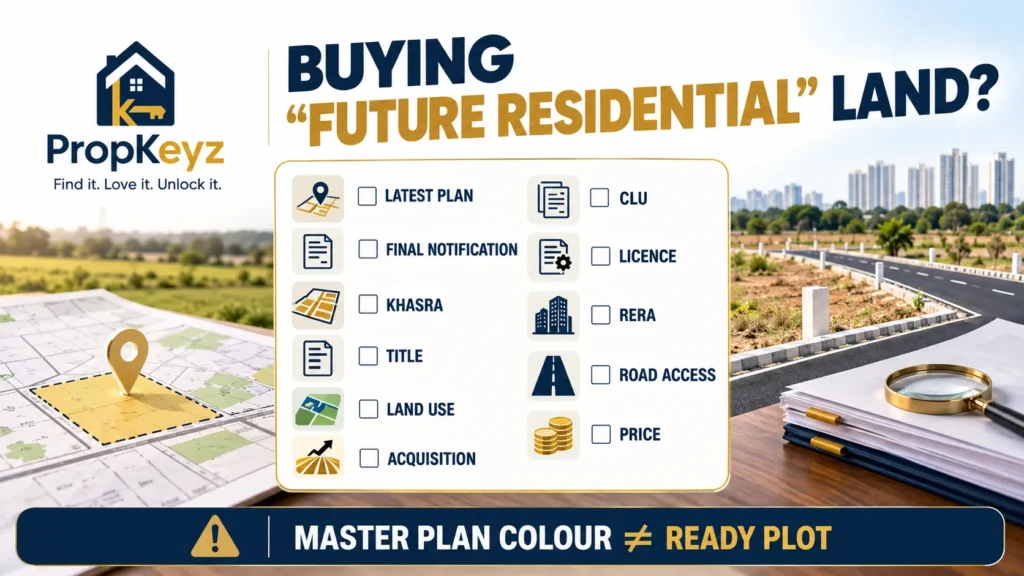
Confirmed vs Reported vs Assumed
| Claim | Current Position |
|---|---|
| ED examining GMADA/Housing authority decisions | Reported |
| Post-June-2025 decisions reportedly being scanned | Reported |
| Master Plan land-use changes under scrutiny | Reported |
| 5,000+ acres acquisition under scrutiny | Reported |
| Advance land aggregation alleged in certain cases | Investigation allegation |
| Illegal planning change proved | No |
| Master Plans have legal force | Yes |
| Development should conform to operative Master Plan | Statutory rule |
| Development/change of use can require separate permission | Yes |
| Master Plans can be amended | Yes |
| SAS Nagar saw official Rural/Agriculture → Residential notification in March 2026 | Confirmed |
| Residential zoning equals CLU | No |
| CLU equals colony licence | No |
| Licence equals RERA | No |
| Residential zone means ready plot | No |
| Land-use change can affect development potential | Yes |
| Land-use change guarantees price rise | No |
Mohali Master Plan Land Use Change 2026: PropKeyz Analysis
The Mohali Master Plan Land Use Change 2026 story explains one of the most important forces behind property value in a rapidly expanding city:
what the law allows land to become.
1. Planning Can Create Economic Optionality
Agricultural land and group-housing-capable land can have very different development potential.
2. That Is Why Planning Decisions Matter Financially
A change in legally permitted use can alter how developers value the parcel.
3. But Planning Is Not Development
The buyer still needs:
- title
- CLU
- licence
- layout
- RERA
- infrastructure.
4. Current ED Scrutiny Makes Timing Important
Investigators are reportedly examining whether certain land aggregation and planning decisions involved irregularities.
This remains an investigation—not a conclusion.
5. Official Land-Use Changes Are Normal Planning Tools
The existence of the March 2026 SAS Nagar Rural/Agriculture-to-Residential notification demonstrates that planning classifications can formally change.
6. Buyers Need the Exact Parcel
Village-level marketing is too broad.
Khasra-level verification is stronger.
7. Draft vs Final Can Create Huge Investment Risk
People frequently price land on:
expectation.
But statutory status may lag behind.
8. Access Can Matter as Much as Zoning
Residentially zoned but inaccessible land can be less valuable than better-connected land.
9. Supply Matters
If thousands of acres enter urban planning simultaneously:
future supply can rise.
More development does not automatically mean faster appreciation.
10. Entry Price Is the Final Investment Variable
A great future location can still be a poor purchase at an inflated price.
Biggest Positive
A final, legally valid land-use change can materially improve the development potential of correctly located land.
Biggest Risk
Retail buyers paying developed-property rates based only on a future Master Plan story.
PropKeyz View
Master Plan zoning can tell you what land may become. Your returns depend on whether it actually reaches CLU, licensing, infrastructure, demand and a sensible entry price.
Mohali Master Plan Land Use Change 2026: Final Verdict
The Mohali Master Plan Land Use Change 2026 issue is important for two very different reasons.
First, current ED scrutiny has brought new attention to the economic value created by planning and land-use decisions.
Second, it gives buyers a chance to understand how property development actually works.
Agricultural land does not become a residential project simply because:
a broker says a Master Plan changed.
The real sequence is:
Planning → Parcel Verification → CLU → Licence → Layout → RERA → Infrastructure → Development
If the Master Plan Changes
That can be important.
It can expand:
future development possibilities.
But
It does not eliminate:
- title risk
- acquisition risk
- approval risk
- infrastructure risk
- market risk.
For Investors
Pay for the:
current verified stage
not only:
future story.
For Agricultural-Land Owners
Verify whether your:
exact khasra
is affected before accepting either:
- panic discount
- speculative premium.
Final PropKeyz Rule
Master Plan decides the planning direction. Approvals decide whether development can proceed. Infrastructure and real demand decide whether the property market actually matures.
Frequently Asked Questions
What is Mohali Master Plan Land Use Change 2026?
It refers to current and recent changes or proposed changes in the planning classification of land within Mohali’s statutory planning framework, including changes between agricultural/rural and urban-use categories.
Why is ED examining Mohali Master Plan decisions?
The Tribune reports that ED investigators are examining authority-level decisions involving land-use changes and large acquisitions as part of the ongoing GMADA investigation. These remain investigative allegations.
Did ED prove the Master Plan changes were illegal?
No.
The current reporting describes an ongoing investigation.
Can agricultural land become residential in a Master Plan?
Yes. GMADA’s official portal lists a March 11, 2026 notification changing villages from Rural and Agriculture Zone to Residential Zone in the SAS Nagar Master Plan.
Does residential Master Plan zoning mean I can build a house immediately?
No. Other permissions, approvals and building rules can still apply.
Is Master Plan approval the same as CLU?
No.
What is CLU?
CLU means Change of Land Use and relates to permission for the intended use/development of specific land under the applicable framework.
Is CLU the same as a colony licence?
No.
Is a colony licence the same as RERA?
No.
Does RERA prove land title?
RERA registration should not be used as a replacement for independent title verification.
Can Master Plan changes increase land prices?
They can increase development potential and buyer/developer interest, but actual prices depend on title, approvals, road access, infrastructure, demand, supply and entry price.
How do I check my land’s Master Plan status?
Start with:
- exact village
- khasra
- latest official GMADA/authority Master Plan
- Revenue Master Plan where available
- final planning notifications.
Is a broker’s Master Plan map enough?
No.
Use current official planning records.
Does a draft Master Plan change count as final?
No.
Draft and final/notified status should be distinguished.
What is the biggest risk in buying “future residential” agricultural land?
Paying a residential-style price before the planning and development approvals become legally and physically real.
Continue Your PropKeyz Research
GMADA ED Raid 2026
Understand the broader investigation around GMADA records, CLU, land deals and auctions:
GMADA Land Aggregator Probe 2026
Understand how fragmented agricultural land enters acquisition/development processes:
GMADA Land Aggregator Probe 2026
CLU in Mohali 2026
Understand what happens after planning and how Change of Land Use works:
Gharuan Master Plan 2026
Understand a current Greater Mohali planning-expansion case study:
New Chandigarh Commercial City Centre 2026
Understand how planning moves into acquisition for a major future commercial district:
New Chandigarh Commercial City Centre 2026
Mohali Aerotropolis Land Acquisition 2026
Understand how acquisition and land pooling affect future urban supply:
Mohali Aerotropolis Land Acquisition 2026
GMADA ₹15,000 Crore Borrowing Plan 2026
Understand the wider large-scale acquisition/financing context:
GMADA ₹15,000 Crore Borrowing Plan 2026
Property in Mohali
For location-level residential/property research:
Buying Agricultural / Future Residential Land Around Mohali?
If you are being offered land with claims like:
- “Master Plan me residential hai”
- “commercial hone wali hai”
- “GMADA acquire karne wali hai”
- “future group housing”
- “CLU coming soon”
- “next sector yahin banega”
send PropKeyz:
Village:
Khasra Number:
Land Area:
Current Land Use:
Seller’s Claimed Future Use:
Master Plan Shared?:
Notification Number?:
CLU?:
Acquisition Notice?:
Road Access:
Quoted Rate:
Total Price:
Self-Use / Investment:
PropKeyz can help you organise the research around:
- current Master Plan
- exact khasra
- land use
- acquisition
- CLU
- approval stage
- road access
- future infrastructure
- comparable property
- buyer risks.
Call / WhatsApp
+91 80534 69929
Suggested WhatsApp Message
Hi PropKeyz, I read your Mohali Master Plan Land Use Change 2026 guide. I am evaluating land in Village ________, Khasra . The seller says it is / will become residential/commercial under the Master Plan. The quoted rate is ₹. Please help me understand what planning and property documents I should verify before proceeding.
Find it. Love it. Unlock it.
Your Property. Our Responsibility.
EXTERNAL SOURCES & VERIFICATION
Last fact-checked: 23 September 2026
Current ED / Master Plan Scrutiny
Used for:
- authority-level decisions under examination
- land-use conversion scrutiny
- 5,000+ acre acquisition context
- reported land-aggregation allegations.
The Tribune — GMADA authority decisions and land-use changes under ED scrutiny
Punjab Regional & Town Planning Law
Used for:
- Master Plan conformity
- permission for development/change of use
- planning-law framework.
Punjab Regional and Town Planning and Development Act, 1995
Official SAS Nagar Land-Use Change Notification
Used to verify the existence of Notification No. 844 dated 11 March 2026 concerning the shift from Rural and Agriculture Zone to Residential Zone.
GMADA — Rural & Agriculture to Residential Zone Notification
GMADA Approved Master Plans
Used for:
- Kharar
- New Chandigarh
- Banur
- wider approved planning framework.
New Chandigarh Commercial City Centre
GMADA’s 40th Authority Meeting approved acquisition of land in Sangala, Bansepur, Tira and Chahar-Majra, with the applicable Land Pooling Policy.
GMADA — Minutes of 40th Authority Meeting
Punjab Land Records
Useful official resource for:
- village
- revenue record
- registered deeds
- cadastral maps.
DISCLAIMER
This article is intended for:
- property education
- planning research
- buyer due diligence
- market intelligence.
It is not:
- legal advice
- planning approval
- CLU certification
- title certification
- investment advice
- valuation advice.
The ED investigation discussed above is ongoing.
Allegations concerning:
- land aggregation
- planning changes
- acquisitions
- proceeds of crime
are attributed to current published reporting and are not presented as final findings of guilt.
Master Plans, notifications and property approvals can change.
Before buying, independently verify the latest:
- official Master Plan
- notification
- revenue map
- title
- CLU
- licence
- RERA
- acquisition status.
PropKeyz does not guarantee:
- land-use change
- CLU approval
- project approval
- infrastructure
- appreciation
- resale.
About PropKeyz
PropKeyz Editorial Team
PropKeyz tracks:
- Mohali
- Kharar
- Gharuan
- New Chandigarh
- Banur
- Aerotropolis
- GMADA
- Master Plans
- CLU
- land acquisition
- infrastructure
- buyer documentation.
Our research follows these rules:
Draft Plan ≠ Final Notification
Master Plan ≠ CLU
CLU ≠ Colony Licence
Licence ≠ RERA
Master Plan ≠ Developed Infrastructure
Future Story ≠ Today’s Property Value
Find it. Love it. Unlock it.
Your Property. Our Responsibility.