
Last Updated: 26 September 2026
Fact-Checked: 26 September 2026
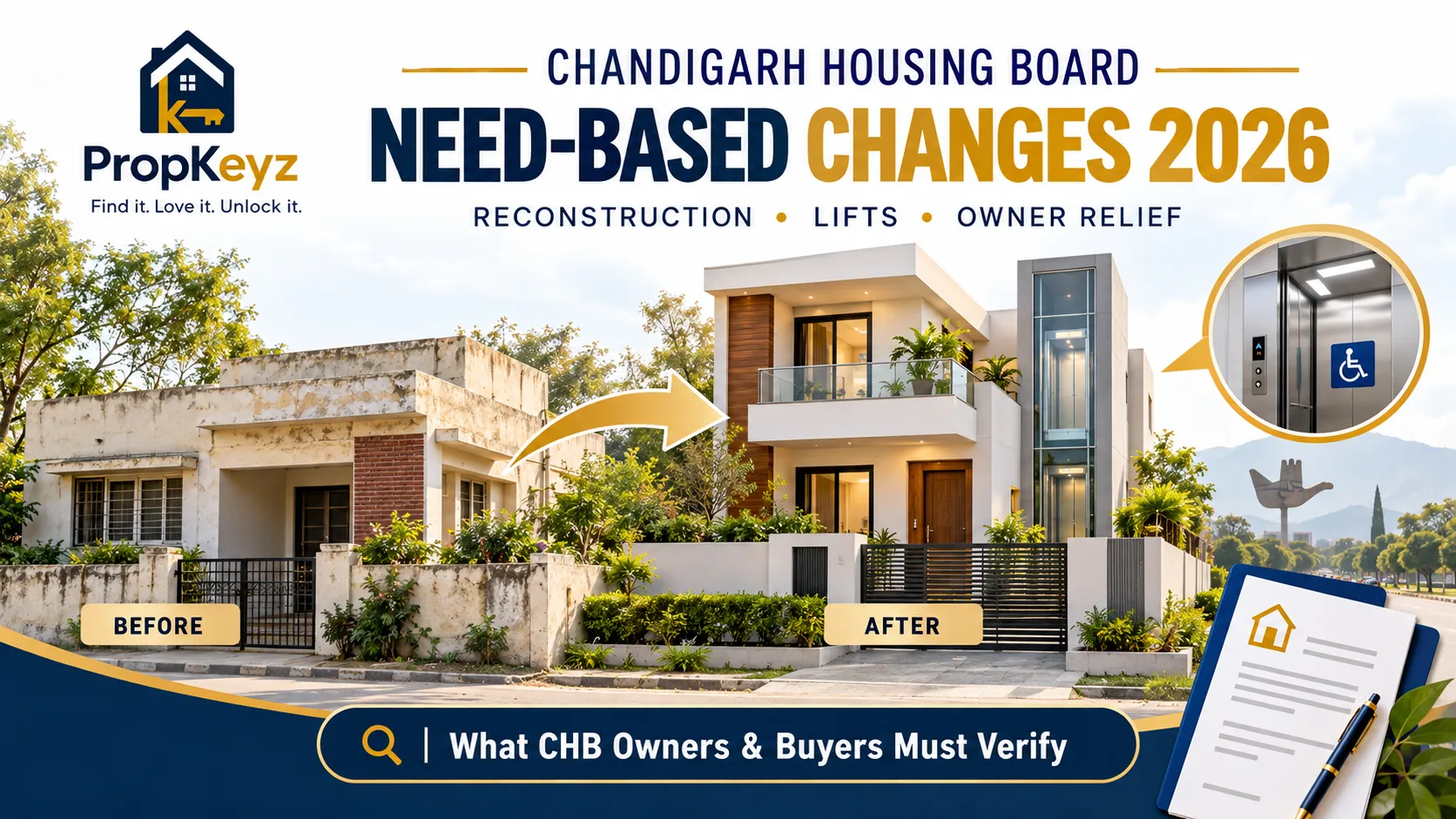
The Chandigarh Housing Board Need-Based Changes 2026 development could become one of the most important owner-focused property-rule changes for Chandigarh Housing Board residents in recent years.
On 16 September 2026, the Chandigarh Housing Board Board of Directors approved a broader framework dealing with:
- need-based changes in independent CHB houses,
- demolition and reconstruction,
- treatment of independent houses broadly at par with Marla houses under the Chandigarh Building Rules, 2017,
- installation of lifts in CHB dwelling units,
- applications through registered architects,
- self-certification,
- completion procedures,
- rooftop solar installations.
Current reporting says the decision could provide major relief to approximately 2,500 independent CHB houses, while lift provisions could affect a much wider pool of CHB dwelling units. Read the latest Hindustan Times report on CHB reconstruction and lifts
But there is one critical distinction every CHB owner and buyer should understand:
CHB Board Approval ≠ Final UT Administrator Approval
The recommendations approved by the CHB Board were still to be submitted to the UT Administrator for approval.
Therefore, the September decision should not be interpreted as:
“Every CHB owner can immediately demolish and reconstruct without further permission.”
Instead, it represents:
a major Board-level step toward a broader and clearer framework for alterations, reconstruction, lifts and owner compliance.
The issue matters because alteration disputes have affected thousands of Chandigarh Housing Board properties.
The Tribune reported more than:
25,000 pending notices
relating to need-based changes or building violations. Read The Tribune report on the 25,000+ pending CHB notices
Separately, reporting indicated that more than:
15,000 demolition notices
had earlier been stayed while a committee examined the wider issue. Read the demolition-notice background
Those two numbers should not be treated as the same dataset.
There is another important part of the story.
CHB had already issued an official order on:
10 March 2026
implementing specified parts of its earlier 3 January 2023 Need-Based Changes Order.
The official Chandigarh Housing Board portal now maintains:
- the 2023 Need-Based Changes Order,
- March 2026 implementation material,
- structural-stability formats,
- registered professional lists,
- approval/regularisation procedures.
Open the official CHB Need-Based Changes portal
So the correct 2026 timeline is:
Existing CHB Need-Based Rules
↓
March 2026 Implementation
↓
September 2026 Broader CHB Board Approval
↓
UT Administrator Approval
↓
Property-Specific Permission / Compliance
For PropKeyz readers, five distinctions matter most:
Board Approval ≠ Final Implementation
Need-Based Change ≠ Unlimited Construction
Existing Alteration ≠ Automatically Regularised
Lift Permission ≠ Every Resident Must Agree
Reconstruction Permission ≠ Ignore Building Rules
This guide explains what the Chandigarh Housing Board has approved, how complete reconstruction could work, what the 25,000-notice figure actually means, lift rules, FAR, structural safety, rooftop solar, existing alterations and what buyers should verify before purchasing a modified CHB property.
For the wider planning context behind Chandigarh’s FAR, density and redevelopment debate, also read Chandigarh Master Plan 2031 Changes 2026. Read Chandigarh Master Plan 2031 Changes 2026 on PropKeyz
Key Takeaways
- The CHB Board of Directors approved a major need-based-change framework on 16 September 2026.
- The recommendations were still to be submitted to the UT Administrator for approval.
- Approximately 2,500 independent CHB houses were reported as potential direct beneficiaries.
- Independent dwelling units are proposed to receive development-control treatment broadly at par with Marla houses under Chandigarh Building Rules, 2017.
- Eligible owners could get a route for:
- alteration,
- demolition,
- complete reconstruction,
subject to required approvals.
- More than 25,000 pending alteration-related notices were reported.
- More than 15,000 demolition notices were separately reported as having been stayed earlier.
- These two notice figures should not be combined.
- CHB had already implemented specified parts of its January 2023 Need-Based Changes Order through an official 10 March 2026 order.
- Structural safety remains essential.
- Lift installation was approved at Board level under a prescribed procedure.
- Every resident in a block does not need to consent to a lift proposal.
- Residents willing to contribute toward installation and maintenance should be allowed to participate and use the lift.
- The proposed lift process uses registered architects and self-certification.
- The September framework provides for a 30-day processing target.
- Offline applications can be used until relevant OBPAS functionality is available.
- Lift/lift-well area is proposed not to count toward FAR or ground coverage in applicable lift cases.
- The same treatment should not automatically be applied to independent dwelling units.
- Rooftop solar under PM Surya Ghar was also addressed.
- Buyers should never assume that every existing alteration has become legal automatically.
PropKeyz View
The biggest mistake would be to interpret “relief” as “anything already constructed is now legal.” The real opportunity is a clearer approval and compliance framework subject to building rules, structural safety, property category and final implementation.
Chandigarh Housing Board Need-Based Changes 2026: Quick Answer
The Chandigarh Housing Board Need-Based Changes 2026 update is a major Board-level decision intended to provide greater flexibility for eligible CHB owners, particularly independent dwelling-unit owners and residents who require lift access.
Current Status — 26 September 2026
| Issue | Current Position |
|---|---|
| CHB Board decision | Approved on 16 September 2026 |
| Final UT Administrator approval | Still an important next step |
| Independent-house alterations | Covered in Board framework |
| Demolition & reconstruction | Approved at Board level subject to clearances |
| Marla-house CBR treatment | Approved at Board level |
| Approx. independent houses affected | Around 2,500 reported |
| Pending alteration-related notices | More than 25,000 reported |
| Earlier stayed demolition notices | More than 15,000 reported separately |
| Lift installation | Board approved |
| Consent of every resident required? | No |
| Registered architect | Part of proposed application process |
| Lift processing target | 30 days |
| Offline applications | Until OBPAS functionality is available |
| Structural safety | Essential |
| March 2026 need-based framework | Already exists for specified changes |

Direct Answer
The CHB Board approved a major need-based-change, reconstruction and lift framework on 16 September 2026, but owners should distinguish Board approval from final implementation and from property-specific building permission.
The latest reconstruction/lift status can be cross-checked against the current September reporting. Verify the latest CHB Board decision
PropKeyz Rule
Board Approved ≠ Build Without Permission
What Happened on 16 September 2026?
The Chandigarh Housing Board Board of Directors considered recommendations dealing with two major owner issues.
Independent Dwelling Units
The first issue concerned how much flexibility owners of independent CHB houses should receive for:
- need-based alterations,
- demolition,
- reconstruction,
- modernisation.
Lift Installation
The second concerned how CHB residents could install lifts without every resident in the block being able to stop the proposal simply by refusing to participate.
The Board approved the recommendations, and current reporting says complete reconstruction would remain subject to required clearances. See the September 2026 reconstruction details
Why This Matters
A large part of Chandigarh’s Housing Board stock was designed decades ago.
Households today may require:
- different layouts,
- accessibility improvements,
- safer construction,
- larger usable family spaces,
- modern utilities.
PropKeyz View
Housing rules eventually have to address how families actually live, but flexibility should never come at the cost of structural safety or Chandigarh’s larger planning framework.
Is the New CHB Policy Finally Approved?
This is the most important question.
CHB Board Level
The framework received Board approval.
Final Implementation
Owners should still verify the final UT Administrator decision and subsequent official CHB implementation before undertaking major work.
Therefore, avoid interpreting a headline such as:
“CHB allows complete reconstruction”
to mean:
“No further approval is required.”
Correct Sequence
Board Policy Decision
↓
UT Administrator Approval
↓
Official Implementation / SOP
↓
Architectural & Structural Documentation
↓
Property-Specific Permission
↓
Construction
↓
Completion Documentation
PropKeyz Rule
Policy Permission ≠ Sanctioned Building Plan
Why the March 10, 2026 Order Matters
September was not the first need-based-change development of 2026.
CHB had already issued an official implementation order on:
10 March 2026
relating to specified clauses of its 3 January 2023 Need-Based Changes Order.
You can verify the implementation directly on the Chandigarh Housing Board website. Official CHB March 10, 2026 Need-Based Changes implementation page
The official CHB Need-Based Changes hub also provides:
- checklist,
- standard drawings,
- registered Structural Engineer information,
- registered architect information,
- January 2023 order,
- approval/regularisation SOP,
- structural-stability formats. Open all official CHB Need-Based Changes resources
Why This Is Important
CHB owners should distinguish:
Existing Permitted Changes
Already available under older CHB rules.
March 2026 Implementation
Specified parts of the 2023 framework brought into implementation.
September 2026 Framework
Broader Board-level policy for:
- independent-house reconstruction,
- lifts,
- further compliance relief.
PropKeyz Rule
Always Identify the Exact Order Your Alteration Relies On
What Are Need-Based Changes?
Need-based changes broadly refer to permitted additions or modifications made to address household requirements while remaining within authority-defined limits.
The official 3 January 2023 CHB Need-Based Changes Order covers several types of modifications and associated conditions. Read the official January 2023 CHB Need-Based Changes Order
The order addresses matters such as:
- balcony projections,
- window changes,
- additional construction,
- internal walls,
- grills and glazing,
- gates,
- temporary car sheds,
- roof access,
- internal changes,
- lift provisions.
For example, the order specifies that certain additional construction requires structural-stability certification and other conditions.
Important
Need-based change does not mean:
unlimited modification.
Owner Rule
Before making a change, determine:
Permitted?
Permitted with approval?
Permitted with structural certification?
Not permitted?
For the most current official documents, always begin with the CHB Need-Based Changes portal, not a broker WhatsApp forward. Official CHB Need-Based Changes portal
Who Could Benefit From the New Framework?
The largest direct beneficiary group appears to be owners of:
independent CHB dwelling units.
Approximately:
2,500 independent houses
were reported as potentially benefiting from the reconstruction flexibility.
Other CHB residents may benefit from:
- lift provisions,
- rooftop solar treatment,
- clearer alteration procedures.
Independent Owner Example
An older CHB house may have:
- outdated room sizes,
- ageing structural elements,
- inefficient layout,
- unsuitable staircase arrangement.
A clearer reconstruction route could be more practical than decades of piecemeal alteration.
What Does “At Par With Marla Houses” Mean?
One of the key September proposals is to treat eligible independent CHB dwelling units broadly:
at par with Marla houses under Chandigarh Building Rules, 2017
for relevant development-control purposes.
What It Does Not Mean
It does not mean:
CHB ownership conditions disappear.
It does not automatically eliminate:
- allotment conditions,
- title requirements,
- building controls,
- structural requirements.
The key significance is:
greater reconstruction and development-control flexibility.
PropKeyz Rule
Similar Building Controls ≠ Identical Property Legal Status
For the broader relationship between Chandigarh planning proposals, FAR and property-specific building entitlement, read Chandigarh Master Plan 2031 Changes 2026. Read the PropKeyz Chandigarh Master Plan guide
Can Independent CHB Houses Be Completely Demolished?
At the Board-policy level, the September proposal allows eligible independent-house owners to:
demolish and reconstruct
subject to required approvals and clearances.
This is potentially one of the most significant changes for older CHB houses.
But Owners Should Not
- start demolition based only on a newspaper headline,
- assume an old structure can be replaced with any design,
- assume FAR or setbacks no longer matter.
Before Demolition Verify
- final policy implementation;
- applicable property category;
- sanctioned building-plan process;
- architect requirements;
- structural requirements;
- applicable ground coverage;
- FAR;
- setbacks;
- height limits;
- completion procedure.
PropKeyz Rule
Demolition Permission Must Be Followed by a Legally Usable Reconstruction Plan
Can Owners Reconstruct the House From Scratch?
The broader intention of the September framework is to create a route for complete reconstruction of eligible independent dwelling units.
That could benefit:
- ageing structures,
- multigenerational families,
- owners wanting modern layouts,
- properties requiring major rebuilding.
Reconstruction Still Requires Compliance
A newly constructed house may remain subject to:
- ground coverage,
- FAR,
- building height,
- building line,
- setbacks,
- structural design,
- applicable parking requirements.
PropKeyz Rule
Reconstruction Freedom ≠ Unlimited Development Rights
If a seller or dealer is using future FAR or redevelopment potential to justify a large premium, compare that claim with our detailed Chandigarh Master Plan 2031 Changes 2026 research before pricing the property. Open the PropKeyz Master Plan analysis
Do Chandigarh Building Rules 2017 Still Apply?
Yes.
The Chandigarh Building Rules (Urban), 2017 remain central to understanding:
- erection,
- re-erection,
- alterations,
- demolition,
- building-plan approvals,
- architects,
- structural engineers,
- self-certification.
View the official Chandigarh Building Rules (Urban), 2017
Buyer Example
A seller says:
“CHB ne reconstruction allow kar di.”
The correct follow-up question is:
“Is exact house ka sanctioned plan aur applicable building-rule compliance kya hai?”
PropKeyz Rule
Authority Relief Should Be Read Together With Building Rules
FAR Freeze & Supreme Court 2023 Judgment
The Supreme Court’s 10 January 2023 judgment concerning Chandigarh remains important.
The Court directed that:
FAR should be frozen and not increased further.
The judgment also imposed important restrictions around Phase-I residential properties and apartmentalisation.
Read the official Supreme Court judgment
Important
Do not interpret:
“CHB houses can follow Marla-house controls”
as:
“FAR can now be freely increased.”
PropKeyz Rule
CHB Relief Must Operate Within Higher Planning and Judicial Restrictions
The interaction between heritage protection, Phase-I and proposed future development is also covered in Chandigarh Master Plan 2031 Changes 2026. Continue to the PropKeyz Master Plan guide
What Happens to Existing Additional Construction?
This is one of the most important owner questions.
Some existing CHB properties may already contain construction that differs from:
- the original CHB plan,
- current building controls.
Existing modifications should not be put into one bucket.
Construction Can Be:
Already Permitted
Built under an applicable CHB provision.
Potentially Retainable
Within an earlier need-based-change allowance.
Potentially Regularisable
Subject to approval, certification and other requirements.
Still Non-Permissible
Outside recognised limits.
The official 2023 CHB order itself demonstrates that different alterations have different conditions—for example, some additional construction requires structural certification, fees and compliance with prescribed drawings.
PropKeyz Rule
Existing Construction Must Be Classified Before It Can Be Called Legal or Illegal
What Does the 25,000-Notice Figure Mean?
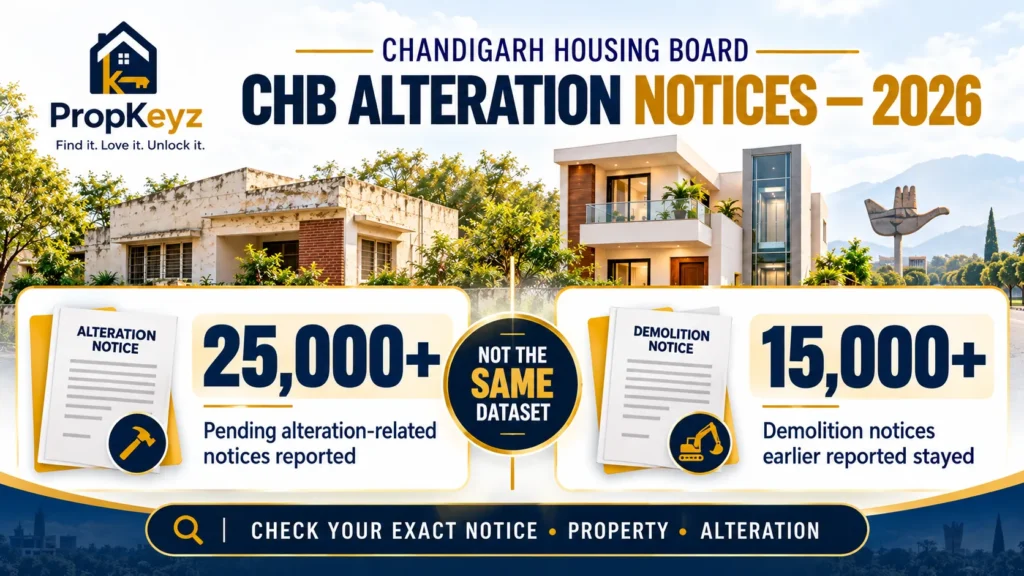
The Tribune reported more than:
25,000 pending notices
for violations relating to need-based changes.
The report said sources expected these notices to become infructuous under the Board decision.
But Be Careful
PropKeyz would not interpret that as:
“CHB has formally cancelled every one of the 25,000 notices.”
The exact result can still depend on:
- nature of alteration,
- property category,
- final policy implementation,
- whether the construction qualifies.
PropKeyz Rule
Policy Relief ≠ Automatic Notice Cancellation
Read the full Tribune report on the 25,000+ CHB notices
What About the 15,000 Demolition Notices?
A separate figure of more than:
15,000 demolition notices
was reported as having been stayed earlier while the need-based-change issue was examined.
Do Not Mix These Figures
The:
25,000+ alteration-related notices
and:
15,000+ demolition notices
should not automatically be treated as the same category.
Why?
They can differ by:
- enforcement stage,
- notice type,
- violation type,
- current legal status.
PropKeyz Rule
Notice ≠ Demolition Order ≠ Actual Demolition
Are All Old Notices Automatically Cancelled?
No blanket conclusion should be drawn.
Each property may fall into a different category.
Permissible Change
Already compliant.
Potentially Regularisable Change
Can potentially be brought into compliance.
Existing Construction Protected by an Earlier Relief
May have a different treatment.
Non-Permissible Construction
May remain outside the framework.
Encroachment
Use of:
- government land,
- common area,
- public space
can involve a different issue.
Structurally Unsafe Change
May fail safety certification.
PropKeyz Rule
Relief Must Be Applied Alteration-by-Alteration
Structural Safety Requirements
Structural safety remains one of the most important parts of the CHB framework.
The official January 2023 order specifically requires structural-stability certification for various changes, including certain additional construction and wall alterations.
The CHB Need-Based Changes portal also provides access to its structural-stability proforma and professional lists. Open CHB structural-safety and professional resources
Why This Matters
An alteration can affect:
- load-bearing walls,
- slabs,
- beams,
- foundations,
- adjoining dwelling units.
PropKeyz Rule
More Built-Up Space Is Never More Important Than Structural Safety
Registered Architect & Self-Certification
The September lift framework provides for applications through:
registered architects
using a:
self-certification route.
Current reporting says qualifying applications are to be processed against prescribed standards.
Self-certification should not be misunderstood as:
no compliance checking.
It means a qualified professional assumes responsibility for certifying the proposal against the applicable framework.
Before Appointing a Professional
Verify:
- valid registration,
- applicable empanelment,
- exact scope,
- Structural Engineer requirement,
- completion responsibilities.
CHB itself maintains professional/resource information through its Need-Based Changes portal. Check the official CHB resource hub
CHB Lift Rules 2026
Lift permission is another major part of the September framework.
The current proposal is intended to provide a clearer route for lift installation across CHB dwelling units.
CHB also already maintains an official Procedure for Permission of Lifts page containing standard drawings and procedural information. Open the official CHB lift-permission procedure
Proposed Process
Residents / Owners
↓
Registered Architect
↓
Self-Certified Application
↓
CHB Processing
↓
Permission
↓
Installation
↓
Completion Documentation
Processing Target
The September framework provides for a:
30-day
decision target for compliant applications.
Why This Matters
Lift access can materially improve usability for:
- senior citizens,
- persons with mobility limitations,
- upper-floor families.
Is Consent of Every Resident Needed for a Lift?
No.
Under the September Board-approved framework:
consent of every resident in the block is not mandatory.
However, any resident willing to contribute toward:
- installation,
- maintenance
should be allowed to join and use the lift.
PropKeyz Rule
No Unanimous Consent ≠ Excluding a Willing Resident
Who Pays for the Lift?
The system is expected to operate through contributions from participating residents.
Owners should agree clearly on:
- installation contribution,
- maintenance,
- annual service contract,
- electricity,
- repair,
- replacement.
Buyer Question
When purchasing a flat in a block with a resident-funded lift, ask:
“Is there any pending lift contribution or recurring maintenance obligation attached to this flat?”
Does Lift Area Count Toward FAR?
Under the September proposal:
lift and lift-well area
are proposed not to count toward:
- ground coverage,
- FAR
for applicable lift cases.
Current reporting also notes that this exemption does not apply in the same manner to independent dwelling units.
PropKeyz Rule
Never Apply One CHB Property Category’s FAR Treatment to Another
What Is a “Block” for Lift Purposes?
For lift-related purposes, the framework treats a block as:
all dwelling units accessed through a common staircase.
The same definition also appears in CHB’s older lift-related framework.
This means the relevant owner group may be:
one common-staircase block
rather than:
the entire CHB scheme or sector.
Offline Applications vs OBPAS
The September framework allows:
offline applications
until the required functionality becomes available through:
OBPAS — Online Building Plan Approval System.
Important
Offline does not mean:
informal.
A formal application and prescribed professional documentation may still be required.
PropKeyz Rule
Offline Application ≠ No Approval Required
Completion Certificates
Property compliance does not necessarily end when physical work finishes.
For newly altered or reconstructed property, buyers should verify whether the applicable approval process also requires:
- completion documentation,
- architect certification,
- structural documentation.
Buyer Rule
For a recently reconstructed CHB house, ask for:
sanction + construction record + completion documentation
rather than only:
“permission letter hai.”
Rooftop Solar & CHB NOC
The September Board also addressed rooftop solar under:
PM Surya Ghar: Muft Bijli Yojana.
Current reporting says the Board decided that no separate prior CHB approval/NOC would be required for qualifying installations under the scheme framework.
Important
This should not be interpreted as:
“Anything can now be built on the roof.”
The relief concerns:
eligible rooftop solar installation
subject to applicable scheme requirements.
Independent House vs Flat — Key Differences

| Issue | Independent House | CHB Flat / Block |
|---|---|---|
| Reconstruction | Major September relief area | Different framework |
| Marla-house treatment | Relevant | Not automatically applicable |
| Lift | Different applicability | Major benefit |
| Resident consent | Usually not same shared issue | Important |
| Common staircase | Less relevant | Central to block definition |
| Shared structural risk | Property-specific | Very important |
| Lift FAR treatment | Different | Exemption proposed in applicable cases |
| Common area | Property-specific | Major concern |
PropKeyz Rule
First Identify the CHB Property Type — Then Apply the Rule
Can Every Existing Violation Be Regularised?
No.
This is one of the most dangerous assumptions a property owner or buyer can make.
An alteration may be:
Already Permitted
No regularisation issue.
Permissible After Approval
Can potentially be sanctioned.
Retainable Under an Older CHB Order
May have special treatment.
Non-Permissible
Still outside the available framework.
Encroachment
May involve public/common land.
Structurally Unsafe
May require removal or remediation.
PropKeyz Rule
Regularisation Starts With Classification — Not Assumption
Common Changes Owners Should Verify
A modified CHB property may contain several types of changes.
Balcony
Was it:
- extended,
- enclosed,
- glazed?
Internal Wall
Was it:
- load-bearing,
- non-load-bearing?
The official 2023 CHB order draws specific distinctions between internal wall changes and structural requirements.
Gate
Was the entrance width changed?
Car Shed
Does it match an allowed temporary design?
Additional Room
Does it fall within a recognised plan/allowance?
Projection / Chajja
Does it meet permitted dimensions?
Roof Access
Was a new staircase or opening created?
Common Area
Has any shared area been enclosed?
PropKeyz Rule
“Sab Ne Kiya Hua Hai” Is Not a Building Approval
CHB Property Buyer Due-Diligence Checklist

When buying a modified CHB property, do not inspect only:
location + size + interiors + price.
Property Identity
- Sector
- Dwelling-unit number
- CHB category
- Independent house or flat
- Original scheme
Ownership
- Allotment documents
- Conveyance/lease/freehold status
- Current owner
- Mutation
- Transfer history
Original Building
- Obtain original CHB plan.
- Compare it with present construction.
Alterations
- What was changed?
- When was it changed?
- Under which order?
- Was approval obtained?
- Were applicable charges paid?
Reconstruction
- Was the original house demolished?
- Is there a sanctioned plan?
- Registered architect?
- Structural Engineer?
- Completion documentation?
Notices
- Show-cause notice?
- Demolition notice?
- Speaking order?
- Stay?
- Appeal?
Structural
- Structural-stability certificate?
- Load-bearing wall changed?
- Shared structural component altered?
Encroachment
- Government land?
- Common area?
- Common passage?
Lift
- Permission?
- Installation cost?
- Maintenance cost?
- Completion documentation?
- Participation rights?
Financial
- CHB dues?
- penalty?
- regularisation charge?
- outstanding authority liability?
Final Buyer Rule
Original Plan → Current Construction → Approval Status → Notice Status → Structural Safety → Price
For official modification documents and checklists, use the Chandigarh Housing Board itself as the first source. Check official CHB Need-Based Change records
Seller / Existing Owner Checklist
If you own a modified CHB property, organise a compliance folder before selling.
Ownership File
Keep:
- allotment,
- conveyance,
- transfer,
- mutation.
Original Building File
Keep:
- original drawing,
- standard CHB plan.
Alteration File
Keep:
- revised plan,
- permissions,
- need-based-change approval.
Structural File
Keep:
- structural-stability certificate,
- Structural Engineer details.
Notice File
Keep:
- notices,
- replies,
- speaking orders,
- appeal/stay documents.
Payment File
Keep:
- CHB charges,
- fees,
- penalties,
- regularisation payments.
PropKeyz View
A serious buyer will trust an organised compliance file more than the sentence, “Sab approved hai.”
NRI & Outstation Owner Perspective
Many Chandigarh properties are owned by:
- NRIs,
- children living abroad,
- owners living in another city.
A remote owner may not know:
- what physical changes were made,
- whether permission was obtained,
- whether a notice was received,
- whether a common area was enclosed.
Remote Owner Checklist
Request:
- current exterior photos,
- room-by-room photos,
- roof photos,
- front/rear elevation,
- common-area images,
- all CHB correspondence,
- latest dues position.
PropKeyz provides a dedicated NRI Property Management service path for owners who need local inspections, reporting, maintenance coordination and tenant support across Chandigarh and the Tricity region. Explore PropKeyz NRI Property Management
For a more detailed overview of the complete owner-management workflow, read Property Management Services in Tricity 2026. Read PropKeyz Property Management Services in Tricity 2026
PropKeyz Rule
Remote Ownership Requires a Current Physical + Document Audit
Rental Owner Perspective
If the CHB property will be rented out, construction compliance and tenancy compliance are separate questions.
A legally transferable property can still require proper:
- tenant documentation,
- rent agreement,
- current Chandigarh tenancy compliance.
For the latest rental-law framework, read Chandigarh Tenancy Rules 2026. Read Chandigarh Tenancy Rules 2026 on PropKeyz
PropKeyz Rule
Building Compliance ≠ Tenancy Compliance
Both should be handled separately.
Property Valuation & Resale Impact
Could the new need-based-change framework improve CHB property values?
Potentially, cleaner compliance and reconstruction flexibility can support:
- buyer confidence,
- utility,
- resale marketability.
But this does not mean:
property prices will automatically increase.
Value still depends on:
- sector,
- property category,
- title,
- plot/house size,
- parking,
- construction quality,
- compliance,
- market demand.
More Important Than Price Appreciation
For many older CHB properties, the biggest benefit may simply be:
better marketability.
A buyer may be more comfortable purchasing a property where:
- alterations are documented,
- structure is safe,
- notices are resolved.
For broader transaction trends and Chandigarh market liquidity, read Chandigarh Property Market 2026. Read Chandigarh Property Market 2026 on PropKeyz
PropKeyz Rule
Compliance Can Support Liquidity — It Does Not Guarantee Appreciation
Bank Loan & Buyer Confidence
Unauthorised construction can create additional questions during:
- bank legal verification,
- technical inspection,
- mortgage processing.
A bank may compare:
- sanctioned plan,
- actual construction,
- ownership documents.
Buyer Question
Do not ask only:
“Loan ho jayega?”
Ask:
“Bank ke legal aur technical review me alteration status kya hai?”
PropKeyz Rule
Loan Approval Is Helpful Context — Not Independent Proof of Complete Compliance
Red Flags Before Buying a Modified CHB Property
“25,000 notices cancel ho gaye, sab legal hai.”
Oversimplification.
“Board approve ho gaya, final permission ki zarurat nahi.”
Incorrect.
“Marla rules lag gaye, FAR unlimited hai.”
Incorrect.
“Complete reconstruction allow hai, sanctioned plan nahi chahiye.”
Incorrect.
“Lift lag gayi to permission bhi hogi.”
Verify.
“Common area cover kar rakha hai, sab karte hain.”
Red flag.
“Structural certificate baad mein bana lenge.”
Red flag.
“Officer ne verbally okay bola tha.”
Ask for documentation.
Correct Buyer Sequence
Ownership
↓
Original Plan
↓
Physical Inspection
↓
Alteration Classification
↓
Notice Check
↓
Structural Safety
↓
Current Policy
↓
Price
Confirmed Facts vs Common Assumptions
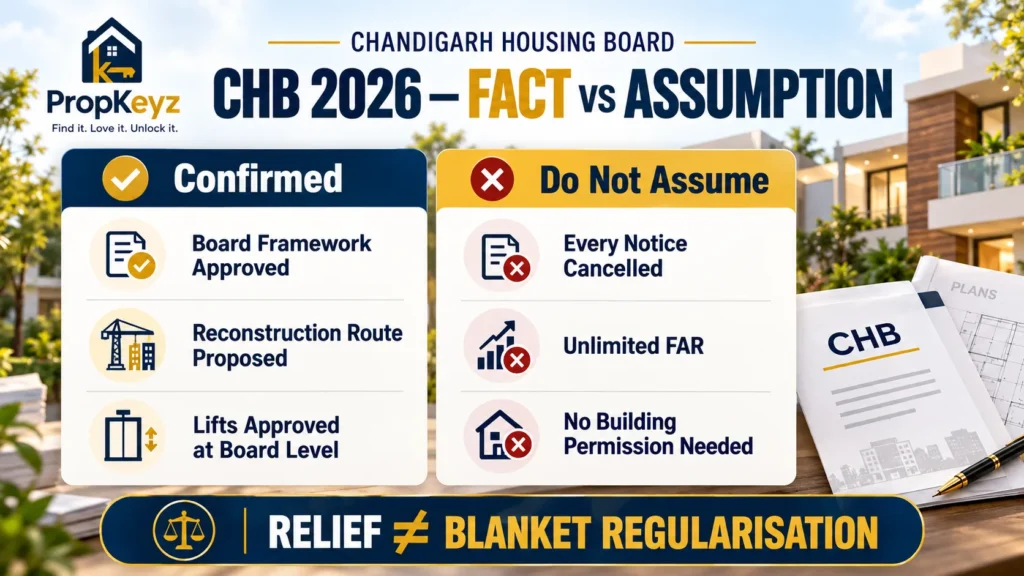
| Confirmed / Supported | Do Not Automatically Assume |
|---|---|
| CHB Board approved September framework | Final implementation is complete |
| Reconstruction route approved at Board level | Rebuild without approval |
| Independent houses proposed for Marla-house treatment | CHB property rules disappear |
| 25,000+ notices reported | Every notice has been formally cancelled |
| 15,000+ demolition notices reported separately | Same dataset as 25,000 |
| March 2026 implementation exists | September was first need-based relief |
| Structural certification matters | Every alteration is structurally safe |
| Lift process targets 30 days | Automatic approval after 30 days |
| Unanimous resident consent not mandatory | Participating residents can be excluded |
| Lift FAR relief proposed for applicable cases | Same exemption applies to every independent house |
| Solar-related relief proposed | No other solar rules apply |
| Some old construction may be retainable | Every violation is now regularised |
PropKeyz View
The new CHB decision creates a stronger route toward compliance—not a blanket amnesty for every alteration.
What Owners Should Do Now
Owners can prepare even before every implementation detail is final.
Step 1 — Identify Property Category
Independent house?
Flat?
Step 2 — Obtain Original CHB Plan
Know what was originally approved.
The CHB Need-Based Changes portal contains standard resources and drawings relevant to different categories. Visit the official CHB Need-Based Changes portal
Step 3 — Compare Current Construction
Create a room-by-room difference list.
Step 4 — List Every Alteration
| Change | Approx. Year | Approval Available? |
|---|---|---|
| Balcony enclosure | 2018 | Check |
| Additional room | 2020 | Check |
| Gate widening | 2022 | Check |
Step 5 — Collect Every Notice
Do not ignore:
- show-cause,
- demolition,
- penalty,
- authority correspondence.
Step 6 — Obtain Structural Review Where Needed
Particularly where major walls or structural elements were changed.
Step 7 — Check Applicable Order
Determine whether your change falls under:
- older CHB order,
- March 2026 implementation,
- September framework.
Step 8 — Verify Final Implementation Before New Construction
Do not undertake irreversible work based on news alone.
How PropKeyz Would Analyse a CHB Property
Step 1 — Exact Property
Sector → Dwelling Unit → Category → House/Flat
Step 2 — Ownership
Original Allotment → Transfer → Mutation → Current Owner
Step 3 — Original Building
What did CHB originally approve?
Step 4 — Current Building
What physically exists today?
Step 5 — Difference Map
Original vs Current
Step 6 — Rule Classification
Each alteration should be classified as:
- permitted,
- permission required,
- potentially regularisable,
- non-permissible,
- unclear.
Step 7 — Enforcement Position
Any:
- notice,
- order,
- stay,
- appeal?
Step 8 — Structural Safety
Does professional certification exist?
Step 9 — Current Policy
What is the latest final CHB/Administrator position?
Step 10 — Commercial Decision
Then compare:
- asking price,
- legal/compliance uncertainty,
- repair cost,
- future marketability.
PropKeyz Formula
Title + Original Plan + Current Construction + CHB Approval + Structural Safety + Notice Status + Current Rules + Asking Price
If you’re comparing a real Chandigarh property and need a structured property-information review, you can share the property details with PropKeyz. Contact PropKeyz for a property assessment
PropKeyz Analysis
The Chandigarh Housing Board Need-Based Changes 2026 story is much bigger than permission for an additional room or lift.
It represents the challenge of adapting ageing public housing to modern family requirements while preserving Chandigarh’s urban-planning and safety framework.
1. September 2026 Is Important — But Not the Starting Point
CHB already had:
- older need-based relaxations,
- a January 2023 order,
- March 2026 implementation.
September broadens the policy direction.
2. Complete Reconstruction Is the Biggest Independent-House Change
Older independent CHB houses no longer have to be viewed only as:
original structure + small alterations forever.
A legally structured reconstruction route could be far more practical.
3. Structural Safety Is the Correct Trade-Off
More owner flexibility is positive only when alterations remain:
professionally designed and structurally safe.
The existing CHB order itself repeatedly links certain modifications with Structural Engineer certification.
4. The Notice Numbers Show a Systemic Problem
When tens of thousands of alteration-related notices exist, the issue is not limited to a few unusual properties.
It becomes:
a city-scale housing compliance challenge.
5. Blanket Regularisation Would Still Be the Wrong Interpretation
A permitted balcony extension should not automatically be treated the same as:
- common-land encroachment,
- government-land construction,
- major structural violation.
6. Lift Rules Could Materially Improve Liveability
For:
- senior citizens,
- mobility-impaired residents,
- upper-floor families,
a lift can determine whether a home remains practical.
7. No-Unanimous-Consent Rule Could Reduce Deadlock
One non-participating resident should not necessarily block an accessibility improvement for everyone else.
8. Buyers Need a New CHB Due-Diligence Mindset
Instead of asking only:
“CHB property transfer ho jayegi?”
buyers should now ask:
“Current construction ka approval status kya hai?”
9. Chandigarh Planning Still Matters
A CHB policy cannot be read independently from:
- Chandigarh Building Rules,
- Supreme Court directions,
- wider Master Plan controls.
For broader planning context, use Chandigarh Master Plan 2031 Changes 2026 as the supporting PropKeyz guide. Read the detailed Chandigarh Master Plan analysis
10. Official Orders Matter More Than Headlines
The strongest due diligence uses:
official CHB order + original plan + current property condition
together.
11. Compliant Properties May Become Easier to Sell
Cleaner alteration records can reduce uncertainty for:
- buyers,
- lenders,
- legal advisers.
12. Clearer Rules Also Expose Non-Compliant Properties
A clearer framework creates a better line between:
permissible
and:
still problematic.
Final PropKeyz Analysis
The Chandigarh Housing Board Need-Based Changes 2026 framework is a major positive step toward making older CHB homes more adaptable and accessible. But its real value will depend on final implementation that clearly separates genuine need-based family modifications from unsafe construction, common-land encroachment and other non-permissible changes. Owners should use the relief to move toward documented compliance—not treat it as permission to build without limits.
PropKeyz Verdict: Chandigarh Housing Board Need-Based Changes 2026
The Chandigarh Housing Board Need-Based Changes 2026 framework could become one of the most meaningful owner-focused housing reforms for CHB properties.
For Independent-House Owners
The possibility of:
alteration + demolition + reconstruction
under a clearer rule framework is significant.
For Flat Residents
Lift permission could materially improve:
- accessibility,
- long-term usability.
For Owners With Notices
Do not assume:
your notice has automatically disappeared.
Identify:
- exact violation,
- applicable order,
- current status.
For Buyers
Construction compliance should now be treated as:
part of property due diligence.
For NRI Owners
Combine:
current physical inspection + current CHB document check.
PropKeyz’s NRI support is designed for owners who need on-ground inspection, reporting and coordination without being physically present. Explore NRI Property Management by PropKeyz
Current Status
Remember:
September brought CHB Board approval; final Administrator-level implementation remains an important distinction.
Final PropKeyz Rule
Relief is most valuable when it converts uncertain construction into verifiable, safe and transferable property compliance.
Frequently Asked Questions
What are Chandigarh Housing Board Need-Based Changes 2026?
The Chandigarh Housing Board Need-Based Changes 2026 framework concerns CHB rules and proposals for permitted property modifications, reconstruction, lift installation and owner-focused compliance relief.
What did CHB approve in September 2026?
The CHB Board approved a framework relating to:
- independent-house need-based changes,
- reconstruction,
- Marla-house development-control treatment,
- lifts,
- rooftop solar,
- associated procedures.
Is the September CHB framework fully implemented?
Owners should distinguish CHB Board approval from final UT Administrator approval and property-specific permission.
Can a CHB independent house be demolished completely?
The September Board framework creates a route for demolition and reconstruction of eligible independent houses subject to required clearances.
How many independent CHB houses may benefit?
Approximately:
2,500 independent houses
were reported as being directly affected by the reconstruction proposal.
What are the 25,000 CHB notices?
More than 25,000 alteration-related notices were reported as pending.
That does not automatically mean every notice has been formally cancelled.
Are all old CHB alterations legal now?
No.
Each alteration should be checked against:
- applicable CHB orders,
- current building rules,
- structural requirements,
- common/government-land restrictions.
What is the March 10, 2026 CHB order?
It relates to implementation of specified provisions of CHB’s earlier Need-Based Changes framework. Read the official March 2026 CHB implementation page
Where can I see all official CHB Need-Based Change documents?
CHB maintains a dedicated official resource page. Open CHB Need-Based Changes resources
Does this mean FAR has increased?
No such conclusion should be drawn.
The Supreme Court’s 2023 judgment specifically directed Chandigarh authorities to freeze FAR and not increase it further.
Where can I read the Supreme Court judgment?
Read the official Supreme Court judgment PDF
Is structural certification important?
Yes.
Official CHB rules require Structural Engineer certification for several categories of modifications.
Can CHB flats install lifts?
The September framework approved a broader lift route, while CHB already maintains an official procedural page for lift permissions. View CHB’s official lift-permission procedure
Does every flat owner have to agree to the lift?
Current September reporting says unanimous consent is not mandatory.
How long should a lift application take?
The new Board-approved framework targets a decision within:
30 days
for compliant applications.
What should I check before buying a modified CHB property?
Verify:
- ownership,
- original building plan,
- present construction,
- alteration permissions,
- structural certificate,
- notice history,
- CHB dues,
- completion documentation.
Does reconstruction permission increase property prices?
It may improve utility and marketability of some properties, but it does not guarantee appreciation.
For wider pricing and market context, see Chandigarh Property Market 2026. Read Chandigarh Property Market 2026
What should a landlord also verify?
If the property will be rented, building compliance and tenancy compliance should be checked separately.
Read Chandigarh Tenancy Rules 2026
What is the safest CHB buyer rule?
Never price a modified CHB property as fully compliant until the original plan, present construction, permissions, notice status and structural documentation have been checked.
Continue Your Chandigarh Property Research
Chandigarh Master Plan 2031 Changes 2026
Understand Chandigarh FAR, higher-density proposals, Phase-I protections, redevelopment and property-specific building entitlement.
Read Chandigarh Master Plan 2031 Changes 2026
Chandigarh Property Market 2026
Understand transaction trends, premium property activity, market liquidity and broader Chandigarh buyer behaviour.
Read Chandigarh Property Market 2026
Chandigarh Tenancy Rules 2026
Essential reading for CHB owners planning to rent out a property.
Read Chandigarh Tenancy Rules 2026
NRI Property Management
For owners living outside India who need local inspection, reporting, tenant and maintenance coordination.
Explore PropKeyz NRI Property Management
Property Management Services in Tricity 2026
Understand the complete PropKeyz owner-support model across Chandigarh, Mohali, Panchkula, Zirakpur and nearby markets.
Read Property Management Services in Tricity 2026
Property Buyer & Owner Support Through PropKeyz
PropKeyz focuses on practical property research and owner support across:
- Chandigarh,
- Mohali,
- Panchkula,
- Zirakpur,
- New Chandigarh,
- Kharar,
- surrounding Tricity markets.
PropKeyz’s current services include:
- NRI property care,
- property inspections,
- tenant coordination,
- rent tracking,
- maintenance coordination,
- structured owner reporting.
Buying a CHB Property?
A stronger buyer comparison should include:
- CHB property category,
- original building plan,
- existing construction,
- alteration approvals,
- notice history,
- structural documentation,
- title,
- asking price.
Already Own a Modified CHB Property?
Start by organising:
- original plan,
- current property photos,
- alteration documents,
- notice history,
- structural records.
These can then be reviewed by the appropriate:
- architect,
- Structural Engineer,
- advocate,
- CHB authority.
NRI or Outstation Owner?
PropKeyz supports eligible remote owners through local coordination and reporting. Explore NRI Property Management
For the full service scope:
Explore PropKeyz Property Management Services
Important Scope
PropKeyz is not:
- Chandigarh Housing Board,
- a law firm,
- an architect,
- a Structural Engineer.
For:
- building-plan certification,
- structural-safety certification,
- formal regularisation advice,
- legal representation,
use an appropriately qualified professional.
Discuss Your Property With PropKeyz
Share:
- sector,
- dwelling-unit category,
- independent house or flat,
- current physical alterations,
- notice status,
- buying/selling/ownership objective.
Contact PropKeyz for a Property Assessment
Your Property. Our Responsibility.
Sources & Verification
This article was last fact-checked on:
26 September 2026
Chandigarh Housing Board — Need-Based Changes
Primary official resource for:
- need-based orders,
- checklists,
- structural forms,
- architect/engineer resources,
- approval/regularisation procedures.
Official CHB Need-Based Changes Portal
Chandigarh Housing Board — March 2026 Implementation
Used for the current implementation history of the 2023 Need-Based Changes framework.
Official CHB March 2026 Implementation Page
Chandigarh Housing Board — January 2023 Need-Based Changes Order
Used to verify specific categories of permitted change and structural-safety conditions.
Official January 2023 CHB Need-Based Changes Order
Chandigarh Housing Board — Lift Procedure
Used to verify existing CHB lift application resources and standard-drawing procedure.
Official CHB Procedure for Permission of Lifts
Chandigarh Building Rules (Urban), 2017
Used for wider building-control and professional-compliance context.
Official Chandigarh Building Rules 2017
Supreme Court — Residents Welfare Association v. UT Chandigarh
Used for:
- Phase-I planning restrictions,
- FAR freeze,
- Chandigarh heritage-development controls.
Official Supreme Court Judgment
The Tribune — September 2026
Used for the latest reporting concerning:
- 25,000+ pending alteration-related notices,
- September Board decision.
Hindustan Times — September 2026
Used for reporting concerning:
- approximately 2,500 independent houses,
- complete reconstruction,
- lift procedure,
- 15,000+ demolition notices,
- Administrator-approval status.
Read the Hindustan Times CHB report
Disclaimer
This article is intended for:
- real-estate research,
- buyer education,
- owner awareness,
- property-compliance understanding.
It does not constitute:
- architectural approval,
- structural certification,
- legal advice,
- CHB permission,
- regularisation approval,
- investment advice,
- property valuation.
The September 2026 framework discussed in this article received:
CHB Board approval
while further Administrator-level approval and implementation remained an important part of the process at the time of fact-checking.
Final:
- eligibility,
- fees,
- building-plan process,
- reconstruction conditions,
- lift requirements,
- notice treatment,
- technical specifications
may change through subsequent official orders.
Before carrying out:
- demolition,
- reconstruction,
- additional construction,
- structural alteration,
- lift installation,
verify the latest official CHB order through the CHB Need-Based Changes portal. Check the latest official CHB resources
Before purchasing a modified CHB property, independently verify:
- ownership,
- original sanctioned plan,
- present construction,
- alteration approvals,
- structural-safety records,
- notice history,
- authority dues,
- completion documentation,
- current applicable CHB policy.
PropKeyz does not guarantee:
- regularisation,
- cancellation of notices,
- reconstruction permission,
- lift approval,
- bank finance,
- resale,
- property appreciation.
Your Property. Our Responsibility.