
Last Updated: 28 September 2026
Fact-Checked: 28 September 2026
The Mohali Society Maintenance Charges 2026 question looks simple until a flat is:
- rented,
- vacant,
- owned by an NRI,
- being sold,
- carrying old dues,
- facing a special society demand.
Then one monthly bill can turn into five separate questions:
Who does the society legally recover from?
Who should pay between owner and tenant?
Does a vacant flat still owe maintenance?
Can old society dues affect a resale buyer?
When does GST apply?
Punjab’s apartment-ownership framework gives important answers.
Under the Punjab Apartment Ownership Act, 1995, common expenses are charged to apartment owners according to their interest in the common areas and facilities.
Where the owner is not occupying the flat, the law also allows recovery from the person occupying it.
The Act separately says an owner cannot avoid common-expense liability simply because they:
- do not use the common facilities;
- abandon the apartment.
It also creates an important resale risk:
unpaid common expenses can follow the apartment into a transfer transaction.
That is why a buyer should never treat society maintenance as:
“Seller ka small pending bill.”
It can become a due-diligence issue.
For NRI and outstation owners, society maintenance is also a recurring property-management problem.
A flat can be perfectly rented and still develop problems because:
- society bills were missed,
- owner records were outdated,
- tenant did not share notices,
- penalties accumulated,
- move-out dues were never reconciled.
PropKeyz’s property-management approach therefore treats society dues as part of the wider owner record:
Rent + Tenant + Society + Utilities + Inspection + Maintenance
For broader Mohali owner-management support, see:
Property Management Company in Mohali 2026
Key Takeaways
- Punjab apartment law recognises common expenses as charges connected with common-area administration, maintenance, repair and replacement.
- Section 24 charges common expenses to apartment owners.
- Where the owner is not in occupation, recovery may also be made from the occupier.
- This statutory recovery framework is different from the private rent-agreement question of whether owner or tenant should ultimately bear a charge.
- Section 25 prevents an owner from avoiding common expenses simply by not using common facilities or abandoning the apartment.
- Mere vacancy therefore does not automatically mean zero common maintenance.
- Section 26 makes unpaid common-expense assessments a charge on the apartment, subject to statutory exceptions.
- Section 27 creates potential liability for an incoming purchaser for old unpaid common expenses.
- A resale buyer is entitled to obtain an unpaid-dues statement from the Board.
- Section 29 gives an association statutory recovery powers, including a Collector-recovery route subject to the section.
- Under the model bye-laws, monthly assessments are stated to be pro rata according to apartment floor area.
- Do not assume every society can lawfully use any arbitrary calculation method.
- Internal apartment repairs and common-area expenses are different categories.
- IFMS, monthly maintenance, sinking fund and special assessments are not the same thing.
- There is no universal statewide move-in/move-out fee found in the core Punjab Act/Rules reviewed.
- GST does not apply merely because maintenance crosses ₹7,500.
- Under CBIC guidance, GST becomes relevant where:
- contribution exceeds ₹7,500/month/member; and
- RWA aggregate annual turnover is ₹20 lakh or more.
- Where both conditions are met, the CBIC circular says GST applies on the entire contribution, not only the excess above ₹7,500.
- NRI owners should track:
- society invoice;
- payment;
- late charges;
- special assessments;
- utility dues;
- notices;
- property condition.
- A rent agreement should clearly allocate recurring maintenance responsibilities.
- A property manager can track and coordinate society dues without replacing the association, owner or legal adviser.
PropKeyz View
The society invoice tells you what is being demanded. Punjab apartment law tells you the wider common-expense framework. The rent agreement should tell you who bears the cost between owner and tenant. Good property management tracks all three.
Mohali Society Maintenance Charges 2026: Quick Answer
The Mohali Society Maintenance Charges 2026 framework begins with the Punjab Apartment Ownership Act, 1995.
Section 24
Common expenses are charged to:
apartment owners
according to their share/percentage of undivided interest in common areas and facilities.
Where the owner is not occupying the apartment, those common expenses may also be recovered from:
the person occupying the apartment.
Section 25
An owner cannot simply say:
“Main amenities use nahi karta, maintenance nahi dunga.”
and automatically escape liability.
Section 26
Unpaid common-expense assessments can constitute:
a charge on the apartment.
Section 27
When a flat is sold, the buyer may face statutory exposure to:
previous unpaid maintenance assessments
subject to the detailed protections in the section.
Section 29
The association has formal recovery powers for qualifying unpaid amounts.
Read the official Punjab Act:
Punjab Apartment Ownership Act, 1995 — PUDA
Direct Answer
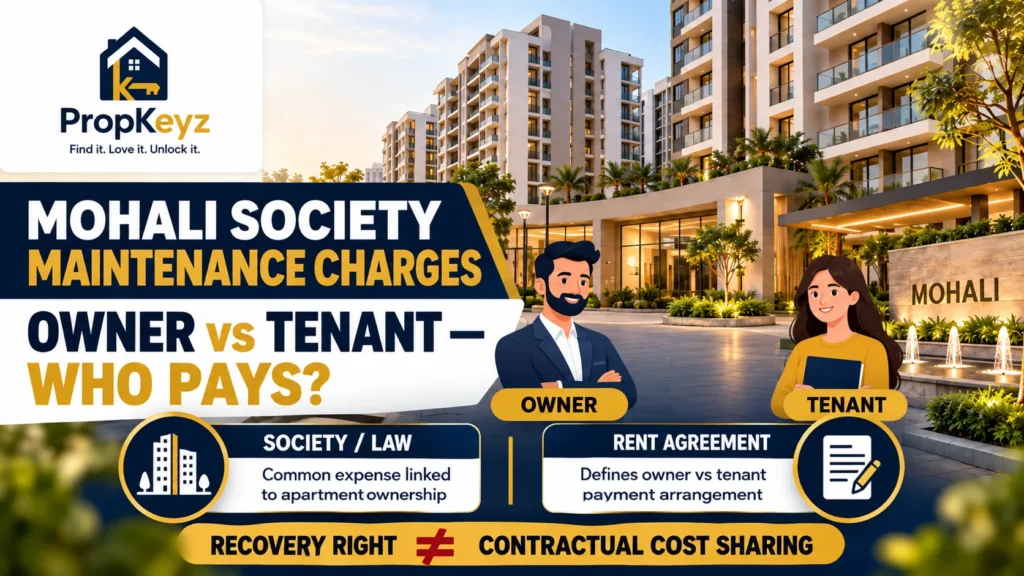
The association-side legal framework and the landlord-tenant contract are not the same thing. The Act places common expenses on the apartment ownership framework and permits recovery from an occupier in specified circumstances. The rent agreement should separately say whether the tenant pays recurring maintenance directly, reimburses the owner, or the owner includes it in rent.
PropKeyz Rule
Society Liability ≠ Rent-Agreement Allocation
What Are Society Maintenance Charges?
In a gated society or apartment complex, maintenance generally funds the shared systems that allow the entire property to function.
The Punjab Apartment Ownership Act defines common expenses broadly to include sums lawfully assessed for:
- administration;
- maintenance;
- repair;
- replacement
of:
common areas and facilities.
The definition can also include:
- expenses declared as common expenses under law or bye-laws;
- certain government/municipal taxes not separately assessed to individual apartments.
Common Examples
Depending on the society:
- security;
- common housekeeping;
- common electricity;
- lift maintenance;
- common-area repairs;
- pumps;
- landscaping;
- common plumbing;
- administration;
- staff;
- insurance;
- common facilities.
Important
Not every line item used by every Mohali society is automatically valid merely because:
“RWA ne invoice me add kiya hai.”
The charge should be checked against:
- the Act;
- Rules;
- registered bye-laws;
- valid association decisions;
- actual common expense.
What Counts as Common Expenses?
Punjab law separates:
common areas/facilities
from:
the interior of the individual apartment.
That difference matters.
Common Expense
Usually relates to shared property such as:
- common corridors;
- lifts;
- shared pumps;
- shared systems;
- security;
- common services.
Unit-Specific Expense
Usually relates to something inside one apartment.
The Punjab Apartment Ownership Rules’ model bye-laws place internal repairs and installations such as:
- water;
- power;
- sewerage;
- telephone;
- AC;
- sanitary installations;
- doors;
- windows
on the apartment-owner side of the ownership framework.
Read the Punjab Apartment Ownership Rules:
Punjab Apartment Ownership Rules, 1995
PropKeyz Rule
Common Maintenance and Internal Flat Maintenance Should Never Be Mixed Into One Undefined “Maintenance” Clause.
Punjab Apartment Ownership Act — Sections Owners Should Know
Section 24 — Common Expenses
This is the starting point.
Common expenses are charged to apartment owners according to their undivided-interest percentage.
If an owner is not in occupation, the Act allows recovery from the occupier.
Section 25 — No Waiver
An owner cannot exempt himself simply through:
- non-use;
- abandonment.
Section 26 — Charge on Apartment
Unpaid assessed common expenses can constitute a statutory charge on the apartment, subject to specified priority exceptions.
Section 27 — Transfer Liability
A buyer/transferee may become jointly and severally liable with the seller/transferor for unpaid assessments up to the transfer date.
But the buyer also has a valuable right:
request a statement from the Board showing outstanding assessments.
Section 29 — Recovery
The association can recover qualifying unpaid amounts and, subject to the statutory procedure, may apply to the Collector for recovery as arrears of land revenue.
PropKeyz View
Maintenance dues are not always a casual monthly billing issue. Under Punjab apartment law they can become a property-level due-diligence issue.
Owner vs Tenant — Who Pays Society Maintenance?
This is probably the most common landlord question.
The safest answer is:
Look at both the statute and the rent agreement.
Association-Side Position
Section 24 starts with common expenses being charged to apartment owners.
If the owner is not occupying the apartment, recovery may also be made from the occupant.
Owner-Tenant Contract
The landlord and tenant should separately agree whether:
- owner pays maintenance;
- tenant pays maintenance directly;
- tenant reimburses owner;
- maintenance is included in rent;
- only usage-based charges are paid by tenant.
Example A
Rent:
₹35,000
Maintenance:
₹4,000 extra, payable by tenant.
Write it clearly.
Example B
Rent:
₹39,000 inclusive of maintenance.
Again:
write it clearly.
Bad Agreement
“Tenant will pay all charges.”
This creates avoidable disputes because:
- property tax?
- special assessment?
- structural repair?
- sinking fund?
- society penalty?
may not have been intended.
Can RWA Recover Maintenance From a Tenant?
Punjab law specifically says that where an apartment owner is not in occupation, the common expenses payable by the owner may be recovered from:
the person in occupation
including a person occupying under a tenancy, licence or other arrangement.
But This Does Not Mean
“The tenant always bears every society bill.”
The rent agreement still matters between owner and tenant.
Example
The society recovers:
₹5,000
from the tenant.
But the rent agreement says:
owner bears maintenance.
That can create a reimbursement issue between:
- landlord;
- tenant.
PropKeyz Rule
Association Recovery Rights and Contractual Cost Allocation Are Separate Layers.
What Should the Rent Agreement Say?
For apartment rentals, include a dedicated:
Maintenance & Society Charges
clause.
Clarify:
Monthly Common Maintenance
Who pays?
Usage-Based Charges
- electricity;
- water;
- DG/power backup.
Special Assessment
Who bears major one-time society expenditure?
Sinking / Corpus Demand
Owner or tenant?
Move-In / Move-Out Fee
Who bears it if validly charged?
Tenant-Caused Damage
Who reimburses?
Pre-Tenancy Arrears
Owner should clear/document.
Post-Tenancy Final Bill
How is it reconciled against security?
PropKeyz View
A good rental agreement should prevent the sentence: “Mujhe laga maintenance aap denge.”
What If the Flat Is Vacant?
A vacant flat still exists inside a functioning building.
The owner may not personally use:
- lift;
- security;
- common lights;
- landscaping.
But those systems continue to operate.
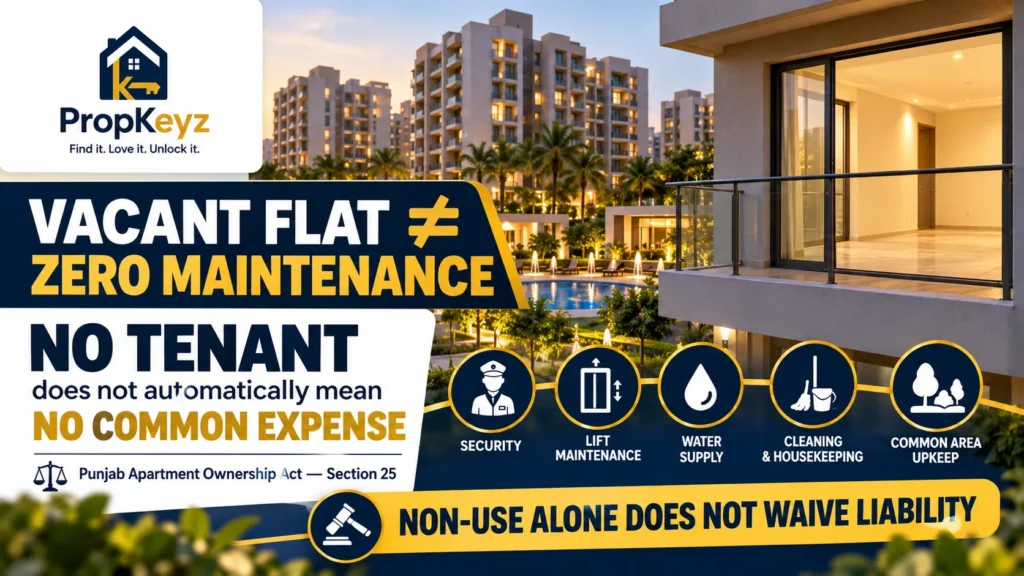
Section 25 says an apartment owner cannot exempt himself from common-expense liability simply through:
- waiver/non-use of common areas;
- abandonment of the apartment.
Direct Answer
Mere vacancy does not automatically eliminate common maintenance liability.
NRI Example
Owner lives in Canada.
Mohali apartment remains locked for eight months.
The fact that:
“koi reh nahi raha”
does not by itself establish:
zero maintenance.
Can an Owner Refuse Because They Don’t Use the Amenities?
Not merely on that basis.
The law specifically blocks a waiver based simply on giving up:
use or enjoyment of common areas and facilities.
This matters for arguments such as:
- “I don’t use the gym.”
- “My tenant doesn’t use the clubhouse.”
- “I live abroad.”
- “Flat is empty.”
Important
This does not mean:
every disputed society charge is automatically valid.
An owner can still examine:
- whether the charge is a lawful common expense;
- calculation;
- bye-law authority;
- accounts.
But:
non-use alone is not the same as invalid charge.
What If the Flat Is Locked for One Year?
Treat this as:
vacant property management
rather than an exemption from property obligations.
Track:
- common maintenance;
- utility minimum/fixed charges;
- electricity status;
- society notices;
- special assessment;
- property inspection.
For remote-owner protection:
Mohali NRI Property Protection 2026
What Powers Does an RWA / Association Have?
Punjab law gives the association responsibility for:
- management;
- common areas;
- maintenance;
- assessment of common expenses;
- recovery of qualifying amounts.
The association’s affairs are governed through:
registered bye-laws
within the statutory framework.
The model bye-laws also give the association responsibility for:
- common-area management;
- accounts;
- staff;
- assessment;
- recovery;
- annual reporting.
But RWA Power Is Not Unlimited
Owners can ask:
- Which bye-law authorises this charge?
- Was the assessment properly approved?
- How was it calculated?
- Is it common or unit-specific?
- Is GST correctly applied?
- Is this old arrear or current demand?
PropKeyz Rule
“RWA Has Power” Does Not Mean “Every Invoice Line Is Beyond Question.”
Can Maintenance Dues Become a Charge on the Flat?
Yes, under Section 26, qualifying unpaid common-expense assessments can constitute a:
charge on the apartment
subject to the statutory priority exceptions.
This is why repeated unpaid dues should not be treated casually.
For Owners
Do not let:
₹4,000 × many months
quietly become:
arrears + disputes + transfer problem.
For Buyers
Do not assume:
“Seller will settle after registry.”
Settle/document before transfer.
Can Old Maintenance Dues Affect a Resale Buyer?
Yes.
Section 27 is one of the most important resale-property provisions.
On sale or other transfer, the incoming transferee can become:
jointly and severally liable
with the previous owner for unpaid common-expense assessments up to the transfer.
Buyer Protection
The same section gives the buyer the right to obtain:
a Board statement showing unpaid assessments.
This is extremely valuable.
PropKeyz Rule
Before Token on a Society Resale → Ask for the Dues Statement
Why Society Dues Statement Matters Before Purchase
For a Mohali resale flat, collect:
- latest maintenance statement;
- paid receipts;
- outstanding statement;
- special assessment;
- electricity/DG dues;
- transfer/move-out demand;
- association letter/NOC if applicable.
Why?
Because the seller may tell you:
“Koi dues nahi hai.”
But your due diligence should rely on:
documented association records.
For an example of Mohali project due-diligence thinking, see:
Purab Premium Apartments Mohali 2026
How Are Maintenance Charges Calculated?
Punjab law refers to the percentage of:
undivided interest in common areas and facilities.
The model bye-laws in the Punjab Apartment Ownership Rules state monthly assessments should be made:
pro rata according to floor area of each apartment.
Important
Do not immediately assume:
carpet area
or:
super area.
Check:
- conveyance deed;
- association bye-laws;
- applicable assessment basis.
PropKeyz Rule
“₹X per sq ft” Is Incomplete Until You Know Which Sq Ft.
Floor Area vs Super Area vs Carpet Area
These three terms are regularly mixed.
Carpet Area
Usable internal area as legally defined in the relevant context.
Super Area
A marketing/billing concept that can include a proportionate share of common areas.
Floor Area
The term used by the model bye-law maintenance-assessment provision.
Buyer / Owner Question
Ask the RWA:
“The rate is ₹3.50 per sq ft—but applied on what documented area?”
Monthly Maintenance vs IFMS
They are different.
Monthly Maintenance
Recurring amount used for ongoing expenses.
IFMS
Usually:
Interest-Free Maintenance Security
collected as a security/deposit under project-specific documents.
IFMS Does Not Automatically Mean
- monthly maintenance prepaid forever;
- no future assessment;
- no special assessment.
Check:
- allotment letter;
- maintenance agreement;
- possession terms;
- association handover.
What Is a Sinking Fund?
A sinking fund is generally intended for:
replacement of significant fixed/common assets
rather than ordinary monthly housekeeping.
Section 24(5) specifically recognises promoter collection toward:
sinking fund for replacement of fixed assets
before association formation, with accounting/transfer obligations.
Examples
Potentially:
- lift replacement;
- major common equipment;
- large fixed-asset renewal.
Important
There is no universal percentage in the reviewed Punjab provisions.
What Is a Corpus Fund?
“Corpus fund” may be used by societies/projects for longer-term financial reserves.
Do not automatically treat:
corpus
and:
sinking fund
as identical without reading:
- bye-laws;
- project documents;
- purpose of collection.
Special Assessments / One-Time Charges
A society may face a major expense not covered by routine monthly maintenance.
Examples may include:
- common infrastructure replacement;
- major repairs;
- emergency common work.
Before paying a large special demand, an owner should ask:
- purpose;
- amount;
- approval;
- allocation method;
- quotation/tender where appropriate;
- accounts;
- payment deadline.
NRI Rule
Never approve a large special assessment from one WhatsApp screenshot alone.
Move-In / Move-Out Charges
Punjab’s core Act/Rules reviewed here do not create one universal:
₹X move-in / move-out fee
for every society.
If charged, verify:
- registered bye-law basis;
- association resolution;
- actual service;
- refundable security vs fee;
- lift/protection arrangements.
PropKeyz Rule
Society Practice ≠ Statewide Standard
Can an RWA Charge Late Fees or Interest?
There is no universal statewide late-interest percentage established in the core provisions reviewed for this article.
Therefore do not accept or reject a penalty merely because someone says:
“Har society 18% charge karti hai.”
Check:
- bye-laws;
- resolution;
- demand;
- contractual basis;
- applicable law.
GST on Society Maintenance Charges

CBIC’s official RWA circular gives a two-part framework.
₹7,500 Monthly Threshold
RWA contribution up to:
₹7,500 per month per member
for common-use goods/services is exempt under the framework described by CBIC.
₹20 Lakh Annual Turnover Test
CBIC says the RWA becomes liable on monthly contributions only where:
- contribution exceeds ₹7,500/month/member; and
- RWA aggregate annual turnover is ₹20 lakh or more.
Read CBIC Circular 109/28/2019:
CBIC — GST on RWA Maintenance Contributions
₹7,500 GST Threshold Explained
Example A
Maintenance:
₹6,500/month
Even if society turnover is high, the CBIC circular’s monthly threshold exemption applies.
Example B
Maintenance:
₹9,000/month
But RWA annual turnover:
₹18 lakh
CBIC says RWA is not required to pay GST merely because monthly contribution exceeds ₹7,500 when aggregate annual turnover does not exceed ₹20 lakh.
Example C
Maintenance:
₹9,000/month
RWA annual turnover:
₹30 lakh
Both conditions are crossed.
GST becomes applicable under the circular.
Is GST Charged Only on Amount Above ₹7,500?
No, according to CBIC Circular 109/28/2019.
Where both conditions for taxability are met and the monthly contribution exceeds ₹7,500:
the entire amount is taxable.
CBIC’s example says if maintenance is ₹9,000, GST at 18% applies to:
₹9,000
not merely:
₹1,500.
PropKeyz Rule
₹7,500 Is an Exemption Threshold—not a Deduction From a Taxable Invoice.
What If an Owner Has Two Flats?
CBIC’s circular says the ₹7,500 ceiling is applied separately to each residential apartment where a person owns multiple flats and is separately treated as an RWA member for each apartment.
Example
Two apartments.
Each:
₹7,000/month.
The threshold is considered separately in the manner explained by the circular.
Owner vs Tenant Repairs
Who pays repairs is different from who pays society maintenance.
Ownership Framework
The model bye-laws place maintenance/repairs within the apartment and internal installations on the apartment owner.
Rental Contract
A rent agreement can separately say:
- minor daily-use repairs — tenant;
- major replacement — owner;
- tenant-caused damage — tenant.
Example
Tap washer:
tenant may handle under agreement.
Major geyser replacement due normal ageing:
may be owner-side.
Tenant breaks the geyser:
different issue.
PropKeyz Rule
Cause + Location + Rent Agreement = Better Repair Decision
Internal Apartment vs Common-Area Repairs
| Issue | Ownership Framework Starting Point |
|---|---|
| Lift | Common |
| Common corridor light | Common |
| Common pump | Common |
| Security gate | Common |
| Internal tap | Apartment |
| Internal AC | Apartment |
| Internal sanitary fitting | Apartment |
| Door/window | Apartment |
| Common area damaged by owner/resident fault | Cost may be recoverable from responsible owner |
Electricity, Water, DG & Utility Charges
Do not lump all utilities into:
maintenance.
Separate:
Individual Metered Electricity
Usually unit-specific.
Common-Area Electricity
May form part of common expenses.
DG / Backup Usage
Can be:
- fixed;
- consumption-based;
- mixed.
Water
Can be:
- common;
- metered;
- flat-rate.
Rent Agreement
Specify who pays:
- individual consumption;
- society recurring charges;
- arrears.
Security Deposit & Move-Out Reconciliation
Before returning security, reconcile:
- rent;
- electricity;
- water;
- society maintenance;
- DG;
- damage;
- keys;
- inventory.
But
Do not automatically deduct:
old owner-side arrears
from tenant security.
The deposit should be reconciled against the tenant’s actual contractual obligations.
NRI Owner With a Vacant Mohali Flat
This is where property management becomes very practical.
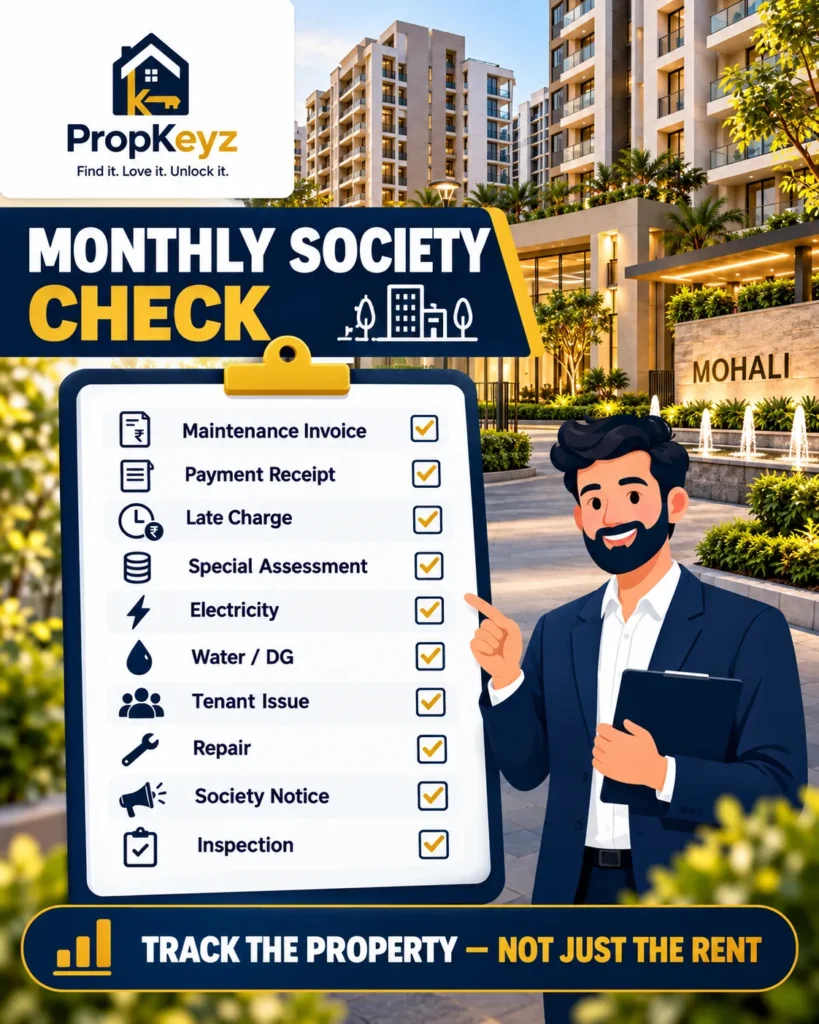
Every month check:
- society maintenance invoice;
- payment receipt;
- late charges;
- special assessment;
- electricity;
- water/DG;
- society notice;
- physical condition;
- access/keys;
- owner contact record with RWA.
PropKeyz already recommends society-record and maintenance-dues monitoring as part of remote property oversight.
NRI Property Record Monitoring Tricity 2026
NRI Owner With a Tenant
A rented NRI flat needs an even broader workflow.
Track:
- rent;
- tenant KYC;
- police verification;
- society maintenance;
- utilities;
- inspection;
- repairs;
- agreement renewal;
- move-out condition.
For Mohali’s current tenant-verification framework:
Tenant Verification in Mohali 2026
Important
Society maintenance compliance does not replace:
- rent agreement;
- tenant verification;
- rental tax/TDS compliance.
Monthly Property-Management Checklist
Rent
- due?
- paid?
- arrears?
Society
- maintenance invoice?
- paid?
- receipt?
- penalty?
- special demand?
Utilities
- electricity?
- water?
- DG?
Tenant
- complaint?
- maintenance request?
- society issue?
Property
- inspection due?
- visible leakage?
- appliance issue?
Documentation
- receipt logged?
- owner approval stored?
- invoice stored?
Owner Update
Simple monthly summary:
Rent | Society | Utilities | Property | Action Required
Can Owners Ask for Audited Society Accounts?
The model bye-laws in the Punjab Apartment Ownership Rules provide for structured association accounting.
They state that the association should publish an:
audited financial statement
by July 31 each year and make it available for inspection by members, with a copy submitted to the competent authority by August 15.
Why This Matters
If maintenance jumps materially, an owner can ask for:
- annual accounts;
- expense heads;
- reserves;
- liabilities.
PropKeyz Rule
Transparency Is Part of Good Society Governance—not an Owner Asking for a Favour.
Purab Premium Apartments 2026 — Current Mohali Maintenance Context
A May 25, 2026 Punjab State Consumer Commission decision involved several Purab Premium Apartments complainants.
Their disputes included claims relating to:
- maintenance charges;
- project issues;
- refund demands.
The case record also notes GMADA’s position that maintenance had been handed to the Residents Welfare Association from:
1 July 2023.
The proceedings are relevant because they show that maintenance disputes can become serious enough to reach consumer forums.
Read the case:
Gurdip Singh v Greater Mohali Area Development Authority — 25 May 2026
What the Purab Case Did NOT Decide
This is extremely important.
The State Commission said it was:
not going into the merits
and dismissed the relevant complaints on:
pecuniary-jurisdiction grounds
while giving complainants liberty to approach the appropriate forum/court.
Therefore Do Not Write
“Consumer Commission held Purab maintenance charges illegal.”
That would be incorrect.
Correct PropKeyz Position
Maintenance grievances were raised, but the May 2026 State Commission decision did not finally decide those claims on merits.
Resale Buyer Checklist

Before buying a flat in Mohali:
Society
- current maintenance bill;
- previous arrears;
- special assessments;
- penalty;
- transfer charge if applicable;
- written dues statement.
Utilities
- electricity;
- water;
- DG.
Ownership
- seller name;
- conveyance/sale deed;
- association record.
Physical
- common-area condition;
- lift;
- parking;
- leakage;
- tower maintenance.
Final Buyer Rule
Price Negotiation Comes After Dues Verification
Landlord Checklist Before Giving a Flat on Rent
- Clear/document old maintenance dues.
- Decide who pays monthly maintenance.
- Put it in agreement.
- Separate utility charges.
- Define minor/major repairs.
- Define special assessments.
- Complete tenant verification.
- Record move-in condition.
- Update society tenant/owner information.
- Keep monthly receipt trail.
For broader landlord management:
Property Management Services in Tricity 2026
Tenant Checklist
Before signing:
- monthly rent?
- monthly maintenance?
- maintenance included/excluded?
- water?
- DG?
- parking?
- move-in charge?
- old dues?
- repair responsibility?
- society rules?
PropKeyz Rule
Ask for the Total Monthly Occupancy Cost—not Only the Rent.
Confirmed Rules vs Common Assumptions
| Confirmed / Supported | Do Not Automatically Assume |
|---|---|
| Common expenses are charged within apartment ownership framework | Tenant always bears all charges |
| Occupier may be pursued in specified cases | Owner has no responsibility once rented |
| Non-use does not waive common expense | Vacant flat = zero maintenance |
| Unpaid dues can become a charge on flat | Maintenance is just an informal society bill |
| Buyer can face previous dues | Seller’s dues can always be ignored |
| Buyer may obtain Board dues statement | Verbal “no dues” is enough |
| Model bye-laws refer to floor-area assessment | Every society can use any super-area figure |
| GST has ₹7,500 + ₹20L tests | GST applies whenever bill crosses ₹7,500 |
| If taxable, entire qualifying contribution is taxed | Only amount above ₹7,500 is taxable |
| Internal repairs are separate from common repairs | Everything is “society maintenance” |
| Purab complaints raised maintenance issues | State Commission declared maintenance illegal |
PropKeyz Analysis
The Mohali Society Maintenance Charges 2026 issue matters because maintenance is one of the few property costs that touches:
- landlords;
- tenants;
- buyers;
- sellers;
- NRIs;
- RWAs.
1. Owner vs Tenant Is Often Drafting Failure
Many disputes start because the agreement says:
“maintenance extra”
without explaining:
- which maintenance;
- special assessment;
- repairs;
- utility charges.
2. Vacant Owners Still Need Active Monitoring
A property can be:
empty
and still generate:
- maintenance;
- utilities;
- notices;
- deterioration.
3. Maintenance Dues Can Affect Resale
Section 27 makes this more than a monthly-cashflow issue.
It is:
transaction due diligence.
4. Society Accounting Matters
Maintenance should be connected to:
- actual common expenses;
- approved assessment;
- documented accounts.
5. GST Is Often Explained Incorrectly
The real test is not only:
₹7,500.
The RWA turnover condition matters too.
6. IFMS and Monthly Maintenance Should Not Be Mixed
One is generally a project/security concept.
The other is recurring common-expense collection.
7. NRI Owners Need a Local Document Trail
A remote owner should not discover:
six months of unpaid society dues
only when a tenant vacates or the owner decides to sell.
8. Property Management Should Track the Invoice and the Property
Simply paying a society bill is not complete property management.
A better process also checks:
- why bill changed;
- property condition;
- tenant issue;
- owner approval.
9. Resale Buyers Need a Society File
Title due diligence without society due diligence can leave a buyer with:
an avoidable arrears problem.
10. The Rent Agreement Should Mirror Real Operations
If the tenant actually pays maintenance every month:
write that.
If owner pays:
write that.
If maintenance is included:
write that.
Final PropKeyz Analysis
Society maintenance should be managed as a property ledger, not an occasional bill. Owners need to know what is recurring, what is one-time, who is contractually responsible, what remains outstanding and what could affect future resale. For NRI and outstation owners, that visibility is one of the core reasons professional property management can be valuable.
PropKeyz Verdict: Mohali Society Maintenance Charges 2026
For Owners
Do not assume:
vacant = maintenance free.
For Landlords
Do not leave:
owner vs tenant maintenance responsibility
undefined.
For Tenants
Ask for:
total rent + maintenance + utilities
before move-in.
For Buyers
Get:
a written society dues statement
before completing the resale.
For NRI Owners
Track monthly:
Invoice → Payment → Receipt → Notice → Property Status
For GST
Remember:
₹7,500 monthly contribution + ₹20 lakh annual RWA turnover
are both relevant under the CBIC circular.
Final PropKeyz Rule
The cleanest society-maintenance system is one where every demand has a basis, every payment has a receipt, every tenant obligation is written, and every owner can see the outstanding balance without asking five people.
Frequently Asked Questions
Who pays society maintenance in Mohali — owner or tenant?
Punjab apartment law places common expenses within the apartment-ownership framework and allows recovery from an occupier where the owner is not occupying the flat.
Who ultimately bears recurring maintenance between owner and tenant should be clearly stated in the rent agreement.
Can an RWA collect maintenance directly from a tenant?
Section 24 permits recovery from the occupier where the apartment owner is not in occupation, subject to the statutory framework.
Does a vacant flat have to pay maintenance?
Mere vacancy/non-use does not automatically remove the owner’s common-expense liability.
What if I never use the clubhouse or gym?
Non-use of common facilities alone does not automatically waive common-expense liability.
Can society maintenance dues affect the flat itself?
Section 26 provides that unpaid assessed common expenses can constitute a charge on the apartment, subject to statutory priority exceptions.
Can a resale buyer become liable for old maintenance?
Section 27 creates potential joint/several liability with the prior owner for unpaid assessments up to transfer, subject to the section’s protections.
What should a resale buyer ask from RWA?
Ask for:
- written outstanding statement;
- latest maintenance receipt;
- special assessment;
- penalties;
- other society dues.
Is an NOC enough?
An NOC can be useful, but examine what it actually certifies and the date through which dues are cleared.
How are maintenance charges calculated in Punjab apartments?
The model bye-laws refer to pro-rata floor-area assessment, while the Act also connects expenses to undivided interest.
Check the society’s registered framework.
Can a society charge on super area?
Do not assume yes or no without checking the valid assessment basis and association documents.
What is IFMS?
Usually Interest-Free Maintenance Security, but its exact terms are project-specific.
Is IFMS the same as monthly maintenance?
No.
What is a sinking fund?
A reserve generally intended for replacement of long-term fixed/common assets.
Can society charge corpus fund?
Verify the legal/bye-law basis, approval and purpose of any corpus demand.
Is there a standard Mohali move-in fee?
No universal statewide amount was identified in the core Punjab apartment-law sources reviewed.
Can society charge late-payment interest?
Check the registered bye-laws and legal basis; do not assume one statewide standard percentage.
Is GST charged if maintenance is above ₹7,500?
Not solely for that reason.
Under CBIC guidance, the RWA’s annual aggregate turnover must also be ₹20 lakh or more for the specified taxability.
If maintenance is ₹9,000, is GST charged only on ₹1,500?
No.
Where the RWA is taxable under the CBIC framework, GST applies on the entire qualifying ₹9,000 contribution.
What GST rate does the CBIC circular use?
18%.
If RWA turnover is below ₹20 lakh?
CBIC says GST is not required merely because monthly maintenance exceeds ₹7,500.
Who pays internal AC repair?
The apartment-ownership model bye-laws place internal installations on the apartment-owner side, while a rent agreement may separately allocate ordinary repair costs between landlord and tenant.
Who pays lift maintenance?
Normally a common-area/common-service expense rather than an internal apartment repair.
Who pays damage caused by a tenant?
The factual cause and rent agreement matter. The owner may remain answerable to the association and separately recover from the tenant where contract/law allows.
Can an NRI owner ignore society notices because the flat is rented?
No.
The owner should maintain visibility over society dues and major notices even where tenant handles routine payments.
Can a property manager pay and track society dues?
A property manager can coordinate tracking, reminders and receipts within the agreed service scope.
What is the safest owner rule?
Keep the rent agreement, society ledger and payment receipts aligned.
Continue Your Property Management Research
Property Management Company in Mohali
For tenant coordination, rent follow-up, inspections, maintenance support and owner reporting:
Property Management Company in Mohali 2026
Property Management Services in Tricity
Understand recurring property-management workflows across Mohali and surrounding Tricity markets:
Property Management Services in Tricity 2026
Tenant Verification in Mohali 2026
For the current landlord verification process:
Tenant Verification in Mohali 2026
NRI Property Record Monitoring Tricity 2026
For remote society records, maintenance dues and document monitoring:
NRI Property Record Monitoring Tricity 2026
Mohali NRI Property Protection 2026
For inspections, record monitoring and vacant-property risk:
Mohali NRI Property Protection 2026
Purab Premium Apartments Mohali 2026
For current Sector 88 buyer, owner and maintenance-related due diligence:
Purab Premium Apartments Mohali 2026
Property Management Support Through PropKeyz
PropKeyz supports NRI, outstation and busy local owners with property-management coordination across selected Mohali and Tricity markets.
Current service workflows can include:
- rent tracking;
- tenant coordination;
- property inspection;
- maintenance coordination;
- move-in/move-out support;
- society-bill monitoring;
- utility reminders;
- owner reporting.
PropKeyz’s current Property Management Company in Mohali guide lists starting plans including Rent Assist, Full Care and NRI Property Care, with final scope/pricing dependent on the property and required service level.
Need Support With a Rented Flat?
Share:
- property location;
- society/project;
- rent;
- tenant status;
- recurring maintenance amount;
- current owner location.
NRI or Outstation Owner?
A structured monthly report can help you monitor:
Rent + Society + Utilities + Property Condition + Pending Action
Explore current services:
Your Property. Our Responsibility.
Sources & Verification
This article was last fact-checked on:
28 September 2026
Punjab Urban Planning & Development Authority — Punjab Apartment Ownership Act, 1995
Used for:
- Sections 24–29;
- owner/common-expense framework;
- vacant/non-use liability;
- old dues;
- resale-transfer liability;
- association recovery rights.
Punjab Apartment Ownership Act, 1995 — Official PUDA PDF
Punjab Apartment Ownership Rules, 1995
Used for:
- model bye-laws;
- internal repairs;
- common-expense assessment;
- floor-area calculation;
- association powers;
- audited financial statements.
Punjab Apartment Ownership Rules, 1995
CBIC Circular 109/28/2019-GST
Used for:
- ₹7,500 monthly RWA threshold;
- ₹20 lakh annual turnover condition;
- GST on entire contribution where taxable;
- 18% example;
- multiple-apartment clarification.
CBIC Circular — GST on RWA Maintenance Contributions
Punjab State Consumer Commission — Purab Premium Proceedings
Used to explain:
- current 2026 maintenance-dispute context;
- maintenance refund claims;
- pecuniary-jurisdiction ruling;
- no decision on merits.
Gurdip Singh v GMADA — 25 May 2026
Disclaimer
This article is intended for:
- property-management education;
- owner awareness;
- tenant awareness;
- resale due diligence;
- NRI property-management guidance.
It does not constitute:
- legal advice;
- society audit;
- GST advice;
- accounting advice;
- a finding that any particular RWA charge is valid or invalid.
The actual responsibility for a society charge can depend on:
- Punjab apartment law;
- registered association bye-laws;
- conveyance/allotment documents;
- valid association resolutions;
- rent agreement;
- nature of charge;
- GST registration/turnover status;
- specific facts.
Before disputing or withholding a material society payment, owners should review the applicable documents and obtain qualified professional advice where necessary.
PropKeyz does not guarantee:
- RWA action;
- waiver of dues;
- removal of penalties;
- GST treatment;
- tenant reimbursement;
- resale clearance.
Your Property. Our Responsibility.