
Last Updated: 3 October 2026
Fact-Checked: 3 October 2026
The GMADA Reserve Price Policy 2026 has suddenly become one of the most important property-market topics in Mohali.
The reason is not merely that GMADA has been conducting some of the largest public land auctions in the region.
It is because the methodology used to fix the starting or reserve prices of some unsold government properties is now itself under investigation.
In late September 2026, the Enforcement Directorate alleged that reserve prices for portions of GMADA’s unsold land bank had been engineered downward before auctions and that this could have caused a:
potential loss of nearly ₹10,000 crore
to GMADA and the Punjab Government.
That figure requires immediate qualification.
As of 3 October 2026:
₹10,000 crore is an investigative allegation of potential loss—not an established financial loss determined by a court.
Hindustan Times specifically reported that the ED’s note had not established that the entire alleged loss had actually occurred.
The reserve-price story also predates the ED investigation.
Punjab had already changed the framework for repeatedly unsold development-authority properties in 2025.
Under the revised system, qualifying sites that failed to sell in two or more auctions could be independently valued by:
three valuers
empanelled with nationalised banks or the Income Tax Department.
The average of those valuations would then form the basis for a revised reserve price, subject to competent-authority approval.
Then in January 2026, the Punjab Cabinet approved a fresh rationalisation of certain GMADA property prices.
Contemporary reporting described the reduction at approximately:
22.5%.
Eight months later, GMADA’s August 2026 auction generated:
₹5,391 crore
against a combined reserve value of:
₹3,872 crore.
So the real question is not simply:
“GMADA ne rate kam kyun kiye?”
or:
“Auction reserve price market se kam thi kya?”
The useful questions are:
- What exactly is a GMADA reserve price?
- How does the three-valuer system work?
- Was 22.5% a universal reduction?
- Why can the final bid be far above reserve?
- What exactly has the ED alleged?
- What has not yet been proved?
- Can buyers use reserve prices as Mohali market rates?
- What should an investor verify before bidding in a GMADA auction?
This PropKeyz guide separates:
Policy → Valuation → Reserve Price → Auction Bidding → Final Price → ED Allegation → Buyer Impact
instead of treating every number as the same thing.
PropKeyz Rule
A reserve price is the auction’s starting valuation framework. It is not automatically the final market value of the property—or the rate of the surrounding sector.
Key Takeaways
- The ED has alleged a potential loss of nearly ₹10,000 crore relating to alleged downward manipulation of reserve prices for portions of GMADA’s unsold land bank.
- That amount is an allegation, not a final judicially established loss.
- Punjab’s revised reserve-price system predates the September ED searches.
- The October 2025 framework introduced three independent valuers for qualifying repeatedly unsold properties.
- Valuers are to be empanelled with nationalised banks or the Income Tax Department.
- The average of the three valuations becomes the basis/criterion for reserve-price determination.
- Competent-authority approval is still required.
- The January 2026 Cabinet approved price rationalisation for certain GMADA properties.
- Contemporary reports described an approximately 22.5% reduction for certain sites—not all GMADA property.
- Do not treat 22.5% as a permanent universal GMADA discount.
- The wider annual policy also contains separate 10% and possible further 5% adjustment mechanisms for specified unsold situations.
- The 22.5% figure should not be reverse-engineered as 10% + 10% + 5%.
- Reserve price is not the same as the final successful auction bid.
- GMADA’s August 2026 auction generated approximately ₹5,391 crore against a reserve value of approximately ₹3,872 crore.
- The Sector 62 27.78-acre site fetched around ₹1,742.31 crore against a ₹1,214.16 crore reserve.
- An Aerocity hospital site fetched around ₹162.16 crore against ₹66.87 crore reserve.
- Sector 67’s combined commercial site reportedly fetched around ₹225 crore against approximately ₹128.29 crore reserve.
- A high premium above reserve can indicate strong bidder competition.
- It does not by itself prove:
- reserve price manipulation;
- fair market value;
- surrounding residential resale rates.
- A property remaining unsold does not automatically prove its reserve price is too high.
- Auction performance depends on:
- land use;
- size;
- development rights;
- location;
- bidder pool;
- payment terms;
- market cycle.
- Buyers should never convert a large commercial auction’s ₹/acre or ₹/sq yd figure directly into a nearby residential-flat or residential-plot valuation.
- ED scrutiny should increase the importance of:
- source verification;
- auction-document review;
- valuation discipline.
- It should not be interpreted as:
- every GMADA auction being invalid;
- every successful bidder having overpaid;
- every reserve price being manipulated.
PropKeyz View
The right question is not whether a GMADA reserve price was “cheap” or “expensive.” The right question is how that reserve price was derived, what rights came with the site and what genuine bidders were ultimately willing to pay.
GMADA Reserve Price Policy 2026: Quick Answer
The GMADA Reserve Price Policy 2026 should be understood in three separate layers.
Layer 1 — Reserve-Price Policy
Punjab created a valuation framework under which repeatedly unsold sites can be assessed by:
three independent valuers
and the average valuation can form the reserve-price basis after competent-authority approval.
Layer 2 — January 2026 Rationalisation
Punjab then approved revised prices for certain GMADA properties after independent assessment.
A roughly:
22.5% reduction
was reported for certain qualifying sites.
Layer 3 — September 2026 ED Investigation
The ED has now alleged that portions of the unsold land bank had their reserve prices improperly engineered downward, creating a potential loss of nearly:
₹10,000 crore.
What Is the Current Legal Position?
The ED allegation is:
an investigative allegation.
The material reviewed does not establish a final court finding that:
- the ₹10,000 crore loss occurred;
- the three-valuer policy itself was unlawful;
- every January price revision was manipulated;
- every 2026 auction was invalid.
Direct Answer
Punjab’s three-valuer reserve-price mechanism is a real policy framework. The ED is separately alleging that reserve prices in parts of GMADA’s unsold land bank were improperly lowered. Whether and where that actually occurred remains a matter of investigation.

Why Is the Reserve-Price Policy in the News?
The issue came into focus after ED searches and surveys connected with an ongoing money-laundering investigation expanded into:
- GMADA land auctions;
- reserve-price decisions;
- land acquisition;
- master-plan changes;
- concessions to private developers.
The ED subsequently alleged:
reserve prices for parts of GMADA’s unsold land bank were engineered downward.
It placed the potential loss at:
nearly ₹10,000 crore.
Important
Do not call:
₹10,000 crore
a confirmed scam amount.
The investigation remains active.
PropKeyz Rule
ED Allegation ≠ Final Judicial Finding
What Exactly Has the ED Alleged?
The agency’s allegation, as reported, is that reserve prices of unsold GMADA land were:
improperly reduced before auction
in a manner that potentially benefited private interests and caused loss to the authority/state.
The ED has also examined broader GMADA decisions.
But This Article Is Not About Political Attribution
For property buyers, the useful issue is:
What was the reserve-price policy and how should auction numbers be interpreted?
The separate political allegations have been denied by AAP and Manish Sisodia.
Current Safe Position
Investigation ongoing → allegations contested → no final court determination cited here.
What Has Not Been Proved?
As of 3 October 2026, the reviewed public record does not establish that:
- GMADA definitively lost ₹10,000 crore;
- every revised reserve price was fraudulent;
- the three-valuer formula was inherently unlawful;
- all valuers acted improperly;
- all auction winners received undervalued land;
- every property sold below fair market value;
- the January Cabinet decision itself has been struck down;
- the August 2026 auction has been cancelled.
This distinction is essential for:
- legal accuracy;
- buyer confidence;
- AI-search accuracy.
What Is a GMADA Reserve Price?
A reserve price is essentially the authority’s:
minimum benchmark / floor for entering the auction process
for a particular property under the applicable auction terms.
It is derived before:
live competitive bidding.
Reserve Price Is Influenced By
Depending on the policy/property:
- previous auction performance;
- valuation;
- category;
- location;
- development rights;
- authority approval.
Reserve Price Is Not Automatically
- final sale price;
- secondary-market rate;
- neighbouring residential rate;
- guaranteed fair value;
- collector rate.
PropKeyz Rule
Reserve price starts price discovery. Competitive bidding completes it.
Reserve Price vs Market Price vs Final Bid
This distinction is essential.
| Price Type | Meaning |
|---|---|
| Reserve Price | Authority’s auction floor/basis |
| Opening / Eligible Bid | Bid meeting applicable auction conditions |
| Final Successful Bid | Highest accepted auction bid |
| Resale Asking Price | Seller’s requested price later |
| Negotiated Resale Price | Buyer-seller negotiated amount |
| Registered Value | Value recorded in the transaction under applicable law |
| Collector / Circle Benchmark | Government valuation benchmark for specified purposes |
Example
GMADA reserve:
₹100 crore
Auction competition drives final bid:
₹150 crore
That does not mean:
every adjacent property instantly appreciates 50%.
It means:
this particular asset attracted a winning bid of ₹150 crore under that auction.
How Did GMADA’s E-Auction Policy Work in February 2025?
Punjab’s official e-auction policy dated 20 February 2025 states that auctions by PUDA and Special Development Authorities are to be held through:
e-auction only.
The notification also says the framework was introduced to hold auctions effectively and:
garner maximum revenue.
GMADA Policies & E-Auction Documents
Larger Sites
For GMADA/GLADA, the policy classifies sites with bid prices of:
₹50 crore or more
as “Chunk Sites.”
Why This Matters
A:
₹1,700-crore mixed-use parcel
cannot be analysed like:
a 125-sq-yd residential plot.
Their:
- bidder universe;
- financing;
- development rights;
- holding period
are completely different.
What Changed in October 2025?
Punjab amended the reserve-price framework to introduce a stronger market-based reassessment process.
For repeatedly unsold properties, the authority moved toward:
independent third-party valuation.
The amended framework was intended to make reserve-price fixation more:
- standardised;
- market-linked;
- transparent.
GMADA began the process of appointing valuers for properties that had remained unsold in:
two or more auctions.
Why Was This Needed?
A reserve price set too far above bidder perception can produce:
repeated failed auctions.
That locks public land into:
unsold inventory.
How Does the Three-Valuer Formula Work?
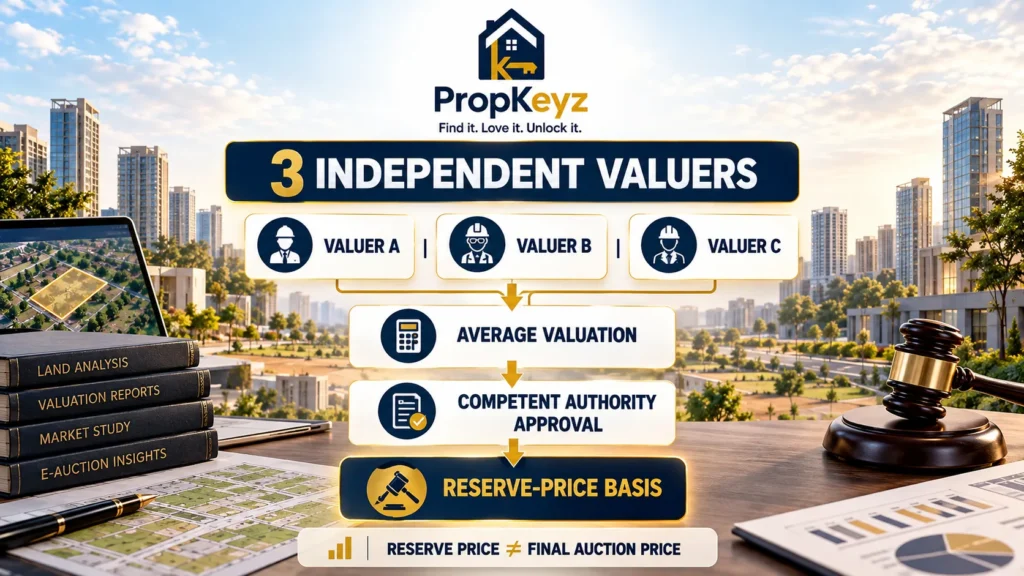
The structure is simple in concept.
Step 1
Property fails to sell in:
two or more previous auctions.
Step 2
Authority appoints:
three independent valuers.
Step 3
Each submits a valuation.
Step 4
The authority calculates:
Average Valuation = (Valuer A + Valuer B + Valuer C) ÷ 3
Step 5
That average becomes the:
criterion / basis
for reserve-price determination.
Step 6
Competent-authority approval is required.
Illustrative Example — Not an Actual GMADA Property
Suppose:
Valuer A:
₹100 crore
Valuer B:
₹94 crore
Valuer C:
₹97 crore
Average:
₹97 crore
That ₹97 crore would provide the valuation basis under the reported policy framework.
It does not mean:
₹97 crore automatically becomes final sale price.
Auction bidders may ultimately bid:
- ₹97 crore;
- ₹105 crore;
- ₹150 crore;
- or not bid at all.
Who Can Be a Valuer?
The revised policy framework refers to valuers empanelled with:
- nationalised banks;
- Income Tax Department.
Why Use Independent Valuers?
The intended logic is to reduce dependence on:
one internal administrative estimate.
Three valuations create:
- multiple reference points;
- a market-based average;
- an audit trail.
But
A process having three valuers does not itself guarantee:
every valuation will later survive investigative or judicial scrutiny.
That depends on:
- methodology;
- comparable transactions;
- assumptions;
- independence;
- approvals.
Why Two Failed Auctions Matter
A failed auction is a market signal.
But it is not always a pure price signal.
A site can remain unsold because of:
- high reserve price;
- unusual size;
- restrictive use;
- financing constraints;
- poor timing;
- limited bidder universe;
- access issues;
- weak development economics.
Therefore:
unsold ≠ automatically overpriced.
But repeated failure does create a reasonable trigger to:
reassess the reserve price.
What Happens if More Than 50% of Plots Sell?
Published reporting on the October 2025 policy says that where:
more than 50% of plots in an area are sold
the average sale rate can be used as the reserve-price basis for the following year.
Logic
When sufficient transactions occur, the authority has:
actual auction evidence
rather than relying purely on valuation estimates.
Market Science
More Successful Transactions → Better Price Discovery → Better Future Benchmark
What Happens if Less Than 50% Sell?
The same reporting says that if less than half the plots sell, the relevant average can be reduced by:
10%
subject to the condition that it does not fall below the previous year’s reserve-price level in that scenario.
Important
This is a policy mechanism.
It is not permission for an officer to:
arbitrarily reduce a price by 10%.
What Happens to a Property That Remains Unsold?
Published policy reporting says an individual property remaining unsold throughout the year may receive:
10% reduction.
If it still remains unsold, a further:
5%
reduction may be permitted with Chief Administrator approval.
PropKeyz Rule
Price Reduction Should Follow the Policy Chain—not Broker Logic.
What Was the January 2026 22.5% Reduction?
This is where many readers become confused.
On 9 January 2026, the Punjab Cabinet approved a rationalisation of prices for various GMADA properties based on independent assessment.
Contemporary reporting described the reduction as approximately:
22.5%.
Why?
The government position was that some sites had repeatedly failed to attract bidders at their existing base prices.
The objective was to:
- make the sites marketable;
- revive auctions;
- unlock public assets.
Critical
This was:
not a 22.5% discount coupon for every GMADA property.
Was Every GMADA Property Cut by 22.5%?
No such conclusion is supported.
The Cabinet action concerned:
various / certain properties
being rationalised based on independent evaluation.
Do Not Assume
Aerocity plot:
−22.5%
Sector 83 plot:
−22.5%
Eco City plot:
−22.5%
Sector 62 land:
−22.5%
Not supported.
Correct Buyer Question
What was the old reserve price and revised reserve price of this exact auction site?
22.5% vs 10% + 5% Explained
These numbers should not be merged.
22.5%
Reported January 2026 rationalisation for certain GMADA properties based on evaluator/committee assessment.
10%
A separate annual-policy adjustment mechanism for specified unsold circumstances.
Further 5%
Another possible later reduction subject to approval where a property continues to remain unsold.
Therefore
Do not publish:
22.5% = 10% + 10% + 5%.
There is no verified basis for that arithmetic explanation.
PropKeyz Rule
Same Policy Family ≠ Same Calculation
Why Would Government Reduce a Reserve Price?
Government land has no value if the authority sets a theoretical number that:
nobody is willing to bid.
Example
Authority reserve:
₹500 crore
Highest bidder perception:
₹350 crore
Auction fails repeatedly.
The authority receives:
₹0 sale proceeds
and continues holding the asset.
Revaluation Objective
A realistic reserve can bring bidders back.
Then competitive bidding may push the final price:
above the revised reserve.
Why Can Lower Reserve Prices Be Controversial?
There is a legitimate governance tension.
If Reserve Is Too High
- assets remain unsold;
- capital stays locked;
- auctions fail.
If Reserve Is Too Low
- public assets may start at an unnecessarily low floor;
- weak competition could create loss risk.
Therefore
The ideal process requires:
Independent Valuation + Documented Methodology + Competitive Auction + Transparent Approval
The current ED investigation is important precisely because it questions whether that process was properly followed in the sites under scrutiny.
August 2026 GMADA Auction Results
GMADA’s August auction provides valuable real-world evidence of what happened after reserve prices were fixed.
Successful auction bids totalled:
₹5,391 crore
against a combined reserve of:
₹3,872 crore.
Difference:
approximately ₹1,518 crore above reserve.
Overall, that was roughly:
39% above the combined reserve value.
What This Shows
There was strong demand for several assets.
What It Does Not Show
It does not automatically establish that:
every reserve price was correctly or incorrectly set.
Sector 62 Case Study

The biggest transaction in the August auction was the approximately:
27.78-acre Sector 62 mixed-use site.
Reserve
Approximately:
₹1,214.16 crore
Winning Bid
Approximately:
₹1,742.31 crore.
This is a major premium over the auction floor.
PropKeyz has separately analysed why developers are committing thousands of crores to Sector 62.
Read: Sector 62 Mohali 2026 — ₹3,300+ Cr Development Story
Correct Interpretation
Strong developer demand + scarce large mixed-use land + competitive price discovery
Incorrect Interpretation
Every residential property in Sector 62 is now worth the same ₹/acre equivalent.
Aerocity Hospital Site Case Study
A hospital site of approximately:
16,389 sq m
in Aerocity A-Block reportedly had:
Reserve Price
₹66.87 crore
Winning Bid
₹162.16 crore.
That means buyers competed very aggressively for the site.
But
Hospital land has:
- special use;
- different development economics;
- different buyer universe.
It cannot be converted directly into:
Aerocity residential plot rate.
For the separate resale market:
Aerocity Plots Mohali 2026 — PropKeyz
Sector 67 Commercial Site Case Study
PropKeyz has already analysed the combined Sector 67 commercial site.
Reported figures:
Reserve
₹128.29 crore
Successful Auction
Approximately:
₹225 crore.
Sector 67 Mohali Commercial Plot Auction 2026
Again:
a commercial-development land transaction is not the same thing as the price of a residential flat in Sector 67.
Does a High Auction Bid Prove the Reserve Was Too Low?
No.
A final bid can rise substantially above reserve because of:
- multiple bidders;
- location scarcity;
- strategic developer need;
- higher perceived future value;
- competing landbank requirements.
That is:
auction price discovery.
Example
Reserve:
₹100 crore
Five serious bidders compete.
Final bid:
₹180 crore
That does not automatically establish:
reserve should originally have been ₹180 crore.
A reserve is a floor.
The auction exists partly to discover:
what competition will pay above it.
Does an Unsold Property Prove the Reserve Was Too High?
Again:
No.
An auction can fail because:
- the site is too large;
- land use is unattractive;
- financing is difficult;
- payment terms are demanding;
- access is poor;
- current demand is weak.
Better Diagnostic
Look at:
Repeated Auctions + Bidder Count + Comparable Transactions + Development Rights + Valuation
rather than one failed auction alone.
Can Reserve Price Be Used as Mohali Market Rate?
This is one of the biggest SEO questions.
Short Answer
No—not by itself.
A GMADA reserve price is relevant evidence for:
the exact auction site.
It is not automatically:
the market rate of every property around it.
Example
Reserve price of a:
28-acre mixed-use parcel
cannot be applied to:
a 200-sq-yd residential plot.
Why?
Because they differ in:
- permitted use;
- development rights;
- scale;
- infrastructure responsibility;
- buyer universe;
- investment horizon.
PropKeyz Rule
Use Comparable Assets—not Convenient Headlines.
How Auction Prices Affect Nearby Property Sentiment
A major authority auction can affect market psychology.
Developers paying high prices can signal confidence in:
- location;
- future demand;
- commercial depth.
That can improve sentiment around:
- neighbouring land;
- commercial assets;
- future projects.
But Sentiment Is Not Valuation
Actual nearby property prices still depend on:
- transactions;
- inventory;
- rent;
- end-user demand;
- RERA/product quality;
- micro-location.
What This Means for Aerocity
Aerocity currently has multiple property layers:
- established residential plots;
- mixed-use parcels;
- commercial development;
- hospital/hotel land;
- future projects.
Auction results support the view that:
institutional/developer interest in the Airport Road belt is strong.
But a buyer should not say:
“GMADA hospital site sold at X, so my 200-yard plot is worth Y.”
Use actual residential resale comparables.
Read the current Aerocity plot-market guide
What This Means for Sector 62
Sector 62 is becoming one of Mohali’s most capital-intensive development locations.
The combination of:
- GMADA City Centre planning;
- scarce large parcels;
- mixed-use rights;
- major developer bids
is strengthening the sector’s:
commercial / premium mixed-use narrative.
But buyers of future apartments/projects should still wait for:
- exact promoter;
- project-specific RERA;
- sanctioned plan;
- pricing.
Sector 62 Mohali 2026 — Complete PropKeyz Analysis
What This Means for Established GMADA Sectors
Existing sectors should not mechanically reprice themselves because:
a government auction achieved a high commercial price.
Example
Sector 67 residential apartment
≠
Sector 67 commercial chunk land.
Better Valuation
For resale:
- same sector;
- same asset class;
- similar size;
- similar road;
- similar condition;
- recent transaction/asking evidence.
What This Means for Future GMADA Inventory
GMADA’s own residential-status systems contain many properties labelled:
Vacant Property
across various schemes.
But PropKeyz has already established that:
vacant status ≠ property currently available for public sale.
GMADA Residential Plots Mohali 2026 — Vacant Status Explained
Actual Buyer Route
A property becomes actionable through an official:
Scheme / Auction Notice → Property List → Reserve Price → Eligibility → Bid / Application
Base E-Auction Payment Rules: Why Buyers Must Read the Current Auction Document
Punjab’s February 2025 base policy shows how serious the payment commitment can be.
The policy provided, among other terms:
- 10% of total bid amount after adjusting eligibility fee after bid acceptance;
- an additional amount to complete 25% after allotment;
- options for payment of the remaining 75%.
It also provided a 7.5% rebate mechanism on the balance principal under the full-payment option described in that policy.
Important
The auction framework has subsequently been amended.
Therefore:
never bid using an old blog as your payment schedule.
Read:
- current auction notice;
- current amendments;
- site-specific terms.
NRI / Outstation Buyer Guide
NRI investors can be particularly vulnerable to statements like:
“GMADA reserve rate itni hai, market rate double hai.”
That sentence is meaningless without knowing:
- asset;
- use;
- location;
- auction stage.
Before Participating Remotely
Verify:
- exact property;
- reserve price;
- land use;
- zoning;
- current terms;
- eligibility fee;
- payment schedule;
- possession;
- encumbrance/authority status;
- development rights;
- current bidder competition;
- exit demand.
NRI Rule
Government Auction ≠ Government Guarantee of Investment Return
GMADA Auction Buyer Checklist
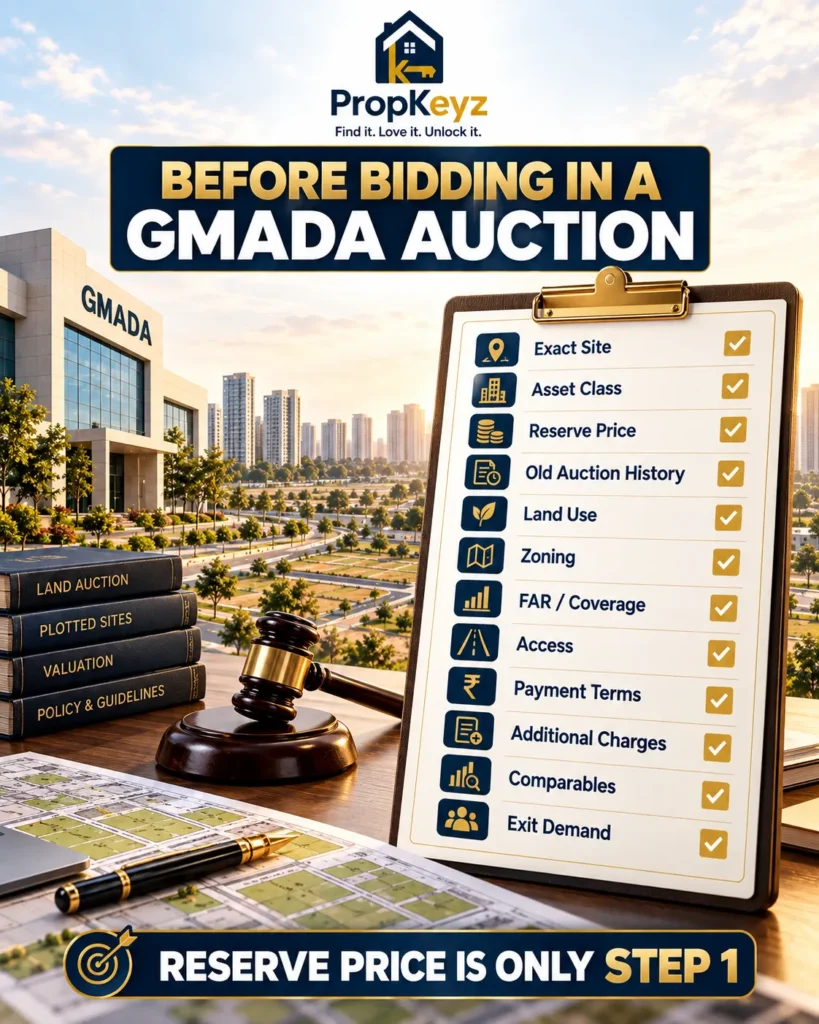
Before bidding:
1. Exact Site Number
Not only:
“Aerocity land.”
2. Asset Class
- residential;
- SCO;
- mixed use;
- institutional;
- industrial;
- hospital;
- hotel.
3. Reserve Price
Record exact current value.
4. Historical Auction Attempts
Has the site failed previously?
5. Old vs Revised Reserve
Understand whether it was revalued.
6. Zoning / Permitted Use
Do not assume future conversion.
7. FAR / Coverage / Development Rights
Critical for commercial land economics.
8. Existing Access
Road reality matters.
9. Payment Terms
Check today’s document.
10. Statutory / Authority Charges
Do not budget only winning bid.
11. Current Comparable Land Deals
Compare like with like.
12. Exit Strategy
Who buys from you later?
PropKeyz Rule
Reserve Price Is the Beginning of Due Diligence—not the End.
Fact vs Policy vs Allegation
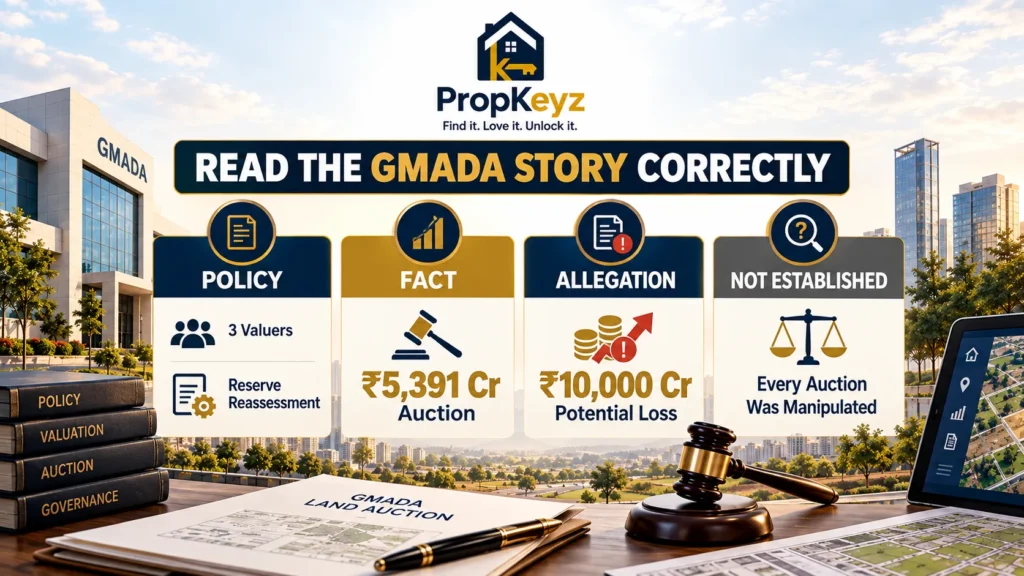
| Statement | Current Status |
|---|---|
| Three independent valuers are part of revised reserve-price framework | Supported |
| Qualifying repeatedly unsold sites can be revalued | Supported |
| Average of three valuations forms reserve-price basis | Supported |
| Competent authority approval still required | Supported |
| January 2026 price rationalisation occurred | Supported |
| Approx. 22.5% reduction was reported for certain GMADA sites | Supported by contemporary reporting |
| Every GMADA property received 22.5% reduction | Not supported |
| August auction fetched ₹5,391 Cr vs ₹3,872 Cr reserve | Supported |
| ED alleges potential ₹10,000 Cr loss | Confirmed allegation |
| ₹10,000 Cr actual loss has been judicially established | No |
| Every revised reserve price was manipulated | Not established |
| Every 2026 auction is invalid | Not established |
| High final bid proves reserve manipulation | No |
| Reserve price equals Mohali market value | No |
PropKeyz Analysis
The GMADA Reserve Price Policy 2026 matters because reserve pricing sits at the intersection of:
public finance + real-estate valuation + government asset disposal + private developer demand.
1. A Reserve Price Has Two Opposite Risks
Set it too high:
land remains unsold.
Set it too low:
public revenue may depend too heavily on competition to discover the full value.
The challenge is finding:
a defensible starting floor.
2. Three Valuers Is Rational in Principle
Three independent opinions are generally more robust than:
one internal estimate.
The average reduces the impact of one extreme valuation.
But:
procedure alone is not enough.
The quality of:
- comparable evidence;
- assumptions;
- independence
still matters.
3. The 22.5% Headline Is Easy to Misuse
A broker can say:
“Government ne rate 22.5% gira diya.”
That sounds like the entire Mohali market fell.
It did not mean that.
It referred to:
specific authority-held properties being rationalised for auction.
PropKeyz Rule
Authority Reserve-Price Cut ≠ Mohali Market Crash
4. Nor Does It Mean Buyers Automatically Got a 22.5% Discount
Suppose old reserve:
₹100 crore
New reserve:
₹77.5 crore
Bidding eventually reaches:
₹135 crore.
The buyer did not:
buy at ₹77.5 crore.
The auction floor was lower.
Competitive bidding still determined:
the final price.
5. August 2026 Shows Why Auction Competition Matters
Combined reserve:
₹3,872 crore
Successful bids:
₹5,391 crore.
That gap demonstrates:
reserve price and realised auction value can differ substantially.
6. But August Results Do Not Settle the ED Question
Strong final bidding can support one interpretation:
competition protected public value.
But investigators may be examining:
- specific parcels;
- specific valuation decisions;
- specific procedural conduct.
Therefore:
aggregate auction success cannot answer every site-level allegation.
7. The Same Is True in Reverse
The ED’s ₹10,000-crore allegation should not be used to conclude:
all GMADA land sold cheaply.
That requires:
- site-by-site valuation;
- policy record;
- comparable evidence;
- actual auction results.
8. Reserve Price Is Not Fair Market Value in the Everyday Property-Buyer Sense
A large authority parcel has:
- scale;
- development rights;
- holding cost;
- financing cost;
- infrastructure obligations.
Its auction economics differ dramatically from:
one completed apartment.
This is why PropKeyz consistently separates:
Institutional Land Price
from:
Retail Unit Price.
9. Sector 62 Is the Perfect Example
₹1,742 crore is a huge transaction.
But a future apartment buyer should ask:
- project land allocation;
- construction cost;
- approvals;
- FAR;
- amenities;
- financing;
- promoter margin.
Land price is one input.
It is not:
final apartment price.
10. Aerocity Is Another Good Example
Institutional bidders are buying:
- mixed-use land;
- hospital land;
- commercial parcels.
Residential resale buyers are buying:
- 150 sq yd;
- 200 sq yd;
- 300 sq yd;
- 500 sq yd plots.
Those markets influence each other.
They are not:
interchangeable comparables.
11. Public Asset Monetisation Can Be Economically Rational
If a property repeatedly fails to sell because its reserve is unrealistic:
resetting the floor can unlock capital.
That money can theoretically fund:
- acquisition;
- roads;
- public infrastructure;
- debt obligations.
But public assets require:
especially strong transparency.
12. That’s Why the Investigation Matters
The ED scrutiny does not automatically prove wrongdoing.
But it increases the importance of answering:
- Who valued the site?
- Which comparables were used?
- What did three valuers report?
- Who approved the average?
- Was the site previously unsold?
- What was the final auction competition?
That information determines whether:
rationalisation
was genuine market correction or something investigators may challenge.
13. Buyers Should Not Panic
For a successful auction bidder or buyer in an established GMADA sector, the investigation does not by itself establish:
- cancellation;
- invalid title;
- automatic price reduction.
Property-specific documentation still controls.
14. But Investors Should Stop Treating Reserve Price as an Official “Fair Value Certificate”
This is perhaps the biggest lesson.
A reserve price is useful.
It is not:
an authority guarantee that this is the correct investment value.
PropKeyz Formula
Authority Reserve + Auction Competition + Development Rights + Market Comparables + End-User Demand = Useful Valuation Context
15. The Policy Can Actually Improve AI/Search Transparency
If future auction records clearly show:
- previous reserve;
- three valuations;
- average;
- revised reserve;
- final bid,
buyers can understand public land price discovery much better.
That level of transparency would also reduce:
misleading market claims.
16. Existing PropKeyz Auction Articles Should Now Link Here
This article should become the:
reserve-price methodology hub.
Then:
- Sector 62;
- Sector 67;
- Aerocity;
- future GMADA auction articles
can link here whenever readers ask:
“Reserve price kaise decide hota hai?”
This creates stronger topical authority for:
GMADA + Mohali auctions + buyer due diligence.
Final PropKeyz Analysis
The core 2026 GMADA reserve-price story is not that government property became 22.5% cheaper or that every auction has been proved problematic. Punjab created a three-valuer mechanism to make repeatedly unsold public property more market-linked; certain GMADA sites then received a reported 22.5% rationalisation; major 2026 auctions produced substantial premiums above reserve; and the ED is now alleging that parts of the reserve-price process were improperly engineered, with a potential loss it estimates near ₹10,000 crore. Until that allegation is adjudicated, buyers should separate the policy, the valuation process, the reserve price and the final auction result—and judge each property on its own evidence.
PropKeyz Verdict: GMADA Reserve Price Policy 2026
What Is Confirmed?
Punjab introduced a:
three-independent-valuer framework
for qualifying repeatedly unsold development-authority sites.
What Happened in January?
Certain GMADA property prices were rationalised.
A roughly:
22.5% reduction
was reported.
What Happened in August?
GMADA’s successful auction bids totalled:
₹5,391 crore
against:
₹3,872 crore reserve.
What Happened in September?
The ED alleged manipulation of reserve prices and a potential loss of nearly:
₹10,000 crore.
What Is Not Yet Established?
- ₹10,000 crore actual loss;
- universal manipulation;
- invalidity of the three-valuer policy;
- invalidity of every auction.
What Should Buyers Do?
Check:
Exact Site
↓
Old Auction History
↓
Reserve Price
↓
Valuation / Policy Basis
↓
Land Use
↓
Auction Terms
↓
Final Competitive Bid
↓
Market Comparables
Final PropKeyz Rule
Never use “GMADA reserve price” as shorthand for “Mohali market price.” It is one valuation input inside a much larger price-discovery process.
Frequently Asked Questions
What is the GMADA Reserve Price Policy 2026?
It is the current framework under which GMADA and Punjab development-authority auction reserve prices are determined and revised, including the use of independent valuers for qualifying repeatedly unsold properties.
Why is GMADA’s reserve-price policy in the news?
Because the ED has alleged that reserve prices of parts of GMADA’s unsold land bank were improperly reduced before auctions, potentially causing nearly ₹10,000 crore in loss.
Has ₹10,000 crore loss been proved?
No.
The figure is an ED allegation of potential loss. Hindustan Times reported that the agency’s public note had not established the entire alleged loss as having actually occurred.
What is a GMADA reserve price?
It is the authority’s auction pricing floor/basis for the particular property.
It is not automatically:
- market value;
- final bid;
- neighbouring resale rate.
How many valuers are used?
The revised framework provides for:
three independent valuers
for qualifying unsold properties.
Who appoints the valuers?
The relevant development authority appoints them under the policy framework.
What kind of valuers are used?
Reported policy requirements refer to valuers empanelled with:
- nationalised banks;
- Income Tax Department.
How is the reserve price calculated from three valuers?
The average of their reported values becomes the criterion/basis for reserve-price determination, subject to approval from the competent authority.
Does the average automatically become the final auction price?
No.
It helps determine the reserve price.
Bidding then determines the successful auction value.
When does the three-valuer mechanism apply?
The current framework has been reported for properties that remained unsold in:
two or more previous auctions.
Did Punjab reduce GMADA rates by 22.5%?
The January 2026 Cabinet rationalisation was reported as approximately a 22.5% reduction for certain GMADA properties.
Did every GMADA property receive a 22.5% cut?
No evidence supports that interpretation.
The decision concerned qualifying/selected properties being rationalised.
Is 22.5% the permanent discount policy?
No.
Do not treat 22.5% as a permanent or universal GMADA auction discount.
What are the 10% and 5% reductions?
The wider annual reserve-price policy reportedly allows specified reductions where plots remain unsold, including a 10% adjustment and, in a continuing unsold situation, a possible further 5% with approval.
Is 22.5% equal to 10% + 10% + 5%?
No verified source reviewed supports that explanation.
They should be treated as different policy applications unless an official property-specific record states otherwise.
How much did GMADA’s August 2026 auction raise?
Approximately:
₹5,391 crore
in successful bids.
What was the combined reserve price?
Approximately:
₹3,872 crore.
Did auction bids exceed reserve prices?
Yes.
The aggregate successful bids were approximately:
₹1,518 crore above combined reserve.
What did the Sector 62 site fetch?
The approximately 27.78-acre mixed-use parcel fetched:
₹1,742.31 crore
against reserve of:
₹1,214.16 crore.
What did the Aerocity hospital site fetch?
Approximately:
₹162.16 crore
against a reserve around:
₹66.87 crore.
Does that prove the reserves were too low?
No.
A competitive auction can legitimately produce bids substantially above reserve.
Can I use the Sector 62 auction price to value my residential plot?
No.
Large mixed-use land and small residential plots have fundamentally different:
- use;
- size;
- development economics.
Does GMADA reserve price equal collector rate?
No.
They serve different purposes.
Does GMADA reserve price equal resale asking price?
No.
Can a property remain unsold even if the reserve price is fair?
Yes.
Auction success also depends on:
- bidder liquidity;
- site size;
- market cycle;
- land use;
- financing.
Should buyers avoid GMADA auctions because of the ED investigation?
The investigation does not by itself establish that every GMADA auction or property is invalid.
Buyers should conduct:
property-specific due diligence.
Where can I check current GMADA policies?
Use GMADA’s official policy repository.
Continue Your PropKeyz GMADA Research
Sector 62 Mohali 2026
Understand how major mixed-use land bids are reshaping central Mohali.
Sector 62 Mohali 2026 — ₹3,300+ Cr Development Story
Sector 67 Mohali Commercial Plot Auction 2026
See how one commercial transaction moved from roughly ₹128.29 crore reserve to around ₹225 crore auction value.
Sector 67 Mohali Commercial Plot Auction 2026
Aerocity Plots Mohali 2026
Compare institutional GMADA auction activity with the actual residential resale market.
GMADA Residential Plots Mohali 2026
Understand why GMADA “Vacant Property” status is not automatically public sale inventory.
GMADA Residential Plots Mohali 2026
GMADA ₹6,400 Crore Fund Case 2026
This is a separate High Court-linked financial-governance issue concerning GMADA funds.
Do not merge it with:
reserve-price allegations.
GMADA ₹6,400 Crore Fund Case 2026
GMADA Land Compensation Dispute 2026
This is another separate 2026 GMADA legal issue dealing with Award No. 569, compensation deposits and LA-7/LA-9 records.
GMADA Land Compensation Dispute 2026
Property Research Through PropKeyz
PropKeyz tracks Mohali real estate through:
- GMADA auction data;
- land acquisition;
- infrastructure tenders;
- court cases;
- authority policies;
- resale-market evidence.
Considering a GMADA Auction or Nearby Property?
Share:
- exact property/site;
- sector/block;
- area;
- land use;
- current reserve price;
- asking or bidding amount;
- intended use.
The correct comparison should be:
Exact Asset → Permitted Use → Reserve Price → Competitive Bid → Development Rights → Current Market → Exit Demand
not:
“GMADA ka rate itna hai.”
Explore Property in Mohali with PropKeyz
Your Property. Our Responsibility.
Sources & Verification
Last Fact-Checked: 3 October 2026
GMADA / Punjab Housing & Urban Development — E-Auction Policy
Used for:
- February 2025 base policy;
- e-auction-only framework;
- site classification;
- bidder/payment mechanics.
GMADA Official Policies Repository
Hindustan Times — Reserve-Price Policy / Independent Valuers
Used for:
- three independent valuers;
- two-or-more failed auctions;
- annual validity;
- 50% sale rules;
- 10% / 5% adjustment mechanisms;
- 31 December 2026 first-implementation validity.
Indian Express — January 2026 Cabinet Decision
Used for:
- Cabinet-approved GMADA price rationalisation;
- three-independent-valuer framework;
- nationalised bank / Income Tax empanelment;
- average valuation as criterion.
PTC / Times of India — Reported 22.5% Reduction
Used only for:
reported approximately 22.5% price reduction/rationalisation for certain GMADA sites.
Enforcement Directorate Allegation — Current Reporting
Used for:
- alleged manipulation of reserve prices;
- potential nearly ₹10,000 crore loss;
- current investigative status.
Hindustan Times / Tribune — August 2026 GMADA Auction
Used for:
- ₹5,391 crore total successful bids;
- ₹3,872 crore combined reserve;
- Sector 62 transaction;
- Aerocity hospital site;
- auction demand evidence.
Disclaimer
This article is intended for:
- property research;
- auction education;
- market intelligence;
- buyer due diligence.
It does not constitute:
- legal advice;
- investment advice;
- official property valuation;
- ED finding;
- court finding;
- allegation of criminal guilt against any individual or entity.
References to:
₹10,000 crore
are references to the:
ED’s allegation of potential loss
and must not be interpreted as:
a judicially established loss.
The article does not conclude that:
- reserve prices were unlawfully reduced in every case;
- all independent valuations were improper;
- all GMADA auctions were manipulated;
- all successful bidders received below-market public land;
- the three-valuer policy is unlawful.
The reported approximately:
22.5% reduction
relates to the January 2026 rationalisation of certain GMADA properties.
It is not presented as:
a universal reduction across all GMADA plots/sites.
Property buyers should independently verify:
Exact Site → Current Auction Notice → Current Reserve Price → Land Use → Zoning → Payment Terms → Physical Status → Development Rights → Market Comparables
before bidding or investing.
Your Property. Our Responsibility.