Last Updated: 5 October 2026
Fact-Checked: 5 October 2026
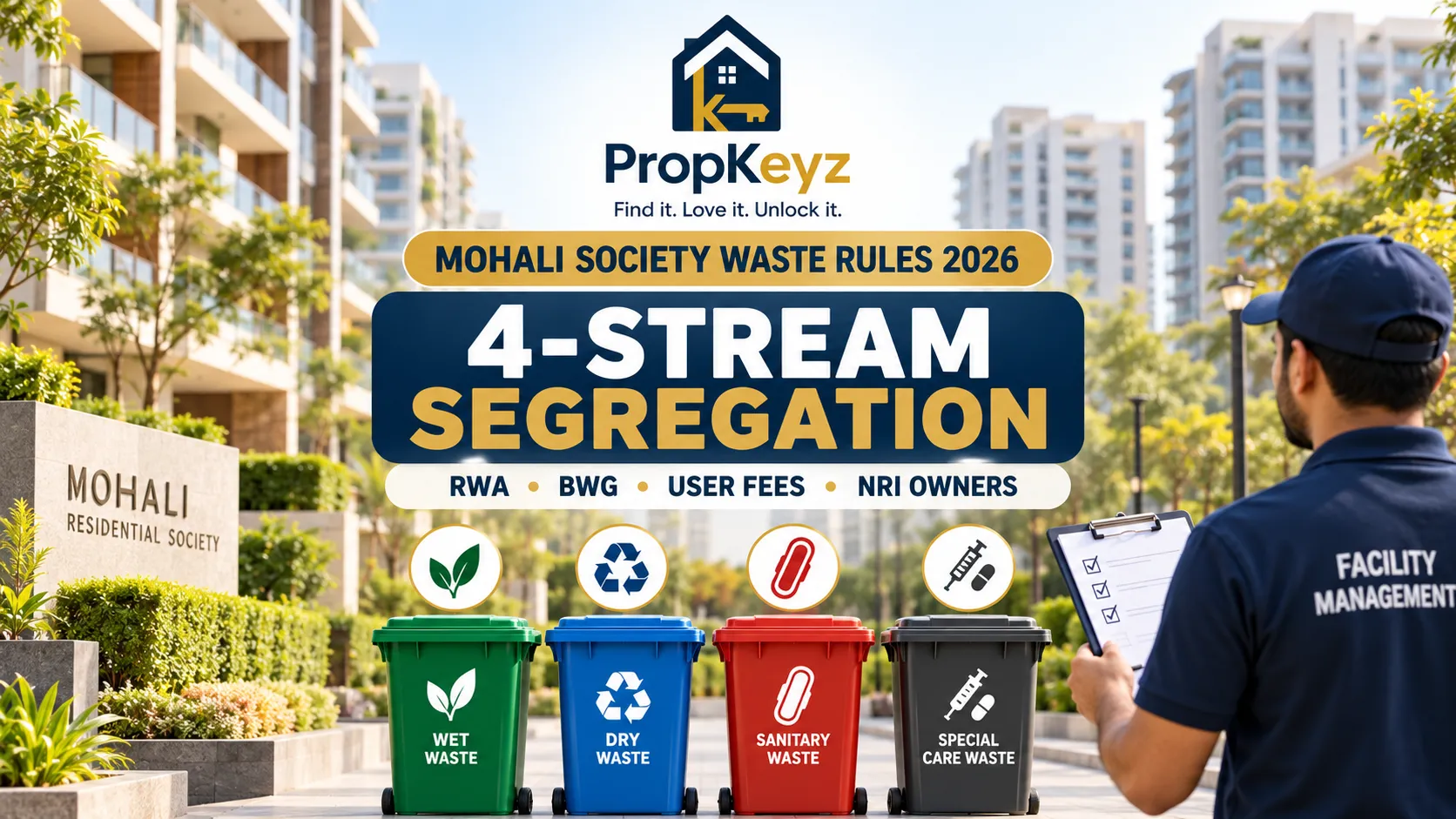
The Mohali Society Waste Management Rules 2026 have changed the compliance conversation for apartment societies, RWAs, facility managers, landlords and NRI property owners.
From 1 April 2026, India’s new Solid Waste Management Rules require every waste generator to separate waste at source into:
four distinct streams
rather than treating household garbage as one mixed bag.
Those streams are:
Wet Waste + Dry Waste + Sanitary Waste + Special Care Waste
The rules also create specific responsibilities for:
- gated communities;
- Resident Welfare Associations;
- Bulk Waste Generators;
- waste collectors;
- local bodies;
- processing facilities.
For Mohali owners, this national compliance change arrives at a time when the city’s own waste system remains under pressure.
In September 2026, the Punjab & Haryana High Court again questioned authorities about Mohali’s long-delayed waste-processing infrastructure and specifically raised issues around:
- door-to-door collection;
- segregation;
- operational waste management.
And in early October, fresh local reporting highlighted:
repeated garbage-dump fires
causing smoke across parts of Mohali.
That makes waste management a:
property-management issue
not merely a municipal sanitation topic.
For a society flat owner, especially an NRI or outstation owner, poor waste management can show up as:
- mixed garbage near the tower;
- foul odour;
- flies/pests;
- garbage burning;
- resident complaints;
- RWA disputes;
- vendor problems;
- waste-user fees;
- composting issues;
- poor common-area perception.
PropKeyz View
A professionally managed society should be able to answer four basic questions: how waste is segregated, who collects it, where wet waste goes and whether the waste chain is authorised.
Key Takeaways
- India’s Solid Waste Management Rules, 2026 became effective on 1 April 2026.
- Every waste generator must now segregate into:
- wet;
- dry;
- sanitary;
- special-care waste.
- Mixed garbage should not be treated as the default household system.
- Sanitary waste must be separately wrapped/stored.
- Construction and demolition waste must remain separate.
- Horticulture/garden waste must also be stored separately and handled as directed.
- Waste must not be:
- thrown;
- burned;
- buried
in public spaces or drains/water bodies.
- All RWAs have source-segregation and collection-facilitation duties under the 2026 rules.
- Gated communities above 5,000 sq m have explicit additional responsibilities.
- The rules say these society/RWA arrangements should be ensured within one year from notification.
- The final BWG threshold is any one of:
- 20,000 sq m floor area;
- 40,000 litres/day water consumption;
- 100 kg/day waste.
- A qualifying society can therefore become a:
- Bulk Waste Generator.
- BWGs must register through the centralised portal.
- BWGs have stronger wet-waste processing duties.
- New BWGs are expected to provide adequate on-site/decentralised wet-waste processing.
- Existing BWGs unable to do so require the applicable local-body exemption/certificate route.
- BWGs must submit annual returns by:
- 30 June.
- Local bodies must identify and geo-tag BWGs annually.
- User fees are not optional merely because society maintenance is being paid.
- The 2026 rules require payment of the user fee specified in local bye-laws.
- Mohali MC continues to host its 2019 waste bye-laws and separate user-charge notification.
- Society maintenance and municipal waste-user fees are:
- not automatically the same charge.
- Mohali’s wider waste-processing infrastructure remains under High Court scrutiny.
- Garbage burning remains prohibited despite recent reports of repeated dump fires.
- An NRI owner does not need to micromanage garbage collection—but should know whether their society has a compliant operational system.
PropKeyz Rule
Owner Responsibility ≠ Personally Sorting the Whole Society’s Waste; Owner Visibility = Knowing whether the society has a working compliant system.
Mohali Society Waste Management Rules 2026: Quick Answer
Yes.
Mohali housing societies, RWAs, residents and waste generators are now subject to the Solid Waste Management Rules, 2026, which superseded the previous central SWM framework and became effective on:
1 April 2026.
The most visible change is:
mandatory four-stream segregation at source.
Current Four Streams
| Stream | Typical Waste |
|---|---|
| Wet | Food, vegetable, fruit, kitchen, biodegradable |
| Dry | Paper, plastic, glass, metal, recyclable/non-recyclable dry material |
| Sanitary | Diapers, pads, tampons, condoms, similar sanitary waste |
| Special Care | Paint containers, certain bulbs, batteries, medicines, mercury items etc. |
Society-Level Rule
RWAs and gated communities must not treat waste segregation as:
only a household issue.
They have explicit responsibilities to:
- facilitate source segregation;
- maintain separate-stream collection;
- hand recyclables to authorised channels;
- process biodegradable waste on premises as far as possible;
- give residual waste to the authorised collection chain.
BWG Rule
A society may become a Bulk Waste Generator if it meets any one of the final thresholds:
20,000 sq m floor area
or
40,000 litres/day water consumption
or
100 kg/day waste generation.
Direct Answer
For a Mohali society in 2026, basic compliance means four-stream segregation + authorised collection + proper wet-waste handling + separate special/sanitary channels + no open burning.
What Changed on 1 April 2026?
The Union Ministry of Environment, Forest and Climate Change notified the new rules on:
27 January 2026
and brought them into effect from:
1 April 2026.
The rules supersede the older 2016 framework.
The revised framework places stronger emphasis on:
- segregation;
- traceability;
- registration;
- decentralised processing;
- BWG accountability;
- online reporting;
- circular-economy principles.
For Societies
The biggest practical shift is:
the compliance system becomes more structured and more auditable.
The New Four-Stream System
The old casual instruction:
“green bin aur blue bin laga do”
is no longer enough to describe the full central rule.
Every waste generator must segregate into:
- wet;
- dry;
- sanitary;
- special-care waste.
Why Four Streams?
Because different waste categories require different:
- handling;
- transportation;
- processing;
- recycling;
- disposal.
If they are mixed:
recovery becomes more difficult.
Wet Waste Explained
Wet waste typically includes:
- kitchen waste;
- food scraps;
- vegetables;
- fruit peels;
- flowers;
- biodegradable organic waste.
The 2026 framework pushes wet waste towards:
- composting;
- biomethanation;
- other approved biological processing.
Society Problem
If wet waste gets mixed with:
- diapers;
- glass;
- medicine packaging;
- plastic,
the whole downstream process becomes harder.
PropKeyz Rule
Good waste management starts inside the kitchen, not at the garbage truck.
Dry Waste Explained
Dry waste can include:
- paper;
- cardboard;
- plastic;
- metal;
- glass;
- other non-wet material.
Dry waste should move towards:
Material Recovery Facilities / authorised recycling channels
rather than being mixed with food waste.
Society Opportunity
Proper dry-waste segregation can improve:
- recycling;
- recovery;
- cleanliness of waste-storage areas.
Sanitary Waste Explained
Sanitary waste now gets its own separate stream.
Examples include:
- diapers;
- sanitary pads;
- tampons;
- condoms;
- similar hygiene waste.
The rules require secure wrapping and separate storage.
Why This Matters
If sanitary waste is mixed with:
- recyclable dry material,
it can contaminate material handled manually by:
- collection staff;
- sorters;
- waste pickers.
Special Care Waste Explained
This category is especially important because residents often throw these items into ordinary dry waste.
Examples can include:
- paint containers;
- pesticide containers;
- bulbs/CFLs;
- expired medicines;
- mercury thermometers;
- batteries;
- certain used needles/syringes subject to applicable waste-management laws.
Society Action
The facility manager should know:
where special-care waste is actually deposited.
Not simply:
“Dry waste wale ko de dete hain.”
Why Old 3-Bin Advice Is Now Incomplete
Mohali MC launched a door-to-door segregation drive in January 2026.
Public reporting at that time described separation into:
- wet;
- dry;
- hazardous.
That rollout happened:
before the final national rules became effective on 1 April.
Today, the national baseline is:
four streams.
Therefore
Do not create a 2026 RWA poster saying only:
Wet / Dry / Hazardous
and assume it fully reflects the final central rule.
Duties of Every Household / Waste Generator
The 2026 rules require every waste generator to:
- prevent/reduce pollution;
- segregate waste into four streams;
- hand waste to authorised collection;
- securely wrap sanitary waste;
- keep C&D waste separate;
- keep horticulture waste separate;
- not throw/burn/bury waste improperly;
- pay applicable user fees.
This Applies Beyond Owners
It also affects:
- tenants;
- occupiers;
- commercial users;
- institutions.
What Must an RWA Do?
This is the core property-management question.
Under Rule 5(2), all RWAs have responsibilities relating to:
- segregation;
- collection;
- recycling;
- wet-waste treatment.
RWA Should Have
Resident Communication
Clear four-stream instructions.
Collection System
Separate containers/collection protocol.
Recyclable Channel
Authorised waste picker/recycler.
Wet-Waste Plan
Composting or biomethanation where feasible.
Residual-Waste Handover
Authorised collector/local body.
Important
RWA duty is not:
“Bas residents ko WhatsApp message bhej diya.”
The system itself has to support segregation.
Gated Community Duties
All gated communities above:
5,000 sq m
come within the explicit Rule 5(2) requirement alongside all RWAs.
The rule gives:
one year from notification
for these arrangements.
Since notification was:
27 January 2026
the statutory one-year point falls on:
27 January 2027
subject to future amendments/clarifications.
Practical Meaning
A society should use 2026 to establish:
- bins;
- collection;
- processing;
- vendor records;
- resident SOPs.
What Is a Bulk Waste Generator?
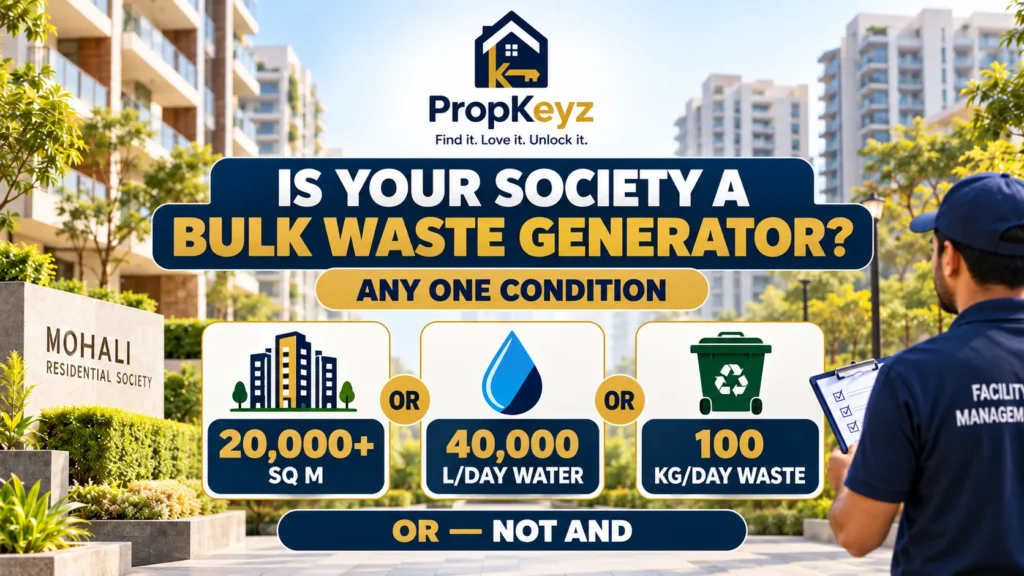
A society/entity is a BWG if it satisfies at least one of these criteria:
Test 1
Building floor area:
20,000 sq m or more
Test 2
Water consumption:
40,000 litres/day or more
Test 3
Solid waste:
100 kg/day or more.
Very Important
It is:
OR
not:
AND
between these thresholds.
A society does not need to satisfy all three.
Does Every Mohali Society Become a BWG?
No.
A small housing society may not cross the BWG threshold.
But:
Not a BWG ≠ No responsibility.
Every RWA still has Rule 5(2) duties.
Simple Difference
RWA
→ general society-level segregation/collection responsibilities.
Qualifying BWG
→ additional registration, processing, certificate and annual-return responsibilities.
BWG Registration
Every Bulk Waste Generator must register with the concerned local body through:
the centralised online portal.
CPCB currently operates the national SWM portal and specifically invites BWG registration.
CPCB Centralised Solid Waste Management Portal
Society Manager Should Preserve
- registration details;
- certificate;
- authorised-vendor record;
- waste quantities where required;
- return filings.
BWG Wet-Waste Processing
A Bulk Waste Generator has a significantly stronger obligation around:
wet waste.
The rules require arrangements for decentralised processing through methods such as:
- composting;
- biomethanation;
- another approved technology.
New BWGs
Must set up and operate adequate wet-waste processing capacity.
Existing BWGs Unable to Do So
The rules create an exemption +:
Extended Bulk Waste Generator Responsibility
certificate route through the local body.
What Is Extended Bulk Waste Generator Responsibility?
EBWGR is one of the biggest new compliance concepts under the 2026 framework.
It creates a responsibility mechanism where BWGs must ensure environmentally sound management of the waste they generate.
If an existing BWG cannot process relevant waste itself, the rules provide for:
purchasing certificates from the local body
under the applicable framework.
Do Not Confuse
EBWGR certificate:
not the same thing as the monthly society maintenance receipt.
Annual Return Deadline
Bulk Waste Generators must file annual returns:
by 30 June every year
through the centralised portal.
NRI Owner Perspective
Individual NRI owners normally should not be expected to file the society’s BWG return themselves.
But a responsible owner can ask:
“Is our society registered and compliant if it qualifies as a BWG?”
Can a Society Use a Private Waste Vendor?
Yes, but authorisation/registration matters.
The 2026 rules say BWGs should not engage:
entities lacking the registration mandated under the rules.
Facility Manager Should Have
- vendor name;
- agreement;
- authorisation/registration status;
- collection schedule;
- destination/processor details.
Weak System
“Private tractor wala le jata hai.”
Stronger System
Named + authorised + documented collection chain.
Society Composting
Society composting can be a practical solution for:
- kitchen waste;
- garden waste.
Benefits can include:
- lower wet-waste transport;
- cleaner dry-waste recovery;
- compost for landscaping.
But Composting Requires
- correct segregation;
- operational space;
- trained staff;
- odour/pest control;
- reliable process.
PropKeyz Rule
Unused compost machine ≠ Waste Processing
Garden / Horticulture Waste
Garden waste should be stored:
separately.
This includes things such as:
- leaves;
- branches;
- grass;
- pruning waste.
It should not automatically be:
- burned;
- mixed into household bins.
The national rules expressly require separate storage and disposal as directed by the local body.
Construction & Renovation Waste
Owners renovating a flat may generate:
- broken tiles;
- masonry;
- plaster;
- wood;
- fittings;
- packaging.
This should not be dumped:
beside the normal society garbage room.
The 2026 SWM rules require C&D waste to be separately stored and dealt with under the applicable C&D waste framework.
Owner Rule
Before renovation ask society:
- debris-lifting procedure;
- contractor route;
- temporary storage;
- fee;
- authorised disposal.
Garbage Burning Rules
The legal position is straightforward.
Waste generators are specifically prohibited from:
throwing, burning or burying solid waste
on:
- streets;
- open public spaces;
- outside premises;
- drains/water bodies.
Therefore
A maintenance worker cannot justify burning leaves/garbage by saying:
“Collection late hai.”
Mohali Garbage-Fire Problem

This isn’t a theoretical concern in Mohali.
On 2 October 2026, fresh reporting described repeated incidents of garbage dumps being set on fire, with smoke affecting residents and concerns over ineffective enforcement.
For Society Owners
If waste is being burned:
- document location/date;
- inform facility/RWA;
- escalate to civic authority where required;
- preserve complaint record.
NRI Owner
Ask your property manager/society contact to send:
- dated photo/video;
- complaint reference;
- follow-up status.
PropKeyz Rule
“Smell aa rahi hai” should become a documented maintenance issue—not a recurring WhatsApp complaint with no record.
User Fees
Every waste generator must:
pay user fee for solid-waste management
as prescribed in the:
local-body bye-laws.
Important
The 2026 central rules do not establish:
one fixed ₹ amount for every Mohali flat.
Mohali MC’s official website currently publishes:
- its Solid Waste Management Bye-Laws 2019;
- Notification No. 1369 dated 3 June 2019 for door-to-door collection charges.
Municipal Corporation SAS Nagar Mohali Official Website
Before Paying
Check:
- latest category;
- latest MC rate;
- whether charge is collected directly;
- whether society pays centrally;
- whether society separately recovers it.
Society Maintenance vs Garbage User Fee
These are not automatically the same.
Society Maintenance
Can fund:
- housekeeping;
- security;
- lifts;
- landscaping;
- common electricity;
- internal waste handling.
Municipal / SWM User Fee
Is related to:
civic solid-waste services
under the applicable local-body framework.
Therefore
Owner paying:
₹4,000/month society maintenance
cannot automatically conclude:
all municipal garbage fees are cleared.
For society-dues treatment, see:
Mohali Society Maintenance Charges 2026 — PropKeyz
Tenant vs Owner Responsibility
The 2026 national waste rules apply to:
waste generators.
So a tenant generating household waste has operational duties such as:
- segregation;
- correct handover;
- no burning/dumping.
Owner Responsibilities
Owner should ensure tenancy/society onboarding tells tenant:
- waste schedule;
- bin system;
- house rules;
- penalties/fees where applicable.
Agreement Tip
A rent agreement can state:
tenant will follow society waste-segregation and sanitation rules.
But:
private agreement does not replace applicable law.
Vacant Flats
A vacant flat may generate very little household waste.
But the owner can still face:
- society fees;
- common-area issues;
- notices;
- renovation debris;
- pest/sanitation problems.
Important
Vacant Flat ≠ Society-Waste System Irrelevant
If garbage area below the tower is poorly managed, the vacant owner’s property can still suffer:
- odour;
- pest activity;
- poor resale impression.
Rented Flats
For a rental property, waste compliance belongs in:
tenant onboarding.
Give the tenant:
- society waste timings;
- segregation categories;
- sanitary-waste instruction;
- special-care waste point;
- renovation/C&D rule.
PropKeyz Rule
Tenant Onboarding Should Explain the Building—Not Just Hand Over the Keys
For the broader onboarding process:
Tenant Verification in Mohali 2026 — PropKeyz
NRI-Owned Flats
An NRI owner cannot watch daily garbage collection from:
- Canada;
- UK;
- UAE;
- Australia;
- USA.
Nor should they need to.
The goal is:
system visibility.
NRI Owner Should Know
- who manages society waste;
- whether four-stream segregation exists;
- whether society qualifies as BWG;
- whether wet-waste processing exists;
- who the vendor is;
- whether charges are being paid;
- whether garbage-burning complaints exist.
What Owner Does Not Need
Daily photos of:
garbage bins.
What Owner Does Need
Escalation when:
- collection fails repeatedly;
- waste accumulates near unit;
- fire occurs;
- society raises unusual charges;
- RWA receives formal compliance notice.
For structured remote-owner support:
NRI Property Management by PropKeyz
Society Facility Manager Checklist
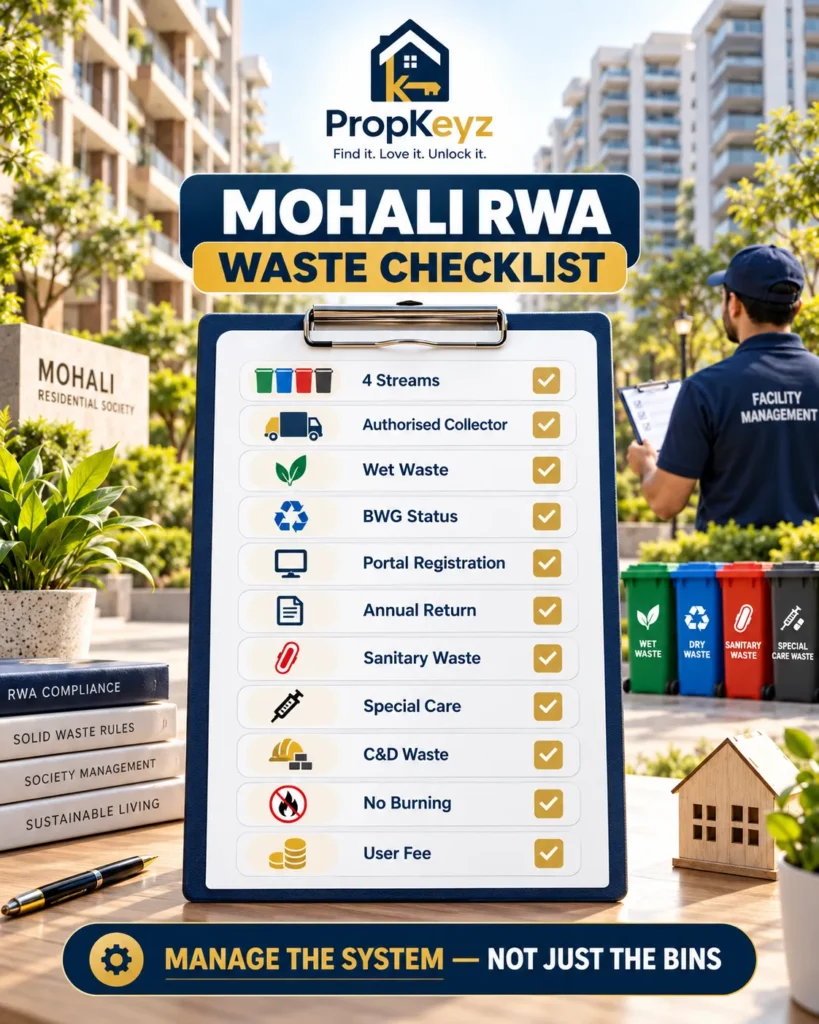
Compliance
- four-stream instructions issued;
- bins/collection arrangement active.
Vendor
- authorised vendor;
- agreement available.
Wet Waste
- composting/biomethanation arrangement;
- logs where relevant.
BWG
- threshold checked;
- portal registration if applicable.
Returns
- annual return calendar.
Horticulture
- separate system.
Sanitary
- separate stream.
Special Care
- designated collection route.
C&D
- renovation debris SOP.
Fire
- zero open burning.
User Fee
- current applicable local fee verified.
What Owners Should Ask the RWA
Do not ask:
“Garbage ka system hai?”
Ask:
1.
Are we following four-stream segregation?
2.
Who is the authorised collector?
3.
Where does wet waste go?
4.
Does our society qualify as a BWG?
5.
Are we registered on the central portal?
6.
Is composting operational?
7.
Where is special-care waste deposited?
8.
How is sanitary waste handled?
9.
What is the current municipal user fee?
10.
Has MC/PPCB/local authority issued any notice?
11.
Has garbage been burned anywhere on society/common land?
12.
Who handles resident complaints?
Mohali’s Wider Waste-Plant Problem
A society can segregate perfectly and still depend on:
a functioning city/regional waste chain.
That is why Mohali’s wider infrastructure problem matters.
In September 2026, the Punjab & Haryana High Court said the waste-management plant issue had remained unresolved for roughly:
20 years
from the original 2006 PIL context and asked authorities to explain efforts toward operationalising the system.
PropKeyz has a separate detailed page for that regional issue:
Mohali Waste Management 2026 — PropKeyz
Important Distinction
This page:
Society/RWA Compliance
That page:
City Processing Plant + HC + Regional Waste Infrastructure
Do not merge the keywords.
Why Waste Segregation Matters for the Proposed Regional Processing Chain
Mohali’s wider waste plan increasingly depends on:
properly separated wet waste.
The reason is simple.
Mixed Waste
Food + plastic + sanitary + glass
↓
Poor feedstock
↓
More sorting/contamination
Segregated Wet Waste
Kitchen/organic waste
↓
Biological processing
↓
Compost / biogas / CBG potential
PropKeyz View
Even the best waste-processing plant cannot fully compensate for segregation failure at source.
Property-Value & Liveability Impact
Waste management rarely adds a visible:
₹5 lakh premium
to a flat by itself.
But poor waste handling can reduce:
- resident satisfaction;
- first impression;
- rental desirability;
- resale confidence.
Common Buyer Reaction
A buyer enters a premium society.
They see:
- landscaped entry;
- clubhouse;
- good tower.
Then near basement/utility area:
garbage overflow + odour.
That directly changes perception.
Property Science
Clean Common Areas
↓
Better Liveability
↓
Stronger Resident Satisfaction
↓
Lower Complaint Friction
↓
Better Tenant / Buyer Perception
Waste Area Near Your Tower — Buyer Check
When buying or renting:
Check Distance
How close is:
- waste room;
- composting area;
- collection point?
Check Access
Does garbage vehicle pass:
- directly below bedroom/balcony?
Check Odour
Visit:
- morning;
- evening.
Check Drainage
Is leachate/dirty water visible?
Check Fire Marks
Blackened patches can indicate:
- previous burning.
Check Pest Signs
- stray animals;
- flies;
- rodents.
PropKeyz Rule
Clubhouse Visit Is Not Enough. Visit the Service Areas Too.
Facts vs Assumptions

| Supported Position | Wrong Assumption |
|---|---|
| Four-stream segregation is mandatory | Wet + dry only is enough |
| RWAs have explicit responsibilities | Only MC is responsible |
| BWG threshold has 3 alternative tests | Society must meet all 3 |
| Water threshold is 40,000 L/day | Draft 5,000 L/day still applies |
| BWGs must register | RWA WhatsApp group counts as registration |
| New BWGs have wet-processing duties | Mixed waste can simply go to dump |
| User fee is required | Maintenance automatically includes it |
| Local body sets amount | Central government fixes Mohali rupee rate |
| Waste burning is prohibited | Leaves can always be burned |
| Garbage fires have been reported in Mohali | Every society burns garbage |
| Mohali waste plant faces court scrutiny | Every society is legally non-compliant |
| NRI owner should monitor compliance | NRI owner must personally manage garbage |
NRI Owner Waste-Management Checklist
Monthly / Quarterly
Check:
- society notices;
- waste/user-fee arrears;
- sanitation complaints;
- facility updates.
Tenant
Ensure tenant understands:
- four streams;
- timing;
- society rules.
RWA
Store:
- manager contact;
- society email;
- escalation number.
If Property Is Vacant
Inspection should also note:
- corridor cleanliness;
- waste accumulation;
- pest signs;
- odour;
- common drain condition.
If Garbage Fire Happens
Request:
- dated image/video;
- complaint number;
- response.
If Society Is a BWG
Ask management:
- registration?
- wet-waste solution?
- annual-return process?
PropKeyz NRI Rule
Remote ownership works best when routine compliance is handled locally and exceptions are escalated with evidence.
For ongoing owner support:
Property Management Company in Mohali — PropKeyz
How Property Management Fits In
Property management does not mean:
PropKeyz becomes the municipal waste authority.
But a property manager can help an owner with visibility around:
- society notices;
- sanitation issues;
- maintenance complaints;
- common-area condition;
- tenant compliance;
- unusual society charges.
PropKeyz currently supports owners through:
- property inspections;
- tenant coordination;
- maintenance coordination;
- structured owner updates.
What PropKeyz Can Do
- flag repeated garbage accumulation;
- photograph visible sanitation issues during inspection;
- coordinate tenant/RWA communication;
- share society notices;
- track owner-approved follow-up.
What PropKeyz Cannot Do
- certify legal compliance;
- issue BWG registration;
- replace MC;
- replace PPCB;
- guarantee society waste performance.
PropKeyz Analysis
The Mohali Society Waste Management Rules 2026 are important because they shift waste compliance from:
“municipality ka kaam”
towards:
shared responsibility.
1. Four Streams Is the Biggest Household Change
The rule is no longer adequately described by:
green and blue bins.
Sanitary and special-care waste now deserve separate handling.
2. RWA Responsibility Is Explicit
Societies cannot say:
“Residents separate nahi karte, hum kya karein?”
The RWA itself has duties to:
- facilitate;
- collect;
- channel;
- process.
3. Not Every RWA Is a BWG—But Every RWA Still Has Duties
This distinction will prevent a lot of wrong advice.
BWG status depends on:
- area;
- water use;
- waste quantity.
But all RWAs have Rule 5(2) obligations.
4. The Final Water Threshold Is 40,000 Litres
This matters because internet articles based on draft rules may still show:
5,000 litres/day.
That was not retained as the final threshold.
PropKeyz Rule
Draft Rule ≠ Final Rule
5. Compliance Is Becoming Digital
BWGs now face:
- registration;
- annual returns;
- certificates;
- traceability.
This moves waste management closer to:
auditable compliance.
6. Wet Waste Is the Critical Operational Stream
Dry waste has recycling value.
But wet waste creates:
- smell;
- leachate;
- flies;
- rapid decomposition.
That is why the rules push:
decentralised processing.
7. Garbage Burning Is a System-Failure Indicator
If garbage piles are being burned, someone is effectively replacing:
collection + processing
with:
combustion in the open.
The new rules expressly prohibit this.
Mohali’s recent fire reports show why that matters locally.
8. User Fee Should Be Transparent
Residents should know:
- what they pay;
- to whom;
- for which service.
Society maintenance, waste-vendor charge and municipal SWM user fee should not become:
one unexplained lump sum.
9. City Infrastructure and Society Compliance Depend on Each Other
A society can segregate.
But the collection chain must preserve segregation.
A city can build a processing plant.
But the plant needs suitable feedstock.
The system works only if:
Household → Society → Collector → Processor
all perform their role.
10. Waste Management Is a Property-Management Issue
For a remote owner, common-area waste problems can affect:
- tenant retention;
- complaints;
- property inspection;
- resale impression.
It belongs in:
property condition monitoring.
11. Premium Society Branding Does Not Guarantee Compliance
A society can have:
- pool;
- gym;
- clubhouse;
and still mishandle waste.
Buyers should check service infrastructure.
12. RWA Compliance Can Become a Governance Quality Signal
A well-run RWA usually has:
- documented vendors;
- notices;
- fee records;
- SOPs;
- complaint escalation.
Waste management is one practical way to test:
how professionally the society is actually run.
Final PropKeyz Analysis
The strongest 2026 waste-management system in a Mohali society is not simply four coloured bins. It is a complete chain in which residents segregate correctly, the RWA preserves that segregation, wet waste is processed appropriately, sanitary and special-care waste enter authorised channels, vendors are documented, applicable fees and BWG filings are maintained, and nobody resorts to dumping or burning waste when the system becomes inconvenient.
PropKeyz Verdict: Mohali Society Waste Management Rules 2026
Household
Use:
four streams
not mixed garbage.
RWA
Build:
segregation + collection + authorised handover + wet-waste system.
Large Society / BWG
Check:
20,000 sq m OR 40,000 L/day OR 100 kg/day
and register if applicable.
Wet Waste
Process:
on site/decentralised as required and feasible under the rules.
Garbage Burning
Not allowed.
User Fee
Pay the:
applicable local-body fee.
But verify the current Mohali category/rate.
NRI Owner
Do not micromanage bins.
Instead monitor:
- notices;
- charges;
- recurring complaints;
- waste-area condition;
- serious sanitation incidents.
Final PropKeyz Rule
A clean society is not the one that hides garbage from residents. It is the one that can show where each waste stream goes after it leaves the flat.
Frequently Asked Questions
What are the Mohali Society Waste Management Rules 2026?
Mohali societies are subject to the national Solid Waste Management Rules, 2026 along with applicable Punjab/Mohali local bye-laws and municipal directions.
When did the new rules start?
They became effective:
1 April 2026.
How many waste streams are required?
Four:
- wet;
- dry;
- sanitary;
- special-care.
Is wet and dry segregation alone enough?
It does not fully reflect the new national four-stream requirement.
What is sanitary waste?
Items such as:
- diapers;
- sanitary pads;
- tampons;
- condoms;
- similar hygiene waste.
What is special-care waste?
It can include items such as:
- paint containers;
- certain bulbs;
- medicines;
- batteries;
- mercury items.
Does every Mohali RWA have duties?
Yes.
The 2026 rules expressly place segregation/collection-related responsibilities on RWAs.
Is every RWA a Bulk Waste Generator?
No.
BWG status depends on the specified thresholds.
What is the current BWG threshold?
Any one of:
- 20,000 sq m floor area;
- 40,000 litres/day water;
- 100 kg/day solid waste.
Is the water threshold 5,000 litres/day?
No.
That appeared in draft material.
The final rule uses:
40,000 litres/day.
Do BWGs need registration?
Yes.
The 2026 rules require registration through the centralised portal.
Where is the central portal?
CPCB currently operates the SWM centralised portal.
Do BWGs need to process wet waste?
Yes, the rules impose decentralised wet/horticulture processing responsibilities, subject to the specific new/existing-BWG framework.
What if an existing society cannot compost all its wet waste?
The rules provide an exemption / Extended Bulk Waste Generator Responsibility certificate route through the local body for qualifying existing BWGs.
Do BWGs file annual returns?
Yes.
Current rule:
30 June each year.
Can the society burn dry leaves?
Open burning of solid waste in the prohibited locations is not permitted under the rules.
Horticulture waste should be handled separately as directed by the local body.
Have garbage fires been reported in Mohali?
Yes.
Fresh October 2026 reporting describes repeated garbage-dump burning incidents in the city.
Do I have to pay a garbage user fee?
The central rules require payment of the user fee specified under local bye-laws.
What is the current Mohali user-fee amount?
The central rules do not set one national Mohali amount.
MC Mohali publishes its local bye-law/user-charge notification, and owners should verify the current applicable category/rate before relying on older fee tables.
Is waste user fee included in society maintenance?
Not automatically.
Check:
- society budget;
- MC charge;
- vendor agreement.
Can my tenant be responsible for segregation?
The tenant/occupier generating waste has operational waste-generator duties.
The rent agreement can also require compliance with society rules.
Can RWA fine residents?
Any penalty/fine must have a valid legal/bye-law basis.
Do not assume every arbitrary RWA penalty is automatically enforceable.
Does the new law mean every society needs a compost machine?
Not exactly.
The framework requires segregation and pushes biodegradable processing within premises as far as possible, with stronger specific requirements for BWGs.
What should an NRI owner check?
At minimum:
- waste-system notices;
- user-fee arrears;
- serious sanitation complaints;
- recurring dumping;
- garbage burning;
- BWG compliance if relevant.
Can PropKeyz handle society waste compliance?
PropKeyz can support:
- inspection visibility;
- tenant communication;
- society notice tracking;
- local coordination.
It cannot:
- certify SWM compliance;
- issue government registration;
- replace MC/PPCB.
Continue Your PropKeyz Research
Mohali Waste Management 2026
For the separate city-level story covering the High Court, long-delayed processing plant and regional 300-TPD CBG proposal:
Mohali Waste Management 2026 — PropKeyz
Mohali Society Maintenance Charges 2026
For:
- owner vs tenant;
- RWA powers;
- vacant-flat dues;
- GST;
- society charges:
Mohali Society Maintenance Charges 2026 — PropKeyz
Property Management Company in Mohali
For:
- inspections;
- tenant coordination;
- maintenance coordination;
- owner reporting:
Property Management Company in Mohali — PropKeyz
NRI Property Management
For remote owners who need:
- local inspections;
- tenant coordination;
- maintenance support;
- structured reporting:
NRI Property Management — PropKeyz
Property Management Services in Tricity
For Mohali, Zirakpur, Kharar, Chandigarh, Panchkula and nearby markets:
Property Management Services in Tricity — PropKeyz
Mohali NRI Property Protection 2026
For vacant-property checks, tenant files, physical inspections and remote-owner monitoring:
Mohali NRI Property Protection 2026 — PropKeyz
PropKeyz Property Management Support
PropKeyz helps NRI, outstation and busy local owners manage properties through structured local coordination.
Depending on the service scope, that can include:
- property inspections;
- tenant coordination;
- maintenance coordination;
- society notice tracking;
- periodic photo/video reporting.
Waste-Related Property Issues We Can Flag
- visible garbage accumulation near the property;
- recurring sanitation complaints;
- common-area waste problems;
- society notices;
- unusual owner charges;
- visible garbage-burning incidents.
What We Don’t Claim
PropKeyz does not:
- certify environmental compliance;
- replace Municipal Corporation Mohali;
- replace PPCB;
- guarantee RWA compliance;
- operate statutory waste portals on behalf of an authority.
NRI Owner?
Your objective should be:
Exception-Based Management
Routine system works locally.
You receive updates only when:
- something fails;
- a cost/notice arrives;
- action is required.
Your Property. Our Responsibility.
Sources & Verification
Last Fact-Checked: 5 October 2026
Ministry of Environment / CPCB — Solid Waste Management Rules 2026
Primary authority for:
- effective date;
- four-stream segregation;
- waste-generator duties;
- RWA duties;
- BWG thresholds;
- BWG registration;
- wet-waste processing;
- annual returns;
- no-burning rule.
Official Solid Waste Management Rules 2026 — CPCB
Press Information Bureau
Used to confirm:
- notification;
- 1 April 2026 commencement;
- four-stream system;
- final BWG thresholds.
CPCB Centralised SWM Portal
Used for:
- current BWG registration system;
- centralised compliance portal.
Municipal Corporation SAS Nagar Mohali
Official local-body source confirming current publication of:
- 2019 SWM bye-laws;
- Notification No. 1369 on door-to-door user charges.
Municipal Corporation SAS Nagar Mohali
Punjab & Haryana High Court Reporting — September 2026
Used for Mohali’s continuing waste-processing/segregation infrastructure issue.
Tribune — January 2026
Used for Mohali’s early-2026 door-to-door source-segregation rollout context.
Times of India — October 2026
Used for the current local garbage-burning/fire context.
Disclaimer
This article is intended for:
- property-owner education;
- RWA awareness;
- property-management planning;
- NRI owner monitoring.
It is not:
- legal advice;
- environmental certification;
- municipal compliance certification;
- PPCB approval;
- professional waste-engineering advice.
The exact duties of a particular society can depend on:
- its size;
- waste quantity;
- water consumption;
- whether it qualifies as a BWG;
- local-body directions;
- updated bye-laws;
- vendor/processor arrangements.
The central 2026 rules establish:
the national legal baseline.
Mohali-specific:
- user fees;
- operational collection systems;
- fines;
- local implementation
can depend on current local-body notifications and should be checked before relying on older schedules.
Your Property. Our Responsibility.