
The Gharuan Sewerage & STP Project 2026 has added an important infrastructure layer to one of Greater Mohali’s most closely watched emerging property markets.
On 2 October 2026, Punjab’s e-Procurement system published a major sanitation tender for Gharuan, District SAS Nagar.
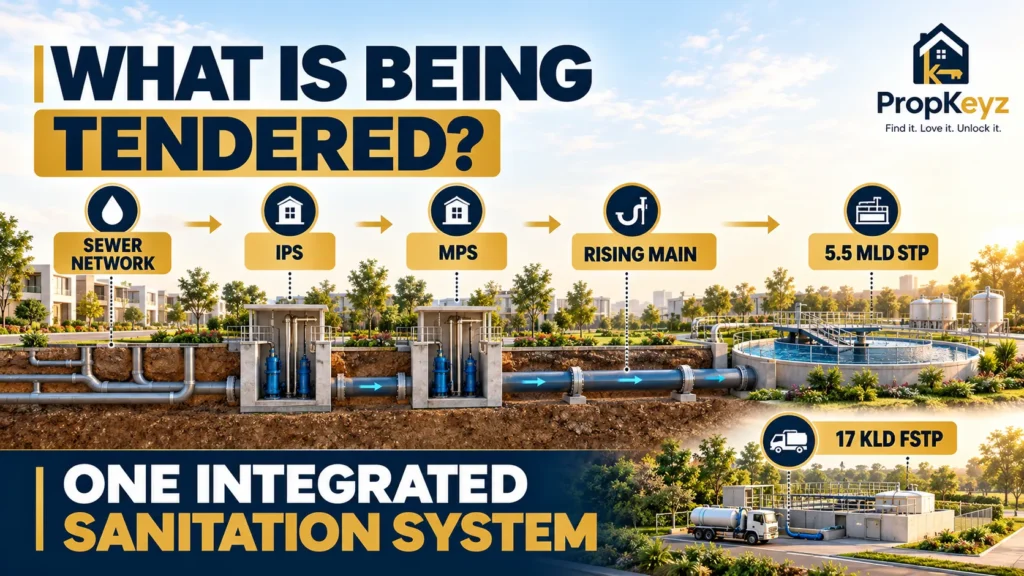
The package covers:
laying of sewer lines
plus:
Intermediate Pumping Station (IPS)
Main Pumping Station (MPS)
rising main
5.5 MLD Sewage Treatment Plant
and:
17 KLD Faecal Sludge Treatment Plant.
The work is being tendered under:
SBM 2 Scheme
through the Department of Local Government / Punjab Water Supply & Sewerage Board.
Current tender details show:
- Tender ID:
2026_DLG_176757_1 - Tender Notice: 43 of 2026
- EMD: ₹56.53 lakh
- Bid submission deadline: 27 October 2026
- Bid opening: 28 October 2026
- bid validity: 120 days.
The current official listing does not disclose the project tender value.
That matters because some third-party tender websites estimate the project at around ₹28 crore based on the EMD—but that estimate should not be presented as an official sanctioned cost.
For the Gharuan property market, the project matters for a deeper reason.
Just weeks earlier, Gharuan had already become one of Greater Mohali’s most searched planning stories because of a proposed amendment to the GMADA Regional Plan covering nearly:
3,000 acres
around Gharuan and surrounding villages.
Planning tells us:
where future development may go.
Sewerage tells us:
whether an area can actually support organised habitation.
That distinction is extremely important.
PropKeyz View
A master plan can create development potential. Sewerage, drainage, roads, water and power are what eventually turn planning potential into a functioning urban market.
Key Takeaways
- Punjab Water Supply & Sewerage Board has floated a comprehensive Gharuan sewerage tender.
- Tender published: 2 October 2026.
- Tender ID:
2026_DLG_176757_1. - Current bid deadline: 27 October 2026.
- Bid opening: 28 October 2026.
- EMD: ₹56.53 lakh.
- Official portal does not disclose the tender value.
- Main package includes:
- sewer network;
- IPS;
- MPS;
- rising main;
- 5.5 MLD STP;
- 17 KLD FSTP.
- 5.5 MLD equals design capacity of approximately 5.5 million litres/day.
- 17 KLD equals approximately 17,000 litres/day.
- STP treats sewage flowing through a sewerage system.
- FSTP treats faecal sludge/septage-type waste, particularly relevant where septic systems/non-sewered sanitation exist.
- IPS/MPS help move sewage where gravity flow alone is insufficient.
- A rising main is a pressurised sewage pipeline.
- The package is under SBM 2.0-related sanitation infrastructure.
- Current stage is:
- tender/procurement.
- Contractor award is not yet established.
- Construction start is not yet established.
- STP commissioning is not yet established.
- The project should not be described as:
- already operational;
- completed;
- currently treating 5.5 MLD.
- Gharuan’s separate 3,000-acre planning story remains draft-stage.
- Sewerage tender does not mean:
- final zoning notification;
- residential approval of every parcel;
- guaranteed property appreciation.
- But it is a stronger physical-infrastructure signal than planning discussion alone.
- For buyers, the important formula is:
Planning + Sewerage + Roads + Water + Power + Occupancy = Organised Urbanisation
PropKeyz Rule
Don’t value Gharuan only on what it may become. Track what infrastructure is actually being procured, built and operated.
Gharuan Sewerage & STP Project 2026: Quick Answer
The Gharuan Sewerage & STP Project 2026 is a live Punjab Government tender for a comprehensive sanitation system at Gharuan in SAS Nagar district.
Main Components
| Component | Confirmed Scope |
|---|---|
| Sewer Network | Yes |
| Intermediate Pumping Station | Yes |
| Main Pumping Station | Yes |
| Rising Main | Yes |
| Sewage Treatment Plant | 5.5 MLD |
| Faecal Sludge Treatment Plant | 17 KLD |
| Scheme | SBM 2 |
| Tender Published | 2 Oct 2026 |
| Bid Closing | 27 Oct 2026 |
| Bid Opening | 28 Oct 2026 |
| Contractor Awarded? | Not yet established |
| Work Started? | Not yet established |
| STP Operational? | No such current confirmation |
| Official Tender Cost Disclosed? | No |
Official tender details come from Punjab e-Procurement.
Direct Answer
Punjab has moved Gharuan’s sewerage/STP system into formal procurement, but buyers should treat it as an infrastructure project at tender stage—not as a completed municipal service.
What Exactly Has Punjab Tendered?
The tender wording is significant because it covers an entire sanitation chain rather than only a small STP structure.
It includes:
Sewer Lines
To collect sewage from connected areas.
IPS
Intermediate Pumping Station.
MPS
Main Pumping Station.
Rising Main
Pressurised pipeline carrying sewage onward from a pumping station.
5.5 MLD STP
A sewage treatment plant designed around 5.5 million litres per day.
17 KLD FSTP
A faecal sludge treatment facility designed around 17,000 litres per day.
Contingent Works
Supporting works required to complete the system.
This is why the project should be analysed as:
a sewerage network
—not merely:
“one STP is coming.”
Latest Tender Dates & Status
Tender Published
2 October 2026
Pre-Bid Meeting
7 October 2026
Bid Submission Deadline
27 October 2026 at 3:00 PM
Bid Opening
28 October 2026 at 1:00 PM
EMD
₹56,53,000
Tender Fee
₹1,000
Bid Validity
120 days
Current Stage
Open tender / procurement
Infrastructure Rule
Tender → Evaluation → Award → Work Order → Construction → Testing → Commissioning → Operation
We are currently near the beginning of that chain.
Is the Gharuan Sewerage Project Worth ₹28 Crore?
Some private tender aggregators estimate the project at approximately:
₹28.27 crore.
But the official Punjab e-Procurement listing currently states:
Tender Value: NA.
Therefore PropKeyz should not use:
“₹28.27 Cr Gharuan Sewerage Project”
as a factual headline.
Correct Reporting
The official portal does not currently disclose the tender value; third-party portals estimate a value above ₹25 crore, but this is not the same as an officially published project cost.
PropKeyz Rule
Estimated Tender Value ≠ Official Sanctioned Cost
What Does 5.5 MLD Mean?
MLD stands for:
Million Litres per Day.
So:
5.5 MLD = 5.5 million litres/day
of design sewage-treatment capacity.
But Be Careful
This does not mean:
the plant will process exactly 5.5 million litres every day from Day 1.
Actual loading depends on:
- households connected;
- sewage generation;
- system coverage;
- occupancy;
- infiltration;
- operational performance.
PropKeyz Rule
Design Capacity ≠ Current Sewage Generation
What Is a Sewage Treatment Plant?
An STP treats wastewater collected from:
- homes;
- commercial establishments;
- institutions;
- other connected users,
subject to the network and plant design.
Its role is to reduce:
- organic pollution;
- suspended solids;
- pathogens/pollutants
before treated effluent is discharged or reused according to applicable standards.
Simplified Flow
Homes / Buildings
↓
Sewer Lines
↓
Pumping Stations
↓
STP
↓
Treated Effluent
↓
Permitted Disposal / Reuse
How Does a Sewage Treatment Plant Work?
Actual technology for the Gharuan STP should be taken from:
the DNIT / approved design.
Do not invent whether it is:
- SBR;
- MBBR;
- ASP;
- another technology.
Broadly, municipal STPs usually involve stages such as:
Preliminary Treatment
Removal of:
- rags;
- grit;
- larger solids.
Biological Treatment
Microorganisms help reduce organic pollution.
Clarification / Separation
Solids are separated from treated water.
Disinfection / Tertiary Stage
May be included depending on:
- design;
- discharge/reuse standards.
Sludge Management
Residual sludge must be handled safely.
What Does 17 KLD FSTP Mean?
KLD means:
kilolitres per day.
So:
17 KLD = 17,000 litres/day
of design faecal-sludge handling capacity.
An FSTP is intended for:
faecal sludge and septage
rather than ordinary continuously flowing sewer wastewater.
MoHUA’s SBM-U 2.0 framework specifically emphasises safe management of sewage, faecal sludge and septage.
STP vs FSTP

| Factor | STP | FSTP |
|---|---|---|
| Full Form | Sewage Treatment Plant | Faecal Sludge Treatment Plant |
| Main Input | Sewer wastewater | Septage/faecal sludge |
| Transport | Sewer network | Often desludging/tanker route |
| Gharuan Capacity | 5.5 MLD | 17 KLD |
| Main Purpose | Treat sewered wastewater | Treat non-sewered sanitation sludge |
Easy Example
A house connected to:
municipal sewer
sends wastewater toward the STP.
A septic tank being desludged can produce:
faecal sludge/septage
that requires controlled treatment through an FSTP or approved co-treatment system.
PropKeyz Rule
STP and FSTP complement each other. They are not interchangeable.
Why Does Gharuan Need Both?
This is one of the most interesting aspects of the tender.
Emerging urban areas rarely transition from:
rural sanitation
to:
fully sewered urban sanitation
overnight.
There can be a mixed environment involving:
- new sewer connections;
- older septic tanks;
- existing buildings;
- peripheral development.
A combined STP + FSTP approach can support:
both sewered and non-sewered sanitation streams.
SBM-U 2.0’s ODF++ framework similarly emphasises safe management of faecal sludge so untreated septage is not dumped into:
- drains;
- open land;
- water bodies.
What Is an IPS?
IPS commonly means:
Intermediate Pumping Station.
Sewers work best by gravity.
But terrain does not always allow sewage to keep flowing downhill all the way to the treatment plant.
An IPS can:
- collect sewage at a lower point;
- lift it;
- push it toward the next portion of the network.
What Is an MPS?
MPS commonly means:
Main Pumping Station.
It generally serves a larger role in the network and can pump accumulated sewage toward:
- the STP;
- another trunk/rising-main section.
Important
Exact Gharuan pump capacities are not established by the public tender summary.
Do not invent:
- pump number;
- horsepower;
- flow rate.
What Is a Rising Main?
A rising main is:
a pressurised sewage pipeline.
Gravity sewers usually flow downhill without continuous pumping.
A rising main carries sewage under pressure from a pumping station.
Simplified
Gravity Sewer
↓
IPS / MPS
↓
Pump
↓
Rising Main
↓
STP
Gravity Sewer vs Pumped Sewer
| Gravity Sewer | Pumped / Rising Main |
|---|---|
| Flows using slope | Requires pumps |
| Lower mechanical dependence | Mechanical equipment required |
| Common local collection | Used where elevation is challenging |
| Manholes/access points | Pumping station required |
A complete urban sewerage network may use both.
How the Complete Gharuan System Could Work
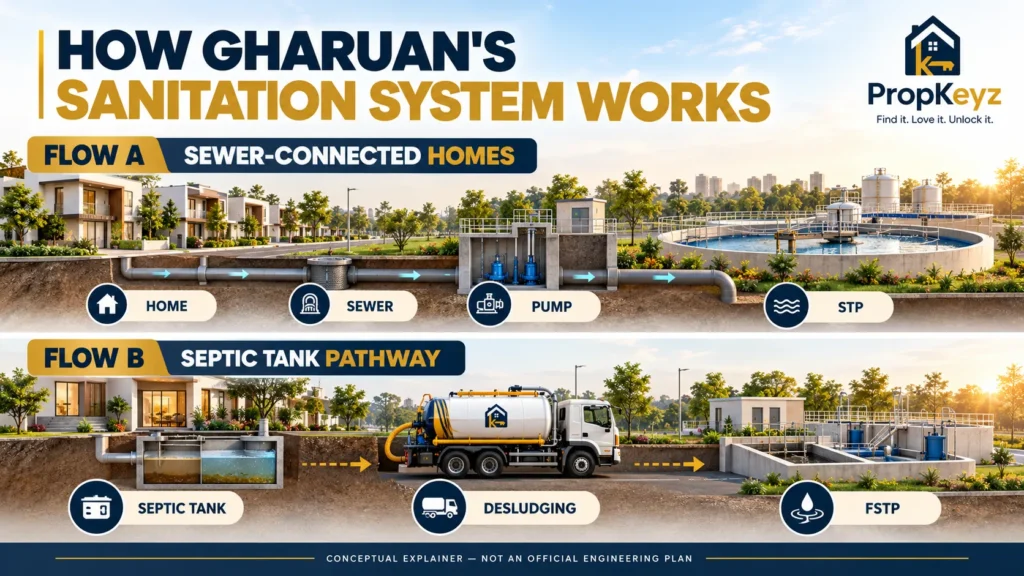
Sewer-Connected Areas
House / Building
↓
Local Sewer
↓
Trunk Sewer
↓
IPS / MPS
↓
Rising Main
↓
5.5 MLD STP
↓
Treated Effluent
Septic / Faecal Sludge Stream
Septic Tank
↓
Authorised Desludging
↓
Transport
↓
17 KLD FSTP
↓
Treatment
Important
This is a conceptual explanation.
The exact approved Gharuan engineering configuration should be taken from:
- DNIT;
- BOQ;
- DPR;
- commissioning documents.
What Is SBM 2.0?
The tender expressly identifies the work under:
SBM 2 Scheme.
Swachh Bharat Mission–Urban 2.0 expands sanitation goals beyond toilet construction into:
- safe used-water management;
- faecal-sludge management;
- sewage treatment;
- reuse and environmental outcomes.
MoHUA’s current SBM material states that:
- ODF++ focuses on safe management of faecal sludge;
- Water+ aims for domestic used water and septage to be collected and treated satisfactorily, with reuse before excess discharge where applicable.
Why This Matters
The Gharuan project is therefore part of a much larger shift:
from basic sanitation toward complete wastewater management.
Why Sewerage Matters for Urban Growth
Roads often get the publicity.
But sewerage determines whether dense urban habitation can grow sustainably.
Without organised sewerage, fast-growing areas can face:
- septic-tank dependence;
- illegal discharge;
- polluted drains;
- groundwater risks;
- odour;
- sanitation complaints.
Urbanisation Formula
Land-Use Planning
Roads
Water
Sewerage
Drainage
Power
=
Buildable Urban Capacity
PropKeyz View
A sewerage tender may be less exciting than a 200-ft road—but for actual habitation, it can be just as important.
Link With Gharuan’s 3,000-Acre Draft Planning Story
This is where the article becomes especially strong for property SEO.
PropKeyz’s existing Gharuan Master Plan 2026 page is already one of the site’s best-performing organic pages.
The current planning story involves:
nearly 3,000 acres
under a proposed amendment to the broader GMADA Regional Plan.
[Read Gharuan Master Plan 2026 — PropKeyz]
The Difference
Master Plan / Regional Plan
Answers:
What land uses are proposed?
Sewerage Project
Answers:
How can habitation be serviced?
Together
They create a stronger future-development signal than either alone.
But:
they are still different processes.
Does the Sewer Tender Mean the Gharuan Master Plan Is Approved?
No.
This is one of the most important SEO questions to answer clearly.
The current Gharuan planning story is still based on:
a draft amendment to the GMADA Regional Plan.
A sewerage tender:
does not finalise land-use zoning.
Likewise:
proposed residential zoning does not automatically mean sewer connections exist today.
PropKeyz Rule
Planning Approval and Utility Infrastructure Are Separate Layers
Gharuan vs Kharar Infrastructure
Gharuan is often marketed as:
Kharar’s next extension.
That makes infrastructure comparison useful.
Kharar
Already has:
- heavy habitation;
- apartment supply;
- builder floors;
- commercial activity;
- traffic;
- existing sewer/water infrastructure with its own capacity challenges.
Gharuan
Has:
- lower current urban maturity;
- draft planning attention;
- fresh sewerage infrastructure procurement;
- more future-stage land.
Investment Difference
Kharar:
current urban utility + congestion risk.
Gharuan:
future infrastructure upside + execution risk.
Gharuan vs Established Mohali
Established Mohali sectors generally offer stronger existing evidence for:
- occupancy;
- roads;
- water;
- sewerage;
- rental demand;
- daily services.
Gharuan offers a different proposition:
lower urban maturity with potentially greater development upside.
PropKeyz Rule
Early-stage infrastructure should come with an early-stage price—not mature-Mohali pricing based only on future promises.
Which Properties Could Benefit Most?
Not every property marketed as:
“Gharuan side”
benefits equally.
Potentially Stronger Beneficiaries
Properties:
- actually within the service catchment;
- near future organised residential zones;
- with legal road access;
- with project approvals;
- where sewer connections become practically available.
Lower Direct Benefit
Land:
- far outside the sewer catchment;
- still agricultural;
- without legal development permissions;
- marketed only through broad location branding.
PropKeyz Rule
Nearby Infrastructure ≠ Guaranteed Connection
Residential Property Impact
For actual residents, organised sewerage can reduce dependence on:
- individual septic tanks;
- repeated desludging;
- informal wastewater disposal.
Potential long-term benefits include:
- better sanitation;
- cleaner neighbourhoods;
- greater development capacity;
- improved buyer confidence.
But
Property impact becomes meaningful only if:
- network is built;
- connections are made;
- STP operates;
- system is maintained.
Commercial Property Impact
Growing:
- retail;
- schools;
- healthcare;
- offices;
- hospitality
also require wastewater management.
A functional sewerage network can improve the area’s ability to support:
higher-intensity urban activity.
But commercial use still requires:
- valid land use;
- approvals;
- access.
Industrial Impact
Gharuan’s draft planning discussions also contain a future industrial angle on designated government land.
Industrial activity can add:
- employment;
- service demand;
- residential demand.
But industrial wastewater requirements can differ greatly from domestic sewage.
Important
The 5.5 MLD municipal-style STP tender should not automatically be described as:
industrial effluent treatment.
Those are different environmental issues.
Rental Demand Impact
Rental demand does not appear because:
an STP tender is published.
The chain is longer.
Planning
↓
Projects
↓
Infrastructure
↓
Employment / Institutions
↓
Residents
↓
Rental Demand
Sewerage supports that chain.
It does not create tenants by itself.
Property Rate Science
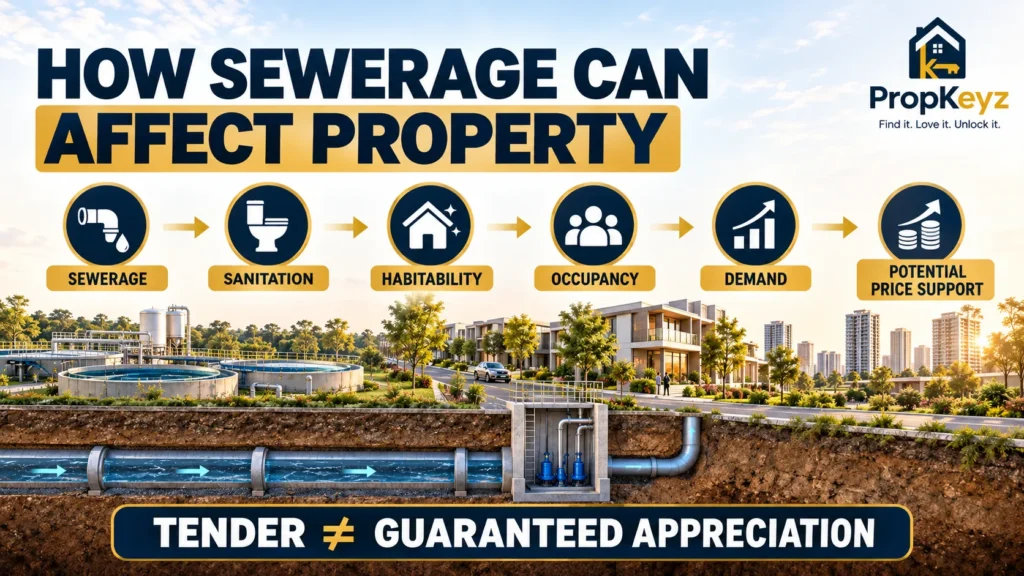
Why can sewerage matter for property pricing?
Because property value depends partly on:
usable urban utility.
Potential Chain
Sewerage Network
↓
Better Sanitation
↓
Higher Development Capacity
↓
More Habitability
↓
More End-User Confidence
↓
Potential Better Liquidity
↓
Potential Price Support
But
The effect can fail if:
- infrastructure remains incomplete;
- approvals remain uncertain;
- asking prices become speculative;
- connectivity stays weak.
Why Prices Do Not Rise Automatically
A common sales line may become:
“STP aa gaya, ab rates badhenge.”
But currently:
STP operational nahi hai — tender live hai.
That is a major difference.
Property Pricing Stages
Tender
→ lowest execution certainty
Contract Award
→ stronger
Construction
→ stronger
Commissioning
→ stronger
Actual Connections
→ practical utility
Stable Operation
→ mature value
PropKeyz Rule
Do Not Pay Operational-Sewerage Premium at Tender Stage
Environmental Impact
The long-term environmental value can be substantial if the project operates effectively.
Proper sewage treatment can help reduce:
- untreated discharge;
- contaminated drains;
- water pollution;
- sanitation stress.
FSTP capacity can help safely manage:
- septic-tank sludge;
- faecal sludge
that may otherwise be dumped improperly.
MoHUA treats safe faecal-sludge and used-water management as central SBM-U 2.0 sanitation outcomes.
Groundwater & Septic-Tank Dependence
In fast-growing peripheral areas, widespread septic systems can create challenges if:
- tanks are badly designed;
- desludging is irregular;
- sludge is dumped informally;
- groundwater table is vulnerable.
A proper FSTP creates:
a controlled treatment destination
for collected sludge.
But
FSTP only works if supported by:
- authorised desludging;
- transport;
- operating system;
- user compliance.
Monsoon / Waterlogging Connection
Sewerage and storm-water drainage are related urban-infrastructure issues but should not be confused.
Sewer
Carries:
domestic wastewater.
Storm Drain
Carries:
rainwater runoff.
A new sewer network alone does not automatically eliminate:
waterlogging.
Waterlogging depends on:
- storm drains;
- road levels;
- natural drainage;
- encroachment;
- outlet capacity.
PropKeyz Rule
Sewerage Improvement ≠ Automatic Flood Solution
What Buyers Should Verify On Site
Do not buy because someone says:
“Government STP bana rahi hai.”
Verify:
1. Exact Village
Gharuan or nearby?
2. Exact Khasra / Project
Broad geography is not enough.
3. Current Land Use
What is legal today?
4. Project Approval
If plotted/project property.
5. Road Access
Drive it.
6. Current Sewerage
Ask:
- sewer exists?
- septic tank?
- open drain?
7. Tender Stage
Tender, award or construction?
8. Proposed Connection
Does the project/property fall within the network catchment?
9. Water Supply
Sewerage is only one utility.
10. Current Price
How much future infrastructure premium is seller charging?
NRI / Outstation Buyer Checklist

Remote buyers face the highest risk of buying:
a narrative instead of a property.
Before investing:
- identify exact parcel;
- obtain title/revenue record;
- verify current land use;
- check proposed draft zoning;
- confirm access road;
- inspect existing habitation;
- check current sewer/septic arrangement;
- verify project licence where applicable;
- check RERA where applicable;
- compare asking price with existing Kharar/Mohali alternatives.
NRI Rule
A future sewerage plant can be upside. It should not replace present-day legal due diligence.
Tender-to-Operation Timeline
Stage 1 — Tender Published
Current verified stage
Stage 2 — Bid Closing
27 October 2026
Stage 3 — Bid Opening
28 October 2026
Stage 4 — Evaluation
Future.
Stage 5 — Contract Award
Future.
Stage 6 — Work Order
Future.
Stage 7 — Sewer Network Construction
Future.
Stage 8 — Pumping Stations
Future.
Stage 9 — STP/FSTP Installation
Future.
Stage 10 — Testing / Commissioning
Future.
Stage 11 — Household / Area Connections
Future operational stage.
Stage 12 — Stable Treatment
This is where actual urban benefit becomes measurable.
Fact vs Assumption
| Confirmed | Do Not Assume |
|---|---|
| Tender published 2 Oct 2026 | Work already completed |
| Sewer network included | Every Gharuan property gets connection |
| IPS & MPS included | Exact pump locations known |
| Rising main included | Pipeline alignment publicly confirmed |
| 5.5 MLD STP included | Plant currently treats 5.5 MLD |
| 17 KLD FSTP included | Every septic tank will be serviced |
| EMD ₹56.53 lakh | Official project cost is ₹28.27 Cr |
| Gharuan draft plan covers ~3,000 acres | Master Plan finally notified |
| Proposed residential zones exist | Every parcel is approved residential |
| Sewerage can improve urban capacity | Property rates must rise |
PropKeyz Analysis
The Gharuan Sewerage & STP Project 2026 may be one of the most important follow-up developments after the Gharuan planning story because it shifts the conversation from:
“What may be zoned?”
to:
“What infrastructure is being prepared?”
1. Gharuan’s SEO Story Is Becoming an Urbanisation Story
The first major signal was:
nearly 3,000 acres of draft planning change.
Now we have:
a substantial sewerage/STP procurement.
That creates a stronger research cluster.
2. Sewerage Is a More Serious Signal Than Broker Marketing
Many speculative markets advertise:
- “future highway”;
- “future township”;
- “future commercial.”
A government sanitation tender is different because it represents:
formal infrastructure procurement.
That still does not guarantee completion.
But it is more concrete than:
verbal future claims.
3. STP + FSTP Is Particularly Interesting
A normal sewerage story might include only:
sewer + STP.
Here the tender includes:
STP + FSTP.
That suggests sanitation planning considers both:
- sewered wastewater;
- faecal sludge / septage.
That is more suitable for a transition market where existing and future settlement forms can coexist.
4. Gharuan Is Still Not Established Mohali
This infrastructure does not make Gharuan equivalent overnight to:
- Sector 66;
- Aerocity;
- IT City;
- established Mohali sectors.
Those markets have:
- stronger habitation;
- deeper transactions;
- more mature services.
Gharuan remains:
an emerging planning/infrastructure market.
5. Sewerage Can Support Denser Residential Development
Organised high-density habitation needs wastewater infrastructure.
Without it:
development capacity eventually hits a sanitation ceiling.
A 5.5 MLD STP can therefore matter more over time as:
- housing;
- institutions;
- local commerce
grow.
6. But 5.5 MLD Is Capacity, Not Demand
Investors should not say:
“Itna bada STP hai, matlab population aa rahi hai.”
Capacity is infrastructure planning.
Actual urban success depends on:
- occupancy;
- connections;
- projects;
- jobs.
7. The Draft Master Plan and STP Should Be Read Together—But Not Merged
Planning says:
future land use.
STP says:
sanitation infrastructure.
One does not legally validate the other.
This distinction is exactly what can make PropKeyz content stronger than broker blogs.
8. Infrastructure Can Reduce Development Risk
A property market based only on:
zoning expectations
has greater infrastructure uncertainty.
Every concrete sewer:
- tender;
- road project;
- utility project
can reduce part of that uncertainty.
But
It does not remove:
- title risk;
- zoning risk;
- approval risk;
- execution risk.
9. The Biggest Winner Could Be End-User Confidence
Investors often think only:
rate.
But the most important effect of organised sewerage can be:
residents becoming more willing to live there.
End-user confidence is what eventually supports:
- occupancy;
- rental demand;
- resale depth.
10. FSTP Can Matter During the Transition Period
Even after a sewer system starts expanding, many existing buildings may remain dependent on:
- septic systems.
An FSTP creates a safer pathway for that sludge.
This is especially relevant in outer-growth areas.
11. Infrastructure Impact Will Be Uneven
A licensed residential project connected to the eventual network may benefit materially.
Agricultural land several kilometres away may receive little direct benefit.
Therefore
“Gharuan sewerage project” is not a universal appreciation trigger for the entire Kharar belt.
12. The Next Milestone Is Procurement Outcome
The first key date is:
27–28 October 2026.
After that we should monitor:
- bid status;
- award;
- contractor;
- work order;
- physical progress.
Do Not Create a New Blog
Update:
this same URL.
Final PropKeyz Analysis
Gharuan’s 2026 development story is becoming more credible because it is moving beyond draft land-use discussion into physical urban-infrastructure procurement. The 5.5 MLD STP, 17 KLD FSTP, pumping stations, rising main and sewer network are meaningful sanitation components—but the property market should value them according to execution stage. The strongest future Gharuan story will be final planning clarity plus roads, sewerage, water, power, legal projects and actual residents—not speculative land prices built on one tender.
PropKeyz Verdict: Gharuan Sewerage & STP Project 2026
What Is Confirmed?
Punjab has floated a live tender for:
- sewer lines;
- IPS;
- MPS;
- rising main;
- 5.5 MLD STP;
- 17 KLD FSTP.
Current Stage
Tender / procurement
What Is Not Yet Confirmed?
- contractor;
- final contract value;
- work order;
- construction start;
- commissioning date;
- actual sewer connections.
Does This Make Gharuan Master Plan Final?
No.
The nearly 3,000-acre planning story remains a:
draft Regional Plan amendment story.
Can It Help Property Values?
Potentially, if completed and integrated with:
- legal development;
- roads;
- water;
- power;
- occupancy.
Should Buyers Pay a Large Premium Today?
Not purely because of this tender.
Final PropKeyz Rule
The Gharuan sewerage project is a strong infrastructure signal—but a good property investment still needs legal clarity, real access, sensible entry pricing and a development stage that matches your investment horizon.
Frequently Asked Questions
What is the Gharuan Sewerage & STP Project 2026?
It is a Punjab Government sanitation tender covering sewer laying, pumping stations, a rising main, a 5.5 MLD sewage treatment plant and a 17 KLD faecal sludge treatment plant at Gharuan, SAS Nagar.
When was the Gharuan sewerage tender published?
2 October 2026.
What is the tender ID?
2026_DLG_176757_1
When do bids close?
27 October 2026 at 3:00 PM.
When are bids scheduled to open?
28 October 2026 at 1:00 PM.
What is the EMD?
₹56.53 lakh.
What is the official project value?
The current official Punjab e-Procurement listing does not disclose a tender value.
Is the project ₹28.27 crore?
Some private tender aggregators estimate that figure, but it is not an officially disclosed tender value in the current Punjab portal listing.
What does 5.5 MLD STP mean?
A sewage-treatment design capacity of approximately:
5.5 million litres per day.
What does 17 KLD FSTP mean?
A faecal-sludge-treatment design capacity of approximately:
17,000 litres per day.
Is FSTP the same as STP?
No.
STP treats sewage, generally from sewer networks.
FSTP treats concentrated faecal sludge/septage.
What is IPS in sewerage?
IPS generally means:
Intermediate Pumping Station.
What is MPS?
MPS generally means:
Main Pumping Station.
Why are pumping stations needed?
They help lift sewage where gravity alone cannot move it efficiently through the network.
What is a rising main?
A pressurised sewer pipeline carrying sewage from a pumping station toward another network point or treatment facility.
Is the Gharuan STP already operational?
No such current confirmation exists.
The package is presently at tender/procurement stage.
Has the contractor been selected?
Not established as of 8 October 2026.
Is this part of Swachh Bharat Mission 2.0?
The tender expressly identifies:
SBM 2 Scheme.
MoHUA’s SBM-U 2.0 framework includes safe management of used water, sewage and faecal sludge.
Does this mean Gharuan Master Plan is approved?
No.
The Gharuan planning proposal remains a separate draft Regional Plan amendment story.
Will all Gharuan properties get sewer connections?
That cannot be assumed.
Exact network catchment and connections require engineering/service-area confirmation.
Will this increase property prices?
A functioning sewerage system can strengthen long-term liveability and development capacity, but property appreciation is not guaranteed.
Will sewerage solve waterlogging?
Not by itself.
Storm-water drainage and sewage networks are separate systems.
Can agricultural land become residential because an STP is coming?
No.
Land-use and development approvals remain separate.
Why does this matter for investors?
Because organised sewerage reduces one major infrastructure uncertainty in a growing urban area—if the project is eventually awarded, built, commissioned and used.
What should buyers monitor next?
The next immediate milestones are:
- 27 October bid closing;
- 28 October bid opening;
- technical/financial evaluation;
- contract award;
- physical construction.
Continue Your Gharuan & Mohali Research
Gharuan Master Plan 2026
The natural internal link for this article.
It explains:
- nearly 3,000-acre draft amendment;
- proposed residential locations;
- agricultural villages;
- industrial planning;
- buyer risks.
Read Gharuan Master Plan 2026 on PropKeyz
Mohali Real Estate Future 2026
For the wider argument that rapid housing growth requires:
- roads;
- sewerage;
- drainage;
- water;
- power.
Read Mohali Real Estate Future 2026
Punjab Building Rules 2026
Planning and sanitation infrastructure do not replace building/project-level compliance.
Read Punjab Building Rules 2026
CLU in Mohali 2026
For the distinction between:
infrastructure nearby
and:
legal permission to develop a specific property.
Property in Mohali
For buyers comparing Gharuan with more established Greater Mohali alternatives.
Explore Property in Mohali with PropKeyz
NRI Property Management
For NRI/outstation owners who need on-ground property monitoring and coordination.
Explore NRI Property Management by PropKeyz
Property Research & Support Through PropKeyz
PropKeyz tracks Mohali and Greater Mohali development using:
- government tenders;
- GMADA planning records;
- infrastructure updates;
- legal/regulatory developments;
- project approvals;
- local property evidence.
Considering Property in Gharuan?
Do not send only:
“rate kya hai?”
Share:
- exact village;
- exact location;
- khasra/project name;
- property type;
- asking price;
- current approvals;
- road access.
The correct comparison is:
Legal Status + Current Infrastructure + Future Infrastructure + Entry Price + Exit Demand
For NRI / Outstation Buyers
A local physical check should include:
- road;
- drainage;
- sewer/septic situation;
- surrounding habitation;
- actual project construction;
- access to daily services.
Your Property. Our Responsibility.
Sources & Verification
Last Fact-Checked: 8 October 2026
Punjab Government e-Procurement — Primary Source
Used to verify:
- tender scope;
- Gharuan location;
- 5.5 MLD STP;
- 17 KLD FSTP;
- IPS/MPS;
- rising main;
- tender ID;
- EMD;
- dates;
- current procurement stage.
Punjab Government e-Procurement — Gharuan Sewerage Tender
Ministry of Housing & Urban Affairs — SBM Urban 2.0
Used for:
- sewage-treatment context;
- faecal-sludge management;
- ODF++;
- Water+;
- used-water management.
PropKeyz — Gharuan Master Plan 2026
Used for:
- nearly 3,000-acre draft-planning context;
- planning status;
- residential/agricultural/industrial differentiation.
Disclaimer
This article is intended for:
- property research;
- infrastructure education;
- Gharuan market analysis;
- buyer due diligence.
It is not:
- an engineering DPR;
- an STP design certificate;
- a sewer-network connection guarantee;
- an environmental clearance;
- a land-use approval;
- investment advice.
The tender establishes:
a procurement process.
It does not establish:
- contract award;
- construction completion;
- plant commissioning;
- sewer connection for a specific property.
The 5.5 MLD and 17 KLD numbers refer to:
design capacities in the tender scope.
They do not establish:
- current wastewater generation;
- current operating load;
- exact population served.
The Gharuan Regional Plan proposal remains a separate planning process.
Before buying property based on the sewerage project, independently verify:
Exact Property → Current Land Use → Project Approval → Existing Access → Sewer Catchment → Tender/Construction Stage → Current Asking Price
Your Property. Our Responsibility.