Last Updated: 27 September 2026
Fact-Checked: 27 September 2026
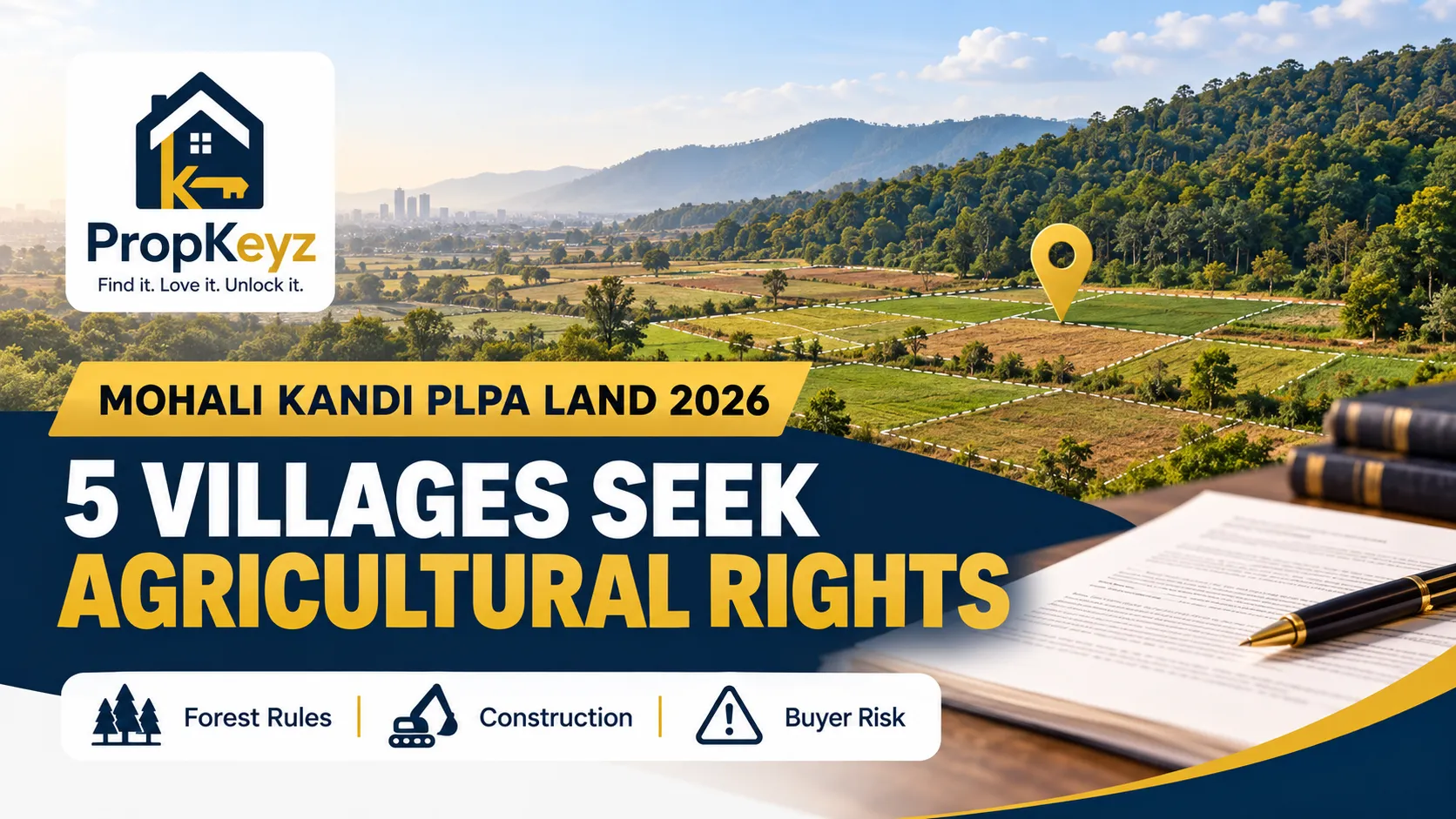
The Mohali Kandi PLPA Land Status 2026 issue has become one of the most important emerging land-status stories for property owners and buyers in Mohali’s Shivalik–Kandi belt.
Five village panchayats—
- Gurha
- Kasauli
- Jayanti Majri
- Bhaghindi
- Karaundewal
—have approached senior constitutional and government authorities seeking recognition of certain delisted land as:
agricultural land
and relief from continuing restrictions which, according to the villagers, are still being enforced through the Forest Department.
The latest representation matters because the dispute sits at the intersection of:
revenue ownership + agricultural use + PLPA history + forest conditions + construction rights + commercial use + property value
For a Mohali property buyer, one distinction matters above all:
Delisted PLPA Land ≠ Unrestricted Development Land
And another:
Agricultural Entry in Revenue Record ≠ Automatic Building Permission
The villagers say their families have been cultivating parts of the Kandi belt for decades and that land-allotment processes began in the early 1970s, with later proceedings continuing into the 1980s.
Current reporting says revenue records refer to entries such as:
- Abal Khewat
- Khanakasht / Khana Kasht
which villagers rely on in support of their ownership/cultivation claims.
At the same time, the Mohali Forest Department says the relevant cultivation and habitation areas were delisted from PLPA Section 4 during the 2010–11 period only:
subject to conditions
including restrictions on:
commercial activity.
This is not a minor technical detail.
A buyer may hear:
“Land forest se delist ho chuki hai.”
and incorrectly translate that into:
“Ab farmhouse, commercial activity ya plotting freely allowed hai.”
That conclusion is unsafe.
In fact, environmental litigation in 2025–26 has made the distinction even more important.
Punjab amended its Farm Stay Policy, 2026 on 15 September 2026 so that the policy now excludes:
- PLPA-protected land;
- land released or delisted from PLPA.
Separately, the National Green Tribunal has continued an interim stay affecting Punjab’s Low Impact Green Habitat / farmhouse policy in relevant forest-adjoining areas.
A fresh Forest Department SOP dated:
14 September 2026
also reportedly requires detailed documentation in relevant PLPA-delisted/closed-land diversion cases, including:
- exact khasra numbers,
- applicable delisting notification,
- building plans,
- proposed built-up/utility maps,
- sewage arrangements,
- waste-disposal arrangements,
- Punjab Pollution Control Board NOC.
For a buyer, therefore, the correct question is not:
“Registry ho jayegi?”
It is:
“Exact khasra ka revenue status, PLPA history, delisting condition, planning land use aur present development permission kya hai?”
This PropKeyz guide explains what the Mohali Kandi PLPA Land Status 2026 dispute means for:
- village landowners,
- agricultural-land buyers,
- farmhouse buyers,
- investors,
- NRIs,
- anyone being offered land marketed as “delisted forest”, “farmhouse land” or “future residential”.
For the broader planning distinction between agricultural land, residential zoning and approved development, also read:
Mohali Master Plan Land Use Change 2026
Key Takeaways
- Five Kandi-belt village panchayats—Gurha, Kasauli, Jayanti Majri, Bhaghindi and Karaundewal—have sought formal recognition of certain delisted land as agricultural land.
- The latest representation is a demand/request; it is not a final judicial declaration in their favour.
- The relevant law is the Punjab Land Preservation Act, 1900, not a 1980 Act.
- PLPA allows government to regulate or restrict activities in notified areas for land, erosion and conservation purposes.
- Cultivation/habitation parcels were later delisted through the 2010–11 process subject to conditions.
- The delisting framework was tied to:
- bona fide agriculture;
- livelihood needs;
- restriction on commercial activity.
- Delisting does not automatically create unrestricted residential or commercial development rights.
- Villagers rely on revenue entries such as Abal Khewat and Khanakasht/Khana Kasht.
- Revenue ownership or cultivation entries do not automatically establish planning/building permission.
- The Mohali Forest Department says the conditions attached to delisting continue to matter.
- A Forest Department SOP dated 14 September 2026 reportedly requires detailed documents in relevant diversion cases.
- These include:
- exact khasra numbers;
- delisting notification;
- ownership by user agency;
- complete building plan;
- built-up/utility map;
- sewage plan;
- waste-disposal plan;
- PPCB NOC.
- Villagers say current restrictions make even traditional livelihood-related improvements difficult.
- They also refer to practical restrictions resulting in G+1 construction limits in their situation.
- This should not be treated as a universal PLPA-wide G+1 rule.
- Punjab amended the Farm Stay Policy 2026 on 15 September 2026.
- The amended Farm Stay Policy explicitly excludes:
- PLPA land;
- released/delisted PLPA land.
- Punjab’s separate Low Impact Green Habitat / farmhouse policy remains under NGT restraint in affected areas.
- Registry does not prove that a farmhouse, commercial use, colony or project can legally be developed.
- Agricultural status does not automatically mean commercial farm-stay eligibility.
- Master Plan zoning does not erase PLPA or forest-related conditions.
- Buyers must verify land at khasra level, not merely by village name.
- Buyers should not pay a residential/farmhouse premium for land whose development permissions remain uncertain.
PropKeyz View
The biggest mistake in Kandi-belt property is to treat “private agricultural land”, “delisted PLPA land” and “freely developable land” as three descriptions of the same thing. They are not.
Mohali Kandi PLPA Land Status 2026: Quick Answer
The Mohali Kandi PLPA Land Status 2026 dispute concerns land in five Kandi-belt villages where residents say parcels delisted from the PLPA framework should be formally recognised and practically usable as agricultural land without continuing Forest Department restrictions that, according to them, interfere even with livelihood-related use.
Current Position — 27 September 2026
| Issue | Current Position |
|---|---|
| Main law | Punjab Land Preservation Act, 1900 |
| Villages | Gurha, Kasauli, Jayanti Majri, Bhaghindi, Karaundewal |
| Latest action | Panchayat representation / petition to senior authorities |
| Agricultural status finally declared? | No such final current ruling established |
| PLPA delisting occurred historically? | Yes, identified cultivation/habitation areas were delisted |
| Delisting unrestricted? | No |
| Commercial activity automatically allowed? | No |
| Bona fide agriculture/livelihood use relevant? | Yes |
| Revenue agricultural entry = building permission? | No |
| Registry = development approval? | No |
| Farm Stay Policy available on delisted PLPA land? | No under Sept 2026 amendment |
| LIGH/farmhouse policy fully operational? | No; NGT stay continues in affected areas |
| Forest SOP issued | 14 September 2026 reported |
| Exact khasra required | Yes in reported SOP process |
| Building plan required in relevant diversion cases | Yes |
| PPCB NOC required in reported SOP process | Yes |
| Blanket right to farmhouse? | No |
| Blanket right to commercial use? | No |
Direct Answer
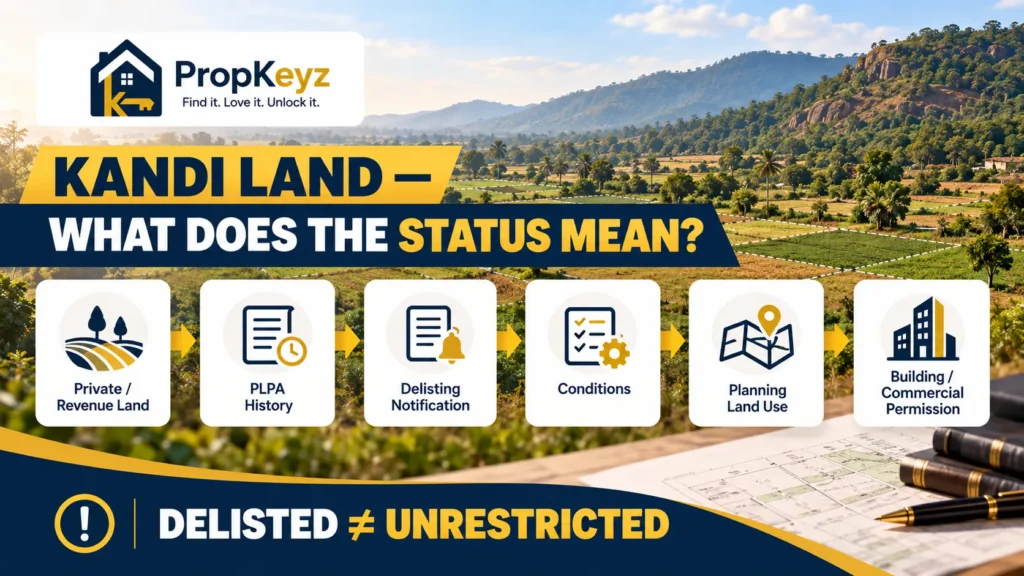
Delisting removes a particular layer of PLPA/forest-list treatment for identified parcels, but it does not automatically convert the land into unrestricted residential, farmhouse, tourism or commercial property. The exact khasra, delisting notification, conditions, planning land use and present permissions still matter.
PropKeyz Rule
Delisted ≠ Unrestricted
What Happened in September 2026?
Residents of five Mohali Kandi-area villages have sent representations seeking relief concerning land they say:
- was allotted for agricultural use;
- appears in revenue cultivation/ownership records;
- has been used agriculturally for decades;
- was later delisted from PLPA-related forest treatment;
- remains practically constrained by Forest Department restrictions.
The five village panchayats named in current reporting are:
Gurha • Kasauli • Jayanti Majri • Bhaghindi • Karaundewal
The representation was addressed to senior authorities including:
- the Prime Minister;
- Punjab Chief Minister;
- Chief Justice of the Punjab & Haryana High Court.
The villagers’ central argument is broadly:
if the land was formally released/delisted for bona fide agriculture and livelihood, it should not continue to be treated in practice as though normal agricultural use remains under forest control.
But the Forest Department’s position is different.
It says:
the delisting itself was conditional.
That disagreement creates the current property/legal issue.
Which Five Villages Are Involved?
1. Gurha
Part of the Kandi-belt representation seeking agricultural recognition and relief from continuing restrictions.
2. Kasauli
The Kasauli referred to in the current Mohali Kandi story should not be confused with the well-known hill station in Himachal Pradesh.
3. Jayanti Majri
An important Shivalik/Kandi-side village name that may appear in land and environmental-property discussions.
4. Bhaghindi
Included in the collective village representation.
5. Karaundewal
Also included in the current representation.
Buyer Rule
A village name alone does not establish the status of a specific land parcel.
Two parcels within the same village can have different:
- khasra numbers;
- ownership;
- PLPA history;
- forest status;
- planning status;
- access;
- development rights.
PropKeyz Rule
Village-Level News Is a Signal to Investigate—Not Parcel-Level Proof
What Is the Punjab Land Preservation Act, 1900?
The relevant statute is:
The Punjab Land Preservation Act, 1900
The official Act can be reviewed through India Code:
Punjab Land Preservation Act, 1900 — India Code
The Act creates a framework for protecting vulnerable land, including objectives connected with:
- conservation of sub-soil water;
- prevention of erosion;
- regulating certain land-use activities.
Important Fact Check
If you see the statement:
“Punjab government enacted PLPA in 1980”
that should not be used as the legal description of the statute.
The Act itself dates to:
1900
The year 1980 is relevant in other forest-law contexts, especially the Forest (Conservation) Act, but it is not the enactment year of PLPA.
PropKeyz Research Rule
Always verify the statute—not just the news summary.
What Does PLPA Section 4 Do?
Section 4 gives the Government power, within applicable notified areas, to regulate, restrict or prohibit specified activities.
The statutory framework can affect matters such as:
- clearing or breaking up land;
- cultivation in certain circumstances;
- grazing;
- tree/forest-produce activity;
- other land-management actions covered by the Act.
Why Buyers Care
A broker may say:
“Land private hai.”
Private ownership and statutory land-use restrictions can coexist.
That means:
ownership answers “whose land?”
while:
PLPA/forest/planning rules answer “what can legally be done?”
These are separate questions.
What Does “PLPA Land” Mean?
The phrase is often used too loosely in property discussions.
“PLPA land” may refer to land that has some history of being:
- included in a PLPA-notified area;
- subject to Section 4 restrictions;
- shown in forest-related administrative records;
- later released/delisted;
- affected by subsequent forest/environment litigation.
Why Loose Language Is Dangerous
Two sellers may both say:
“Ye PLPA wali land hai.”
But Parcel A may be:
- currently protected;
while Parcel B may be:
- delisted subject to conditions.
A third parcel may have:
- unclear boundary/demarcation.
PropKeyz Rule
Never buy a “PLPA story.” Buy only after verifying the exact PLPA history of the exact khasra.
What Does “Delisted PLPA Land” Mean?
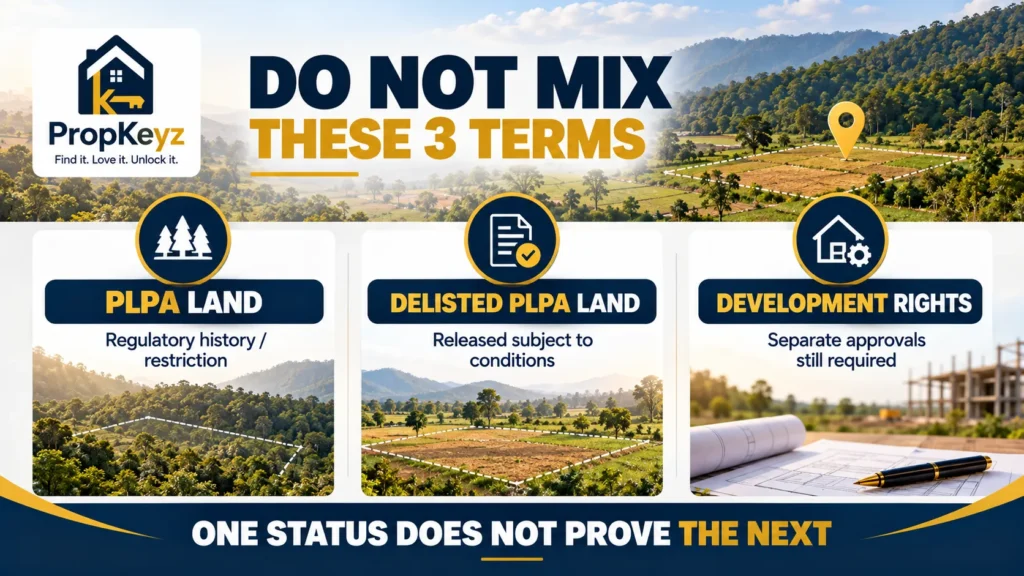
Delisting is one of the most misunderstood terms in Mohali Kandi property.
The 2010–11 process concerned cultivated and habitation areas which had earlier been included in forest-related records because they were closed under PLPA.
The delisting framework was pursued after Central environmental/forest approvals and earlier Supreme Court-linked proceedings.
What Delisting Can Mean
For identified land:
a particular PLPA/forest-list restriction can cease to apply in the manner stated in the notification.
What Delisting Does Not Automatically Mean
It does not automatically mean:
- commercial activity is allowed;
- farmhouse construction is allowed;
- colony development is allowed;
- hotel/resort is allowed;
- land is residential;
- CLU is approved;
- building plan is sanctioned.
PropKeyz Rule
Removal From One Restriction Does Not Equal Approval Under Every Other Law
Why Were Cultivation and Habitation Areas Delisted?
The delisting history relates to land that was described as:
cultivated and habitation area
and intended for:
- bona fide agriculture;
- livelihood needs.
NGT proceedings quoting the historical delisting conditions show that the Central approval specifically referred to:
bona fide agricultural use and other livelihood needs.
The same material records conditions restricting:
commercial activity.
This history is extremely important for current property buyers.
Buyer Mistake
“Delisted means Forest Department ka koi role nahi aur commercial farmhouse bana sakte hain.”
Better Interpretation
The land’s current use must be tested against the precise delisting notification, its conditions and every other applicable law/policy.
What Conditions Came With Delisting?
The historical conditions quoted in NGT proceedings include the following broad principles:
No Commercial Activity
The State was required to ensure that commercial activity was not permitted on the identified delisted land.
Bona Fide Agriculture / Livelihood
The land was to be used for:
- bona fide agriculture;
- sustaining the livelihood of owners/people.
Forest Areas Accidentally Included
If actual notified/otherwise forest areas were inadvertently included in delisting lists, they were not to be automatically treated as validly delisted.
The relevant NGT record can be reviewed here:
NGT Proceedings on Punjab Farm Stay Policy & Delisted PLPA Land
And an earlier NGT matter reproducing the historical delisting conditions can be reviewed here:
NGT Record on 2011 PLPA Delisting Conditions
PropKeyz Rule
Always Read the Conditions Attached to a Delisting—Not Only the Word “Delisted.”
Agricultural Land vs Delisted PLPA Land
These terms overlap in some cases but are not synonyms.
| Question | Agricultural Land | Delisted PLPA Land |
|---|---|---|
| Revenue agricultural use possible? | Yes, depending on record | Often central to delisting history |
| PLPA history necessarily involved? | No | Yes |
| Commercial use automatically allowed? | No | No |
| Residential project automatically allowed? | No | No |
| Farmhouse automatically allowed? | No | No |
| CLU automatically available? | No | No |
| Khasra verification required? | Yes | Essential |
| Forest/delisting conditions may matter? | Sometimes | Yes |
PropKeyz View
“Agricultural” describes a land-use/revenue context. “Delisted PLPA” describes a regulatory history. A parcel can involve both at the same time.
What Do Abal Khewat and Khanakasht Mean?
The latest village representation relies partly on revenue-record terminology.
Current reporting describes:
Abal Khewat
as a primary or first ownership account reference.
Khanakasht / Khana Kasht
as a cultivation/possession-related revenue column.
Why This Matters
Revenue records can be very important for:
- ownership history;
- cultivation;
- possession entries;
- land description.
But a buyer should never translate such an entry into:
“Development legally approved.”
PropKeyz Rule
Revenue Record ≠ Building Sanction
What Do Villagers Say About the 1970s–1980s Allotments?
According to the village representatives:
- the land-allotment process began around 1972–73;
- appeals and subsequent proceedings delayed completion;
- finalisation stretched until around 1983–84.
The villagers say their families and earlier generations have cultivated land in the Kandi belt for decades.
Important
PropKeyz would treat this as:
the villagers’ historical account
unless the exact allotment orders and appeals for a given khasra are independently verified.
Buyer Rule
If a seller relies on a historic allotment:
ask for:
- original allotment order;
- appeal/revision order;
- mutation;
- jamabandi;
- current fard;
- exact khasra.
What Does the Forest Department Say?
The Forest Department’s position is essential.
According to current reporting, the department says:
- habitation and cultivation areas were identified in the Kandi belt;
- the relevant areas were delisted from Section 4 during the 2010–11 process;
- Central forest approval formed part of that process;
- the delisting was subject to conditions;
- restrictions on commercial activity continue to matter.
This means the disagreement is not necessarily about whether delisting occurred.
The bigger dispute is:
what rights and restrictions remain after delisting.
PropKeyz View
The real legal/property issue is no longer just “was it delisted?” It is “what did the delisting legally allow?”
What Is the 14 September 2026 Forest SOP?
A Forest Department SOP dated:
14 September 2026
has become especially relevant.
Current reporting says the SOP applies to relevant cases involving:
PLPA-delisted / closed land
and requires several items before proposed diversion/use can be considered.
Reported Requirements Include
- Land should be owned by the user agency.
- Relevant delisting notification must be provided.
- Exact khasra numbers must be identified.
- Approved map showing proposed built-up area must be submitted.
- Utility areas must be shown.
- Complete building plan must be provided.
- Sewage arrangements must be detailed.
- Waste-disposal arrangements must be detailed.
- Proper Punjab Pollution Control Board NOC must be supplied.
Why This Matters for Buyers
If a seller says:
“PLPA delisted hai, construction simple hai.”
the fresh SOP points in the opposite direction:
document-heavy, parcel-specific scrutiny can still apply.
PropKeyz Rule
Delisted Land Can Still Be Approval-Heavy Land
Why Khasra-Level Verification Matters
“Kandi belt” is too broad for a property decision.
“Jayanti Majri” is still too broad.
Even:
“My land is in the delisted village list”
may still be insufficient.
The key question is:
Is this exact khasra covered by the relevant notification and what conditions attach to it?
Verify
- khasra number;
- jamabandi;
- fard;
- mutation;
- delisting schedule;
- Section 4 history;
- forest demarcation;
- current Master Plan/Regional Plan;
- current access;
- proposed use.
PropKeyz Formula
Khasra → Revenue Record → PLPA History → Delisting Notification → Conditions → Planning Land Use → Permission
Can Owners Build Houses on Delisted PLPA Land?
There is no safe universal:
yes
for all delisted PLPA land.
A house/building proposal may need analysis of:
- exact delisting conditions;
- Forest Department requirements;
- planning zone;
- building rules;
- sanctioned plan;
- environmental conditions;
- road/access;
- authority jurisdiction.
Incorrect Buyer Logic
“Agricultural land private hai, ghar bana sakte hain.”
Better Question
“Which rule permits the exact proposed building on this exact khasra?”
Is G+1 the Rule?
Villagers involved in the latest representation say the existing restriction environment effectively limits them to:
G+1 — ground plus one floor
in their situation.
But this should not be published as:
“PLPA Section 4 universally allows G+1.”
That is not established.
Correct PropKeyz Wording
Villagers say current restrictions in the Kandi belt effectively limit construction to G+1 in their circumstances; the exact legally permissible construction for a parcel must be verified from the applicable planning, forest and building approvals.
Important
G+1 refers to:
floor configuration
not FAR.
FAR is:
total covered floor area relative to plot area.
Can Owners Construct Agricultural Sheds?
The villagers say Forest Department objections can make even traditional livelihood-related construction—such as cattle sheds—difficult.
But again:
individual agricultural structures should be assessed against the applicable rules and purpose.
A cattle shed for bona fide livelihood use should not automatically be equated with:
- farmhouse villa;
- banquet property;
- resort;
- commercial homestay;
- plotted colony.
PropKeyz Rule
Agricultural Livelihood Structure ≠ Commercial Real Estate Development
Can Buyers Build a Farmhouse?
This is one of the highest-risk marketing words in the Kandi belt.
A dealer may say:
“Farmhouse land.”
That phrase may describe:
- plot size;
- surrounding landscape;
- marketing concept.
It does not prove:
a legally approved farmhouse is permitted.
Before Buying “Farmhouse Land,” Verify
- exact revenue use;
- PLPA history;
- delisting conditions;
- forest status;
- applicable Housing policy;
- NGT orders;
- Master Plan;
- CLU if relevant;
- sanctioned building route.
For a broader explanation of why land ownership and land-use permission are separate, read:
Can Owners Open a Farm Stay?
This answer changed materially in September 2026.
Punjab’s Farm Stay Policy, 2026 originally raised controversy because it could have been read to cover some delisted PLPA land.
After National Green Tribunal intervention, Punjab amended the policy.
The amendment was notified on:
15 September 2026
and explicitly excludes:
- land protected under PLPA;
- land released/delisted from PLPA.
Read the current policy-development report:
Punjab Farm Stay Policy Amendment After NGT Intervention
Direct Answer
A buyer should not rely on the Farm Stay Policy 2026 as a route to commercial farm-stay construction on PLPA or delisted PLPA land.
September 2026 Farm Stay Policy Amendment
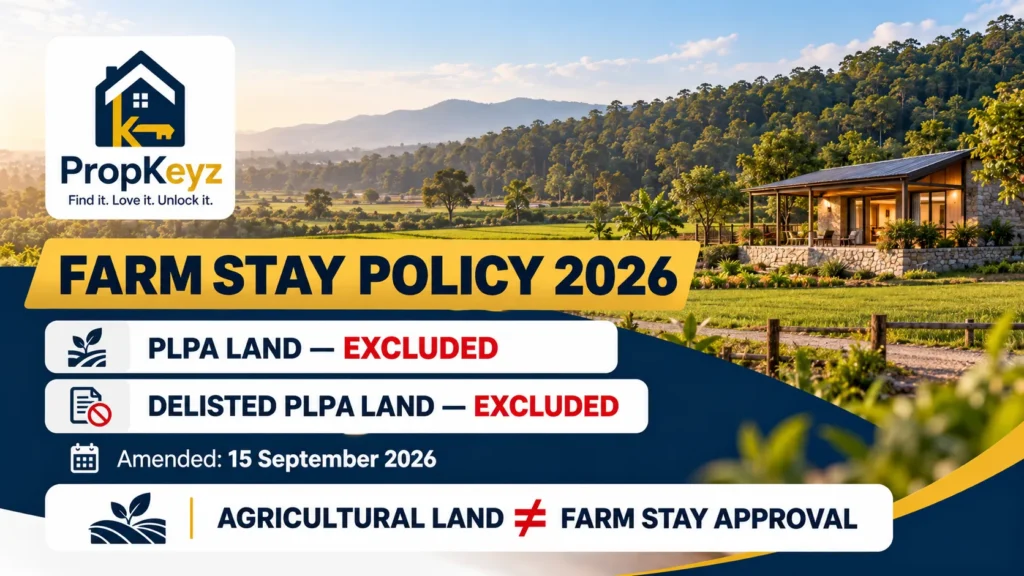
The 15 September amendment is one of the most important current facts for Kandi property buyers.
Previously
The policy framework triggered concern that farm stays could facilitate commercial construction on environmentally sensitive/delisted land.
Now
The amended policy expressly keeps:
PLPA land
and:
released/delisted PLPA land
outside its scope.
Why This Is Important
A seller cannot responsibly say:
“Agricultural land hai, Farm Stay Policy me commercial rooms bana lena.”
without confronting the September exclusion.
PropKeyz Rule
Farm Stay Policy ≠ Backdoor Farmhouse Approval on Delisted PLPA Land
Farm Stay Policy vs LIGH / Farmhouse Policy
These are two different policy tracks.
Farm Stay Policy 2026
Department:
Tourism & Cultural Affairs
Objective:
rural/experiential tourism.
Current PLPA position:
PLPA + delisted PLPA land excluded.
Low Impact Green Habitat / Farmhouse Policy
Department:
Housing & Urban Development
Objective:
separate low-impact / farmhouse-development framework.
Current status:
the National Green Tribunal has continued its interim stay in the affected policy context.
The Tribune reported on 19 September 2026 that the NGT continued the restraint on permissions under the policy in relevant areas.
Read the NGT Farmhouse-Policy Stay Update
PropKeyz Rule
Farm Stay ≠ Farmhouse Policy
What Is the Current NGT Position?
The National Green Tribunal has been examining two connected environmental-policy concerns.
Farm Stay Policy
Punjab modified the policy and excluded:
- PLPA land;
- delisted PLPA land.
LIGH / Farmhouse Policy
The NGT continued its interim restraint in September 2026.
The Tribunal’s concern arises from the relationship between:
- forest-adjoining land;
- delisted areas;
- construction;
- earlier environmental/forest directions.
Buyer Meaning
Do not accept:
“NGT issue solve ho gaya.”
without identifying:
- which policy;
- which order;
- which date;
- which exact land category.
Does Agricultural Status Mean Commercial Use?
No.
This distinction is central.
A parcel can be:
agricultural land
without allowing:
- resort;
- banquet hall;
- commercial farm stay;
- plotted colony;
- apartments;
- retail development.
Correct Sequence
Revenue Status → Planning Status → Regulatory Restrictions → Proposed Use → Required Permission
PropKeyz Rule
Agricultural Ownership Is Not a Commercial Licence
Does Registry Prove Buildability?
No.
A registered sale deed can establish the recorded transaction and ownership transfer subject to law.
It does not prove:
- the plot is residential;
- farmhouse construction is approved;
- commercial activity is legal;
- CLU exists;
- Forest Department permission exists;
- building plan is sanctioned.
Classic Buyer Mistake
“Registry ho rahi hai, matlab legal farmhouse plot hai.”
That is unsafe.
PropKeyz Rule
Registrable ≠ Buildable
Does Mutation Prove Building Permission?
No.
Mutation generally concerns updating revenue/ownership entries.
It does not establish:
- zoning;
- CLU;
- building sanction;
- colony licence;
- forest clearance.
Buyer Formula
Title Verification + Mutation + Land Use + Approvals
—not mutation alone.
Can CLU Be Obtained?
There is no universal answer for all Kandi land.
A Change of Land Use application can depend on:
- Master Plan / Regional Plan compatibility;
- current land classification;
- exact site;
- road/access norms;
- PLPA/forest conditions;
- environmental approvals;
- proposed use.
Therefore:
delisted land does not guarantee CLU.
For the complete Mohali approval sequence, read:
CLU in Mohali 2026: GMADA Process, Charges & Buyer Guide
PropKeyz Rule
Potential to Apply ≠ Approval Guaranteed
PLPA vs Master Plan Land Use
A Master Plan and PLPA answer different legal/planning questions.
PLPA / Forest History
Addresses environmental/land-preservation restrictions and regulatory history.
Master Plan
Addresses the broader planning use intended for land.
A buyer may therefore encounter a parcel where:
- revenue record says agricultural;
- PLPA history exists;
- Master Plan shows another future use.
That still does not automatically create a project.
For a detailed explanation, read:
Mohali Master Plan Land Use Change 2026
Correct Development Chain
Title → PLPA/Forest Status → Master Plan → CLU Where Required → Licence → Layout/Building Approval → RERA Where Applicable → Construction
PropKeyz Rule
Master Plan Potential Does Not Erase Environmental History
Can a Colony Be Developed on This Land?
Not merely because:
- many plots have been sold;
- roads have been cut;
- registry is possible;
- land is agricultural;
- land was delisted.
A plotted colony can involve requirements such as:
- planning compatibility;
- promoter permissions;
- licence;
- layout;
- development works;
- RERA where applicable;
- forest/environment compliance.
Warning
If somebody offers:
“Farmhouse plotting”
or:
“small plots in Kandi belt”
ask who is legally authorised to subdivide and market them.
Does Unauthorized Colony Regularisation Help?
Punjab’s current unauthorized-colony regularisation framework should not be treated as a universal cure.
More importantly for Greater Mohali, the current 2026 route carries an important:
GMADA Regional Plan exclusion
in the framework discussed by PropKeyz.
Read:
Punjab Unauthorized Colony Regularisation 2026
Even Where Regularisation Applies
Regularisation does not automatically override:
- forest conditions;
- PLPA history;
- environmental restrictions;
- title defects.
PropKeyz Rule
Regularisation of a Colony ≠ Erasure of Environmental Law
How Is This Similar to the Sector 69 Green Parcel Case?

The Kandi PLPA issue and the Sector 69 green-parcel case are different disputes.
But they teach the same property principle:
Private Ownership ≠ Unrestricted Development Right
In Sector 69, PropKeyz documented a roughly 23-acre green parcel involving:
- private ownership;
- GMADA ownership;
- environmental restrictions;
- construction/tree-felling concerns.
Read:
Mohali Sector 69 Green Parcel 2026
Kandi Lesson
Agricultural / private / delisted status does not answer every construction question.
Sector 69 Lesson
Private title does not eliminate environmental and planning controls.
PropKeyz View
Ownership is the beginning of due diligence—not the end.
What Buyers Must Verify Before Token

If someone offers land in:
- Gurha;
- Kasauli;
- Jayanti Majri;
- Bhaghindi;
- Karaundewal;
- another Kandi/forest-adjoining Mohali location,
use this checklist before paying token money.
Property Identity
- Exact village
- Hadbast number
- Khasra number
- Khewat/khatauni details
- Exact area
Ownership
- Current jamabandi
- Current fard
- Mutation chain
- Seller’s ownership share
- Possession
PLPA / Forest
- Was the land ever under PLPA notification?
- Section 4 history?
- Exact delisting notification?
- Is exact khasra included?
- What conditions apply?
- Any Forest Department demarcation?
- Any current Forest Department objection?
Planning
- Master Plan / Regional Plan zone
- Current agricultural/residential/other use
- CLU required?
- CLU obtained?
- Road/access requirement?
Construction
- Building permission?
- Approved plan?
- Forest SOP applicable?
- PPCB NOC required?
- Sewage/waste arrangement required?
- Height/floor controls?
Commercial Use
- Farm Stay Policy applicable?
- LIGH/farmhouse policy affected?
- Commercial use permissible?
- Hospitality use permissible?
Transaction
- Sale deed?
- Any litigation?
- Bank finance possible?
- Any acquisition notification?
- Easement/access?
Price
- Is seller charging agricultural-land value?
- Farmhouse-development premium?
- Future residential premium?
Final Buyer Rule
Do Not Pay Residential Value for Land That Has Only Agricultural Ownership and Unverified Development Rights
Landowner Documentation Checklist
Kandi landowners should maintain a structured document file.
Revenue Documents
- old jamabandi;
- current jamabandi;
- fard;
- mutation;
- khasra girdawari where relevant;
- khewat/khatauni.
Historical Allotment
- allotment order;
- appeal order;
- revision proceedings;
- final ownership/possession record.
PLPA / Forest
- Section 4 notification/history;
- delisting notification;
- annexure showing khasra;
- forest demarcation;
- Forest Department letters.
Use
- agricultural-use evidence;
- crop records;
- tubewell/electricity documentation;
- cattle/livelihood evidence where relevant.
Development
- proposed building plan;
- authority application;
- Forest SOP documents;
- PPCB correspondence;
- sewage/waste proposal.
PropKeyz Rule
In Kandi Land Disputes, the Exact Khasra Paper Trail Is More Valuable Than a General Village-Level Certificate
NRI & Outstation Owner Guide
NRI and outstation owners face additional risk because land may remain physically unattended for long periods.
Risks Include
- boundary encroachment;
- cultivation by third parties;
- unnoticed revenue-entry changes;
- local road/access disputes;
- Forest Department notices;
- acquisition/planning developments.
For remote ownership protection, read:
Mohali NRI Property Protection 2026
PropKeyz also provides eligible owners with:
- inspections;
- photo/video reporting;
- maintenance coordination;
- local property oversight.
Explore PropKeyz NRI Property Management
Important
PropKeyz does not replace:
- revenue lawyer;
- forest-law specialist;
- planning authority;
- Forest Department;
- PPCB.
Confirmed Facts vs Claims vs Unknowns
| Category | Current Position |
|---|---|
| Five villages submitted representation | Confirmed in current reporting |
| Villages named Gurha, Kasauli, Jayanti Majri, Bhaghindi, Karaundewal | Confirmed in current reporting |
| PLPA enacted in 1900 | Confirmed official statute |
| Villagers say allotment process began 1972-73 | Villager account |
| Villagers say finalisation continued to 1983-84 | Villager account |
| Revenue records contain ownership/cultivation entries | Reported |
| Cultivation/habitation areas were delisted | Supported |
| Delisting carried restrictions/conditions | Supported |
| Commercial activity unrestricted | False assumption |
| Forest SOP dated 14 Sep 2026 | Reported |
| SOP asks for khasra/delisting/building/PPCB documents | Reported |
| Universal G+1 PLPA rule | Not established |
| Farm Stay Policy includes delisted PLPA land | No; now excluded |
| Farmhouse/LIGH policy fully open | No; NGT stay continues |
| Registry proves construction permission | No |
| Agricultural status guarantees CLU | No |
| All five villages will receive complete relief | Unknown |
| Every Kandi parcel has same status | False assumption |
PropKeyz View
The most important buyer skill in this market is separating ownership evidence, agricultural use, environmental history and development rights into four different questions.
What Could Improve the Position for Landowners?
Several developments could improve clarity.
1. Parcel-Wise Official Classification
Clear khasra-wise publication distinguishing:
- current PLPA land;
- delisted land;
- other forest land;
- normal agricultural land.
2. Written Permissible-Use Matrix
Landowners need clarity on:
- agriculture;
- cattle sheds;
- owner residence;
- utilities;
- commercial use;
- hospitality.
3. Digital Delisting Records
Historical delisting notifications should be easier to match to:
- current khasra;
- ownership records.
4. Consistent Planning + Forest Workflow
Owners should not face contradictory signals from:
- revenue;
- planning;
- forest;
- tourism;
- housing departments.
5. Clear SOP Processing Timelines
If approvals can be considered, owners need:
- document list;
- authority;
- fee;
- timeline;
- appeal route.
What Could Go Wrong?
1. “Delisted” Becomes a Marketing Shortcut
Buyers may pay high prices based on the false assumption:
“forest restriction khatam.”
2. Agricultural Land Sold as Farmhouse Plots
A broker may sell lifestyle imagery instead of legal rights.
3. Parcel Not Actually in Delisting Annexure
Village may be covered broadly, but exact khasra may differ.
4. Commercial Use Conflicts With Delisting Conditions
This can create serious future approval problems.
5. NGT Policy Changes Continue
Environmental-policy litigation can materially alter:
- farmhouse;
- farm stay;
- low-density development routes.
6. Master Plan Premium Paid Too Early
A buyer may pay future residential pricing while the land remains several approvals away.
7. Access Is Weak
Large agricultural parcels can have:
- narrow revenue rasta;
- disputed approach;
- forest-adjoining access restrictions.
PropKeyz Rule
The Highest Risk Is Paying Development Value Before Development Rights Exist
PropKeyz Analysis
The Mohali Kandi PLPA Land Status 2026 dispute is important because it reveals a fundamental mismatch between:
what landowners believe their agricultural ownership allows
and:
what environmental and forest authorities believe the historic delisting permits.
1. Ownership Is Not the Central Dispute
The latest representation is not simply:
“Who owns the land?”
The bigger question is:
“What can owners legally do with land that was historically subject to PLPA and later conditionally delisted?”
2. The Word “Delisted” Is Being Overvalued in Property Marketing
For a buyer:
delisted
sounds like:
all restrictions removed.
The historical record does not support that simplistic interpretation.
3. The 2011 Conditions Matter More Than the Marketing Label
The delisting was linked to:
- agriculture;
- livelihood;
- restrictions on commercial activity.
That makes any future:
- farmhouse;
- resort;
- plotting;
- tourism
proposal legally more complex.
4. The September Forest SOP Shows Scrutiny Is Becoming More Structured
The fresh SOP reportedly requires:
- ownership;
- exact khasra;
- delisting document;
- building plan;
- sewage/waste;
- PPCB NOC.
That is a sign that authorities are looking for:
parcel-level compliance
rather than accepting broad descriptions.
5. Farm Stay Policy Is No Longer an Easy Commercial Argument
The September amendment removes:
PLPA and delisted PLPA land
from the Tourism Department’s Farm Stay Policy.
This is extremely important for anyone being sold a:
“farm stay investment”
in an environmentally sensitive Kandi location.
6. The LIGH Stay Adds a Second Layer of Risk
Farm Stay and farmhouse/LIGH policy are different.
But both show that:
commercial or lifestyle construction near sensitive forest/PLPA areas is under active environmental scrutiny.
7. Agricultural Recognition Could Help Landowners—but Would Not Automatically Create Urban Development Rights
Even if the villagers obtain clearer agricultural status/relief:
that would not automatically create:
- residential zoning;
- commercial approval;
- colony licence.
8. Revenue Records Remain Crucial
The historical Abal Khewat / Khanakasht discussion reinforces that:
land rights are document-driven.
9. Buyers Need a Multi-Layer Verification Model
For Kandi land, ordinary:
seller → registry → possession
due diligence is not enough.
The model should be:
Title → Revenue → PLPA → Delisting → Forest Conditions → Master Plan → Proposed Use → Approval → Access → Price
10. This Topic Fits the Wider Mohali Land-Use Story
Greater Mohali is experiencing rapid:
- planning change;
- urban expansion;
- CLU activity;
- environmental litigation.
Read:
Mohali Master Plan Land Use Change 2026
The Kandi issue shows the opposite side of that growth story:
not all land near an expanding city can automatically be urbanised.
Final PropKeyz Analysis
The Mohali Kandi PLPA dispute is fundamentally a conflict between agricultural livelihood rights, historical environmental restrictions and modern property-development pressure. Delisting may support the villagers’ case that identified parcels should not be treated like active PLPA forest land, but the historic delisting conditions, current Forest Department SOP, Farm Stay exclusion and NGT scrutiny mean buyers should not equate agricultural ownership with unrestricted farmhouse or commercial development rights.
PropKeyz Verdict: Mohali Kandi PLPA Land Status 2026
The current development is meaningful.
Five Kandi-belt village panchayats have formally sought:
agricultural recognition and relief from continuing restrictions
for land they say was delisted and has been cultivated for decades.
For Landowners
The strongest case will be built from:
exact khasra + allotment history + revenue record + delisting notification + actual agricultural use
not only village-level arguments.
For Buyers
The safest rule is:
do not buy land merely because the seller says “PLPA se delisted hai.”
Verify:
- exact khasra;
- notification;
- conditions;
- planning zone;
- building route;
- access;
- current environmental policy.
For Farmhouse Buyers
Do not treat:
agricultural land
as:
approved farmhouse land.
For Farm Stay Investors
Punjab’s September 2026 amendment now excludes:
PLPA and delisted PLPA land
from the Farm Stay Policy.
For Plot Investors
Do not pay:
future residential / farmhouse rates
until the exact development entitlement can be verified.
Final PropKeyz Rule
Buy the legal rights attached to the exact land today—not the “farmhouse”, “delisted”, “green belt” or “future residential” story attached to it by marketing.
Frequently Asked Questions
What is the Mohali Kandi PLPA Land Status 2026 issue?
It concerns five Kandi-area village panchayats seeking agricultural recognition and relief from continuing Forest Department restrictions on land they say was historically delisted from PLPA treatment.
Which five villages are involved?
The villages named in the latest representation are:
- Gurha;
- Kasauli;
- Jayanti Majri;
- Bhaghindi;
- Karaundewal.
What is PLPA?
PLPA stands for:
Punjab Land Preservation Act, 1900
It provides a statutory framework for land preservation and regulation in relevant notified areas.
Was PLPA enacted in 1980?
No.
The Punjab Land Preservation Act dates to:
1900.
What does Section 4 PLPA do?
Section 4 enables regulation/restriction/prohibition of specified activities in applicable notified areas.
What is delisted PLPA land?
It generally refers to identified land removed from a particular PLPA/forest-list treatment through the historical delisting process, subject to applicable conditions.
Does delisted mean there are no restrictions?
No.
Historical delisting conditions included restrictions on commercial use and linked the land to bona fide agriculture/livelihood use.
Can I buy delisted PLPA land?
A buyer must verify:
- title;
- exact khasra;
- delisting notification;
- conditions;
- planning land use;
- access;
- development permissions.
A generic yes/no answer is unsafe.
Can registry be done on delisted land?
Transaction/registration status is a separate question from development permission.
Even where registration is possible:
registry does not prove construction rights.
Does agricultural status mean I can build a farmhouse?
No automatic farmhouse right follows merely from an agricultural revenue entry.
Can I open a farm stay on delisted PLPA land?
Punjab’s September 2026 amendment excludes PLPA and released/delisted PLPA land from the Farm Stay Policy.
When was the Farm Stay Policy amended?
The amendment was notified on:
15 September 2026.
What is LIGH?
It refers to Punjab’s separate Low Impact Green Habitat / farmhouse-policy framework.
Is LIGH fully operational in PLPA-adjoining areas?
The National Green Tribunal has continued an interim stay in the affected policy context.
Is Farm Stay Policy the same as LIGH?
No.
They are separate government policies under different departments.
What is the 14 September Forest SOP?
It is a reported Forest Department SOP laying down documentation requirements in relevant PLPA-delisted/closed-land diversion cases.
What documents does the SOP reportedly require?
Items include:
- ownership;
- delisting notification;
- exact khasra;
- built-up/utility map;
- complete building plan;
- sewage;
- waste disposal;
- PPCB NOC.
Is G+1 automatically allowed everywhere on PLPA land?
No universal PLPA-wide G+1 rule has been established.
Villagers say existing restrictions effectively create a G+1 limit in their circumstances.
What is Abal Khewat?
The latest report describes it as a primary/first ownership-account reference in revenue records.
What is Khanakasht?
The latest reporting links Khanakasht/Khana Kasht with the cultivation/possession column.
Does Khanakasht prove ownership?
Revenue entries should be interpreted in the context of the full revenue/title record and applicable law.
Can I get CLU on delisted PLPA land?
Do not assume CLU will be granted.
Exact:
- forest history;
- Master Plan;
- use;
- authority;
- conditions
must be examined.
Does Master Plan residential zoning override PLPA restrictions?
No such blanket rule should be assumed.
Master Plan zoning and environmental/forest conditions are separate layers.
Can an unauthorized colony on such land be regularised?
Do not assume so.
The applicable regularisation framework, authority jurisdiction and forest/environment status must all be verified.
Does private ownership mean the Forest Department has no role?
No.
Private ownership can coexist with statutory environmental or land-use restrictions.
Can I build a cattle shed?
Livelihood/agricultural structures may be treated differently from commercial development, but exact permission should be checked for the parcel.
Is all land in Jayanti Majri restricted?
Do not infer the status of every parcel from the village name.
Verify the exact khasra.
Is all Kandi-belt land PLPA land?
No such blanket assumption should be made.
Is this good land for investment?
That depends on:
- legal status;
- use;
- access;
- price;
- development entitlement;
- holding period.
What is the safest buyer rule?
Verify the exact khasra and development rights before you pay a “farmhouse” or “future residential” premium.
Continue Your Mohali Property Research
Mohali Master Plan Land Use Change 2026
Understand how agricultural land can move toward residential/commercial planning—and why a Master Plan change is still not the same as an approved project.
Read Mohali Master Plan Land Use Change 2026
CLU in Mohali 2026
Understand the Change of Land Use process, approvals, charges and the difference between ownership and development permission.
Mohali Sector 69 Green Parcel 2026
Understand why privately owned land can still remain subject to environmental and development restrictions.
Read Mohali Sector 69 Green Parcel 2026
Punjab Unauthorized Colony Regularisation 2026
Understand the current 25% built-up regularisation framework, GMADA Regional Plan exclusion and why regularisation does not solve every land/title/environment issue.
Read Punjab Unauthorized Colony Regularisation 2026
Mohali Real Estate Future 2026
Understand Greater Mohali’s wider expansion across central Mohali, New Chandigarh, Kharar/Gharuan and the Banur–Aerotropolis belt.
Read Mohali Real Estate Future 2026
Mohali NRI Property Protection 2026
For NRI and remote landowners who need a structured record-monitoring and inspection approach.
Read Mohali NRI Property Protection 2026
Property Buyer & Owner Support Through PropKeyz
PropKeyz tracks practical property risks across:
- Mohali;
- Kharar;
- New Chandigarh;
- Zirakpur;
- Banur;
- wider Tricity.
Looking at Agricultural or Land Investment?
Share:
- village;
- exact location;
- property type;
- asking price;
- intended use.
PropKeyz can help organise the questions a buyer should verify before shortlisting a property.
NRI or Outstation Owner?
PropKeyz provides eligible property-management support across Mohali including:
- inspections;
- photo/video updates;
- tenant coordination;
- maintenance coordination;
- property-record organisation.
Explore Property Management Company in Mohali
Explore NRI Property Management
Discuss a Property
Share:
- exact location;
- current land/property status;
- buying or ownership objective.
Your Property. Our Responsibility.
Sources & Verification
This article was last fact-checked on:
27 September 2026
Hindustan Times — 26 September 2026
Used for:
- five Kandi villages;
- latest representation;
- villagers’ historical allotment account;
- Abal Khewat / Khanakasht references;
- Forest Department position;
- 2010–11 delisting context;
- 14 September Forest SOP;
- reported G+1 concern.
Read the Latest Mohali Kandi Villages Report
India Code — Punjab Land Preservation Act, 1900
Used to verify:
- correct Act year;
- Section 3/4 framework;
- statutory land-preservation powers.
Read the Punjab Land Preservation Act, 1900
NGT Proceedings — Farm Stay Policy 2026
Used to verify historical delisting conditions cited before the Tribunal, including:
- no commercial activity;
- bona fide agriculture;
- livelihood use.
NGT Proceedings — Historical Delisting Conditions
Used to cross-check:
- 65,670.26-hectare in-principle delisting background;
- 2011 notification structure;
- commercial-use restriction;
- bona fide agriculture/livelihood condition.
Read the NGT Record on the PLPA Delisting Framework
Punjab Farm Stay Policy Amendment — September 2026
Used to verify:
- 15 September amendment;
- exclusion of PLPA land;
- exclusion of released/delisted PLPA land.
Read the Farm Stay Policy Amendment Report
The Tribune — NGT Farmhouse / LIGH Stay
Used to verify:
- continuation of NGT interim stay;
- affected policy context;
- distinction between Farm Stay and Housing Department farmhouse policy.
Read the September 2026 NGT Stay Update
Disclaimer
This article is intended for:
- real-estate research;
- buyer education;
- landowner awareness;
- property due diligence.
It does not constitute:
- legal advice;
- forest-law opinion;
- revenue-title certification;
- CLU approval;
- building permission;
- investment advice;
- property valuation.
The latest village representation discussed above is:
a request/demand from the village panchayats
and not a final order declaring unrestricted land rights.
Historic delisting can be:
- parcel-specific;
- notification-specific;
- condition-specific.
Before buying or developing land in the Kandi belt, independently verify:
- exact khasra;
- ownership;
- mutation;
- revenue status;
- PLPA history;
- delisting notification;
- conditions;
- Forest Department status;
- Master Plan / Regional Plan;
- CLU where relevant;
- building permission;
- PPCB requirements;
- current NGT/court orders;
- access.
PropKeyz does not guarantee:
- agricultural-status relief;
- CLU;
- farmhouse permission;
- farm-stay eligibility;
- commercial-use approval;
- colony regularisation;
- appreciation.
Your Property. Our Responsibility.