

Who pays when something breaks in a rented property in Mohali?
The answer is usually more complicated than:
“Owner ka ghar hai, owner pay karega.”
or:
“Tenant use kar raha hai, tenant pay karega.”
The Mohali Landlord vs Tenant Repair Responsibility 2026 question depends on at least five things:
- what actually failed;
- whether it is structural or day-to-day maintenance;
- what caused the failure;
- what the written tenancy agreement says;
- whether the relevant Punjab Rent Act provisions apply to that particular premises.
Punjab’s rent framework creates a useful division.
Where the Punjab Rent Act applies, Section 17 puts specified structural/major repair obligations on the landlord, while Section 18 and Schedule II Part B make the tenant responsible for several day-to-day repairs.
But there is a major legal caution:
The Punjab Rent Act does not automatically apply to every Mohali tenancy.
Section 3 contains exemptions, including a 15-year exemption for premises constructed after commencement of the Act, calculated from completion as defined in the statute.
That matters enormously in Mohali because a significant share of rental inventory is in:
- newer group-housing societies;
- recently completed apartments;
- modern builder floors;
- newer plotted sectors.
So the safest practical framework is:
Applicable Law + Written Agreement + Repair Category + Actual Cause + Evidence
—not simply:
Owner vs Tenant.
For NRI and outstation owners, a sixth factor becomes equally important:
Who verifies the problem before someone approves a repair bill?
PropKeyz currently supports property owners through tenant communication, inspection updates, vendor coordination, owner approvals and before/after reporting rather than performing technical repair work itself.
Key Takeaways
- There is no sensible universal rule that every rental repair is paid by the owner.
- There is also no sensible universal rule that every repair caused during occupancy is paid by the tenant.
- Where the Punjab Rent Act applies, landlord-side Schedule II repairs include:
- structural repairs;
- periodic whitewashing/painting;
- necessary plumbing-pipe replacement;
- major internal/external wiring and related maintenance.
- Tenant-side Schedule II repairs include:
- taps and washers;
- drain cleaning;
- water-closet repairs;
- wash basins;
- bath tubs;
- geyser repairs;
- circuit breakers;
- switches/sockets;
- certain electrical equipment;
- kitchen fixtures;
- locks and knobs;
- glass panels.
- Tenant negligence can shift liability to the tenant.
- Normal wear and tear is different from tenant-caused damage.
- Seepage liability depends on the actual source.
- A concealed pipe failure is different from a dripping tap.
- Major wiring is different from a damaged switch.
- Geyser repair and complete geyser replacement may require different analysis depending on cause and agreement.
- Routine painting and abnormal tenant wall damage are separate questions.
- Society/common-area defects can involve the RWA/association or maintenance agency rather than simply owner vs tenant.
- The written agreement remains extremely important.
- Newer Mohali properties may fall within statutory exemptions, including the 15-year new-construction exemption.
- Repair complaints should be documented:
- time;
- photos;
- videos;
- vendor diagnosis;
- estimate;
- approval.
- NRI owners should avoid authorising major repairs based only on a tenant’s verbal explanation.
- PropKeyz can coordinate:
- visible inspection;
- tenant communication;
- repair estimate;
- owner approval;
- completion proof.
- PropKeyz does not replace:
- plumber;
- electrician;
- structural engineer;
- waterproofing specialist;
- lawyer.
PropKeyz Rule
First diagnose who caused the problem. Then decide who pays.
Mohali Landlord vs Tenant Repair Responsibility 2026: Quick Answer
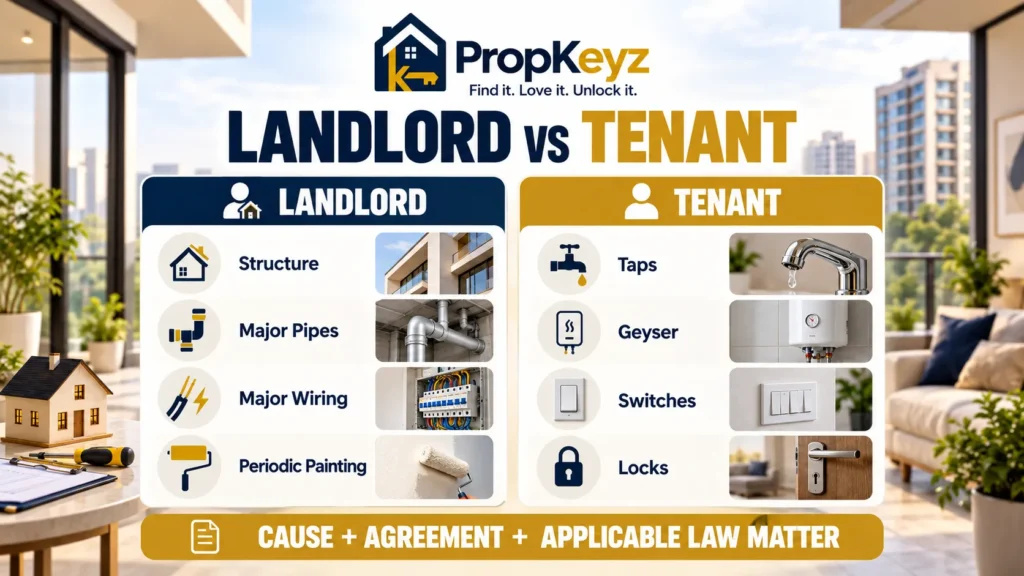
Where the Punjab Rent Act applies, the repair split is broadly:
Landlord
Responsible for specified major/structural matters such as:
- structural repairs;
- periodic whitewashing/painting;
- necessary plumbing-pipe replacement;
- major internal/external wiring.
Tenant
Responsible for several day-to-day matters such as:
- taps;
- drain cleaning;
- sanitary fixtures;
- geyser repairs;
- circuit breakers;
- switches;
- sockets;
- kitchen fixtures;
- locks;
- glass panels.
But this is only the starting point.
The actual answer can change because of:
- written agreement;
- statutory exemption;
- age of property;
- tenant negligence;
- pre-existing defect;
- society/common-area source.
Best One-Line Test
Is this a major building/system failure, a day-to-day repair, or damage caused by someone?
Does the Punjab Rent Act Apply to Every Mohali Rental?
No.
This is one of the most important things other online articles often miss.
The Punjab Rent Act extends across urban Punjab, but Section 3 contains exemptions. One significant exemption covers premises constructed after commencement of the Act for:
15 years from completion.
This means a modern apartment may require a different legal analysis from an older property where the Act clearly applies.
Also Check
- date of tenancy;
- building completion date;
- category of premises;
- written agreement.
Therefore This Guide Uses
“Where the Punjab Rent Act applies…”
rather than:
“Punjab law always says…”
PropKeyz Rule
Before arguing about Section 17 or Schedule II, confirm that the statutory framework applies to the exact tenancy.
Section 17: What Is the Landlord Responsible For?
Section 17 says that, subject to a written contract to the contrary, the landlord must keep premises in good and tenantable repair for matters listed in Schedule II Part A.
Schedule II Part A lists:
1. Structural Repairs
Except structural damage caused by the tenant.
2. Whitewashing / Painting
Whitewashing walls and painting doors/windows once in three years.
3. Plumbing Pipes
Changing plumbing pipes where necessary.
4. Major Wiring
Internal/external wiring and related maintenance.
This is the legal backbone of the owner side of the article.
Section 18: What Is the Tenant Responsible For?
Section 18 places responsibility for Schedule II Part B day-to-day repairs on the tenant.
It also separately says the tenant must make good damage caused by:
tenant negligence.
Schedule II Part B includes:
- tap washers and taps;
- drain cleaning;
- water closet;
- wash basin;
- bath tub;
- geyser;
- circuit breaker;
- switches and sockets;
- electrical equipment other than major wiring;
- kitchen fixtures;
- locks and knobs;
- flynets;
- glass panels;
- garden/open-space maintenance.
Critical Distinction
Tenant-side repair responsibility does not mean tenant caused every defect.
It means the statutory schedule allocates those specified day-to-day repair categories to the tenant where that framework applies.
Landlord vs Tenant Master Repair Table
| Repair Issue | Starting Responsibility | Important Exception |
|---|---|---|
| Structural crack | Landlord | Tenant-caused damage |
| Foundation / structural element | Landlord | Tenant alteration/negligence |
| Major plumbing-pipe replacement | Landlord | Tenant physically damages pipe |
| Dripping tap | Tenant | Pre-existing major pipe defect |
| Tap washer | Tenant | — |
| Drain cleaning | Tenant | Common municipal/society line |
| Water closet repair | Tenant | Major concealed pipe issue |
| Wash basin repair | Tenant | Structural plumbing failure |
| Geyser repair | Tenant | Replacement due age/capital failure may need agreement/cause analysis |
| Circuit breaker repair | Tenant | Major wiring/system issue |
| Switch/socket | Tenant | Major internal wiring fault |
| Major electrical wiring | Landlord | Tenant-caused electrical damage |
| Whitewashing / periodic painting | Landlord-side Schedule II | Tenant abnormal wall damage |
| Door knob/lock | Tenant | Owner-side structural door/frame defect |
| Window glass | Tenant | Common-area/external event may require different analysis |
| Seepage | Depends on source | Must diagnose |
| Roof leakage | Usually owner/society issue | Tenant-caused blockage/damage possible |
| Common stack leak | Society/owner coordination | Depends on association documents |
| AC service | Agreement/cause based | Not expressly named in Schedule II |
| Fridge/washing machine | Agreement + cause | Furnished-flat inventory matters |
Important
This table is:
a practical starting framework, not a substitute for the applicable agreement and law.
Who Pays for Structural Repairs?
Structural repairs are expressly placed on the landlord side under Schedule II.
Examples can include:
- structural wall cracking;
- slab defect;
- beam/column problem;
- major building integrity issue.
But:
tenant-caused structural damage is excluded from the landlord-side rule.
Example
Tenant drills ordinary wall holes for frames:
not necessarily structural.
Tenant removes/weakens a structural wall without approval:
completely different issue.
Safety Rule
Any suspected structural issue should be evaluated by:
a qualified structural/civil professional
—not a broker, tenant or property manager.
PropKeyz routine inspections are visual and are not structural audits.
Plumbing: Owner or Tenant?
Plumbing is where most arguments begin.
The statute itself makes an important distinction.
Owner Side
Changing plumbing pipes when necessary.
Tenant Side
- tap washers;
- taps;
- water closet;
- wash basin;
- bath tub.
Practical Rule
Pipe system = potentially owner-side. Fixture maintenance = often tenant-side.
Example: Tap Is Leaking
If the problem is:
worn-out tap washer,
Schedule II places that day-to-day item on the tenant side.
If the real problem is:
pipe inside wall leaking,
it becomes a different repair category.
Never Approve From One WhatsApp Message
“Bathroom me leak hai”
is not a diagnosis.
Ask:
- leak from where?
- visible pipe or concealed?
- tap or wall?
- meter running?
- unit above?
- common shaft?
Drain Blockage
Schedule II Part B includes:
drain cleaning
on the tenant side.
Tenant Example
Kitchen drain blocked by:
- food waste;
- grease;
- routine local blockage.
Different Example
Building’s main soil stack is blocked.
That may involve:
- society;
- maintenance agency;
- owner coordination.
PropKeyz Rule
Internal Drain ≠ Common Sewer
Geyser Repair: Who Pays?
This is one of the clearest Schedule II items.
Geyser repairs
are listed in Part B as a tenant-side day-to-day repair.
But don’t overextend this into:
“Tenant must buy a new geyser whenever it dies.”
Those are not necessarily identical questions.
Example A — Minor Repair
- thermostat;
- small service issue;
- minor component.
Starting point:
tenant-side repair.
Example B — 10-Year-Old Unit Reaches End of Life
Now ask:
- age;
- cause;
- lease clause;
- whether repair is viable;
- whether replacement is really a capital asset replacement.
Example C — Tenant Damages Unit
Tenant negligence can create direct tenant liability.
Strong Rule
Repair responsibility and full asset replacement are not always the same thing.
What About AC Repair?
Air-conditioning is not separately named in the Schedule II list quoted above.
Therefore do not create a fake statutory rule saying:
“AC always tenant”
or:
“AC always owner.”
Use:
- agreement;
- cause;
- age;
- normal servicing vs major failure.
Practical Rental Structure
Often agreements separately define:
- routine AC servicing;
- gas refill;
- filter cleaning;
- compressor replacement.
The agreement should be explicit.
Electrical Repair: Owner or Tenant?
This is another clear split.
Tenant Side
- circuit breakers;
- switches;
- sockets;
- repair/replacement of electrical equipment.
Landlord Side
major internal/external wiring and related maintenance.
Example
Socket damaged:
tenant-side starting point.
Burnt concealed cable inside wall:
major wiring / owner-side starting point.
Safety
Electrical faults should be inspected by:
qualified technicians.
Do not encourage temporary unsafe fixes.
Major Wiring Problems
Warning signs:
- repeated MCB trips;
- burnt smell;
- heating wire;
- sparks;
- multiple dead circuits;
- exposed old wiring.
This is not the moment to argue:
“Tenant karega ya owner?”
First:
make the property safe.
Then determine financial responsibility.
Painting & Whitewashing
Painting creates some of the most common landlord-tenant disputes.
Schedule II puts:
whitewashing walls and painting doors/windows once in three years
on the landlord side.
That means:
vacating tenant = automatic full repainting bill
is too simplistic.
Routine Paint Ageing
Can form part of:
normal wear and tear.
Tenant Damage
Different question if walls contain:
- major staining;
- unauthorised paint;
- large holes;
- crayon/marker damage;
- deliberate damage.
PropKeyz Rule
Repainting Needed ≠ Tenant Automatically Liable
What Is Normal Wear and Tear?
Section 17’s explanation and Section 18 both recognise:
normal wear and tear.
Examples can include:
- routine paint fade;
- ordinary ageing;
- minor usage deterioration.
But there is no universal statutory checklist saying:
one scratch = wear
and:
two scratches = damage.
Always compare:
- move-in condition;
- tenancy length;
- severity;
- cause.
For deposit-related analysis, read the existing PropKeyz Mohali Security Deposit Refund 2026 guide.
Seepage: Who Pays?
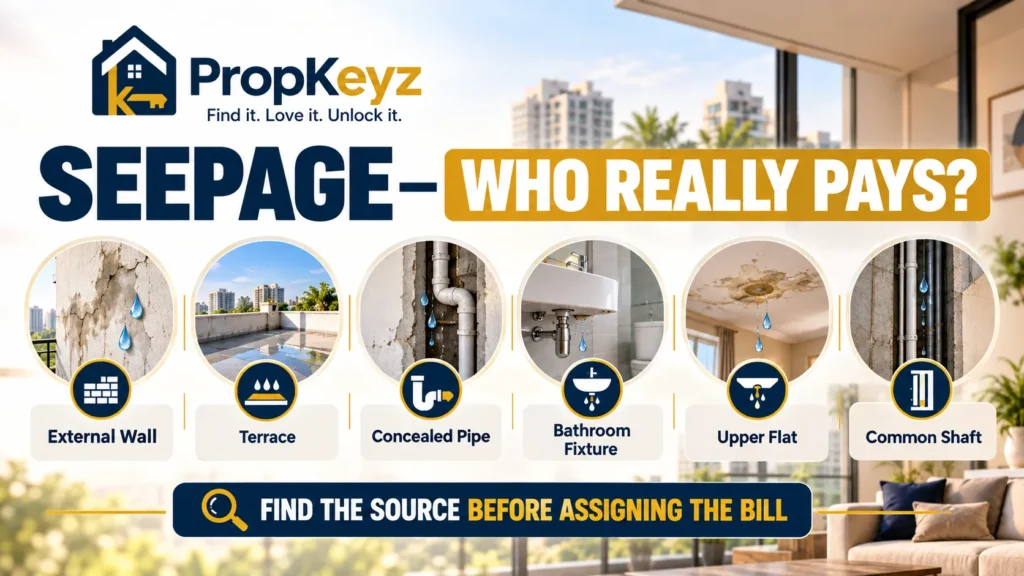
This is where simplistic landlord-vs-tenant answers fail.
Seepage can originate from:
1. External Wall
Possible:
- waterproofing;
- facade;
- structural crack.
Likely owner/society-side analysis.
2. Terrace
Potential:
- waterproofing;
- roof drainage;
- common terrace.
3. Concealed Pipe
Potential owner-side plumbing-pipe issue.
4. Upper-Floor Bathroom
Could involve:
- upstairs owner;
- upstairs tenant;
- common plumbing;
- society.
5. Internal Tap / Fixture
Could be tenant-side day-to-day repair.
6. Tenant Negligence
Example:
tenant ignores a known leak for weeks and damage spreads.
That can change liability.
PropKeyz Rule
Seepage Is a Diagnosis Problem Before It Is a Payment Problem.
Terrace Leakage
If leakage comes from:
- roof slab;
- waterproofing;
- structural defect,
it normally looks more like a major property/common-building issue.
But in an apartment society:
terrace ownership / common-area responsibility matters.
Ask:
- common terrace?
- exclusive terrace?
- society responsibility?
- owner modification?
Bathroom Leakage
Possible causes:
- tap;
- basin;
- WC fitting;
- trap;
- concealed line;
- waterproofing.
Each can create a different responsibility.
Don’t Accept This Vendor Diagnosis
“Bathroom repair ₹25,000.”
Ask for:
- actual source;
- testing;
- itemised estimate.
Leakage From Upstairs Flat
Your tenant may report:
ceiling dampness.
Your property’s pipe may be perfectly fine.
Source could be:
upstairs bathroom.
Then the problem may require:
- society coordination;
- upper owner communication;
- access to another flat.
This is why property management often involves:
coordination
rather than merely paying bills.
Society Common-Area Leakage
A leakage can originate from:
- common vertical shaft;
- external facade;
- shared water line;
- common roof.
That can introduce a third party:
RWA / association / maintenance agency.
For the separate owner-vs-society expense framework, cross-link to the PropKeyz Mohali Society Maintenance Charges 2026 article, which covers common expenses and society liability.
Door Locks, Knobs & Glass
Schedule II Part B includes:
- replacement of door/cupboard/window knobs and locks;
- replacement of glass panels.
So these are typically placed on the tenant-side day-to-day list where the Act applies.
But Cause Still Matters
A door-frame structural issue is not the same as:
a worn lock.
Kitchen Fixtures
Schedule II puts:
kitchen fixture repairs
on the tenant-side day-to-day list.
Possible examples:
- normal fixture repair;
- small fitting.
But:
- concealed pipe;
- structural cabinet failure;
- major capital replacement
may require further analysis.
Furnished Flat Appliances
Fully furnished Mohali flats can include:
- refrigerator;
- washing machine;
- TV;
- microwave;
- RO;
- chimney;
- AC.
These assets create disputes because Schedule II does not individually prescribe each modern appliance.
Agreement Should Define
Routine Service
Who pays?
Major Component Failure
Who pays?
End-of-Life Replacement
Who pays?
Misuse
Tenant.
PropKeyz Rule
Furnished Property Needs an Appliance Clause—not Assumptions.
Pest Control
Pest control is another agreement/cause issue.
Routine Occupancy Issue
May be tenant responsibility.
Pre-Existing Infestation
Could be owner-side.
Structural Termite Issue
May require:
- owner;
- society;
- specialist treatment.
Again:
cause matters.
Tenant Negligence
Section 18 expressly says tenant must make good:
damage caused by negligence.
Examples:
- leaving leaking tap running for days;
- damaging wiring through unauthorised work;
- drilling through concealed pipe;
- breaking fixture;
- ignoring known leak that materially worsens damage.
Evidence Matters
Record:
- date complaint received;
- tenant response;
- inspection;
- vendor diagnosis;
- photographs.
What If the Problem Is Normal Ageing?
A rental property is expected to age.
That is why the Act itself recognises:
normal wear and tear.
Examples
- ageing paint;
- ordinary fixture deterioration;
- natural material wear.
Ageing ≠ Negligence
Owner should not convert:
normal depreciation
into:
tenant damage.
Emergency Repairs
Examples:
- burst pipe;
- live electrical hazard;
- major water leak;
- dangerous ceiling failure.
Priority should be:
Safety → Damage Control → Documentation → Liability
not:
argue first, stop leak later.
NRI Owner Tip
Use an emergency approval threshold in advance.
Example:
Up to ₹X for urgent damage-control work after photo/video evidence, with larger repairs requiring written owner approval.
What If Tenant Repairs Something Without Owner Approval?
This depends on:
- urgency;
- agreement;
- statutory framework;
- whether repair was owner or tenant responsibility.
Best Practice
Tenant should:
- notify;
- send photos/video;
- obtain approval where possible;
- preserve invoice.
Owner Concern
Avoid:
₹25,000 repair completed first, permission asked later.
What If Owner Refuses a Necessary Repair?
Where Section 17 applies, the statute contains a formal route where specified landlord-side repairs necessary for habitability/usability remain undone after written notice.
Section 17 provides a mechanism involving:
the Rent Authority
rather than simply permitting the tenant to deduct any amount they choose.
Important
Do not tell tenants:
“Just repair it and subtract rent.”
That can be legally risky.
Use the statutory/agreement procedure appropriate to the tenancy.
Security Deposit & Repair Deductions
Repairs and deposit settlement overlap at move-out.
But:
repair needed
does not automatically mean:
deposit deduction valid.
Check:
- whose responsibility?
- tenant damage or wear?
- actual cost?
- move-in evidence?
For full detail, use the PropKeyz Mohali Security Deposit Refund 2026 guide.
Why Move-In Baseline Matters
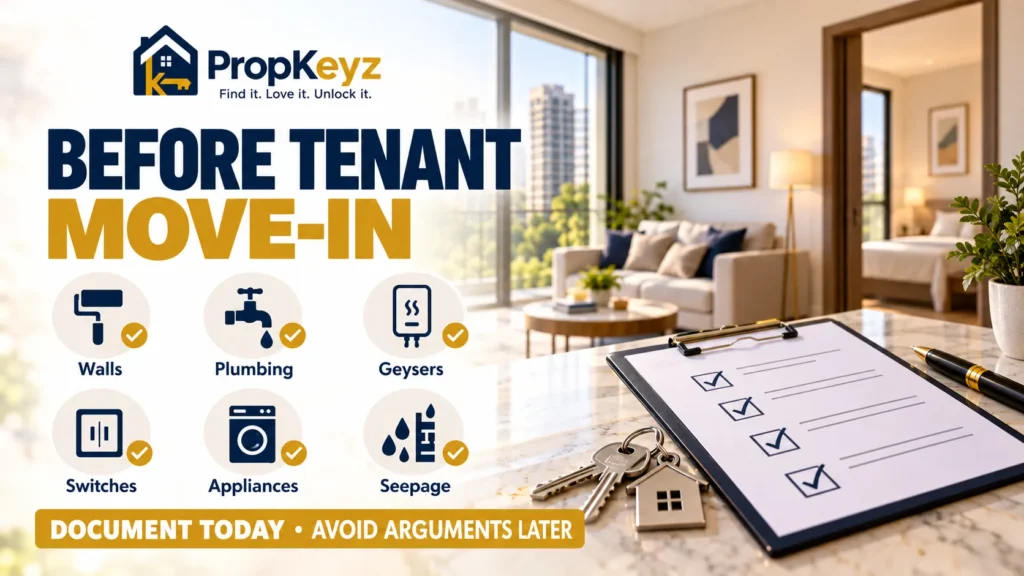
At move-in, document:
- walls;
- seepage;
- bathrooms;
- taps;
- geysers;
- electrical points;
- appliances;
- locks;
- furniture.
Example
Without baseline:
“AC pehle se noise karta tha.”
becomes:
owner memory vs tenant memory.
With baseline:
dated video.
PropKeyz Rule
Maintenance Responsibility Is Easier When Starting Condition Is Documented.
Move-Out Inspection
Compare:
move-in condition
against:
move-out condition.
Check:
- unresolved tenant-side repairs;
- abnormal damage;
- outstanding issues;
- normal ageing.
A professional move-out inspection helps reduce security-deposit disputes.
NRI Owner Repair Workflow

For NRI owners, the biggest risk is approving a repair without seeing:
- problem;
- estimate;
- completion.
Better Workflow
Tenant Reports Issue
↓
Photo / Video
↓
Initial Inspection
↓
Cause Identified
↓
Owner vs Tenant vs Society Responsibility
↓
Vendor Estimate
↓
Owner Approval
↓
Repair
↓
Before / After Evidence
↓
Invoice
↓
Property Log
This is closer to professional property management than:
tenant sends screenshot → owner sends money.
PropKeyz Maintenance Workflow
PropKeyz’s current service framework includes:
- tenant communication support;
- maintenance request coordination;
- local technician/vendor coordination;
- repair estimates;
- owner approval workflows;
- inspection updates;
- before/after reporting.
Actual repair work is performed by:
third-party technicians/vendors
rather than PropKeyz acting as the repair contractor.
Why This Structure Matters
Property manager:
coordinates.
Technician:
diagnoses / executes.
Owner:
approves major expenditure.
Repair Approval Threshold
A useful owner-service agreement can define:
Low-Cost Routine Repairs
Pre-approved up to:
₹____
Medium Repairs
Share estimate first.
Major Repairs
Require:
- multiple quotes where practical;
- owner written approval.
Emergency Damage Control
Allow limited immediate intervention.
PropKeyz’s current service model already uses:
owner approval workflows
for repair expenses.
What the Rent Agreement Should Say
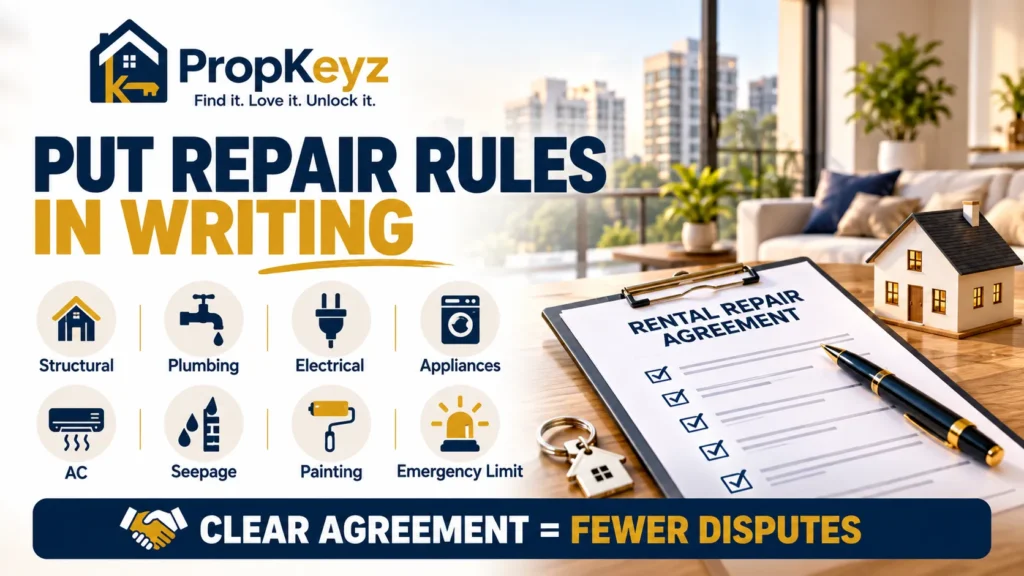
Do not leave maintenance to verbal assumptions.
Add clear sections covering:
Structural Repairs
Owner responsibility subject to applicable law.
Day-to-Day Repairs
Tenant responsibility.
Plumbing
Distinguish:
- concealed/main pipe;
- taps/fixtures.
Electrical
Distinguish:
- major wiring;
- switches/sockets.
Appliances
Specify each major item.
AC
Routine service vs major component.
Seepage
Inspection/source determination.
Painting
Normal wear vs abnormal damage.
Emergency Repairs
Define procedure.
Approval Limit
₹____ without fresh approval.
Reporting
Tenant must report leaks/damage promptly.
PropKeyz Rule
If a repair can create an argument later, define it in the agreement today.
Facts vs Assumptions
| Supported Position | Dangerous Assumption |
|---|---|
| Structural repairs appear landlord-side | Owner pays every repair |
| Plumbing pipes appear landlord-side | Owner pays every leaking tap |
| Taps appear tenant-side | Tenant pays concealed pipe replacement |
| Geyser repair appears tenant-side | Tenant must always buy a new geyser |
| Major wiring is landlord-side | Owner pays broken socket |
| Switch/socket repairs appear tenant-side | Tenant pays for whole-building wiring |
| Painting appears landlord-side | Tenant can damage walls freely |
| Normal wear is recognised | Every mark is normal wear |
| Tenant negligence creates liability | Everything during tenancy is negligence |
| Seepage depends on source | Seepage always owner responsibility |
| Agreement matters | Agreement can safely ignore every statutory rule |
| Punjab Rent Act has exemptions | The Act applies identically to every Mohali flat |
| Property manager coordinates | Manager is automatically engineer/contractor |
PropKeyz Analysis
The Mohali Landlord vs Tenant Repair Responsibility 2026 issue reveals why professional rental management needs more than:
a vendor phone number.
1. Most Repair Arguments Are Actually Classification Arguments
The parties agree something is broken.
They disagree on:
what kind of repair it is.
Example:
“Plumbing problem.”
Could mean:
- tap washer;
- concealed pipe;
- common stack;
- waterproofing.
Four different responsibilities.
2. Cause Matters More Than Cost
A ₹500 problem can be owner-side.
A ₹10,000 problem can be tenant-side.
Do not allocate based on:
bill size.
Allocate based on:
category + cause + agreement.
3. Seepage Is the Most Misunderstood Issue
People say:
“Seepage owner ki hoti hai.”
Not always.
The better framework is:
Source → Cause → Area → Responsibility
4. Schedule II Is Surprisingly Practical
Punjab’s Schedule II gives actual categories:
Owner side:
- structural;
- pipes;
- major wiring;
- painting.
Tenant side:
- taps;
- sanitary repairs;
- geyser;
- switches;
- locks.
That is much more useful than generic online advice.
5. Modern Appliances Need Contractual Detail
The statute predates many modern rental arrangements.
A premium furnished flat may contain:
- 4 ACs;
- smart TV;
- modular appliances;
- inverter;
- RO.
A modern lease should define these separately.
6. New Mohali Buildings Create an Applicability Trap
Mohali has significant newer housing supply.
Section 3’s 15-year new-construction exemption means:
you cannot blindly quote Sections 17–18 to every apartment without checking applicability.
This is one of the article’s biggest legal differentiators.
7. Property Management Should Reduce Information Asymmetry
NRI owner sees:
WhatsApp message.
Tenant sees:
broken property.
Vendor sees:
repair opportunity.
Professional coordination should create:
evidence.
8. Owner Approval Should Be Based on Diagnosis
Not:
“Plumber says ₹12,000.”
Instead:
- problem photo;
- diagnosis;
- material;
- labour;
- warranty;
- before/after.
9. Repair Logs Protect Both Owner and Tenant
A maintenance log answers:
- when problem started;
- who reported;
- who was responsible;
- what was repaired;
- what it cost.
This becomes useful at:
- move-out;
- security deposit;
- resale;
- recurring defect.
10. Delayed Repair Can Become a Bigger Owner Loss
A ₹1,000 leak ignored for two months can become:
- wall seepage;
- wardrobe damage;
- neighbour complaint;
- paint repair.
So even when tenant may ultimately bear cost:
owner still has an interest in fast diagnosis.
11. Tenant Also Benefits From Written Responsibility
Tenants should not be blamed for:
- old wiring;
- structural cracks;
- concealed-pipe ageing.
Clear responsibility protects both sides.
12. Society Apartments Have Three-Party Problems
The actual chain can be:
tenant → owner → society.
So a property manager may need to coordinate:
- tenant;
- owner;
- maintenance office;
- upstairs flat;
- vendor.
This is why rental management is operational work, not just rent collection.
13. NRI Owners Need Stronger Controls
Distance creates risk.
Best practice:
- repair threshold;
- photos;
- itemised estimates;
- invoice archive;
- monthly update.
PropKeyz’s current NRI service model is built around:
- inspections;
- WhatsApp-first updates;
- maintenance coordination;
- owner approval workflows.
Final PropKeyz Analysis
The cleanest repair decision is not “owner pays” or “tenant pays.” It is: identify the failed component, determine the cause, check whether it is structural or day-to-day, review the agreement and applicable law, verify whether a society/common-area system is involved, document the evidence and only then allocate the cost.
PropKeyz Verdict: Mohali Landlord vs Tenant Repair Responsibility 2026
Landlord Usually Starts With
Where the relevant Punjab Rent Act provisions apply:
- structural repairs;
- necessary plumbing-pipe replacement;
- major wiring;
- scheduled painting/whitewashing.
Tenant Usually Starts With
- taps;
- drain cleaning;
- WC/basin;
- geyser repair;
- circuit breaker;
- switches/sockets;
- kitchen fixtures;
- locks;
- glass.
But Always Ask
Who caused it?
For Seepage
Find the source.
For Appliances
Check the agreement and age/cause.
For Newer Mohali Buildings
Check whether the Punjab Rent Act provisions actually apply because statutory exemptions can matter.
For NRI Owners
Never approve a major repair from a verbal description alone.
Final Rule
Diagnosis first. Responsibility second. Payment third.
Frequently Asked Questions
Who pays for structural repairs in a rented Mohali property?
Where the Punjab Rent Act applies, Schedule II places structural repairs on the landlord side, except where the tenant caused the damage.
Who pays for plumbing repairs?
It depends on the component. Necessary plumbing-pipe replacement appears landlord-side, while taps, washers and several sanitary-fixture repairs appear tenant-side.
Who pays for a leaking tap?
Schedule II lists taps and tap washers under tenant day-to-day repairs.
Who pays for a concealed pipe leak?
Necessary plumbing-pipe changes are listed on the landlord side where the Act applies, unless tenant damage changes the situation.
Who pays for geyser repair?
Geyser repair is expressly listed in Schedule II Part B as a tenant-side repair.
Does that mean a tenant must buy a new geyser?
Not automatically. Repair, end-of-life replacement and tenant-caused damage can be different issues.
Who pays for electrical switches?
Switches and sockets are listed on the tenant side.
Who pays for major electrical wiring?
Internal/external wiring and related major maintenance appear on the landlord side.
Who pays for painting?
Schedule II puts periodic whitewashing and painting of doors/windows on the landlord side. Tenant-caused abnormal wall damage can be a separate issue.
Can landlord charge tenant for normal paint fading?
Normal wear and tear is expressly recognised under the Punjab Rent Act framework.
Who pays for seepage?
There is no one-line answer. Identify whether it originates from structural waterproofing, concealed plumbing, tenant fixture, neighbouring flat or society/common system.
Who pays for terrace leakage?
Often owner/society-side depending on terrace ownership, source and building structure, but exact responsibility requires investigation.
Who pays for an AC repair?
AC is not expressly listed in the Schedule II list reviewed here. Check the agreement, age, servicing obligation and cause.
Who pays if tenant damages the property?
Section 18 places liability on the tenant for damage caused through negligence.
Can landlord enter and inspect?
Where Section 18 applies, landlord or authorised person has a statutory inspection right after prescribed notice.
Does the Punjab Rent Act apply to every new Mohali flat?
No. Section 3 contains exemptions, including a 15-year exemption for certain newly constructed premises.
What if the agreement says something different?
Section 17’s landlord duty is expressly subject to a written contract to the contrary. Exact enforceability and other clauses should be reviewed in the context of the applicable law.
Can tenant deduct repair from rent?
Do not assume an automatic right. Section 17 contains a formal Rent Authority route for specified landlord-side repairs where the section applies.
Can landlord deduct repair cost from security deposit?
Only after analysing actual tenant liability, cause, documentation and agreement. For full deposit rules, see PropKeyz’s security-deposit guide.
Should NRI owners keep a repair approval limit?
Yes. A written pre-approved threshold can reduce emergency delays while preserving owner control.
Does PropKeyz perform plumbing or electrical work?
PropKeyz coordinates repair workflows; current website disclosures state actual repair work is carried out by third-party technicians/vendors.
What can PropKeyz coordinate?
Depending on service scope:
- inspections;
- tenant communication;
- quotations;
- owner approvals;
- vendor coordination;
- completion updates.
Continue Your Mohali Property Management Research
Mohali Security Deposit Refund 2026
Learn how repair responsibility connects with:
- move-out damage;
- normal wear;
- deposit deductions.
Read Mohali Security Deposit Refund 2026
Mohali Society Maintenance Charges 2026
Understand:
- common expenses;
- owner liability;
- tenant arrangements;
- RWA charges.
Read Mohali Society Maintenance Charges 2026
Tenant Verification in Mohali 2026
Good maintenance management begins with good tenant onboarding and clear documentation.
Read Tenant Verification in Mohali 2026
Property Management Services
For:
- tenant communication;
- inspections;
- repair coordination;
- owner reporting.
Explore PropKeyz Property Management Services
NRI Property Management
For owners living in:
- Canada;
- UK;
- UAE;
- USA;
- Australia;
- other countries.
Explore NRI Property Management
PropKeyz Property Management Support
PropKeyz helps NRI, outstation and busy local owners across Mohali and selected Tricity locations with:
- tenant communication;
- rent tracking;
- property inspections;
- maintenance coordination;
- owner approval workflows;
- move-in / move-out documentation;
- monthly photo/video updates.
Current PropKeyz service information describes maintenance support as a coordination workflow rather than PropKeyz acting as the repair contractor itself.
Typical Repair Workflow
Issue Reported
→
Visual Verification
→
Vendor Diagnosis
→
Responsibility Review
→
Estimate
→
Owner Approval
→
Repair
→
Before / After Proof
Need Help Managing a Mohali Rental?
Share:
- property location;
- property type;
- tenant status;
- current repair issue.
Your Property. Our Responsibility.
Sources & Verification
Last Fact-Checked: 5 October 2026
Punjab Rent Act, 1995 — Full Act
Used for:
- applicability;
- exemptions;
- Sections 17–18;
- Schedule II;
- written tenancy framework.
Punjab Rent Act 1995 — Indian Kanoon
Section 17 — Duties of Landlord
Used for:
- landlord-side repairs;
- normal wear;
- statutory repair mechanism.
Section 18 — Duties of Tenant
Used for:
- tenant repair duty;
- negligence damage;
- inspection;
- handover condition.
PropKeyz Services
Used to verify current:
- maintenance coordination;
- inspections;
- owner approvals;
- reporting.
PropKeyz Service Disclaimer
Used to verify:
- vendor role;
- structural-inspection limitations;
- repair-cost boundaries.
Disclaimer
This article is for:
- owner education;
- tenant education;
- rental maintenance planning;
- property-management awareness.
It is not:
- legal advice;
- structural certification;
- electrical safety certification;
- waterproofing diagnosis;
- plumbing engineering advice.
Repair responsibility can depend on:
- whether the Punjab Rent Act applies;
- statutory exemptions;
- written agreement;
- age of property;
- source of defect;
- tenant negligence;
- society/common-area responsibilities.
For a disputed or high-value repair:
obtain appropriate technical and legal advice.
PropKeyz may coordinate:
- visible inspections;
- communication;
- vendor quotes;
- repair follow-up;
- owner reporting.
PropKeyz does not replace:
- plumber;
- electrician;
- structural engineer;
- waterproofing consultant;
- advocate.
Your Property. Our Responsibility.