

A tenant missing one rent payment can be frustrating.
A tenant missing three months can become a serious property-management problem.
But in Mohali, a landlord should not jump from:
“Rent nahi aaya”
to:
“Kal flat khaali karo.”
Where the Punjab Rent Act, 1995 applies, rent-default eviction follows a specific statutory sequence.
Section 20(2)(a) deals with a tenant who has failed to pay or tender:
three or more consecutive months
of legally recoverable rent and other charges.
But even at that point, eviction is not automatic.
The landlord ordinarily has to serve the prescribed:
Schedule VII notice
demanding the arrears, other legally recoverable charges and:
15% annual interest
and give the tenant:
two months from receipt of the notice
to clear the default.
If the tenant still fails to comply, the landlord may proceed before the:
Rent Authority
under Section 20.
The Act also contains a broader 15% simple-interest rule in Section 13 for rent defaults from the date payment becomes due.
And if eviction is ultimately ordered, Section 38(10) requires the Rent Authority to additionally order recovery of:
- arrears;
- other charges;
- 15% annual interest.
There is another issue owners often misunderstand:
mesne profits.
Mesne profits or use-and-occupation compensation after an eviction decree are not the same thing as 15% interest on unpaid rent.
A February 2026 Punjab & Haryana High Court case arising from Phase 3B-2, Mohali upheld ₹65,000/month use-and-occupation charges after eviction because the rent agreement itself contained a ₹65,000 penal-rent clause after expiry, while the original rent was ₹32,000/month.
That does not create a universal formula.
It does show why:
the rent agreement you draft on Day 1 can matter dramatically when the tenancy goes wrong later.
For NRI and outstation owners, the lesson is even more important.
A rent-default case is easier to manage when the owner already has:
- a signed agreement;
- verified tenant records;
- rent ledger;
- bank trail;
- proof of service;
- documented communication;
- local representation.
PropKeyz Rule
Rent default should be managed as a documented legal process—not as a WhatsApp argument.
Key Takeaways
- Where the Punjab Rent Act applies, Section 20(2)(a) can support eviction for three or more consecutive months of legally recoverable arrears.
- Three months of arrears do not automatically authorise physical eviction.
- A prescribed Schedule VII demand notice is central to the normal Section 20(2)(a) route.
- The notice demands:
- unpaid rent;
- other legally recoverable charges;
- 15% annual interest.
- The tenant generally receives two months from receipt of the notice to clear the demanded amount.
- Schedule VII itself contains termination wording tied to the statutory 60-day timeline.
- Notice service must follow Section 106 of the Transfer of Property Act.
- Section 13 independently provides 15% simple interest on rent/charges from due date until payment.
- Section 38(10) provides for arrears + charges + 15% interest when ejectment decree is passed.
- Do not charge 15% “three times” merely because it appears in three statutory contexts.
- Mesne profits are different from arrears interest.
- A 2026 Mohali High Court case upheld ₹65,000/month use-and-occupation charges based on the actual lease clause and facts.
- That ₹65,000 figure is not a universal Mohali rate.
- Where the Act applies, repeated default after a tenant has already used the statutory cure benefit can be treated differently.
- Punjab Rent Act Section 3 contains major exemptions.
- New premises can be exempt for 15 years from completion.
- Many newer Mohali society flats therefore require an applicability check before relying on Section 20.
- Premises let before 30 November 2013 can fall under a different legal regime.
- NRI owners do not get an automatic “fast-track eviction” for every new tenancy.
- Section 24(3)’s special NRI route is narrow and tenancy-date sensitive.
- Security deposit should not automatically be treated as rent unless the agreement permits adjustment.
- Landlord should not:
- change locks;
- cut electricity/water;
- remove belongings;
- threaten tenant
as a substitute for lawful process.
- A rent ledger is one of the most important owner records.
- Every payment should be matched to:
- month;
- rent;
- maintenance/other charge;
- arrears;
- interest where applicable.
- NRI owners should appoint a local property-management workflow before default occurs.
PropKeyz View
The strongest eviction case starts months before the eviction petition—with a clear agreement, rent ledger, bank trail and correctly served notice.
Mohali Rent Default & Eviction 2026: Quick Answer
Where the Punjab Rent Act applies, the Mohali Rent Default & Eviction 2026 process can broadly work like this:
Rent Becomes Due
↓
Default Continues
↓
3+ Consecutive Months Arrears
↓
Schedule VII Notice
↓
Rent + Charges + 15% Interest Demanded
↓
2 Months From Receipt to Cure
↓
Default Continues
↓
Section 20 Eviction Application
↓
Rent Authority Proceedings
↓
Eviction Order / Arrears Recovery if Grounds Proved
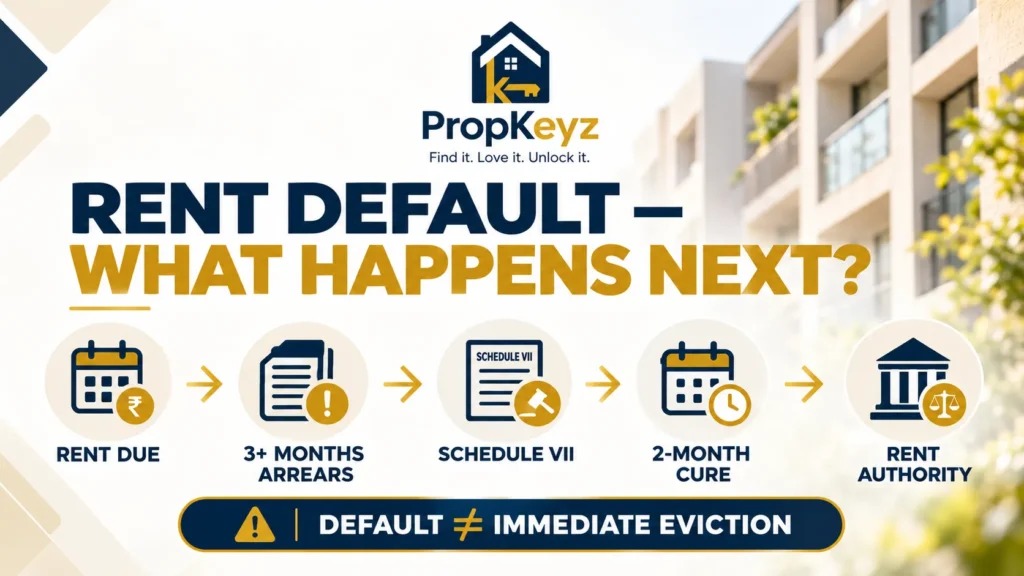
Section 20(2)(a) expressly refers to three or more consecutive months of legally recoverable arrears and a two-month period after service of Schedule VII notice.
Direct Answer
Three months of unpaid rent creates the statutory default ground; it does not itself give the landlord a right to physically remove the tenant.
Does the Punjab Rent Act Apply to Every Mohali Flat?
No.
This is one of the most important legal cautions in this entire guide.
The Punjab Rent Act came into force on:
30 November 2013.
Section 3 exempts several categories of premises.
One particularly important Mohali exemption covers premises constructed on or after commencement of the Act for:
15 years from the date of completion of construction.
Why This Matters in Mohali
Mohali has a large amount of relatively new rental inventory:
- new group-housing societies;
- premium high-rises;
- newer independent floors;
- recently delivered apartments.
A flat completed in, for example:
2021
may raise a completely different Rent Act applicability question than an older property.
Completion Date
Section 3 links completion to the earlier of:
- completion intimated to the relevant authority; or
- property-tax assessment,
subject to the statutory wording.
Also Excluded
The Act contains other exemptions, including certain premises:
- let before commencement;
- government/local-authority premises;
- specified categories.
Therefore
This guide uses:
“Where the Punjab Rent Act applies…”
not:
“Every Mohali landlord must always follow exactly this route.”
PropKeyz Rule
Before sending a Section 20 notice, confirm the tenancy and building actually fall within Section 20’s statutory framework.
What Counts as Rent Default?
Rent default sounds simple:
tenant did not pay.
Legally, the first question is:
What amount was actually due?
That can include:
- contractual monthly rent;
- legally recoverable other charges;
- interest where applicable.
Do Not Mix
- rent;
- security deposit;
- damage claim;
- brokerage;
- random penalties.
A landlord should maintain a proper ledger.
When Is Rent Legally Due?
Section 13(1) says the tenant must pay rent and other charges:
according to the date fixed in the contract.
If the contract does not specify a date:
by the 15th day of the month following the month for which the amount is payable.
Example
Agreement says:
rent due by 7th of each month.
Use:
7th.
If agreement says nothing:
the statutory fallback may become relevant where the Act applies.
Strong Agreement Clause
Record:
- monthly rent;
- due date;
- mode of payment;
- maintenance;
- late/default consequences.
What Does “Three or More Consecutive Months” Mean?
Section 20(2)(a) uses:
three or more consecutive months
of legally recoverable rent/charges.
Example
January unpaid
February unpaid
March unpaid
This can create the three-consecutive-month condition.
Different Example
January unpaid
February paid
March unpaid
April paid
That is not the same straightforward factual pattern.
Important
The final legal calculation depends on:
- rent ledger;
- credits;
- partial payments;
- legally recoverable charges.
Is Eviction Automatic After Three Months?
No.
This is the biggest misconception.
The statute does not say:
three months default = landlord changes locks.
The normal Section 20(2)(a) route requires:
- qualifying default;
- Schedule VII notice;
- valid service;
- two-month cure period;
- continued default;
- Rent Authority application.
PropKeyz Rule
Arrears Create the Ground. The Legal Process Creates the Eviction Order.
Schedule VII Notice Explained
Schedule VII is the Act’s prescribed:
Form of Notice for Payment of Arrears.
It is linked directly to Section 20(2)(a).
The Notice Identifies
- landlord / authorised representative;
- tenant;
- premises;
- monthly rent;
- other charges;
- period of non-payment.
It Demands
- rent arrears;
- other legally recoverable charges;
- payment up to actual payment date;
- 15% annual interest.
It Gives
two months from receipt
to comply.
What Must Schedule VII Demand?
At minimum the statutory form centres on:
Premises
Identify the rented property clearly.
Monthly Rent
State the agreed monthly amount.
Default Period
Example:
January 2026 to March 2026.
Other Charges
Only legally recoverable charges.
Interest
15% per annum
for the default period.
Cure Period
two months from date of receipt.
PropKeyz Practical Add-On
A lawyer-drafted notice should also consider attaching or clearly identifying:
- rent ledger;
- bank account;
- calculation;
- agreement details.
Two-Month Cure Period Explained
The two-month period is not:
two months from the day landlord decides tenant is in default.
It runs from:
receipt/service of the Schedule VII notice
under Section 20(2)(a).
Example
Notice received:
10 April
Two-month cure window:
runs from receipt according to the statutory notice framework.
Why Service Proof Matters
If parties later dispute:
“Notice mila hi nahi”
the service record becomes central.
How Must the Notice Be Served?
Section 20 refers to service in the manner provided by:
Section 106 of the Transfer of Property Act.
Section 106 requires written, signed notice and recognises service by:
- post;
- personal delivery;
- delivery at residence to qualifying person;
- affixation where personal service is not practicable.
Best Practice
Preserve:
- signed notice;
- postal receipt;
- tracking screenshot;
- delivery proof;
- envelope;
- email/WhatsApp copy as supplementary evidence.
Important
WhatsApp may be useful evidence of communication.
But don’t replace the prescribed legal service route casually with:
“WhatsApp blue tick aa gaya.”
WhatsApp vs Formal Notice
For property management:
WhatsApp Is Good For
- reminder;
- rent follow-up;
- settlement discussion;
- record of communication.
Formal Schedule VII Is For
statutory default/eviction process where the Act applies.
Better Workflow
Day 1 late
Friendly reminder.
Repeated default
Written ledger.
Serious default
Legal review.
Three-consecutive-month statutory ground
Correct formal notice where applicable.
What Is the 15% Interest Rule?
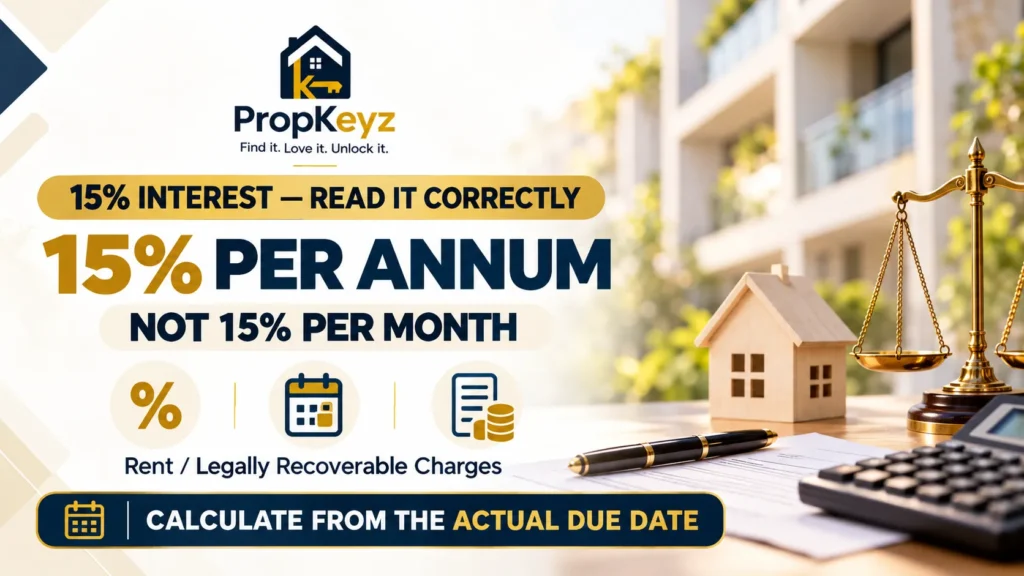
The Punjab Rent Act contains a strong default-interest mechanism.
Section 13(1) says that where rent/other charges are not paid when due:
simple interest at 15% per annum
runs from the due date until payment.
Example
Suppose:
Monthly rent: ₹30,000
A payment remains unpaid.
The landlord should calculate:
simple annual interest
for the actual default period.
Do Not Calculate
15% every month.
It is:
15% per annum, not 15% monthly.
Section 13 vs Section 20 vs Section 38(10)
This is where many articles become confusing.
Section 13
Creates the general rent-payment and default-interest obligation.
Section 20(2)(a)
Uses:
- 3+ consecutive months arrears;
- Schedule VII;
- 15% interest;
- 2-month cure
as the rent-default eviction ground.
Section 38(10)
At ejectment decree stage, provides for recovery of:
- arrears;
- charges;
- 15% interest.
Important
These are related statutory stages.
Do not claim:
15% + 15% + 15% = 45%.
That would be wrong.
Can Interest Be Charged Three Times?
No—not merely because the same 15% rate appears in different provisions.
Think of it as:
the statutory interest obligation following the arrears through the process.
PropKeyz Rule
One default should not become a fake triple-interest calculation.
Use a proper date-wise ledger.
What Happens If Tenant Pays Within Two Months?
If the tenant clears the legally recoverable:
- arrears;
- charges;
- 15% interest
within the statutory cure period, that affects the Section 20(2)(a) eviction ground.
The statute also contains a significant proviso for:
repeat default.
A tenant who has already received this statutory benefit once for the same premises may not be entitled to rely on it again in a subsequent default.
Important
A repeated-default case should be reviewed by counsel rather than handled from a template.
What Happens After the Cure Period Expires?
If qualifying arrears remain unpaid after valid notice/cure:
the landlord may proceed to:
Rent Authority
for recovery of possession under Section 20.
This Still Does Not Mean
physical self-help eviction.
The landlord needs:
legal process + order.
Schedule XII Eviction Application
The Punjab Rent Act prescribes:
Schedule XII
as the form of application for eviction under Section 20.
It includes:
- landlord/petitioner;
- tenant/respondent;
- premises;
- boundaries;
- rent;
- grounds for eviction;
- territorial jurisdiction.
Why This Matters
The statute is designed as a:
formal Rent Authority proceeding
—not a private landlord enforcement system.
Rent Authority Procedure
Section 38 provides the procedural framework.
The Rent Authority:
- hears both sides;
- considers evidence;
- follows statutory procedure;
- may award costs;
- is expected to dispose of cases expeditiously.
Section 38(8) says an endeavour should generally be made to conclude applications within:
six months
subject to specific provisions.
Important
This is an:
endeavour/statutory process target.
Do not promise an owner:
“eviction definitely six months me ho jayegi.”
Actual litigation time varies.
What If Tenant Defaults Again?
Section 20(2)(a)’s proviso matters here.
A tenant who once obtained the benefit of the statutory notice/cure process in respect of the same premises may lose the benefit on a later default.
Why Landlords Need Records
You need proof of:
- first default;
- first notice;
- cure/payment;
- later default.
Without documentation, repeat-default history becomes harder to establish.
Can Security Deposit Be Adjusted Against Rent?
Do not assume:
security deposit = last months’ rent.
Check:
- agreement;
- owner consent;
- actual deposit balance;
- damage/utility exposure.
Bad Practice
Tenant says:
“Last 2 months deposit se adjust kar lena.”
Owner silently accepts but continues to record unpaid rent.
That creates ambiguity.
Better
Put any adjustment:
in writing.
For detailed move-out treatment, read the PropKeyz security-deposit guide once live/current.
Maintenance Charges & Other Charges
Section 20 refers not only to rent but also:
other charges payable
and Schedule VII uses similar wording.
But
Only include:
legally/contractually recoverable charges.
Possible examples:
- agreed maintenance;
- utilities payable by tenant.
Do Not Add
- owner’s old society arrears;
- arbitrary penalty;
- unrelated repair bills
into “rent arrears” merely to increase the default figure.
Partial Payment of Rent
Suppose monthly rent is:
₹30,000
Tenant pays:
₹10,000.
Do not record:
“month paid.”
Maintain the real balance.
Ledger
| Month | Due | Paid | Balance |
|---|---|---|---|
| Jan | ₹30,000 | ₹10,000 | ₹20,000 |
| Feb | ₹30,000 | ₹0 | ₹30,000 |
| Mar | ₹30,000 | ₹15,000 | ₹15,000 |
Why?
Section 20 focuses on:
whole legally recoverable arrears.
Accounting matters.
Cash Rent vs Bank Transfer
Section 13 recognises that a cash-paying tenant can demand:
a signed receipt.
It also provides that if the landlord supplies bank particulars, rent/charges can be deposited into that account.
For NRI Owners
Prefer:
bank traceable payment.
Avoid:
cash to “someone in Mohali”
with no monthly record.
What If Landlord Refuses Rent?
This is why eviction cases are not always simple.
A tenant may argue:
landlord refused payment.
A landlord may argue:
payment was never offered.
Owner Protection
Maintain:
- bank account details;
- notices;
- rejected/failed payment evidence;
- payment communications.
Tenant Protection
Maintain:
- transfer attempts;
- receipts;
- money-order/bank evidence where relevant.
Can Owner Change the Locks?
Not as a substitute for lawful eviction.
The safer principle is:
possession should be recovered through the applicable legal process.
Changing locks while the tenant remains legally in possession can create:
- civil disputes;
- police complaints;
- allegations of dispossession.
PropKeyz Rule
Rent Default Does Not Create a Self-Help Eviction Right.
Can Owner Cut Water or Electricity?
Do not use essential services as:
rent-recovery leverage.
The Punjab Rent Act contains specific protections and procedures concerning essential services.
A separate PropKeyz guide covers this in detail:
Mohali Society Essential Services 2026
Better Route
rent ledger + notice + legal proceedings.
Not:
“Bijli band karwa do.”
What Are Mesne Profits?
Mesne profits / use-and-occupation charges generally concern compensation for continued occupation after the tenant’s entitlement to remain has ended, particularly after an eviction decree while possession remains withheld.
They are not the same as:
- ordinary rent arrears;
- 15% default interest;
- security deposit.
Important
Mesne profits can be assessed by reference to:
- market rent;
- evidence;
- agreement terms;
- facts of occupation.
Mohali 2026 Mesne-Profit High Court Case
One of the most useful current cases for PropKeyz readers is:
Mohammad Panjatan v Kulwant Kaur & Others
decided by Punjab & Haryana High Court on:
20 February 2026.
The dispute concerned a commercial shop behind:
SCF No. 94, Phase 3B-2, Mohali.
Facts Reported by the Court
Original monthly rent:
₹32,000
Rent agreement contained a clause providing:
₹65,000/month penal rent
if the tenant failed to vacate after expiry without executing a fresh agreement.
The eviction petition was under:
Section 20(2)(a)
for arrears.
The High Court upheld the ₹65,000/month mesne-profit/use-and-occupation assessment because it corresponded with the actual agreement clause in that case.
Crucial Lesson
₹65,000 was case-specific—not a statutory Mohali mesne-profit rate.
Rent vs Penal Rent vs Mesne Profits
| Item | Meaning |
|---|---|
| Contract Rent | Normal rent during lawful tenancy |
| Arrears | Contract rent that remains unpaid |
| 15% Interest | Statutory default interest where applicable |
| Penal / Holdover Clause | Contractual amount for overstaying, subject to law |
| Mesne Profits | Court-assessed compensation for use/occupation after entitlement ends |
PropKeyz Rule
Do Not Mix All Five Into One “Penalty.”
How Are Mesne Profits Assessed?
There is no universal:
“2× rent in every Mohali case”
rule for ordinary Section 20 eviction.
Courts can consider:
- agreement;
- prevailing rental value;
- comparable evidence;
- property type;
- location;
- use.
In the 2026 Mohali case, the signed rent agreement itself strongly supported:
₹65,000/month.
Strong Drafting Lesson
A well-drafted holdover clause can matter.
But it should still be:
- legally reviewed;
- reasonable;
- property-specific.
What If Tenant Vacates During the Case?
Vacant possession can resolve:
possession.
It does not necessarily erase:
- past arrears;
- interest;
- financial claims.
A September 2026 Punjab & Haryana High Court matter, Sukhdeep Hundal v Shobha Aggarwal, recorded an argument that although possession had been handed over, arrears still had to be decided in light of Section 38(10).
PropKeyz Rule
Keys Returned ≠ Old Rent Ledger Automatically Becomes Zero
Arrears After Possession Is Returned
Final settlement should separately calculate:
- rent up to relevant date;
- valid charges;
- statutory interest where applicable;
- security deposit;
- utilities;
- court-ordered compensation where applicable.
Do Not Confuse
possession settlement
with:
money settlement.
They can finish at different times.
NRI Landlord Eviction Rules

NRIs need to be particularly careful because Punjab has a separate special NRI eviction provision:
Section 24(3).
But this is not a universal fast-track route.
Section 24(3) applies to qualifying NRI owners who return to India for permanent residence and concerns premises meeting the statutory tenancy-date requirement.
A major 2026 High Court case:
Manpreet Kaur v Jai Singh
held that a tenancy created in:
2020
could not use the old repealed NRI remedy or Section 24(3)’s special route on those facts because of the tenancy timing.
For full context:
NRI Landlord Eviction Punjab 2026 — PropKeyz
Key Point
NRI Owner ≠ Automatic Eviction Shortcut
Section 24(3) vs Ordinary Rent Default
Section 24(3)
Special NRI possession route.
Focused on:
- qualifying NRI;
- permanent return;
- qualifying older tenancy;
- owner’s use.
Section 20(2)(a)
Rent-default route.
Focused on:
- rent arrears;
- notice;
- cure;
- eviction for non-payment.
Completely Different Grounds
An owner may be:
NRI
but their actual problem may be:
rent default.
Use the correct legal ground.
NRI Owner Rent-Default Workflow
Day 1–7
Confirm:
- bank;
- tenant communication;
- whether payment failed.
First Month
Issue written reminder.
Update rent ledger.
Second Month
Document:
- unpaid amount;
- maintenance;
- communication.
Third Consecutive Month
Before acting:
- confirm Punjab Rent Act applicability;
- review agreement;
- calculate legally recoverable arrears;
- take legal advice;
- prepare statutory notice where applicable.
After Schedule VII
Track:
- service date;
- cure expiry;
- payments;
- partial payments.
If Unresolved
Lawyer / Rent Authority proceeding.
PropKeyz Role
Operational documentation and coordination.
Not:
legal representation.
What Property Manager Can Do
A property manager can help the owner maintain:
- rent ledger;
- reminders;
- tenant communication;
- inspection records;
- bank-payment tracking;
- move-in/out records;
- agreement file;
- maintenance records.
PropKeyz’s current Mohali property-management service includes rent follow-up and structured owner support.
Property Management Company in Mohali 2026
What Property Manager Cannot Do
A property manager should not pretend to be:
- Rent Authority;
- court;
- police;
- advocate.
PropKeyz should not independently decide:
“tenant legally evict ho gaya.”
Legal notices, pleadings and disputed recovery should be handled through:
qualified legal counsel.
PropKeyz Position
Manager documents and coordinates. Lawyer advises. Authority/court decides.
12 Documents Owners Should Keep

1. Signed Rent Agreement
Complete version.
2. Tenant KYC
ID/address details.
3. Police Verification Record
Where applicable.
Current Mohali/SAS Nagar tenant-verification framework is separately covered here:
Tenant Verification in Mohali 2026
4. Security Deposit Receipt
Amount + mode + date.
5. Rent Ledger
Month-by-month.
6. Bank Statements
Rent credits.
7. Maintenance Ledger
If tenant-responsible.
8. WhatsApp / Email Communication
Supporting evidence.
9. Schedule VII Notice
Signed copy.
10. Notice-Service Proof
Postal/tracking records.
11. Property Inspection Records
Relevant if other eviction grounds arise.
12. Move-Out / Possession Handover
Keys + date + condition.
Rent-Default Timeline
Stage 1 — Rent Due
Agreement controls due date.
Stage 2 — Initial Default
15% simple interest can arise under Section 13 where applicable.
Stage 3 — Three Consecutive Months
Potential Section 20(2)(a) default threshold.
Stage 4 — Schedule VII
Formal demand notice.
Stage 5 — Two-Month Cure
Tenant can clear qualifying dues.
Stage 6 — Continued Default
Eviction application becomes possible where statutory conditions are satisfied.
Stage 7 — Rent Authority
Case proceeds.
Stage 8 — Ejectment Order
If grounds proved.
Stage 9 — Financial Recovery
Arrears + charges + statutory interest under Section 38(10).
Stage 10 — Continued Occupation
Mesne profits/use-and-occupation questions may arise depending on case and orders.

Fact vs Assumption
| Supported Position | Dangerous Assumption |
|---|---|
| 3+ consecutive months can trigger Section 20(2)(a) ground | 3 months = immediate physical eviction |
| Schedule VII gives two months to cure | One WhatsApp reminder is enough |
| 15% annual interest is statutory where Act applies | 15% per month |
| Section 38(10) recovers arrears after ejectment | Interest automatically triples |
| Mesne profits can arise after eviction decree | Mesne profits are always double rent |
| 2026 Mohali case upheld ₹65k/month | Every Mohali tenant owes ₹65k |
| Rent agreement can matter heavily | Any penalty clause is automatically enforceable |
| NRI special remedy exists | Every NRI gets instant eviction |
| New premises can be exempt 15 years | Section 20 applies to every new society flat |
| Returned possession can end possession dispute | Old arrears disappear |
| Property manager can track defaults | Manager can legally evict tenant |
| Essential services have legal protection | Landlord can disconnect services for arrears |
PropKeyz Analysis
The Mohali Rent Default & Eviction 2026 issue is one of the best examples of why rental management should start before the tenant defaults.
1. Eviction Cases Are Often Accounting Cases First
Before arguing:
tenant defaulter hai
the owner needs to prove:
- due date;
- rent amount;
- amount received;
- remaining balance.
Poor ledger:
weakens clarity.
2. Three Months Is a Threshold, Not an Eviction Date
This is probably the biggest misconception.
The statute says:
3+ consecutive months
plus:
notice + cure + procedure.
So:
3 Months ≠ Keys Back
3. Schedule VII Is More Important Than Aggressive Communication
Ten WhatsApp messages saying:
“Rent bhejo”
do not replace:
correctly structured legal notice
when statutory notice is required.
4. Service Evidence Can Decide Whether the Timeline Even Started
Two-month cure period depends on:
receipt/service.
If owner cannot show when notice was served:
the chronology becomes disputed.
5. 15% Interest Should Be Calculated Professionally
Owners should use:
- principal;
- due date;
- payment date;
- simple-interest calculation.
Not:
round-number penalty.
6. Security Deposit Is Not a Free Rent Buffer
A tenant may assume:
2 months deposit hai, so 2 months rent nahi dena.
Unless owner and agreement allow adjustment:
that can still create default.
Strong Agreement Clause
Clarify:
security deposit cannot be adjusted against monthly rent without written owner consent.
7. Mesne Profits Can Be Much More Expensive Than Rent
The 2026 Mohali Phase 3B-2 case demonstrates the risk.
Rent:
₹32,000.
Post-expiry/holdover contractual amount:
₹65,000.
The High Court upheld the mesne-profit assessment on those specific facts.
Lesson
Overstaying can become much more expensive than ordinary rent.
8. But Landlords Should Not Invent Penal Rent
The same case does not give owners licence to say:
“Tenant default = triple rent.”
Mesne profits require:
- agreement;
- evidence;
- order;
- legal context.
9. NRI Owners Need a Local Rent-Control System
The biggest NRI risk is not:
tenant misses one payment.
It is:
owner realises after four months.
Better System
Monthly:
- rent due alert;
- bank confirmation;
- overdue flag;
- written follow-up.
This is a core property-management function.
10. Modern Mohali Buildings Create an Applicability Problem
A major portion of Mohali’s rental market is new.
Section 3’s 15-year exemption means the owner cannot simply search:
“Punjab Rent Act eviction”
and assume the same route applies.
PropKeyz Rule
First identify the legal regime. Then choose the eviction route.
11. Agreement Drafting Can Change the Outcome Years Later
The Mohammad Panjatan case is a perfect example.
The ₹65,000 clause was drafted:
years before the 2026 High Court order.
But it later became highly relevant to:
use-and-occupation compensation.
Lesson
A good agreement should define:
- due date;
- default;
- holding over;
- security adjustment;
- notice;
- possession.
12. Tenant Verification and Rent Management Are Connected
Verification answers:
who is occupying?
Rent ledger answers:
are they complying financially?
Inspection answers:
what condition is the property in?
A property manager should connect all three.
13. Rent Default and Essential Services Must Remain Separate
The owner may be owed money.
That does not mean:
water/electricity becomes debt-collection leverage.
Use lawful recovery methods.
14. Possession and Money Are Separate Outcomes
Tenant may hand over keys.
Owner may still have:
- unpaid rent;
- interest;
- utility dues.
Or owner may recover money first while possession remains disputed.
Treat:
Possession Ledger
and:
Money Ledger
separately.
15. Repeat Default Should Be Documented
The proviso to Section 20(2)(a) makes prior cure/default history legally relevant.
That means the owner should archive:
- old notices;
- payment after notice;
- second default.
16. Good Property Management Is Preventive
The objective should not be:
“How do we evict fast?”
It should be:
How do we detect default early enough that the problem never becomes six months old?
Final PropKeyz Analysis
The strongest landlord position is created through disciplined administration: a clear rent agreement, verified tenant, traceable monthly payments, a clean rent ledger, early written follow-up, correct statutory notice where applicable and proper legal process if the default continues. By the time an eviction case reaches the Rent Authority, the owner’s records should already tell the complete story without depending on memory or verbal claims.
PropKeyz Verdict: Mohali Rent Default & Eviction 2026
Where the Punjab Rent Act Applies
The rent-default eviction route broadly requires:
3+ Consecutive Months Arrears
↓
Schedule VII Notice
↓
Rent + Charges + 15% Interest
↓
2-Month Cure
↓
Continued Default
↓
Section 20 Eviction Application
15% Interest
It is:
per annum
—not monthly.
Mesne Profits
They are:
separate from arrears interest
and depend on:
- agreement;
- market evidence;
- court assessment.
NRI Owners
Do not assume:
NRI status = immediate possession.
Section 24(3) is narrow and tenancy-date sensitive.
New Mohali Apartments
Before relying on Section 20:
check the Section 3 exemption.
Never Use
- lock change;
- essential-service disconnection;
- threats
as substitutes for legal process.
Final PropKeyz Rule
Rent default is easiest to solve when the owner can prove five things clearly: what rent was due, when it became due, what remained unpaid, when the legal notice was received and what happened during the cure period.
Frequently Asked Questions
How many months of unpaid rent are required for eviction in Mohali?
Where Section 20(2)(a) of the Punjab Rent Act applies, it refers to:
three or more consecutive months
of legally recoverable unpaid rent/charges.
Can landlord evict immediately after three months?
No.
The statutory route generally also requires:
- Schedule VII notice;
- two-month cure period;
- Rent Authority proceedings.
What is a Schedule VII notice?
It is the prescribed arrears-demand notice under Section 20(2)(a).
It demands:
- rent;
- charges;
- 15% interest;
within:
two months from receipt.
Is 15% interest monthly?
No.
It is:
15% per annum, simple interest under Section 13 where applicable.
When does 15% interest begin?
Section 13 ties it to:
the date rent/other charges became due
until payment.
Does landlord need to send legal notice?
For the Section 20(2)(a) default route, the prescribed Schedule VII demand notice is central.
Can notice be sent by WhatsApp?
Do not rely only on WhatsApp for statutory service.
Section 20 refers to service under Section 106 TPA.
Can notice be sent by post?
Section 106 recognises postal service as one of the permitted modes.
What happens if tenant pays during the two-month cure period?
That can cure the qualifying default for the ordinary first-default Section 20(2)(a) route, subject to facts and the statutory proviso.
What if tenant defaults again?
Section 20 contains a proviso limiting repeat use of the notice benefit after it has already been obtained once for the same premises.
Can owner adjust security deposit against arrears?
Only according to:
- agreement;
- written settlement;
- applicable law.
Do not assume automatic adjustment.
Can tenant tell owner to adjust last two months from deposit?
The owner does not have to accept that unless:
- agreement;
- written consent
supports it.
Can owner change locks if tenant stops paying?
Do not use lock changes as a substitute for lawful eviction.
Can landlord switch off electricity?
Rent recovery and essential-service obligations should be handled separately.
What are mesne profits?
Compensation/use-and-occupation charges that may become payable after the tenant’s legal entitlement to remain has ended, particularly after an eviction decree.
Are mesne profits always double rent?
No.
There is no universal 2× rule for ordinary Section 20 cases.
What happened in the 2026 Mohali mesne-profit case?
Punjab & Haryana High Court upheld ₹65,000/month in a Phase 3B-2 commercial-shop case because the rent agreement itself contained that holdover/penal-rent amount.
What was the original rent in that case?
₹32,000/month.
Does that mean every Mohali tenant pays ₹65,000 after eviction?
No.
The amount was case-specific.
Does Punjab Rent Act apply to every Mohali flat?
No.
Section 3 includes exemptions, including certain premises constructed after commencement for 15 years from completion.
Why is 30 November 2013 important?
That is when the Punjab Rent Act, 1995 came into force.
Does NRI landlord get instant eviction rights?
Not for every tenancy.
Section 24(3)’s special route is narrowly worded and tenancy-date sensitive.
What if NRI rented the property in 2020?
A September 2026 High Court ruling held that Section 24(3)’s special NRI remedy was unavailable on those facts because the tenancy was created after commencement of the 1995 Act.
Can normal Section 20 rights still matter for NRI landlord?
Potentially, subject to:
- applicability;
- tenancy;
- facts;
- legal advice.
NRI status does not remove ordinary landlord rights.
What if tenant vacates but owes rent?
Possession and arrears are separate issues.
Section 38(10) specifically addresses recovery of arrears and charges when ejectment decree is passed.
What records should an NRI owner keep?
At minimum:
- agreement;
- KYC;
- verification;
- deposit;
- rent ledger;
- bank statements;
- notices;
- service proof;
- move-in/out records.
Continue Your Mohali Rental & Property Management Research
Property Management Company in Mohali 2026
For:
- rent follow-up;
- tenant coordination;
- inspections;
- maintenance;
- move-in/out support.
Property Management Company in Mohali 2026
PropKeyz’s current service model includes structured rent follow-up and owner reporting.
NRI Property Management
For overseas owners who need:
- local inspections;
- monthly updates;
- rent tracking;
- tenant coordination.
NRI Property Management by PropKeyz
NRI Landlord Eviction Punjab 2026
For the September 2026 High Court ruling on:
- old Section 13-B;
- Section 24(3);
- post-2013 tenancies.
NRI Landlord Eviction Punjab 2026
Tenant Verification in Mohali 2026
Rent enforcement becomes easier when tenant identity and occupancy are properly documented from Day 1.
Tenant Verification in Mohali 2026
Mohali Landlord vs Tenant Repair Responsibility 2026
Rent arrears and maintenance disputes should not be mixed.
Mohali Landlord vs Tenant Repair Responsibility 2026
NRI Rental Income TDS 2026
For the separate tax-compliance side of rental income received by an NRI landlord:
PropKeyz Property Management Support
PropKeyz helps NRI, outstation and busy local owners manage rented properties in Mohali and selected Tricity markets through workflows such as:
- tenant placement;
- rent tracking;
- payment follow-up;
- inspection reporting;
- maintenance coordination;
- move-in;
- move-out;
- monthly owner updates.
If Rent Becomes Overdue
A professional workflow should produce:
Due Date
↓
Bank Check
↓
Reminder
↓
Rent Ledger
↓
Escalation
↓
Owner Decision
↓
Legal Review if Required
—not:
owner discovers six months later that the tenant stopped paying.
Important
PropKeyz provides:
property-management and documentation support.
PropKeyz is not:
- Rent Authority;
- law firm;
- eviction court.
Legal notices and contested eviction proceedings should be handled by a qualified advocate.
Your Property. Our Responsibility.
Sources & Verification
Last Fact-Checked: 6 October 2026
Punjab Rent Act, 1995 — India Code
Primary legal source for:
- Section 3;
- Section 13;
- Section 20;
- Section 24;
- Section 38;
- Schedule VII;
- Schedule XII.
Punjab Rent Act, 1995 — India Code PDF
Section 20 — Punjab Rent Act
Used for:
- three consecutive months;
- Schedule VII;
- two-month cure;
- 15% interest;
- repeat-default proviso.
Section 13 — Punjab Rent Act
Used for:
- rent due date;
- 15% simple default interest;
- rent receipts;
- bank payment.
Section 38 — Punjab Rent Act
Used for:
- Rent Authority procedure;
- arrears recovery;
- 15% interest after ejectment decree.
Transfer of Property Act — Section 106
Used for:
- statutory notice-service method.
Mohammad Panjatan v Kulwant Kaur — Punjab & Haryana High Court, 20 February 2026
Used for current Mohali-specific evidence on:
- Section 20(2)(a) arrears;
- eviction;
- rent agreement;
- ₹65,000/month mesne profits;
- use-and-occupation compensation.
Manpreet Kaur v Jai Singh — Punjab & Haryana High Court, 7 September 2026
Used for:
- commencement of the Punjab Rent Act;
- Section 3 exemptions;
- Section 24(3) NRI limitation;
- post-commencement tenancy distinction.
Sukhdeep Hundal v Shobha Aggarwal — Punjab & Haryana High Court, 15 September 2026
Used for current context showing:
return of possession does not necessarily make the arrears issue disappear.
Disclaimer
This article is intended for:
- landlord education;
- tenant education;
- property-management planning;
- NRI-owner awareness.
It is not:
- legal advice;
- a Schedule VII notice;
- an eviction petition;
- a rent-arrears calculation;
- a mesne-profits assessment.
The exact legal route can depend on:
- date of tenancy;
- construction/completion date;
- whether Section 3 exemption applies;
- residential vs non-residential use;
- rent agreement;
- amount legally recoverable;
- notice wording;
- service;
- prior defaults;
- possession status;
- procedural history.
Before:
- terminating tenancy;
- serving eviction notice;
- claiming penal rent;
- filing before Rent Authority;
- withholding security;
- pursuing mesne profits,
obtain case-specific advice from a qualified advocate.
Never use:
- forcible dispossession;
- lock changing;
- threats;
- unlawful disconnection of essential services
as a substitute for the appropriate legal process.
Your Property. Our Responsibility.