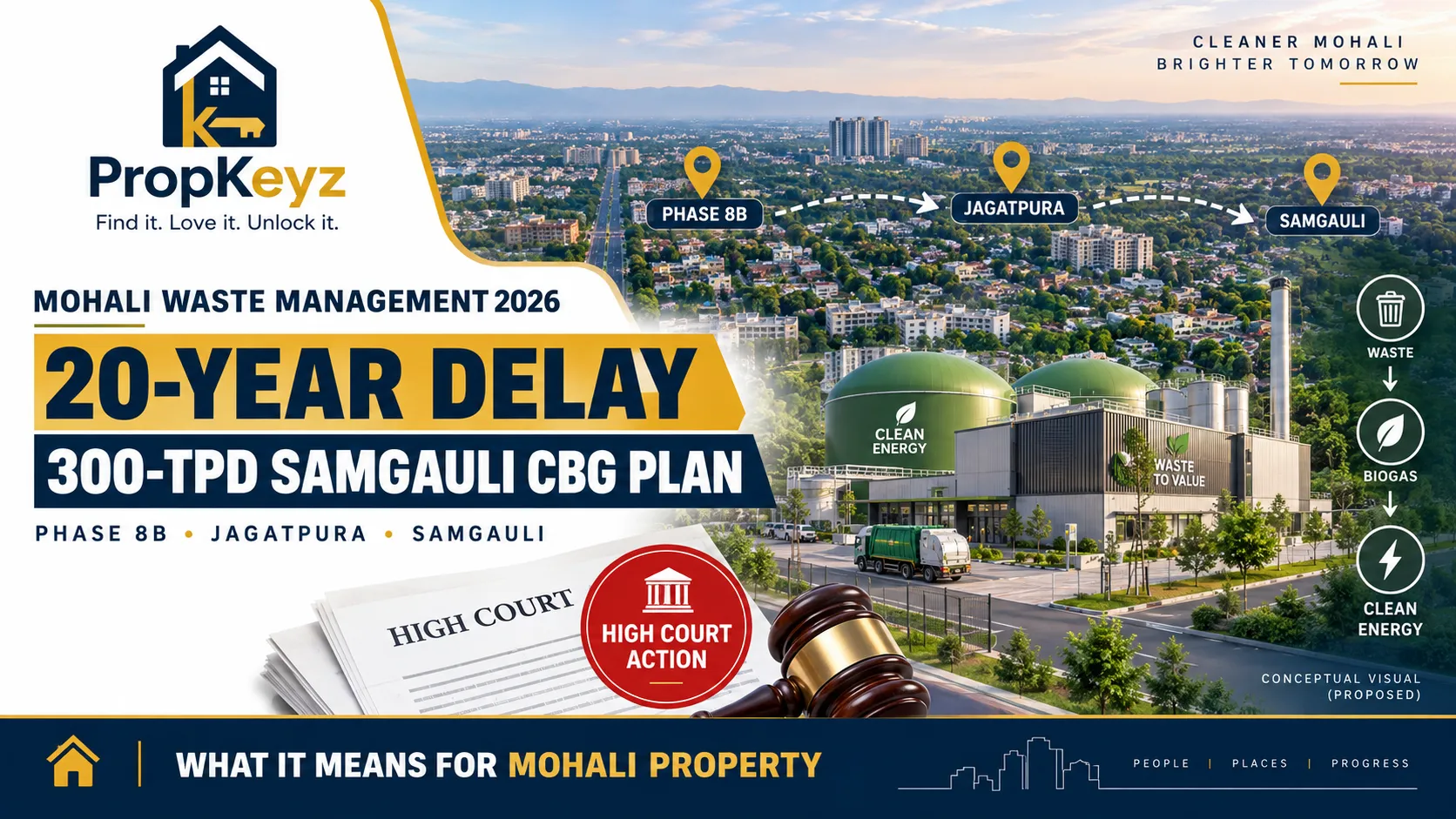
The Mohali Waste Management 2026 story has become one of the city’s most important civic-infrastructure issues after the Punjab and Haryana High Court again questioned why a long-term solid-waste management solution remains incomplete roughly two decades after the original case began.
The litigation dates back to:
2006
when a Mohali residents’ welfare body approached the High Court over alleged inadequate waste treatment and the resulting stench affecting:
Industrial Area Phase 8B and surrounding areas.
The proceedings were disposed of in 2012 following assurances from authorities, but residents returned to court in 2019, and the matter has remained under judicial monitoring.
In the latest proceedings reported on 20 September 2026, the High Court expressed serious concern that the required solid-waste management plant had still not been established after around 20 years and asked the state to use the available time effectively to move the project forward.
At the same time, another important development is moving separately.
Mohali Municipal Corporation has approved a proposal for an approximately:
300-tonne-per-day compressed biogas plant
at:
Samgauli village, Dera Bassi
in collaboration with:
HPCL Renewable & Green Energy Limited.
The proposed plant is designed around segregated wet waste from Mohali and several surrounding urban bodies and could convert organic waste into:
- compressed biogas
- organic fertiliser/manure.
But buyers, residents and investors need to understand the project stage correctly.
The plant is not yet an operating 300-TPD facility.
The correct current sequence is closer to:
MC Approval → Land/Feasibility → Agreements → Project Development → Construction → Commissioning → Operations
Meanwhile, Mohali is still relying partly on temporary arrangements such as the Jagatpura 150-TPD processing facility, which was created after dumping at the old Phase 8B site was restricted but has itself faced operational problems.
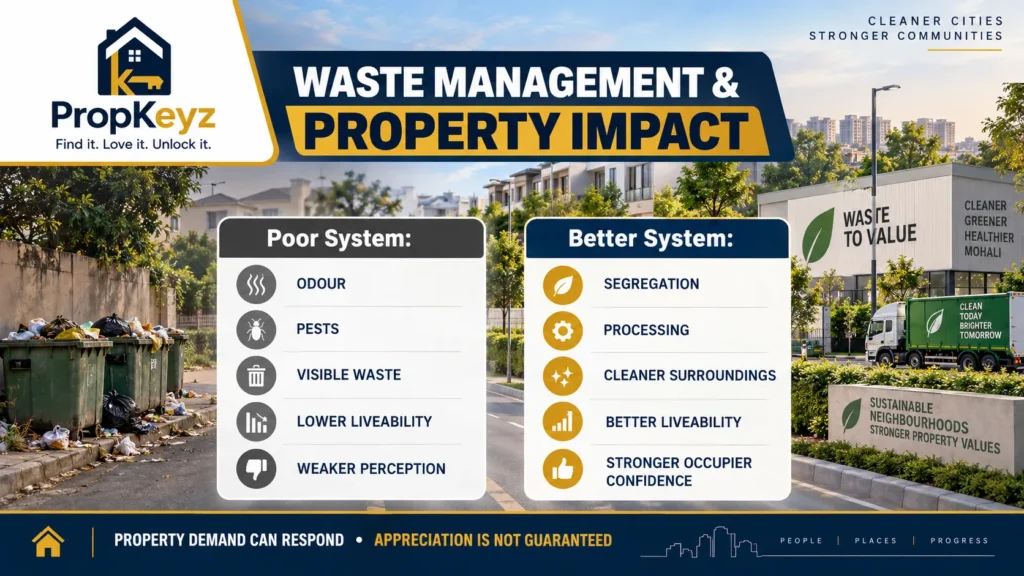
This matters for property buyers because waste management is not merely:
“municipal cleaning.”
It directly affects:
- liveability
- odour
- pests
- visual quality
- truck movement
- environmental perception
- business operations
- rental preference
- buyer confidence.
For PropKeyz, the key property lesson is simple:
Good roads and premium buildings cannot compensate indefinitely for weak civic infrastructure.
This guide explains the complete story from:
Phase 8B → Jagatpura → Samgauli
and separates:
what exists today
from:
what is still proposed for the future.
Last fact-checked: 21 September 2026
Key Takeaways
- The Mohali solid-waste case traces back to a PIL filed in 2006.
- The High Court’s latest reported proceedings questioned why the required waste-management plant had still not been established after around 20 years.
- The original dispute involved allegations of poor waste treatment and stench affecting Industrial Area Phase 8B and surrounding areas.
- The matter was disposed of in 2012 after assurances and revived in 2019.
- The next reported High Court hearing is 27 October 2026.
- Mohali MC told the court that corporation limits contain around 40,289 households generating approximately 100 MT of waste daily.
- That current figure includes roughly 40 MT wet waste and 60 MT mixed waste.
- A temporary 150-TPD processing facility was established at Jagatpura in March 2025.
- Jagatpura was still facing operational difficulties in September 2026.
- Mohali MC has separately approved a proposed 300-TPD CBG plant at Samgauli.
- The proposed partner is HPCL Renewable & Green Energy Limited, a wholly-owned HPCL subsidiary.
- The CBG proposal envisages roughly 20 acres for 30 years, subject to formal project agreements.
- The plant is currently a proposal/approved-project pathway—not an operational facility.
- Samgauli has a wider long-term waste-management history extending back more than a decade.
- India now operates under the Solid Waste Management Rules, 2026, effective from 1 April 2026.
- The new rules mandate four-stream source segregation.
- Better waste infrastructure can improve liveability and property perception.
- Better waste infrastructure does not guarantee property appreciation.
- A proposed CBG plant does not mean Mohali’s waste problem is already solved.
PropKeyz View
The important Mohali story is no longer just where garbage is dumped. It is whether the city can build a complete system from segregation and collection to processing, recovery and safe disposal.
Mohali Waste Management 2026: Quick Answer
The Mohali Waste Management 2026 issue currently has three important layers.
Phase 8B
This is where the long-running litigation began.
Residents alleged inadequate waste treatment and serious odour problems around Industrial Area Phase 8B.
Jagatpura
After dumping at Phase 8B was restricted, Mohali MC shifted toward a temporary Jagatpura arrangement.
A:
150-TPD processing plant
was established there in March 2025.
But as of September 2026, the facility was still reported to be facing operational difficulties.
Samgauli
Samgauli is intended to form part of Mohali’s longer-term waste-management solution.
Mohali MC has now approved a proposed:
300-TPD compressed-biogas plant
in partnership with HPCL Renewable & Green Energy Limited.
However:
the plant is not yet operational.
The High Court is separately continuing to press authorities over the long-delayed solid-waste-management solution.
Latest Verified Status — 21 September 2026
| Issue | Current Position |
|---|---|
| Original Waste PIL | Filed in 2006 |
| Core Original Area | Industrial Area Phase 8B |
| Case Disposed | 2012 after assurances |
| Case Revived | 2019 |
| Latest HC Reporting | 20 Sep 2026 |
| Next Reported Hearing | 27 Oct 2026 |
| Mohali MC Households | 40,289 |
| Daily Waste | Approx. 100 MT |
| Wet Waste | Approx. 40 MT |
| Mixed Waste | Approx. 60 MT |
| Jagatpura Capacity | 150 TPD |
| Jagatpura Status | Temporary / operational issues reported |
| Samgauli CBG Capacity | Proposed 300 TPD |
| CBG Partner | HPRGE |
| Proposed Land | Around 20 acres |
| Proposed Lease | 30 years |
| Samgauli Main Plant Operational? | No |
| SWM Rules 2026 | Effective from 1 Apr 2026 |
The household and waste-generation figures are those reported by Mohali MC in the current court context and relate to corporation limits, not the entire Greater Mohali cluster.
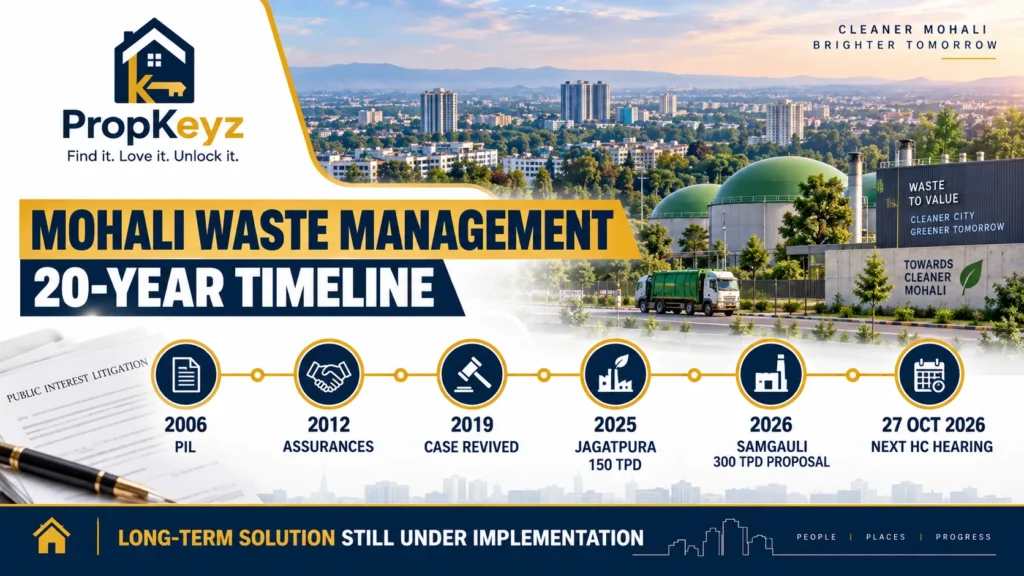
Why Has the Mohali Waste Case Lasted Around 20 Years?
The current court proceedings are important because this is not a newly discovered civic problem.
The original PIL was filed in:
2006.
The petition involved residents who complained about:
- ineffective solid-waste treatment
- waste accumulation
- odour affecting Phase 8B and surrounding areas.
The case was disposed of in:
2012
after authorities gave assurances that remedial steps would be taken.
Residents returned to court in:
2019
seeking revival of the matter.
In the latest September 2026 proceedings, the High Court observed that even after roughly 20 years the required solid-waste management plant had not been established and described the state’s position as a serious default requiring urgent action.
Why This Matters
The story is therefore not simply:
“new garbage plant announced.”
It is:
a long-standing waste infrastructure gap that authorities are still trying to close.
What Happened at Industrial Area Phase 8B?
Industrial Area Phase 8B became central to the waste-management dispute because the old waste site affected nearby:
- industrial units
- businesses
- workers
- residents
- surrounding neighbourhoods.
The original petition alleged that ineffective waste treatment created:
persistent stench
around the Phase 8B area.
Over the years, large quantities of legacy waste also accumulated at the site.
A December 2024 court update recorded Mohali MC saying that around:
70% of legacy waste
had been remediated at that point, with the remaining portion targeted for later clearance.
Important
That historical target should not automatically be converted into:
“Phase 8B is now 100% cleared.”
unless a fresh official status confirms it.
PropKeyz Rule
Target Date ≠ Verified Completion.
Why Is Phase 8B Important for Property Research?
Phase 8B is an established industrial and business location.
Its property value depends on more than:
- road frontage
- plot size
- office demand
- commercial activity.
Businesses and occupiers also care about:
- cleanliness
- odour
- pest control
- drainage
- water
- power
- road access
- waste movement.
Property Science
Persistent environmental nuisance can influence:
occupier experience
which can influence:
tenant preference
which can influence:
rental demand and buyer perception.
That does not mean every Phase 8B property loses value because of one waste issue.
But it does mean:
civic quality is part of commercial property quality.
What Happened After Dumping at Phase 8B Was Restricted?
Authorities needed an alternative arrangement.
That led to greater use of:
Jagatpura
as a temporary dumping and processing site.
Times of India reports that a:
150-tonne-per-day waste processing plant
was set up at Jagatpura in:
March 2025
after the High Court stopped dumping at the primary Phase 8B site.
The logic was understandable:
Phase 8B dumping problem → temporary alternative processing site.
But temporary infrastructure must still function reliably.
Jagatpura 150-TPD Facility: Why It Has Not Solved the Problem
By September 2026, the Jagatpura facility was being reported as facing repeated operational difficulties.
Issues reported included:
- processing disruptions
- garbage accumulation
- odour
- flies
- mosquitoes
- resident complaints
- difficulty disposing of processed material.
The site is also close enough to the airport environment that aviation-related concerns about bird attraction have been raised.
Processed-Waste Problem
The Jagatpura system reportedly depended partly on industries taking processed material for fuel use.
When that off-take reduced, the processing chain became harder to sustain.
Important Lesson
Waste management is not simply:
collect garbage and move it somewhere else.
A functioning system needs:
Collection → Segregation → Processing → Product/Recovery → Residual Disposal
If one link fails, waste starts accumulating again.

What Is Planned at Samgauli?
Samgauli village in Dera Bassi has been linked with Greater Mohali’s long-term waste-management plans for more than a decade.
Current reporting refers to approximately:
50 acres
having been acquired/earmarked for the wider waste-management project, with around:
39 acres
forming the walled/possessed area discussed in current proceedings.
In August 2026, Mohali Municipal Corporation approved a more specific proposal:
a 300-TPD compressed-biogas plant.
The planned partner is:
HPCL Renewable & Green Energy Limited.
What Is a Compressed Biogas Plant?
A compressed-biogas facility processes biodegradable organic material.
In the Samgauli proposal, the main planned input is:
segregated wet municipal waste.
Organic waste can be biologically processed to generate biogas.
After purification and compression, the gas can become:
compressed biogas — CBG.
The process can also generate:
organic manure/fertiliser
depending on plant design and feedstock.
Why This Is Different From Open Dumping
Open dumping treats waste as:
something to store.
A CBG system attempts to treat suitable organic waste as:
a resource.
Simplified Flow
Wet Waste
→ Segregation Quality Check
→ Biological Digestion
→ Biogas
→ Purification
→ CBG
→ Organic By-product / Manure
Important
CBG works best when the incoming waste stream is properly segregated.
If wet waste arrives mixed with:
- plastic
- sanitary waste
- glass
- metal
processing becomes much harder.
That is why source segregation is not a minor housekeeping issue.
It is central to the plant’s viability.
What Capacity Is Proposed?
The Samgauli plant proposal is approximately:
300 tonnes per day
of segregated wet waste.
The project agenda also refers to around:
20 tonnes/day of animal dung
as an additional feedstock component.
Important Context
Mohali MC’s corporation-limit waste generation is currently reported around:
100 MT/day
across all waste streams.
The proposed Samgauli plant is larger because it is intended to serve:
multiple urban local bodies
—not Mohali city alone.
Which Areas Could Send Waste to Samgauli?
The proposal identifies wet waste from nine urban bodies:
- Mohali
- Zirakpur
- Kharar
- Nayagaon
- Dera Bassi
- Kurali
- Lalru
- Banur
- Gharuan.
This makes Samgauli a:
regional waste-infrastructure proposal
rather than just a Mohali city facility.
Why This Matters
Greater Mohali urbanisation is no longer confined to one municipal boundary.
Residential and commercial growth is increasingly spread across:
- Mohali
- Kharar
- Zirakpur
- Dera Bassi
- Banur
- Gharuan
- Kurali.
Regional growth creates:
regional waste volumes.
Therefore long-term waste infrastructure also has to work at:
regional scale.
Who Is HPRGE?
HPRGE stands for:
HPCL Renewable & Green Energy Limited.
HPCL confirms that HPRGE was incorporated in 2024 as its wholly-owned subsidiary to develop green-energy businesses including:
- biofuels
- renewable energy
- green hydrogen
- green mobility
- other alternative-energy activities.
HPRGE’s involvement gives the Samgauli proposal a defined institutional partner.
But institutional partner involvement should not be confused with:
completed project execution.
Has Mohali MC Approved the Samgauli Plant?
Yes.
The Mohali Municipal Corporation House approved the proposal in August 2026.
But approval is only one stage.
After Approval
Current reported next steps include:
- land demarcation
- project feasibility
- memorandum of understanding
- wet-waste supply agreement
- long-term land lease.
Therefore the Correct Stage Is
Approved proposal / pre-development formalities
not:
operational plant.
PropKeyz Infrastructure Rule
Approval ≠ Agreement ≠ Construction ≠ Commissioning ≠ Operations.

How Much Land Could the CBG Plant Use?
The approved proposal envisages around:
20 acres
for the CBG project.
The land could be made available to HPRGE for approximately:
30 years
under the proposed lease framework, subject to final terms and agreements.
Wider Samgauli Site
This 20-acre proposal sits within a larger waste-management land story.
Current court reporting refers to:
- about 50 acres acquired
- approximately 39 acres of walled area.
These figures should not be merged into:
“The CBG plant itself is 50 acres.”
It is not.
Correct Distinction
Wider waste-management site: around 50 acres in historical/current reporting.
Proposed CBG project land: around 20 acres.
What Infrastructure Already Exists at Samgauli?
The latest High Court reporting says authorities informed the court that the site has:
- a boundary wall
- gate
- six CCTV cameras
- an effluent treatment plant for leachate
- firefighting equipment.
These are meaningful preparatory/site-management works.
But:
boundary wall ≠ waste-processing plant
and:
ETP ≠ 300-TPD CBG facility operational.
PropKeyz Rule
Site Preparation ≠ Core Plant Commissioning.
Why Has Samgauli Taken So Long?
Samgauli’s waste-management role is not a new 2026 idea.
Residents and civic groups have raised questions for years over why land allocated for the regional waste facility has not resulted in a functioning long-term plant.
A recent NGT-related report says:
- around 50 acres were acquired in 2017
- possession of nearly 39 acres was handed to Mohali MC in 2020
- the long-term facility remained non-operational.
Earlier, Mohali MC had also expressed concerns about:
- distance from Mohali
- transportation cost
- financial feasibility.
Why Distance Matters
Moving waste over long distances creates:
- fuel cost
- vehicle cost
- staff cost
- transfer/logistics complexity
- road movement.
Therefore a waste plant is not evaluated only by:
“land available hai.”
It must also work economically and operationally.
What Is the High Court Asking Authorities to Do Now?
In the latest proceeding, the Punjab and Haryana High Court asked the state to move the waste-management project forward rather than allowing another long period of delay.
The state told the court that:
in-principle approval
had been granted and the issue was pending before the:
finance department.
The court allowed approximately a month for further processing but made clear that the period should be used effectively.
The court also sought clarity regarding:
- door-to-door collection
- garbage segregation
- connected waste-management arrangements.
The next reported hearing is:
27 October 2026.
Important
The High Court is not simply asking:
“Plant kab banega?”
The wider issue is:
Does Mohali have a complete working waste-management chain?
Solid Waste Management Rules 2026: Why They Matter
India introduced new:
Solid Waste Management Rules, 2026
which superseded the 2016 framework.
They were notified on:
27 January 2026
and became effective from:
1 April 2026.
Four-Stream Segregation
The rules require source segregation into:
- wet waste
- dry waste
- sanitary waste
- special-care waste.
Why This Matters for Samgauli
The proposed CBG plant depends heavily on:
segregated wet waste.
If household waste is poorly segregated, processing efficiency can fall.
So the Complete Logic Is
Household
→ Correct Segregation
→ Separate Collection
→ Transport
→ Wet-Waste Processing
→ CBG / Organic Recovery
→ Residual Waste Management
PropKeyz View
A ₹-crore plant cannot solve a waste system if segregation fails at the first step.
How Much Waste Does Mohali Generate?
According to figures submitted by Mohali MC in the latest court context, corporation limits contain around:
40,289 households
generating approximately:
100 metric tonnes per day.
Reported breakup:
Wet waste: approximately 40 MT/day
Mixed waste: approximately 60 MT/day.
Important Geographic Limitation
This does not include the entire regional cluster.
The current court figures specifically exclude councils such as:
- Kharar
- Zirakpur
- Dera Bassi
- Nayagaon.
Therefore:
Mohali MC 100 MT/day ≠ Total Greater Mohali Regional Waste.
Why 300 TPD Can Make Sense for a Regional Plant
At first glance someone may ask:
“Mohali produces around 100 tonnes/day, then 300 TPD plant kyun?”
Because the proposed CBG plant is not intended only for Mohali Municipal Corporation.
It is designed to receive segregated wet waste from multiple towns.
Regional Logic
Mohali
- Zirakpur
- Kharar
- Nayagaon
- Dera Bassi
- Kurali
- Lalru
- Banur
- Gharuan
→ Regional Wet-Waste Feedstock
→ Samgauli CBG Plant
But Capacity ≠ Guaranteed Feedstock
A 300-TPD plant still requires:
- sufficient segregated wet waste
- reliable collection
- transportation
- contracts
- plant uptime.
What Does Better Waste Management Mean for Property?
This is where waste infrastructure becomes a PropKeyz topic.
Property value is influenced by more than:
- road width
- floor plan
- developer brand
- nearby mall.
Urban property also reflects:
quality of daily life.
A Better Waste System Can Support
- cleaner roads
- lower visible dumping
- fewer odour complaints
- lower pest nuisance
- improved public-space perception
- better occupier confidence.
The Property Chain
Better Waste Collection
→ Less Street Accumulation
→ Better Liveability
→ Better Tenant/Buyer Experience
→ Stronger Location Perception
→ Potential Demand Support
Important
The final step is:
potential demand support
—not:
guaranteed appreciation.
How Can Poor Waste Management Affect Property?
Poor waste management creates what economists call a:
negative externality.
That means a problem created in one place affects people and properties around it.
Examples:
- odour
- flies
- mosquitoes
- smoke/fire risk
- waste trucks
- visual pollution
- groundwater/environment concerns.
A buyer may like:
- the building
- the floor
- the road
but still reject the property because:
“Area ka environment achha nahi lag raha.”
That buyer reaction matters.
What Could This Mean for Phase 8B Property?
Phase 8B is one of the most relevant micro-markets in this story because the long-running court case itself emerged from complaints affecting that area.
If Waste Pressure Reduces
Potential local benefits include:
- lower nuisance
- cleaner surrounding environment
- improved workplace conditions
- better visitor experience
- stronger industrial/business perception.
But Don’t Overstate It
A buyer should not conclude:
“Waste problem solve hote hi Phase 8B rates jump karenge.”
Commercial and industrial property prices depend on many other variables:
- road access
- permitted use
- business demand
- plot size
- parking
- power
- water
- building quality.
Phase 8B Is Also Receiving Other Infrastructure
Waste management should not be examined alone.
PropKeyz recently covered a new:
₹2.31-crore underground water reservoir
for Phase 8/8B with:
- 5.40 lakh gallons storage
- planned 1.121 MGD canal-water supply.
Read:
Mohali Water Infrastructure 2026
Why This Is Important
Phase 8B’s property quality depends on several infrastructure systems working together:
Water + Power + Sewerage + Waste + Roads
—not one headline.
Why Waste Infrastructure Matters to Industrial Property
Industrial/commercial occupiers care about:
- worker environment
- customer visits
- truck movement
- utilities
- compliance
- surrounding cleanliness.
Poor waste infrastructure can create:
- odour
- blocked roads
- pest problems
- environmental complaints
- reputational issues.
Therefore industrial property analysis should include:
environmental civic infrastructure
along with rent and road width.
For Mohali’s wider industrial-development story, also read:
Mohali Sector 101 & 103 Industrial Parks 2026
What Could This Mean for Residential Property?
Residential buyers are often even more sensitive to:
- smell
- cleanliness
- garbage accumulation
- pests
- health perception.
A family may reject a property because of a nearby waste issue even if:
- apartment quality is good
- price is competitive
- road is wide.
Rental Effect
Tenants can move more easily than owners.
That means nuisance can sometimes affect:
tenant preference first
before a clear sale-price effect appears.
PropKeyz Rule
Liveability affects rentability before it necessarily shows up in official property rates.
What About Jagatpura Property?
Jagatpura deserves separate caution.
The current site is described as a temporary waste-processing/dumping arrangement and has faced resident complaints and operational difficulties.
Property buyers near any temporary or permanent waste facility should verify:
- actual distance
- prevailing wind/odour experience
- truck route
- current operational status
- future closure/relocation plan.
Do Not Assume
Temporary means ending next month.
Infrastructure labelled temporary can remain in use longer than expected.
What About Property Near Samgauli?
The property impact near Samgauli can be different.
A modern, scientifically operated CBG plant is not the same thing as:
an unmanaged open dump.
But buyers still need to evaluate:
- truck movement
- plant access
- buffer distance
- environmental approvals
- treatment technology
- odour controls
- residual-waste handling.
Potential Infrastructure Effect
A properly operated facility can create:
- organised infrastructure
- road movement
- employment
- energy-production activity.
Potential Local Concerns
Depending on plant design and operations:
- waste-truck traffic
- odour risk
- noise
- local perception
may still matter.
PropKeyz Rule
Scientific Waste Plant ≠ Open Dump — but Scientific Plant ≠ Zero Local Impact.
Will the Samgauli Plant Increase Nearby Property Rates?
There is no reliable basis today to say:
“Samgauli rates will rise X% because of the CBG plant.”
A waste-processing plant is not the same price catalyst as:
- metro station
- business district
- major commercial hub.
Its Main Property Value Is
civic-function improvement at regional level.
If Mohali gains a reliable regional processing solution, the larger benefit may be felt through:
- reduced uncontrolled dumping
- improved cleanliness
- stronger waste-system reliability.
That can help the wider urban market.
It does not automatically create a speculative land-price boom beside the plant.
Waste Infrastructure vs Road Infrastructure
Road projects often create visible connectivity improvements.
Waste infrastructure is different.
Road Benefit
Better travel.
Waste Benefit
Better urban functioning.
Why Waste Is Still Important
A city cannot remain premium simply because it has:
- highways
- airports
- expensive apartments.
It also needs:
- water
- sewerage
- electricity
- drainage
- waste processing.
PropKeyz View
Premium real estate requires premium civic infrastructure behind the scenes.
Mohali Water + Power + Sewerage + Waste: The Bigger Property Story
PropKeyz is now tracking Mohali’s infrastructure as a complete system.
Water
Kajauli, Sinhpur WTP Phase 2 and Phase 8/8B canal-water infrastructure.
Read Mohali Water Infrastructure 2026
Power
Grid upgrades and new power capacity across Mohali growth sectors.
Read Mohali Power Infrastructure 2026
Sewerage
Fresh underground sewerage works in Kharar.
Read Kharar Sewerage Upgrade 2026
Waste
Phase 8B → Jagatpura → Samgauli.
Why Buyers Should Track All Four
A building can be premium.
But long-term urban quality depends on:
Building + Roads + Water + Power + Sewerage + Waste
PropKeyz Rule
Real estate is only as functional as the infrastructure serving it.
Is the Samgauli Plant the Final Solution?
Potentially important?
Yes.
Final solution already achieved?
No.
The project still has several steps.
Current Development Chain
MC Proposal
→ House Approval
→ Land Demarcation
→ Feasibility
→ MoU
→ Waste Supply Agreement
→ Lease Agreement
→ Detailed Project Development
→ Construction
→ Testing
→ Commissioning
→ Operations
Current Position
Early project-development / formalisation stage
—not:
operational plant.

Confirmed vs Proposed vs Not Established
| Claim | Status |
|---|---|
| Original waste PIL filed in 2006 | Confirmed |
| Phase 8B central to original complaint | Confirmed |
| Matter revived in 2019 | Reported |
| Around 20-year delay noted by HC | Confirmed in latest reporting |
| Next hearing 27 Oct 2026 | Reported |
| Mohali MC 40,289 households | Reported to HC |
| Mohali MC approx. 100 MT/day waste | Reported |
| Jagatpura plant 150 TPD | Confirmed in reporting |
| Jagatpura final solution | No |
| Samgauli site around 50 acres historically | Reported |
| 300-TPD CBG plant approved by MC House | Confirmed |
| HPRGE proposed partner | Confirmed |
| 20-acre CBG land proposal | Confirmed in reporting |
| 30-year proposed lease | Confirmed in reporting |
| Plant construction complete | No |
| Plant commissioned | No |
| 300 TPD currently processed | No |
| Waste issue solved | No |
| Phase 8B property prices will rise | Not established |
| Samgauli property prices will rise | Not established |
What Should Mohali Property Buyers Check?
1. Distance From Waste Site
Do not rely on:
“thoda door hai.”
Map it.
2. Current Operational Status
Is it:
- active dump
- transfer point
- processing plant
- proposed facility?
3. Truck Route
Waste facilities create vehicle movement.
4. Odour
Visit the location at:
- morning
- afternoon
- evening
if the issue is material.
5. Wind & Local Experience
Talk to:
- residents
- shopkeepers
- workers.
6. Planning Stage
Do not confuse:
proposal
with:
operational infrastructure.
7. Other Civic Infrastructure
Also check:
- sewerage
- drainage
- water
- power.
8. Entry Price
Ask:
Is the current price already ignoring a known environmental nuisance—or charging a premium despite it?
What Should Phase 8B Owners Track?
Existing owners should track:
- current legacy-waste status
- waste movement around the old site
- court developments
- Samgauli implementation
- Jagatpura status
- environmental improvement on the ground.
Do Not Judge Only From Court Headlines
The real property signal will be:
what changes physically around Phase 8B.
What Should Samgauli-Area Buyers Track?
Track:
- final land demarcation
- feasibility report
- MoU
- wet-waste supply agreement
- environmental approvals
- construction award
- construction progress
- buffer/traffic plan
- commissioning.
Biggest Mistake
Buying land because a seller says:
“HPCL plant aa gaya, area boom karega.”
The plant’s main purpose is:
waste processing and green-energy production
—not real-estate price creation.
Mohali Waste Management 2026: PropKeyz Analysis
The Mohali Waste Management 2026 issue is important because it exposes a less glamorous but critical side of urban growth.
Mohali is expanding through:
- premium residential projects
- IT City
- Aerocity
- industrial sectors
- road infrastructure
- water projects
- power upgrades.
But more development also means:
more daily waste.
1. Twenty Years Is the Central Warning
The strongest fact in the current story is not 300 TPD.
It is:
the original court case dates to 2006.
That shows how long large civic-infrastructure gaps can persist.
2. Phase 8B Shows Why Waste Is a Property Issue
Environmental nuisance affects:
- businesses
- workers
- visitors
- residents.
3. Moving Waste Does Not Solve Waste
Phase 8B pressure contributed to the shift toward Jagatpura.
But Jagatpura itself has experienced problems.
That proves:
location change without system reliability is not enough.
4. Samgauli Is More Structured
The proposed CBG model has a stronger resource-recovery logic:
wet waste → biogas + organic output.
5. The Plant Needs Segregation to Work
This is why the 2026 SWM Rules matter.
A modern plant cannot efficiently process:
mixed everything.
6. Regional Capacity Makes Sense
Greater Mohali is not one municipality anymore in practical urban terms.
Kharar, Zirakpur, Dera Bassi, Banur, Gharuan and other towns contribute to a shared urban-growth corridor.
7. Property Impact Is Mostly About Liveability
Waste processing is unlikely to create the same speculative premium as a new expressway.
Its value is more fundamental:
making the city function properly.
8. Phase 8B Could Benefit From Nuisance Reduction
But that benefit should be measured through:
- cleaner environment
- fewer complaints
- improved occupier experience
before making any price claims.
9. Jagatpura Needs to Be Watched Separately
Samgauli does not automatically mean Jagatpura closes tomorrow.
10. October 27 Is the Next Key Date
The next High Court hearing may provide:
- finance-department status
- project-progress details
- collection/segregation clarification
- implementation timeline.
Biggest Positive
Mohali now has a defined 300-TPD regional CBG proposal with an identified institutional partner.
Biggest Concern
The long-term waste facility remains non-operational after years of delay.
Biggest Property Lesson
A city’s invisible infrastructure matters as much as its visible real estate.
PropKeyz View
Mohali’s property story cannot be analysed only through roads, towers and auctions. Waste, water, power and sewerage ultimately determine whether growth remains liveable.
Mohali Waste Management 2026: Final Verdict
The Mohali Waste Management 2026 story is at an important but unfinished stage.
Confirmed
The High Court is still monitoring a waste-management dispute that traces back to:
2006.
Confirmed
Phase 8B was central to the original waste-treatment and odour concerns.
Confirmed
Jagatpura has a:
150-TPD temporary processing facility
but operational difficulties have continued to be reported.
Confirmed
Mohali MC has approved a:
300-TPD Samgauli CBG proposal
with HPRGE.
Not Yet Confirmed
The Samgauli CBG plant is:
- built
- commissioned
- processing 300 TPD.
It is not.
What Happens Next Matters More
The market should now track:
Feasibility → Agreements → Construction → Commissioning → Actual Processing
Property Impact
A properly functioning regional waste-management system can support:
- cleaner surroundings
- better liveability
- stronger occupier confidence
- a more sustainable urban-growth story.
But:
waste infrastructure does not guarantee property appreciation.
Final PropKeyz Rule
A clean city supports real estate. A plant announcement alone does not.
Frequently Asked Questions
What is the latest Mohali Waste Management 2026 update?
The Punjab and Haryana High Court has again pressed authorities to move forward with a long-term solid-waste solution, while Mohali MC has separately approved a proposed 300-TPD CBG plant at Samgauli. The CBG plant is not yet operational.
Why is the Mohali waste case called a 20-year issue?
The original PIL was filed in 2006, and the High Court’s latest reported proceedings in 2026 specifically noted that the required plant had still not been established after around 20 years.
What was the Phase 8B problem?
The original petition involved allegations of inadequate waste treatment and stench affecting Industrial Area Phase 8B and surrounding areas.
Is garbage still dumped at Phase 8B?
Dumping at the primary Phase 8B site was restricted through court intervention, and a temporary processing arrangement was later developed at Jagatpura. Current Phase 8B legacy-waste status should be checked through fresh official updates.
What is the Jagatpura waste plant capacity?
The Jagatpura processing facility was established with reported capacity of approximately:
150 TPD.
Is Jagatpura the permanent waste solution?
It has been described as a temporary arrangement and has faced operational challenges.
What is planned at Samgauli?
Mohali MC has approved a proposal for an approximately:
300-TPD compressed-biogas plant
at Samgauli, Dera Bassi.
Is the Samgauli CBG plant operational?
No.
The project still requires further feasibility, contractual and implementation steps before commissioning.
Who is proposed to develop the plant?
The proposal involves:
HPCL Renewable & Green Energy Limited
a wholly-owned subsidiary of HPCL.
How much land may be used for the plant?
The current proposal refers to approximately:
20 acres
under a proposed long-term arrangement.
How long is the proposed lease?
Current reporting refers to approximately:
30 years.
Which cities could send waste to Samgauli?
The proposal includes wet waste from Mohali, Zirakpur, Kharar, Nayagaon, Dera Bassi, Kurali, Lalru, Banur and Gharuan.
How much waste does Mohali generate daily?
Mohali MC told the court that corporation limits generate approximately:
100 MT/day
including roughly 40 MT wet waste and 60 MT mixed waste.
What are the Solid Waste Management Rules 2026?
They are India’s current central solid-waste rules, effective from 1 April 2026, replacing the 2016 rules and requiring four-stream source segregation among other reforms.
Will better waste management increase Phase 8B property prices?
Better environmental conditions can improve liveability and occupier perception, but no specific appreciation or price increase can be guaranteed.
Is property near a CBG plant necessarily bad?
No. A scientifically managed processing plant is different from uncontrolled dumping. Buyers should still examine traffic, odour control, environmental compliance, buffer distance and plant operations.
When is the next High Court hearing?
The latest reported next hearing date is:
27 October 2026.
Continue Your Mohali Infrastructure Research
Mohali Water Infrastructure 2026
Phase 8/8B is also receiving new water-storage infrastructure.
Read Mohali Water Infrastructure 2026
Mohali Power Infrastructure 2026
Understand grid-capacity expansion across Mohali and its growth sectors.
Read Mohali Power Infrastructure 2026
Kharar Sewerage Upgrade 2026
Track the latest ₹4.04-crore combined sewerage tender story around Nijjar Chowk and Khunni Majra.
Read Kharar Sewerage Upgrade 2026
Mohali Sector 101 & 103 Industrial Parks 2026
Understand Mohali’s wider industrial-development pipeline.
Read Mohali Sector 101 & 103 Industrial Parks 2026
Property Management Company in Mohali
For landlords and NRI owners who need tenant, inspection, maintenance and property-management support:
Property Management Company in Mohali
Evaluating Property in Phase 8B, Jagatpura, Samgauli or Nearby Mohali?
If a seller or broker is using:
- upcoming waste plant
- removal of garbage site
- new civic infrastructure
- industrial development
- future CBG plant
as part of the property’s sales pitch, send PropKeyz:
Location / Sector:
Society / Village:
Property Type:
Plot / Unit Size:
Quoted Price:
Distance From Waste Site:
Current Use:
Self-Use / Investment:
Seller’s Infrastructure Claim:
PropKeyz can help organise your research around:
- current infrastructure stage
- location
- civic facilities
- environmental factors
- seller claims
- comparable property
- buyer risks.
Call / WhatsApp
+91 80534 69929
Suggested WhatsApp Message
Hi PropKeyz, I read your Mohali Waste Management 2026 guide. I am evaluating a property in . The seller is quoting ₹ and has told me ________ about the nearby waste/infrastructure situation. Please help me understand the current project stage and what I should verify before proceeding.
Find it. Love it. Unlock it.
Your Property. Our Responsibility.
Sources & Verification
Last fact-checked: 21 September 2026
Punjab & Haryana High Court Proceedings — Current Reporting
Used to verify:
- 2006 PIL
- Phase 8B background
- approximately 20-year delay
- state’s in-principle approval position
- court’s current direction
- 27 October hearing
- current Mohali MC household/waste figures
- Samgauli site preparation.
Hindustan Times — High Court Waste Plant Update
Mohali MC — Samgauli CBG Proposal
Used to verify:
- 300 TPD proposal
- House approval
- HPRGE involvement
- around 20 acres
- 30-year proposed land arrangement.
The Tribune — 300-Tonne Samgauli Plant Approval
Samgauli Project Agenda
Used to verify:
- 300 TPD wet waste
- approximately 20 TPD animal dung
- nine participating urban bodies
- feasibility
- MoU
- wet-waste supply agreement
- lease steps.
The Tribune — Samgauli CBG Project Agenda
Jagatpura Temporary Waste Facility
Used to verify:
- 150 TPD capacity
- March 2025 setup
- temporary role
- current operational problems
- resident and aviation-related concerns.
Times of India — Jagatpura Waste Facility Update
Solid Waste Management Rules 2026
Used to verify:
- notification in January 2026
- effective date 1 April 2026
- four-stream segregation
- replacement of 2016 rules.
CPCB — Solid Waste Management Rules 2026
Press Information Bureau — SWM Rules 2026
HPCL Renewable & Green Energy Limited
Used to verify HPRGE’s status as HPCL’s wholly-owned renewable/green-energy subsidiary.
Disclaimer
This article is for:
- property research
- infrastructure awareness
- buyer education
only.
It does not constitute:
- environmental certification
- investment advice
- legal advice
- public-health advice
- property valuation
- government approval.
Waste-management projects can change in:
- capacity
- technology
- partner
- land area
- implementation model
- timeline.
Property-market impact depends on many separate factors.
PropKeyz does not claim that:
- Phase 8B property values will rise
- Samgauli land prices will rise
- Jagatpura property prices will fall
- the CBG plant will eliminate all waste problems
- waste nuisance will disappear on a fixed date.
Property buyers should independently verify:
- current site operations
- distance
- local conditions
- environmental approvals
- zoning
- title
- access
- applicable government records.
About PropKeyz
PropKeyz Editorial Team
PropKeyz tracks real-estate and civic-infrastructure developments across:
- Mohali
- Greater Mohali
- Chandigarh Tricity
- Kharar
- Zirakpur
- Dera Bassi
- Banur
- Gharuan
- IT City
- Aerocity
- New Chandigarh.
Our infrastructure research follows one core rule:
Proposal ≠ Approval ≠ Construction ≠ Commissioning ≠ Operational Infrastructure.
And for property:
Infrastructure headline ≠ Guaranteed appreciation.
Find it. Love it. Unlock it.
Your Property. Our Responsibility.