

A fresh Punjab & Haryana High Court judgment has changed how NRI landlords should think about creating a new tenancy in Punjab.
On 7 September 2026, the High Court in Manpreet Kaur v. Jai Singh set aside an eviction order obtained by an NRI landlord who had rented the property to the tenant in January 2020.
The case is important because the landlord had tried to use the special NRI eviction provision under:
Section 13-B of the East Punjab Urban Rent Restriction Act, 1949.
But Punjab’s old 1949 Act had already been repealed when the Punjab Rent Act, 1995 came into force on 30 November 2013.
The High Court also examined whether the landlord could instead use the newer NRI provision:
Section 24(3) of the Punjab Rent Act, 1995.
The answer, on those facts, was also no.
Why?
Because Section 24(3)’s special NRI remedy applies to qualifying premises:
let out on or before the commencement of the Act.
The tenancy in the case had started in:
2020.
Therefore, the landlord could not use either:
- the repealed Section 13-B route; or
- the special Section 24(3) NRI route.
But this is where many headlines can become misleading.
The High Court did not say:
“NRI landlords cannot evict tenants in Punjab.”
The Court specifically left the landlord free to pursue:
any other remedy available under applicable law.
It also did not decide whether the landlord’s claimed personal requirement was genuine, because the case failed on the legal provision under which the eviction petition had been filed.
For an NRI property owner in:
- Mohali
- Zirakpur
- Kharar
- other urban Punjab markets
the practical lesson is much bigger than one court case:
The date and structure of your tenancy can materially affect which eviction route is available later.
That means property protection must begin:
before the tenant receives the keys.
Last fact-checked: 24 September 2026
Key Takeaways
- Punjab & Haryana High Court delivered the key ruling on 7 September 2026.
- The disputed tenancy began on 17 January 2020.
- The landlord was an NRI stated to be permanently settled in Canada.
- He filed under Section 13-B of the old 1949 Rent Act.
- The old Act had already been repealed in Punjab after the Punjab Rent Act, 1995 came into force on 30 November 2013.
- The High Court held the old Section 13-B remedy could not be used to create a fresh eviction right for a tenancy made in 2020.
- The Court also held that the special NRI route under Section 24(3) of the 1995 Act did not apply because that provision is restricted to premises let out on or before commencement of the Act.
- This does not mean NRI landlords have no eviction rights.
- Other remedies may exist under the Punjab Rent Act or other applicable law depending on:
- property type
- tenancy date
- statutory exemption
- agreement
- eviction ground.
- Where the Punjab Rent Act applies, Section 20 contains general eviction grounds.
- Fresh tenancies in Punjab should be documented in writing.
- Tenant KYC, police verification, move-in records and rent agreements still matter.
- A rent agreement should clearly record:
- tenure
- rent
- deposit
- permitted use
- notice
- expiry
- handing-back obligation.
- NRI status does not replace good tenancy management.
- The safest owner mindset is:
Do not assume “NRI hoon, fast eviction automatically mil jayegi.” Know which law actually applies to your tenancy.
NRI Landlord Eviction Punjab 2026: Quick Answer
The NRI Landlord Eviction Punjab 2026 ruling does not remove an NRI owner’s right to seek possession.
It limits a specific:
special NRI eviction route.
The High Court held that an NRI landlord whose tenancy was created in 2020 could not use:
repealed Section 13-B of the 1949 Act
and could not switch to:
Section 24(3) of the Punjab Rent Act, 1995
because Section 24(3) is specifically framed for premises let out on or before commencement of the new Act.
In One Line
Post-2013 NRI tenancy does not automatically get the old special NRI fast-track eviction route.
But:
other lawful eviction remedies may still be available depending on the facts.

What Exactly Happened in Manpreet Kaur v. Jai Singh?
The NRI landlord had purchased a plot through a registered sale deed dated:
24 May 2012.
Construction was subsequently raised.
The property was then rented to the tenant on:
17 January 2020
for:
₹20,000 per month.
The landlord later filed an ejectment petition on:
29 April 2021
under Section 13-B of the old 1949 Act, claiming bona fide personal requirement.
The Rent Controller ultimately:
- dismissed the tenant’s leave-to-contest application; and
- ordered ejectment.
The tenant challenged that order.
On 7 September 2026, the High Court set it aside.
Why Did the High Court Set Aside the Eviction?
The case involved two major legal problems.
Problem 1
The landlord filed under:
Section 13-B of the East Punjab Urban Rent Restriction Act, 1949.
But that statute had already been repealed in Punjab.
Problem 2
The landlord could not simply move into:
Section 24(3) of the Punjab Rent Act, 1995
because the tenancy was created:
after the Act commenced.
The Court therefore held that the special eviction proceeding used by the landlord was not maintainable.
What Happened to the Eviction Order?
It was:
set aside.
But the Court made an extremely important clarification.
The landlord remained free to:
pursue whatever remedy was available under the law applicable to the premises.
The High Court specifically did not decide:
- whether the landlord genuinely needed the property;
- whether another eviction proceeding could succeed.
PropKeyz Rule
Wrong eviction provision ≠ no landlord rights. It means the owner must use the correct legal route.
What Was Section 13-B?
Section 13-B belonged to the:
East Punjab Urban Rent Restriction Act, 1949.
Historically, it provided certain NRI landlords a special route for recovering possession from tenants for bona fide use.
But in Punjab:
the old Act was repealed after the Punjab Rent Act, 1995 became operational on 30 November 2013, subject to statutory savings.
September 2026 High Court Lesson
A landlord cannot create a new right in 2021 under a provision repealed in 2013 merely because:
the landlord is an NRI.
What Is Section 24(3) of the Punjab Rent Act?
Section 24 deals with special immediate-possession rights for specified categories of landlords.
Its NRI component is in:
Section 24(3).
It covers a qualifying NRI owner who returns to India for permanent residence and requires qualifying residential/non-residential premises for:
- personal use; or
- use of someone ordinarily living with and dependent upon the owner.
But the text has an important limitation:
the premises must have been let out on or prior to commencement of the Act.
And the Act commenced:
30 November 2013.
Why Did Section 24(3) Fail in the 2026 Case?
Because the tenancy started:
17 January 2020.
That was more than six years after the Act commenced.
The High Court held that the tenant’s admitted 2020 induction placed the tenancy outside the temporal requirement of Section 24(3).
The Rule Owners Should Remember
Section 24(3) is not a general NRI eviction provision for every tenancy created in Punjab today.
That is the major September 2026 takeaway.
Pre-2013 NRI Tenancy vs New NRI Tenancy
Older Tenancy
If the property was let out:
on or before 30 November 2013
Section 24(3) may be relevant if its other conditions are satisfied.
Fresh Tenancy
If you rent the property:
today in 2026
you should not assume Section 24(3) will give you the special NRI recovery route.
Important
This does not mean:
new tenants can never be evicted.
It means:
the owner must rely on the correct legal framework applicable to that tenancy and property.

Does This Mean an NRI Landlord Cannot Evict a Tenant?
No.
That would be a serious misreading of the judgment.
Where the Punjab Rent Act applies, Section 20 contains various grounds under which a landlord may seek recovery of possession.
Depending on the facts, these can include matters such as:
- qualifying rent default
- misuse of premises
- substantial damage
- tenant agreeing/informing in writing that the property would be vacated but failing to do so
- bona fide personal/family requirement.
Important
An NRI owner does not automatically win because one of these facts is alleged.
The owner must satisfy:
the legal requirements of the ground actually relied upon.
Section 20: Why It Matters to Today’s NRI Landlord
For a new tenancy created in 2026, Section 20 can become much more relevant than assuming the old special NRI remedy will apply.
But even Section 20 must be used correctly.
Example
If the tenant stops paying rent:
the law contains a particular statutory structure concerning:
- arrears
- notice
- period of default
- applicable interest.
It is not simply:
“One month rent late → instant eviction.”
Bona Fide Personal Requirement
Section 20(2)(q), where applicable, includes a ground where the premises are genuinely required for occupation by:
- the landlord; or
- qualifying family/dependent persons,
and there is no other reasonably suitable accommodation.
It also includes conditions concerning recently transferred ownership.
Why This Is Important
An NRI landlord who genuinely wants to return and occupy the property may still have a legal route.
But:
it may not be the special Section 24(3) route if the tenancy was created after November 2013.
What If the Tenant Promised to Vacate on a Fixed Date?
Section 20 also includes a ground concerning a tenant who:
- agreed with the landlord; or
- informed the landlord in writing
of a date on which the tenant would vacate, but then failed to do so.
This is another reason why:
written documentation matters.
What About Property Misuse?
The Act also contains eviction grounds relating to issues such as:
- use inconsistent with the agreed purpose
- substantial property damage
- certain illegal/nuisance use.
Owner Lesson
Your agreement should clearly state:
what the premises are being rented for.
For example:
Residential use only.
Not:
“use however tenant wants.”
What If the Property Is New?
This requires extra care.
Section 3 of the Punjab Rent Act contains exemptions, including an exemption framework for certain premises constructed on or after commencement for a specified period.
The September 2026 High Court itself stressed that:
date of land purchase is not the same as date of completion of construction.
The statutory completion test must be examined.
Therefore
Do not conclude:
“New building = Section 20 definitely applies.”
or:
“New building = old Section 13-B revives.”
Neither is safe.
The applicable law must be checked property by property.
Why NRI Owners Must Fix the Tenancy Before Handing Over Keys
The High Court ruling makes one property-management lesson very clear:
Your future eviction position starts on the day you create the tenancy.
You cannot wait until a dispute begins and then try to reconstruct:
- occupancy terms
- rent
- duration
- intended use
- move-out commitment.
Create the record first.
Punjab Rent Act: Written Agreement Matters
Section 4(1) of the Punjab Rent Act states that after commencement of the Act, premises should not be let or taken on rent except through:
an agreement in writing.
For an NRI owner:
this is especially important.
You may be living in:
- Canada
- UK
- UAE
- USA
- Australia
and relying entirely on the written record if a dispute develops.
Does the Rent Agreement Need Registration?
Section 4(2) provides a registration framework for the agreement.
However, Punjab & Haryana High Court in Geeta Vasudev v. Veena Jindal (2024) held that the non-registration of a written agreement did not by itself make the agreement void in that context; the Court treated the registration requirement as directory.
Practical Owner Rule
Do not interpret that as:
“Registration is useless.”
A formally prepared and properly documented tenancy reduces uncertainty.
Before renting:
use appropriate professional help for:
- agreement drafting
- stamping
- registration
- local compliance.
What Should Be Written in the Agreement?
A strong rental agreement should clearly address matters such as:
Parties
- landlord
- tenant
- authorised representative where relevant.
Property
- exact address
- unit/floor
- parking where applicable.
Tenancy
- start date
- duration
- expiry date.
Rent
- monthly rent
- due date
- escalation.
Deposit
- amount
- adjustment/refund conditions.
Occupants
- approved occupants.
Use
- residential/non-residential purpose.
Maintenance
- landlord responsibility
- tenant responsibility.
Notice
- termination / exit mechanism.
Handover
- tenant’s obligation to return vacant possession as legally applicable.
Inventory
- furniture/appliances.
Important
A contractual clause cannot override mandatory law.
The agreement should be:
legally compliant—not merely owner-friendly.

What Does the February 2026 Ravinder Pal Judgment Tell Us?
The law is not simply:
“2026 High Court is anti-NRI landlord.”
Another 2026 High Court decision demonstrates why the facts matter.
In Ravinder Pal v. Harminder Singh, the landlords were persons of Indian origin settled in Canada and sought possession of commercial premises under Section 24(3).
The underlying tenancy was decades old.
The High Court upheld the eviction orders and rejected arguments that:
- Canadian passport holders could not qualify as NRIs
- the landlords had to physically return before filing
- filing through Power of Attorney made the petition invalid.
The landlords had pleaded their intention to return permanently and start their own business.
The Lesson
Compare:
Old tenancy + Section 24 statutory ingredients
→ special NRI route may be available.
versus:
2020 tenancy
→ Section 24(3) temporal requirement failed in Manpreet Kaur v. Jai Singh.
PropKeyz Rule
NRI status may be the same. Tenancy date can change the legal route.
Does an NRI Have to Fly Back to India Before Filing?
Not necessarily in every Section 24(3) case.
Punjab & Haryana High Court precedent has treated a properly pleaded intention to return permanently as sufficient in relevant cases rather than requiring the NRI to physically relocate before filing.
The February 2026 Ravinder Pal decision followed that approach.
But
This point matters only if:
Section 24(3) is otherwise legally available.
If the tenancy itself was created in 2020 or 2026:
the September 2026 judgment creates the more fundamental problem:
Section 24(3)’s tenancy-date condition.
Can an NRI File Through Power of Attorney?
A properly authorised POA can be relevant.
In the Ravinder Pal case, the Court rejected the argument that proceedings were defective merely because they were instituted through a duly constituted Power of Attorney.
Earlier Mohali litigation has also involved NRI eviction proceedings filed through a GPA.
But
Do not assume:
any POA is automatically sufficient.
Check:
- scope
- authority
- execution
- authentication/registration requirements
- exact proceeding.
Tenant’s Leave to Contest: Why Timing Matters
Certain special proceedings under the Punjab Rent Act use a summary procedure.
Section 38 and Schedule III contemplate:
leave to contest
within the prescribed period, commonly 15 days for applicable special proceedings.
This is primarily a litigation-procedure issue.
Owner Lesson
Even when a special remedy exists:
service and procedural compliance matter.
A strong case can still become complicated by:
- wrong provision
- wrong summons
- wrong procedure
- wrong property classification.
What Does the Ruling Mean for Mohali NRI Owners?
Mohali has a large mix of:
- sector houses
- independent floors
- Aerocity homes
- apartments
- NRI-owned rental properties.
For any new tenancy in 2026:
do not tell yourself:
“I’m NRI, Section 24 se kabhi bhi tenant nikal jayega.”
The September 2026 judgment says otherwise for post-2013 tenancies.
Better Approach
Before renting:
- classify property/legal regime
- use written tenancy
- document tenant
- verify occupancy
- define use
- record expiry
- track rent
- inspect property
- keep owner records organised.
For ongoing remote management:
NRI Property Management by PropKeyz
What Does It Mean for Zirakpur NRI Owners?
Zirakpur has a high concentration of:
- gated societies
- investor-owned flats
- NRI apartments.
Tenant turnover can be relatively frequent.
That makes:
new-tenancy documentation
especially important.
A 2026 tenancy in a Zirakpur flat should not be created on the assumption that historic NRI fast-track provisions automatically apply.
Build the Rental File
- written agreement
- KYC
- verification
- society record
- move-in condition
- keys
- rent ledger.
For a professional tenant onboarding framework:
Tenant Placement & Verification by PropKeyz
What Does It Mean for Kharar NRI Owners?
Kharar contains a more diverse rental market:
- builder floors
- independent houses
- apartments
- private colonies.
An NRI owner should first understand:
what exact property is being rented and which legal framework applies.
Do not combine:
- colony status
- title
- tenancy
- tenant verification
into one issue.
A property may have a perfectly valid tenant relationship but separate underlying:
- NOC
- colony
- title
questions.
Does This Judgment Affect Property Rates?
Not directly.
This is not:
a rate-increase or rate-crash judgment.
It affects:
landlord risk perception and rental management discipline.
Possible Market Science
Clear Agreements
- Better Tenant Onboarding
- Professional Management
→ Lower Operational Uncertainty
→ Greater Owner Confidence in Renting
versus:
Poor Documentation
- Informal Tenancy
- Remote Owner
→ Higher Perceived Management Risk
→ Some owners may prefer vacancy over renting.
But
There is no evidence that the September judgment by itself will:
increase or decrease Mohali property prices.
Could It Affect Rental Supply?
Potentially at the margin.
An NRI owner who incorrectly believes:
“tenant once entered can never be removed”
may hesitate to rent.
But a properly informed owner can understand:
the ruling limits one special route—it does not eliminate all lawful remedies.
Better education can therefore support:
more confident renting.
What NRI Owners Should Do Before Renting in 2026
Step 1 — Know the Property
- address
- property type
- legal ownership
- completion age
- applicable authority.
Step 2 — Identify the Legal Regime
Do not assume historic rent law applies.
Step 3 — Written Agreement
Record the tenancy properly.
Step 4 — Tenant Verification
Complete the applicable local process.
For Mohali:
Tenant Verification in Mohali 2026
Step 5 — Approved Occupants
Know who will live there.
Step 6 — Move-In Inventory
Photograph the property before possession.
Step 7 — Rent Ledger
Track due/received dates.
Step 8 — Inspection Cycle
Do not manage only when something goes wrong.
Step 9 — Agreement Expiry Calendar
Start renewal/exit discussion before expiry.
Step 10 — Professional Escalation
If tenant disputes possession or refuses to vacate:
speak to an appropriate lawyer early.
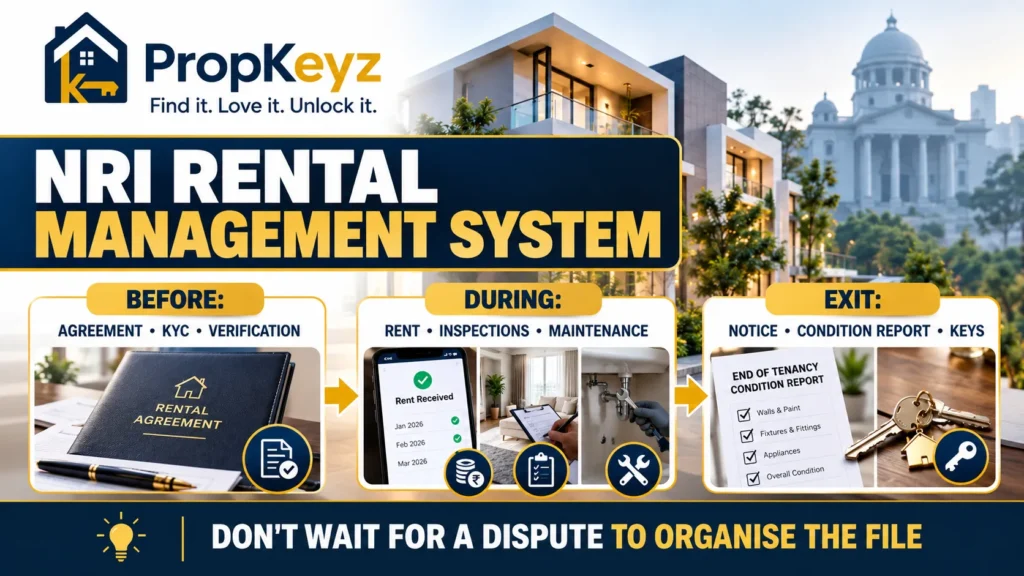
What Should Be in the Move-In File?
For every tenant:
Identity
- tenant KYC
- permanent contact
- local contact.
Verification
- police-verification acknowledgement where applicable.
Agreement
- signed copy
- relevant registration/stamping record.
Money
- deposit receipt
- first rent
- rent ledger.
Property Condition
- photos
- walkthrough
- existing damage.
Inventory
- AC
- geyser
- fridge
- washing machine
- furniture
- keys
- parking card.
Owner Communication
- emergency contact
- maintenance process.
Why Move-Out Documentation Matters
When a tenant finally vacates:
compare:
move-in condition
with:
move-out condition.
Record:
- keys
- meters
- utilities
- inventory
- damage
- society dues
- final settlement.
PropKeyz Rule
The best move-out evidence is created on move-in day.
NRI Property Management Becomes More Important After This Ruling
The judgment does not mean every NRI owner needs a lawyer every month.
It means:
the owner should not depend on an assumed emergency eviction shortcut.
A good property-management system should reduce the chance that issues remain unmanaged for months.
For owners abroad:
PropKeyz NRI Property Management
PropKeyz currently supports NRI owners through services such as:
- tenant coordination
- rent tracking
- inspections
- maintenance coordination
- photo/video updates.
Physical Inspection Is Still Critical
A legal agreement cannot tell you:
- unauthorised occupant
- property damage
- commercial misuse
- seepage
- additional occupants
- poor maintenance.
Periodic inspection helps create:
on-ground evidence.
Property Management Services in Tricity
Keep the NRI Property Record Updated
A tenancy dispute can become harder if the owner cannot quickly produce:
- title
- mutation
- deed
- POA
- agreement.
For documentary monitoring:
Internal link:
NRI Property Record Monitoring Tricity 2026
That article should be linked once published/live.
The Full Owner File
Ownership
- Tenancy
- Occupancy
- Rent
- Inspection
- Maintenance
What Should an NRI Owner Never Assume?
Assumption 1
“NRI hoon, special law automatically tenant nikal dega.”
Wrong.
Assumption 2
“11-month agreement means automatic physical possession on day 366.”
Not necessarily.
Assumption 3
“Police verification means tenant cannot create a dispute.”
Wrong.
Assumption 4
“Agreement registered hai, so eviction guaranteed.”
Wrong.
Assumption 5
“Tenant verbally said he will vacate.”
Written evidence is far stronger.
Assumption 6
“Broker tenant laga gaya; ab property safe hai.”
Tenant placement is the beginning of management.
What Should NRI Owners Ask a Lawyer Before a New Tenancy?
A useful pre-rental legal consultation can ask:
- Which rent law applies to my property?
- Is the property exempt from the Punjab Rent Act?
- What eviction grounds would apply to this tenancy?
- What should the rent agreement contain?
- Should it be registered?
- Who can sign through POA?
- How should notice be served?
- What happens at expiry?
- What documentary evidence should I retain?
That One Conversation Can Be More Valuable Than
waiting until:
tenant refuses to leave.

High Court Ruling: Confirmed vs Common Misunderstanding
| Statement | Correct Position |
|---|---|
| Punjab HC ruled on NRI eviction in Sep 2026 | Yes |
| Case was Manpreet Kaur v Jai Singh | Yes |
| Tenancy started in 2020 | Yes |
| Landlord filed under Section 13-B | Yes |
| 1949 Act had already been repealed | Yes |
| Section 13-B eviction was set aside | Yes |
| Section 24(3) also unavailable for that 2020 tenancy | Yes |
| Court ruled NRIs can never evict tenants | No |
| Court ruled landlord had no other remedy | No |
| Court decided landlord’s bona fide need was fake | No |
| Pre-2013 tenancy and 2020 tenancy treated identically | No |
| NRI status alone guarantees special eviction | No |
| Written agreement is important after 2013 | Yes |
| Section 20 may contain other grounds where applicable | Yes |
| Property-specific legal advice can be necessary | Yes |
NRI Landlord Eviction Punjab 2026: PropKeyz Analysis
The NRI Landlord Eviction Punjab 2026 judgment is important because it removes a dangerous assumption from the rental market:
“NRI landlords always have the old fast-track eviction right.”
That is too simplistic.
1. Tenancy Date Is Now a First-Line Question
Before discussing NRI status, ask:
When was the tenancy created?
2. The Old 1949 Provision Cannot Be Used as a Time Machine
A tenancy created years after repeal cannot generate a fresh right under repealed Section 13-B.
3. Section 24(3) Is Not a Universal NRI Remedy
Its language has a specific:
on or before commencement
requirement.
4. New NRI Tenancies Need Better Contract Management
Owners should plan around:
- written agreement
- occupancy evidence
- rent records
- notices
- inspections.
5. General Landlord Remedies Still Matter
Where the Punjab Rent Act applies, Section 20 includes several general recovery grounds.
6. Personal Need Still Matters
But a genuine need must be pursued using:
the legally available route.
7. POA Can Be Useful
But it needs proper scope and documentation.
8. NRI Property Management Is Now More Than Convenience
It reduces:
- missing rent evidence
- undocumented occupancy
- delayed renewal
- unknown property condition.
9. Professional Tenant Onboarding Is Risk Management
A cheap or informal tenancy can become expensive later.
10. Owners Should Not Overreact
This judgment is not a reason to stop renting NRI-owned properties.
It is a reason to:
rent professionally.
Biggest Risk
Creating a casual tenancy today because you assume NRI status will automatically solve possession tomorrow.
Biggest Opportunity
Build a complete, written, monitored tenancy from day one.
PropKeyz View
The September 2026 ruling does not weaken every NRI landlord. It weakens one dangerous assumption: that historic NRI fast-track eviction provisions automatically cover every modern tenancy. For owners creating a new tenancy today, the best protection is the correct legal structure plus disciplined property management.
Final Verdict
The September 7, 2026 Punjab & Haryana High Court judgment should be read carefully.
It does not say:
NRI landlords have no eviction rights.
It says that an NRI landlord with a tenancy created in 2020 could not use:
repealed Section 13-B
and could not use:
Section 24(3)’s special NRI remedy
because the tenancy did not satisfy its pre-commencement requirement.
For an NRI Owner With an Old Tenancy
Section 24(3) may still be relevant if:
- tenancy date
- ownership
- NRI status
- return requirement
- bona fide use
and other statutory requirements are satisfied.
For an NRI Owner Renting in 2026
Do not rely on Section 24(3) as your default future eviction plan.
Instead:
- identify applicable law,
- use a proper written tenancy,
- document occupants,
- complete verification,
- track rent,
- inspect the property,
- manage expiry,
- use the correct legal remedy if a dispute arises.
Final PropKeyz Rule
NRI status is not an eviction strategy. The real strategy is correct law + clear agreement + strong records + ongoing property management.
Frequently Asked Questions
What is the latest NRI landlord eviction ruling in Punjab in 2026?
On September 7, 2026, the Punjab & Haryana High Court in Manpreet Kaur v. Jai Singh set aside an eviction obtained under Section 13-B of the repealed 1949 Act where the tenancy had begun in 2020.
Does the ruling apply to Mohali?
The Punjab Rent Act extends across Punjab’s urban areas subject to statutory exemptions and property-specific facts. Mohali landlords should have the exact property’s legal position reviewed rather than assume every property is governed identically.
Does it apply to Zirakpur and Kharar?
The same Punjab statutory framework can be relevant to urban Punjab properties in Zirakpur and Kharar, but exemptions and property-specific facts must still be checked.
Can an NRI landlord still evict a tenant in Punjab?
Potentially yes. The September ruling did not abolish NRI landlord eviction rights. It rejected the specific legal route used in that case and expressly left other remedies open.
What is Section 24(3) of the Punjab Rent Act?
It is a special provision concerning qualifying NRI owners seeking recovery of qualifying premises for their use or dependent family use, but its wording limits the remedy to premises let out on or prior to commencement of the Act.
When did the Punjab Rent Act come into force?
30 November 2013.
Can Section 24(3) be used for a tenancy created in 2026?
The September 2026 High Court judgment indicates that a post-commencement tenancy falls outside Section 24(3)’s special NRI temporal requirement.
Does old Section 13-B still apply to a new Punjab tenancy?
The September judgment held that the repealed Section 13-B could not create a fresh right for a tenancy created after repeal.
Can an NRI landlord use other eviction grounds?
Depending on the property and applicable law, yes. Section 20 of the Punjab Rent Act contains general grounds for recovery of possession where that Act applies.
Can an NRI evict for personal use?
Potentially, subject to the correct statutory route and its conditions. Section 20(2)(q) includes a bona fide occupation ground where applicable.
Does an NRI need to physically return to India before filing?
Not necessarily in every Section 24(3) case. High Court precedent has accepted filing without prior physical return where the statutory case for permanent return is properly pleaded.
Can an NRI file through Power of Attorney?
A properly constituted POA can be used in relevant circumstances, as recognised in prior High Court cases, but the actual document and authority should be reviewed.
Must a new Punjab rent agreement be in writing?
Section 4(1) states that post-commencement letting should be through a written agreement.
Is an unregistered Punjab rent agreement automatically void?
Not necessarily. In Geeta Vasudev v. Veena Jindal, the High Court held that non-registration by itself did not render the written agreement void in that context.
Should an NRI owner stop renting property after this judgment?
The judgment itself does not justify that conclusion. It supports better legal structuring and professional tenant management before the tenancy starts.
Continue Your PropKeyz Research
NRI Property Management
For NRI owners who need local tenant, rent, inspection and maintenance coordination:
NRI Property Management by PropKeyz
Property Management Services in Tricity
For the wider property-management framework across Mohali, Zirakpur, Chandigarh and Panchkula:
Property Management Services in Tricity 2026
Property Management Company in Mohali
For Mohali-specific owner support:
Property Management Company in Mohali 2026
Mohali NRI Property Protection
For illegal occupation, property records, remote monitoring and NRI-owner protection:
Mohali NRI Property Protection 2026
Tenant Verification in Mohali
For the current tenant-verification process:
Tenant Verification in Mohali 2026
Tenant Placement & Verification
For structured tenant onboarding:
Tenant Placement & Verification by PropKeyz
NRI Property Record Monitoring Tricity 2026
Link once live.
Suggested anchor:
NRI Property Record Monitoring Tricity 2026
NRI Landlord Checklist Tricity 2026
Link once live.
Suggested anchor:
NRI Landlord Checklist Tricity 2026
NRI Owner in Mohali, Zirakpur or Kharar?
If you are about to rent your property—or already have a tenant—send PropKeyz:
Owner Country / City:
Property Location:
Property Type:
Rented / Vacant:
Current Tenant Since:
Rent Agreement Date:
Agreement Expiry:
Monthly Rent:
Police Verification Done?:
Last Property Inspection:
Any Rent Delay?:
Tenant Has Agreed Move-Out Date?:
Need Tenant Placement / Ongoing Management?:
PropKeyz can help organise your rental-management workflow around:
- tenant onboarding
- KYC / verification coordination
- agreement support
- move-in documentation
- rent tracking
- inspection reports
- maintenance coordination
- move-out documentation
- owner updates.
For legal eviction strategy or court proceedings:
consult an appropriate landlord-tenant lawyer.
Call / WhatsApp
+91 80534 69929
Suggested WhatsApp Message
Hi PropKeyz, I am an NRI/outstation owner living in ________. I own a ________ property in ________. It is currently rented/vacant. I read your NRI Landlord Eviction Punjab 2026 guide and want to structure the tenancy properly with tenant documentation, verification, rent tracking and property inspections. Please guide me on the suitable property-management support.
Find it. Love it. Unlock it.
Your Property. Our Responsibility.
EXTERNAL SOURCES & OUTBOUND LINKS
Manpreet Kaur v. Jai Singh — Punjab & Haryana High Court, 7 September 2026
Primary judgment used for:
- tenancy date
- repeal of Section 13-B
- Section 24(3) interpretation
- Section 3 construction-date discussion
- other-remedies clarification.
Read Manpreet Kaur v. Jai Singh judgment
Punjab Rent Act, 1995 — India Code
Used for:
- commencement date
- extent
- Section 24
- repeal/savings.
Punjab Rent Act, 1995 — India Code PDF
Section 24 — Punjab Rent Act
Used for the current NRI special-recovery wording.
Section 24 of the Punjab Rent Act
Section 20 — General Eviction Grounds
Used for:
- rent default
- misuse
- damage
- agreed move-out
- bona fide occupation.
Section 20 of the Punjab Rent Act
Section 4 — Written Rent Agreements
Used for the written-tenancy requirement.
Section 4 of the Punjab Rent Act
Ravinder Pal v. Harminder Singh — 2026 High Court
Used to explain:
- older tenancy context
- NRI definition
- prior physical return
- POA
- bona fide requirement.
Read Ravinder Pal v. Harminder Singh
Geeta Vasudev v. Veena Jindal
Used for the rent-agreement registration nuance.
Read Geeta Vasudev v. Veena Jindal
DISCLAIMER
This article is for:
- landlord education
- NRI property-management awareness
- tenancy documentation awareness.
It is not:
- legal advice
- eviction advice for a specific case
- court representation
- title certification
- guarantee of possession.
Rent law can depend on:
- tenancy date
- construction date
- property classification
- statutory exemptions
- ownership history
- agreement
- exact facts.
The September 2026 High Court ruling concerns the maintainability of a specific eviction petition.
It should not be interpreted as:
a blanket ban on NRI landlord evictions.
Before filing an eviction case, terminating a tenancy or taking possession:
obtain advice from an appropriate legal professional.
PropKeyz provides:
- property management
- tenant coordination
- inspection
- documentation coordination
- owner reporting
within agreed service scope.
PropKeyz does not:
- forcibly evict tenants
- issue court orders
- guarantee possession
- replace a lawyer
- guarantee future tenant behaviour.
About PropKeyz
PropKeyz Editorial Team
PropKeyz is a Tricity-first property-management and real-estate brand supporting NRI, outstation and local property owners.
Current support areas include selected locations across:
- Mohali
- Zirakpur
- Chandigarh
- Panchkula
- Kharar
- nearby Tricity markets.
Our property-management services can include:
- tenant placement
- verification coordination
- rent tracking
- property inspections
- maintenance coordination
- move-in / move-out documentation
- NRI owner reporting.
Our owner-education framework follows these rules:
NRI Status ≠ Automatic Eviction
Old Tenancy ≠ New Tenancy
Section 13-B ≠ Section 24(3)
Wrong Legal Route ≠ No Landlord Rights
Rent Agreement ≠ Guaranteed Possession
Police Verification ≠ Eviction Right
Property Management ≠ Legal Representation
Find it. Love it. Unlock it.
Your Property. Our Responsibility.