
The Punjab Non-Conforming Zone Exemption 2026 has brought an important land-use and industrial-property development for business owners, factory landlords and commercial-property buyers across Punjab.
The Punjab Government has extended conditional relief for qualifying existing industries operating in non-conforming zones until:
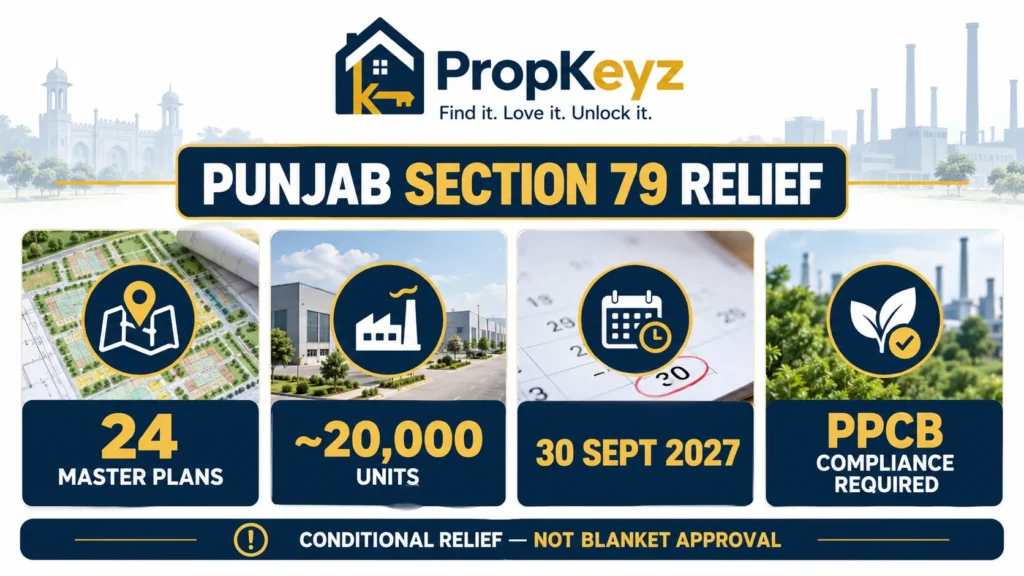
30 September 2027
According to reports published on 9–10 October 2026, the decision may benefit nearly:
20,000 industrial units across 24 master-plan areas.
The change is particularly relevant to Mohali district because six covered master-plan areas are located in and around the region:
- Mohali / SAS Nagar;
- Mullanpur;
- Dera Bassi;
- Zirakpur;
- Kharar;
- Banur.
The exemption concerns the application of Section 79 of the Punjab Regional and Town Planning and Development Act, 1995, which governs conformity of land use and development with an operative master plan.
The Punjab Government reportedly exercised its powers under Section 178 to extend the relief.
However, the exemption is conditional.
It requires compliance with the norms of the Punjab Pollution Control Board (PPCB) and obtaining the applicable PPCB No Objection Certificate.
For industrial-property owners, the news raises several important questions.
“Residential zone mein factory hai — kya ab legal ho gayi?”
“Kharar ya Zirakpur mein industrial property khareed sakte hain?”
“Kya factory owner ko CLU ki zarurat nahi rahegi?”
“PPCB NOC ke bina exemption milegi?”
“September 2027 ke baad kya hoga?”
These questions cannot be answered correctly by interpreting the announcement as blanket legalization.
The notification concerns a specific statutory provision, a defined class of existing industries, listed master-plan areas and environmental conditions.
It does not automatically convert every existing factory location into a permanently approved industrial zone.
That distinction matters for:
- industrial premises;
- workshops;
- manufacturing units;
- warehouses;
- commercial landlords;
- factory tenants;
- business-property investors;
- owners planning future resale or redevelopment.
This PropKeyz guide examines the October 2026 development, the underlying law, the six Mohali-area master plans, environmental requirements and practical implications for property transactions.
PropKeyz Property Rule
A conditional exemption may allow a qualifying existing industrial activity to continue under specified circumstances. It does not automatically change the legal land-use classification of the entire property.
Key Takeaways
- Punjab issued the reported exemption notification on 8 October 2026.
- The notification concerns qualifying existing industries in non-conforming zones.
- Relief has been extended until 30 September 2027.
- The exemption concerns Section 79 of the Punjab Regional and Town Planning and Development Act, 1995.
- The Government reportedly used Section 178 exemption powers.
- Approximately 20,000 industrial units statewide may benefit.
- Around 10,000 of the reported units are in Ludhiana.
- The relief covers 24 specified master-plan areas.
- Six covered master plans fall in Mohali district: Mohali, Mullanpur, Dera Bassi, Zirakpur, Kharar and Banur.
- Existing industries must comply with PPCB norms and obtain the applicable PPCB NOC.
- The announcement does not waive other environmental obligations.
- It is not general permission for new factories in residential zones.
- It does not automatically amend master-plan zoning.
- It does not automatically grant CLU or building-plan approval.
- Existing factory leases and property titles still require independent review.
- Industrial land prices and rents are not guaranteed to increase.
- The exemption’s precise applicability depends on the original notification and property-specific facts.
- The previous Ludhiana exemption reportedly ran from 11 September 2023 to 10 September 2026.
- The exact future policy after 30 September 2027 is not established.
- Property buyers should verify the actual land-use classification before making payments.
PropKeyz View
This is a business-continuity relief measure with property implications—not a government announcement converting thousands of buildings into permanently approved industrial real estate.
Punjab Non-Conforming Zone Exemption 2026: Quick Answer
What changed in Punjab’s industrial land-use rules in October 2026?
The Punjab Government has reportedly extended conditional relief from Section 79 of the 1995 planning legislation for specified existing industrial units in non-conforming zones until 30 September 2027.
The decision applies across 24 listed master-plan areas.
Latest Verified Position
| Factor | Current Position |
|---|---|
| State | Punjab |
| Notification Date | 8 Oct 2026 |
| Department | Housing and Urban Development |
| Reference | H-U-11022/19/2026-4H1/I/1523943/2026 |
| Main Legal Provision | Section 79 |
| Exemption Power | Section 178 |
| Beneficiary Class | Qualifying existing industries |
| Covered Master Plans | 24 |
| Estimated Units | Nearly 20,000 |
| Estimated Ludhiana Units | Around 10,000 |
| Mohali District Master Plans | 6 |
| Relief End Date | 30 Sep 2027 |
| Pollution-Control Compliance | Required |
| Applicable PPCB NOC | Required |
| Permanent Zoning Change | Not established |
| New Industrial Development Approved? | Not generally |
| Blanket CLU Exemption? | Not established |
| Guaranteed Property Appreciation? | No |
Direct Answer
The October 2026 notification provides conditional, time-limited relief for qualifying existing industries from the specified master-plan conformity provision. It does not grant permanent industrial status to every non-conforming property.
Important for Property Buyers
Before buying a factory or warehouse premises, establish whether the property itself has valid rights and approvals.
Do not rely solely on a seller’s statement that:
“Government ne industry ko exemption de di hai.”
For the relationship between land use and property approvals, read:
CLU in Mohali 2026: GMADA Process, Charges and Buyer Guide
What Happened on 8 October 2026?
The Punjab Housing and Urban Development Department issued a notification extending relief for certain existing industrial units operating in non-conforming areas.
The announcement followed concerns among small manufacturers about the expiry of earlier arrangements.
Contemporary reporting states that the latest order covers 24 master-plan areas.
What Was the Immediate Concern?
Many small industrial units have operated in locations that do not conform to the land-use designation of the applicable master plan.
For example, an established workshop may operate in an area designated for another land use.
After the relevant master plan becomes operative, Section 79 imposes a conformity requirement.
Where transitional or exemption arrangements expire, the owners of affected units may face uncertainty about continued operation.
What Does the October Decision Do?
It provides a further reported period of conditional relief for the covered existing industries.
How Long?
Until:
30 September 2027
What Must the Industry Still Do?
The reporting expressly identifies compliance with PPCB norms and the applicable PPCB NOC.
What Does It Not Do?
The announcement does not establish a general right for every person to start a new industrial operation in an incompatible land-use zone.
News Sources
Hindustan Times — Punjab Extends Exemption for Units in Non-Conforming Zones
Times of India — Punjab Extends Relief Until September 2027
What Is a Non-Conforming Zone in Punjab?
A non-conforming land use generally exists when the activity taking place on a property does not match the use designated under the applicable planning framework.
Example 1 — Workshop in Residential Zone
A small engineering workshop operates in an area designated for residential use.
The operation may be considered non-conforming, depending on the master-plan provisions and applicable permissions.
Example 2 — Industrial Unit in Another Designated Zone
An existing manufacturing facility is located in an area that the master plan designates for another use.
Its legality and continued operation may require examination of:
- historical use;
- existing permissions;
- relevant planning provisions;
- current exemptions;
- environmental approvals.
Example 3 — Approved Industrial Area
A properly approved industrial site operating in conformity with the master plan does not need to rely on this particular non-conformity relief for the same reason.
However, it must still comply with its other applicable laws and permissions.
Important Distinction
Non-conforming does not automatically mean:
- property ownership is fake;
- every existing document is invalid;
- the building must immediately be demolished;
- every industrial operation is unlawfully continuing.
The exact position depends on the facts and governing law.
PropKeyz Rule
The first question is the property’s land use. The second is the activity operating there. The third is whether the law permits that activity to continue.
What Does Section 79 of Punjab’s Planning Act Say?
Section 79 forms part of the Punjab Regional and Town Planning and Development Act, 1995.
It addresses land use and development after a master plan becomes operative.
The General Principle
Land should be used and developed in conformity with the applicable operative master plan.
Why Does This Matter?
A master plan may divide an area into different categories, such as:
- residential;
- commercial;
- industrial;
- institutional;
- recreational;
- agricultural;
- other permitted uses.
Once the plan has legal effect, the provisions governing land use and development become relevant.
What About Existing Uses?
Section 79 also contains a proviso concerning continued use of land for purposes existing when the master plan came into operation, subject to specified statutory limits and regulatory conditions.
This should not be interpreted as unconditional permission.
Is the October Exemption the Same as That Proviso?
Not exactly.
The October 2026 decision is reported as an exemption made under Section 178, affecting the application of Section 79 to a defined class of existing industries.
Important
Do not assume that Section 79 relief changes every other provision of the planning legislation.
Section 80, for example, addresses development or change of land use and related permissions.
The complete statutory framework must be considered.
Primary Legal Source
Punjab Regional and Town Planning and Development Act, 1995 — Government-Hosted Text
For a section-specific reference:
Why Is Section 178 Important?
Section 178 concerns exemptions under the 1995 Act.
The relevant power allows the State Government, subject to the law and imposed conditions, to exempt specified classes or areas from particular statutory provisions.
Why Would an Exemption Be Needed?
Planning rules can create difficulties when existing activities do not match a newly operative planning framework.
A conditional exemption can provide a legally defined arrangement for affected cases.
What Makes This Relief Different From General Zoning?
A zoning amendment changes the planning framework through the appropriate legal process.
An exemption permits specified departures from a provision for qualifying cases, subject to its terms.
Example
Suppose a workshop has operated for years in an area now classified as residential.
A valid exemption may address the applicable Section 79 issue for that qualifying existing workshop during the notified period.
It does not follow that:
- every nearby vacant plot becomes industrial;
- the workshop can double its floor area;
- its pollution obligations disappear;
- a new owner can necessarily start a completely different factory.
PropKeyz Rule
An Exemption Operates Within Its Conditions. It Is Not a Rewrite of the Master Plan.
Legal Reference
Who Could Benefit From the October 2026 Exemption?
The reporting identifies:
Existing industries operating in non-conforming zones of the specified master plans.
The announcement is particularly relevant to micro and small manufacturers.
Types of Industries Mentioned in Reporting
Examples include:
- bicycle-component manufacturers;
- automobile-component manufacturers;
- hosiery and garment units;
- fastener manufacturers;
- hardware workshops;
- sewing-machine component makers;
- engineering workshops;
- fabrication units;
- certain metal-treatment and electroplating operations.
Does Industry Type Alone Establish Eligibility?
No.
A unit’s eligibility can depend on several factors, including:
- whether it qualifies as an existing industry;
- its exact location;
- the relevant master plan;
- applicable notification conditions;
- PPCB status;
- the nature of its operations.
What About High-Pollution Industries?
Environmental compliance remains essential.
Certain industrial processes require particularly careful examination under pollution-control laws.
What About a Business Without a PPCB NOC?
The reported exemption is expressly conditional on obtaining the applicable PPCB NOC.
Such a business should not assume that relief automatically protects it regardless of its compliance status.
What About a New Factory?
The October reporting does not establish general eligibility for newly proposed industrial units.
PropKeyz Rule
An Industry May Be in a Covered City but Still Fail the Property-Specific or Compliance Conditions.
Why Are Nearly 20,000 Industrial Units Mentioned?
The estimated beneficiary population is significant.
Contemporary reports describe:
Nearly 20,000 existing industrial units across Punjab.
About half are reported to operate in Ludhiana.
Why Are So Many Units Potentially Affected?
Punjab has a long-established network of small manufacturing businesses.
Some operate within designated industrial estates.
Others developed over time in:
- mixed-use areas;
- older urban neighbourhoods;
- small workshops;
- historically industrial streets;
- areas subsequently governed by newer planning classifications.
Does the 20,000 Figure Mean All Units Have Been Approved?
No.
It is a reported estimate of potentially affected businesses.
Does It Mean 20,000 Separate Properties?
Not necessarily.
More than one business can operate from a property, and a business can use multiple premises.
Does It Mean 20,000 Factories Are Located in Mohali?
No.
The figure is statewide.
The reports do not establish a separate verified count for each of the six Mohali district master plans.
PropKeyz Rule
Estimated Beneficiary Units Are Not the Same as Approved Properties or a Property-Transaction Database.
Which 24 Punjab Master Plans Are Covered?
The Times of India report identifies the following 24 master-plan areas:
| # | Master-Plan Area |
|---|---|
| 1 | Ludhiana |
| 2 | Mohali / SAS Nagar |
| 3 | Mullanpur |
| 4 | Dera Bassi |
| 5 | Zirakpur |
| 6 | Abohar |
| 7 | Bathinda |
| 8 | Kharar |
| 9 | Banur |
| 10 | Jalandhar |
| 11 | Patiala |
| 12 | Gobindgarh |
| 13 | Amritsar |
| 14 | Khanna |
| 15 | Goindwal |
| 16 | Hargobindpur |
| 17 | Baghapurana |
| 18 | Tarn Taran |
| 19 | Kotkapura |
| 20 | Sangrur |
| 21 | Sultanpur Lodhi |
| 22 | Rama Mandi |
| 23 | Hoshiarpur |
| 24 | Fatehgarh Sahib |
Why This List Matters
The relief is tied to specified planning areas.
It is not described as an exemption from Section 79 for every industrial property across the entire state, irrespective of location.
Does Listing a Town Cover Every Industrial Unit There?
No.
The relevant property must fall within the notified geographical and legal scope and meet applicable conditions.
How Should an Owner Verify Coverage?
Check the exact property against the official master-plan boundary and the authenticated October notification.
Official Planning Resource
Six Mohali District Master Plans: Why This Matters for PropKeyz
The six reported master-plan areas in Mohali district are particularly relevant to regional property research.

| Area | Main Property-Research Question |
|---|---|
| Mohali / SAS Nagar | Does an existing industrial activity qualify under the notified conditions? |
| Kharar | Is a workshop’s location and current use compliant or covered by conditional relief? |
| Zirakpur | Is the premises’ industrial use lawful under the exact planning and pollution-control framework? |
| Dera Bassi | What are the applicable factory, warehouse and land-use permissions? |
| Banur | Is the property inside the relevant master-plan area and eligible existing-use category? |
| Mullanpur | Does the property’s actual historical use meet the exemption’s conditions? |
Important Local Distinction
These are master-plan areas, not a list of individual exempt plots.
What About Gharuan?
PropKeyz has separately researched the Gharuan regional-planning amendment.
That proposal remains distinct from this October exemption.
A property described as:
“Gharuan side, near Kharar”
should not automatically be treated as covered by the Kharar Master Plan exemption.
The exact geographical and legal planning status must be checked.
Read:
Gharuan Master Plan 2026: 3,000-Acre Draft and Buyer Guide
Mohali / SAS Nagar: Industrial Property Impact
Mohali contains both established industrial areas and mixed residential-commercial development.
Which Properties Could Be Relevant?
Potential examples include older industrial premises or workshops that may be situated in non-conforming areas.
But eligibility cannot be assumed from the word “Mohali” alone.
What Should an Existing Owner Check?
- exact property address;
- applicable master-plan boundary;
- current land-use designation;
- historical industrial activity;
- existing permissions;
- PPCB NOC;
- applicable consent and safety documentation.
What About Properly Approved Industrial Sectors?
Industries located in approved industrial zones should be evaluated under their own zoning and operational approvals.
They should not be portrayed as requiring this relief merely because they are in Mohali.
What About Future Industrial Parks?
GMADA’s Sector 101 and Sector 103 industrial-development projects are separate acquisition and planned-development initiatives.
The new exemption concerns certain existing non-conforming activities.
It does not establish that future industrial parks have become operational.
PropKeyz View
Existing Industrial-Use Relief and New Industrial Land Development Are Two Different Property Stories.
Kharar Industrial Property: Who Should Pay Attention?
Kharar’s property market combines:
- traditional settlements;
- residential colonies;
- commercial premises;
- warehouses;
- workshops;
- privately developed property;
- agricultural/revenue land.
Why the Exemption Could Matter
An existing industrial unit operating in a non-conforming area may need to examine whether it falls under the new notification.
Example
A fabrication workshop has operated for years in a building that is now within a non-industrial master-plan land-use category.
The operator should verify:
- Whether the premises are inside the Kharar Master Plan area.
- Whether the industrial use is an eligible existing activity.
- Whether the business has the necessary PPCB documentation.
- Whether the notification’s other conditions are satisfied.
Does It Mean a New Factory Can Be Opened Anywhere in Kharar?
No.
Does It Make Every Existing Workshop Building Legally Approved?
No.
What About Registry?
Property-transfer eligibility and lawful building use are separate questions.
For broader Kharar property due diligence, read:
Kharar Property NOC 2026: Colony Status, Charges and Buyer Risks
PropKeyz Rule
A Kharar Factory Address Does Not Establish Its Master-Plan Classification.
Zirakpur Industrial Property: What Changes?
Zirakpur has a highly mixed property market involving residential development, commercial premises and other existing activities.
Potential Relevance
Qualifying existing industrial operations in a non-conforming part of the Zirakpur planning area may benefit from the reported conditional exemption.
What Remains Important?
- exact planning boundary;
- permitted land use;
- historic industrial operation;
- PPCB compliance;
- building safety;
- any applicable development permissions.
What About a Warehouse?
A warehouse should not automatically be treated as an exempt manufacturing unit.
Its actual activity, legal classification and approvals matter.
What About a Shop?
A commercial shop does not automatically qualify merely because commercial activity is also a form of business.
The announcement specifically concerns qualifying existing industries.
What About Converting a Residential Building to a Workshop?
The notification does not establish general permission for a new industrial conversion.
Property Buyer Rule
Do Not Buy a Zirakpur Property Based Only on a Claim That “Industrial Use Is Now Allowed.”
Dera Bassi: Factory and Warehouse Property Impact
Dera Bassi has a substantial industrial and logistics property market.
The area’s relevance is especially important because factory and warehouse properties often involve multiple compliance layers.
Relevant Buyer Questions
- Is the property in a designated industrial zone?
- Is it operating under a qualifying non-conforming exemption?
- What industry is permitted?
- What PPCB documents exist?
- Are building and fire approvals applicable?
- Is the seller transferring land, building, business or lease rights?
Example
A manufacturing unit seeks to lease an older factory premises.
The landlord claims that the government has extended relief until 2027.
The tenant should still verify:
- whether the premises qualify;
- whether the proposed manufacturing activity is permitted;
- whether the required environmental permissions are in place;
- whether the proposed operations involve additional legal requirements.
Why This Matters
A leased industrial premises can involve separate risks for:
- owner;
- occupier;
- business operator.
PropKeyz Rule
A Valid Property Lease Is Not Automatically a Valid Industrial Operating Permission.
Banur: What Should Industrial Land Buyers Verify?
Banur is part of the wider Mohali development region.
The reported exemption includes the Banur Master Plan.
What Does That Establish?
Banur is among the specified planning areas covered by the reported notification.
What Does It Not Establish?
- every Banur plot is industrial;
- every manufacturing unit qualifies;
- agricultural land is automatically converted;
- every warehouse is approved;
- all future factories can be established without CLU.
Buyer Checklist
Verify:
- Exact village.
- Khasra number.
- Revenue records.
- Master-plan designation.
- Existing industrial-use history.
- Relevant permission or exemption.
- PPCB documents.
- Road access.
- Utility availability.
- Current transaction terms.
PropKeyz Rule
Banur Master Plan Coverage Is a Starting Point for Verification—not a Property-Level Approval.
Mullanpur: Does the Exemption Apply to New Chandigarh Property?
Mullanpur is among the listed master-plan areas.
However, that does not mean all New Chandigarh plotted townships or residential projects have become eligible for industrial activity.
What Is the Relevant Scope?
Existing qualifying industrial units in non-conforming zones, subject to the notification.
What Should Be Checked?
- exact planning area;
- property location;
- current approved land use;
- history of industrial activity;
- relevant environmental permissions.
What About Eco City Residential Plots?
The exemption does not establish that an Eco City residential plot can be converted into a factory.
What About Future Commercial Centres?
The exemption should not be treated as an approval for unrelated future commercial projects.
Important
Mullanpur, New Chandigarh and the broader GMADA region overlap in everyday property marketing language.
They are not interchangeable legal descriptions.
PropKeyz Rule
A Covered Master Plan Does Not Remove the Land-Use Restrictions of Every Individual Project Within It.
Earlier Ludhiana Exemption: Why the 2026 Extension Was Needed
The current announcement follows an earlier exemption for certain existing industrial units in the Ludhiana planning area.
Previous Relief Period
11 September 2023 to 10 September 2026
The earlier arrangement was also conditional on pollution-control compliance and the necessary NOC.
What Happened After Expiry?
According to reporting, small manufacturers in Ludhiana expressed concern about the expiry of the earlier exemption.
Industrialists staged a protest on 8 October 2026, seeking additional relief.
Why Were Businesses Concerned?
The issue involved uncertainty about continuing industrial activity in areas that do not conform to the master-plan land-use designation.
What Did the Government Do?
The State announced a broader exemption covering 24 specified master plans until 30 September 2027.
Important Legal Question
The earlier Ludhiana relief expired on 10 September.
The later notification is dated 8 October.
That timing raises a question about the treatment of any intervening period.
However, the reviewed reporting does not establish the complete retrospective or transitional legal effect of the new notification.
What Should Affected Units Do?
Check the authenticated notification and seek legal advice regarding any relevant action, notice or enforcement matter arising during the intervening period.
PropKeyz Rule
Do Not Assume a Later Extension Automatically Resolves Every Earlier Compliance or Enforcement Issue.
PPCB NOC: The Most Important Condition
The exemption is expressly linked to pollution-control compliance.
PPCB means:
Punjab Pollution Control Board
What Does the Reporting Require?
Compliance with applicable PPCB norms and obtaining the relevant PPCB No Objection Certificate.
Why Does Pollution Control Still Matter?
Industrial operations can produce:
- emissions;
- wastewater;
- chemical waste;
- hazardous waste;
- noise;
- other environmental effects.
The applicable standards depend on the industrial activity.
Does a Planning Exemption Waive Pollution-Control Requirements?
No.
What About Different Industrial Categories?
PPCB administers consent and authorization processes linked to industrial activity and applicable pollution laws.
Businesses may encounter categories and processes such as:
- Consent to Establish;
- Consent to Operate;
- hazardous-waste authorization;
- other activity-specific approvals.
The exact requirements depend on the operation.
Important
The wording “PPCB NOC” in reporting should not be interpreted as automatically replacing every consent or authorization required under another law.
Official Environmental Compliance Resource
Punjab Pollution Control Board — Online Consent Management and Monitoring System
The portal directs applicants for relevant industrial approvals to the Punjab Business First system.
PropKeyz Rule
Relief From a Planning Provision Is Not Relief From Environmental Responsibility.
Does Having a PPCB NOC Automatically Legalize the Property?
No.
The legal status of the property and the regulatory status of the industrial activity must be examined separately.
Property-Level Questions
- Who owns the land?
- What is its current permitted use?
- Is the building legally constructed?
- Are there encumbrances?
- Does the property fall within the notified planning area?
Industrial-Operation Questions
- What manufacturing activity is carried out?
- What pollution category applies?
- Are the required consents valid?
- Are there activity-specific authorizations?
- Is the operation eligible under the exemption?
Example
A factory has a valid environmental consent for its processes.
That does not independently prove that the building’s planning and construction approvals are complete.
The reverse is also true.
An approved industrial building does not automatically authorize every polluting activity.
PropKeyz Rule
Environmental Permission and Land-Use Permission Are Different Compliance Layers.
Existing Industrial Unit vs New Industrial Unit
This distinction is essential.
Existing Industrial Unit
A business already operating before the relevant qualifying reference point may fall within the class described by the notification, subject to its exact conditions.
New Industrial Unit
A newly proposed unit cannot automatically rely on relief explicitly described for existing industries.
What About a Change in Business Operator?
Suppose an older workshop closes and a new company proposes a different manufacturing operation at the same premises.
It should not automatically assume that the previous unit’s exemption transfers to the new activity.
What About Expansion?
An existing factory may wish to:
- add a new production line;
- increase output;
- construct another building;
- change products;
- add chemical processing.
The new activity or expansion may require separate planning and environmental approvals.
What Must Be Verified?
The precise definition of an eligible existing industry, any qualifying dates and treatment of changes in activity must be checked against the full notification.
PropKeyz Rule
Existing Use Protected Under Conditions ≠ Unlimited Future Industrial Development.
Section 79 Exemption vs CLU: What Is the Difference?
This is one of the most important property-investment questions arising from the announcement.
CLU means Change of Land Use.
Section 79 Exemption
A conditional statutory relief from the application of a specified master-plan conformity provision for qualifying cases.
CLU
A planning/development permission concerning the lawful use of land where such permission is required.
Comparison
| Factor | Section 79 Exemption | CLU |
|---|---|---|
| Basic Function | Relief from specified conformity provision | Permission concerning a land-use change |
| Current News | Existing non-conforming industries | Separate planning-approval process |
| Time Limit | Reportedly until 30 Sep 2027 | Depends on applicable approval |
| Automatic Property Conversion | No | Must be assessed under actual approval |
| PPCB Compliance | Required under reported exemption | Separately applicable as required |
| Building Plan | Not automatically approved | Not automatically approved by CLU alone |
| Property Title | Not created | Not created |
| New Industrial Project | Not generally authorized by this announcement | Separate permission requirements apply |
Can an Existing Workshop Ignore All CLU Rules?
No such blanket conclusion is established.
Can a Buyer Assume an Exempt Premises Is a Permanently Approved Industrial Plot?
No.
What About an Approved Industrial Plot?
Its actual approved land-use position must be considered separately.
Related PropKeyz Research
CLU in Mohali 2026: GMADA Approval Process and Buyer Checklist
PropKeyz Rule
A Time-Limited Exemption Is Not a Substitute for Every Land-Use Approval.
Exemption vs Building Rules, Fire Safety and Factory Approvals
The October relief concerns Section 79 of the planning legislation.
It does not establish that every other approval has been waived.
Building Rules
Depending on the property, applicable rules may govern:
- building use;
- sanctioned construction;
- structural safety;
- height;
- setbacks;
- access;
- parking;
- other building requirements.
Fire Safety
Certain buildings and industrial uses may require fire-safety permissions or compliance.
Factory-Related Approvals
Manufacturing businesses may require activity-specific registrations, licences and occupational-safety compliance.
Electrical Safety
Some operations may require relevant electrical installations and safety approvals.
Environmental Requirements
PPCB and other environmental obligations remain relevant.
Example
An existing workshop receives the benefit of a valid Section 79 exemption.
That does not automatically authorize the construction of an additional unapproved floor.
Read More
Punjab Building Rules 2026: Shop Height, Solar, Fire Safety and Property Guide
PropKeyz Rule
One Exemption Should Never Be Used to Claim Five Unrelated Approvals.
Does the Exemption Change Property Registry Rules?
The October notification does not establish a blanket amendment to property-transfer or registration rules.
What Does Registry Concern?
A sale deed or other legally applicable conveyance documents a transaction involving property rights.
What Does Section 79 Relief Concern?
Specified planning conformity requirements for qualifying industrial operations.
Therefore
A property may be capable of a lawful transaction while still requiring examination of:
- its actual land use;
- building compliance;
- industrial-operation eligibility;
- existing restrictions.
Can a Buyer Rely on the Exemption Instead of Checking Title?
No.
Can a Seller Claim That All Non-Conforming Industrial Premises Now Have Clear Registry Status?
That claim is not established by the reported notification.
Property Buyer Rule
Registry, Title, Land Use, Industrial Operation and Environmental Clearance Are Different Questions.
For a broader explanation of registry-related approvals in Kharar, read:
Can Existing Industrial Premises Be Bought or Sold?
An industrial premises may be transferable where the owner has valid transferable rights and relevant legal conditions are satisfied.
However, the current exemption should not be treated as a guarantee that a particular property can be sold for unrestricted industrial use.
What Should a Buyer Verify?
- Seller’s ownership and authority.
- Current land-use classification.
- Historical use of the property.
- Applicability of the October exemption.
- Current environmental permissions.
- Building-plan and safety position.
- Existing tenants or occupiers.
- Outstanding charges.
- Legal disputes or enforcement notices.
- Whether the buyer’s intended future use is permitted.
Example
A buyer purchases a building currently used by a small manufacturer.
The seller states:
“September 2027 tak exemption hai.”
Before purchase, the buyer must determine:
- whether this particular unit qualifies;
- whether the exemption applies to the buyer’s intended operation;
- whether transfer affects any operating permission;
- what happens after the relief period.
PropKeyz Rule
Buy the Property Rights That Exist Today. Do Not Automatically Price a Temporary Business Exemption as Permanent Industrial Zoning.
Can a Landlord Rent Factory or Warehouse Premises Under the Exemption?
Potentially, subject to the property’s legal status and the nature of the proposed activity.
However, a property owner should not assume that renting premises to a business automatically transfers every legal responsibility to the tenant.
Questions for the Landlord
- Who owns the property?
- Is the premises authorized for the intended use?
- Does the proposed activity qualify as an existing industry?
- What PPCB documents are required?
- Are building and fire requirements relevant?
- What obligations are included in the lease?
Questions for the Tenant
- Is the location covered?
- Does the tenant’s manufacturing activity qualify?
- Does the business need its own environmental consent?
- Is expansion proposed?
- Are there restrictions on hazardous activities?
- What happens if regulatory permission changes?
Lease Provisions to Consider
A professionally prepared industrial lease may address:
- permitted use;
- compliance with applicable law;
- obtaining and maintaining permissions;
- safety responsibilities;
- maintenance obligations;
- waste management;
- insurance;
- inspections;
- alterations;
- restoration of premises;
- consequences of regulatory non-compliance.
The exact wording requires legal advice.
Important
A lease agreement cannot independently authorize activity prohibited by applicable law.
PropKeyz Rule
A Landlord Can Lease Property Rights, Not Government Regulatory Permission.
What Happens if an Existing Factory Wants to Expand?
Expansion is a separate high-risk area.
The October exemption is reported as relief for existing industrial operations.
That does not necessarily authorize materially different development.
Possible Expansion Scenarios
Additional Machinery
May affect power, emissions, output or safety requirements.
New Production Line
Could change the type of activity or environmental category.
Additional Floor
May require building approval.
Larger Built-Up Area
Could affect development permissions and fire safety.
Different Industrial Process
May require a fresh or revised consent.
What Should the Owner Do?
Before expanding, obtain advice about:
- permitted industrial use;
- development permissions;
- PPCB implications;
- building requirements;
- notification applicability.
PropKeyz Rule
Permission to Continue an Existing Operation Is Not Automatically Permission to Expand It.
What Happens After 30 September 2027?
The latest reported relief ends on:
30 September 2027
Will the Government Extend It Again?
That has not been established.
Will Every Existing Factory Have to Close on 1 October 2027?
That conclusion is also unsupported.
The legal position after the notified period will depend on:
- subsequent government action;
- applicable statutory provisions;
- property-specific planning status;
- any available separate permissions;
- court or administrative proceedings;
- the actual compliance position.
What Should Existing Businesses Do Before the Deadline?
Use the period to:
- Confirm eligibility.
- Obtain the authenticated notification.
- Maintain required PPCB compliance.
- Review historical permissions.
- Examine the long-term land-use position.
- Assess relocation or regularization options if necessary.
- Plan for future regulatory changes.
What Should Property Investors Do?
Avoid treating a temporary exemption as an indefinitely renewable right.
PropKeyz Rule
Time-Limited Relief Should Be Treated as Time-Limited Relief.
Punjab Industrial Property Prices: Will Rates Increase?
The Punjab Non-Conforming Zone Exemption 2026 may influence confidence among certain business owners and property occupiers.
But the available reports do not establish a measurable price increase in any specific industrial-property market.
Potentially Positive Effects
For qualifying operations, the exemption could reduce immediate uncertainty about continued use under Section 79 during the notified period.
This may influence:
- business planning;
- decisions to maintain premises;
- landlord-tenant discussions;
- certain property-investment assessments.
Remaining Risks
- relief is conditional;
- relief is temporary;
- environmental compliance continues;
- site-specific permissions matter;
- later policy remains uncertain.
Can Factory Rent Increase?
There is no verified basis for predicting an automatic increase.
Can Industrial Land Appreciate?
Property prices remain influenced by:
- permitted use;
- title;
- access;
- building condition;
- power supply;
- water;
- drainage;
- industrial demand;
- local supply;
- financing;
- legal certainty.
Market Mechanism
Conditional Relief
↓
Potentially Greater Operational Continuity
↓
Potentially Lower Short-Term Occupancy Uncertainty
↓
Possible Change in Buyer/Tenant Interest
↓
Actual Transactions Determine Price Effect
Important
This is a possible mechanism, not a measured forecast.
PropKeyz View
Industrial-property value is stronger when legal use, location, utilities and business demand align—not merely when one temporary exemption exists.
What About Residential Neighbourhoods Near Existing Factories?
Property impact is not limited to industrial owners.
Residents living near non-conforming industrial activities may also have concerns.
Possible Issues
Depending on the activity:
- noise;
- vehicle movement;
- emissions;
- wastewater;
- waste handling;
- traffic;
- fire and safety risks.
Does the Exemption Remove Environmental Standards?
No.
The reported relief remains conditional on PPCB compliance.
What Should Residential Buyers Verify?
If purchasing a house near workshops or factories, examine:
- current neighbouring uses;
- actual operating hours;
- traffic conditions;
- environmental concerns;
- applicable planning designations;
- any legally relevant complaints or orders.
Is Every Factory Harmful to Residential Property?
No blanket conclusion should be drawn.
Different industrial processes have very different environmental and operational profiles.
PropKeyz Rule
Land-Use Compatibility and Actual Environmental Performance Matter More Than a Broad Industrial Label.
Industrial Property Buyer Checklist: What to Verify Before Paying

A. Property Identity
- Exact address.
- Village, sector or locality.
- Khasra/plot number.
- Actual property boundaries.
- Present possession.
B. Ownership
- Seller’s title.
- Ownership chain.
- Encumbrances.
- Existing lease rights.
- Outstanding dues.
C. Planning and Land Use
- Applicable master plan.
- Current land-use classification.
- Whether the premises are non-conforming.
- Existing-use history.
- Actual applicability of Section 79 relief.
- Any existing CLU or other permissions.
D. Environmental Compliance
- PPCB NOC.
- Applicable consent status.
- Industry category.
- Waste-management requirements.
- Any environmental enforcement notices.
E. Building and Safety
- Sanctioned building plan.
- Actual construction.
- Fire-safety requirements.
- Electrical infrastructure.
- Industrial access and loading.
F. Transaction
- Permitted future use.
- Transferability.
- Lease documentation, if tenanted.
- Current comparable market evidence.
- Regulatory expiry risk.
- Independent legal and technical assessment.
PropKeyz Property Rule
Never Pay the Price of a Fully Approved Industrial Asset Without Verifying That the Asset Is Actually Approved for the Intended Use.
How to Verify Whether Your Industry Qualifies
A property owner or operator should follow a structured process.
Step 1 — Obtain the Exact Notification
Ask for the authenticated copy of:
H-U-11022/19/2026-4H1/I/1523943/2026
Dated:
8 October 2026
Step 2 — Confirm the Master Plan
Determine whether the premises fall within one of the specified master-plan boundaries.
Step 3 — Verify Existing-Industry Status
Gather available proof of the unit’s historical operation and check the notification’s eligibility requirements.
Step 4 — Identify the Current Land Use
Review the applicable operative master plan and relevant planning documents.
Step 5 — Check PPCB Compliance
Verify the relevant environmental permissions and conditions.
Step 6 — Review Other Permissions
Depending on the activity:
- building approvals;
- fire safety;
- factory-related permissions;
- electricity and utility compliance;
- other statutory requirements.
Step 7 — Examine Any Existing Notices
A property may already be subject to an enforcement or legal proceeding.
The notification’s effect on that proceeding requires separate review.
Step 8 — Keep Written Evidence
Preserve:
- notification;
- master-plan extract;
- ownership/lease records;
- historical operation records;
- PPCB documentation;
- relevant government correspondence.
Step 9 — Obtain a Professional Opinion Where Needed
Industrial land use can involve overlapping planning, environmental and property-law questions.
Official Reference Points
Punjab Pollution Control Board Consent Portal
PropKeyz Rule
Eligibility Should Be Confirmed Against the Exact Unit, Exact Property and Exact Notification.
Fact vs Assumption: Punjab Non-Conforming Zone Exemption 2026
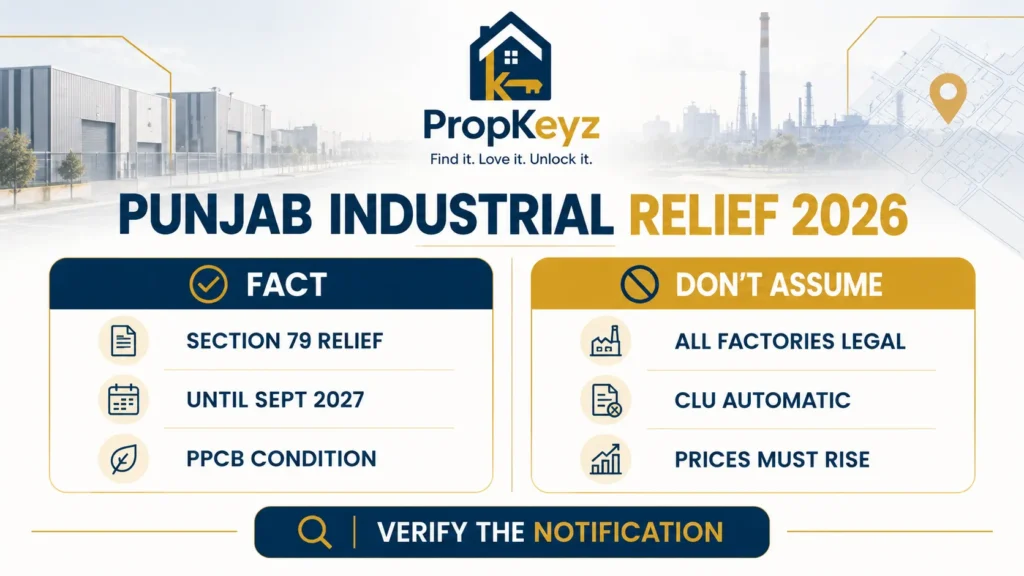
| Confirmed or Reported | Do Not Automatically Assume |
|---|---|
| Relief announced until 30 Sep 2027 | Permanent industrial zoning |
| Approximately 20,000 units may benefit | 20,000 units already fully compliant |
| 24 master plans covered | Every property in those towns qualifies |
| Six Mohali district plans listed | Every Mohali factory is exempt |
| Section 79 relief reported | All planning-law provisions waived |
| Section 178 power used | Automatic CLU granted |
| Existing industries covered | Every new factory can open |
| PPCB NOC required | Pollution-control rules waived |
| Earlier Ludhiana exemption expired in September | Every earlier enforcement matter automatically cured |
| Owners may gain operational certainty | Every factory’s market value rises |
| Relief has a stated end date | Government will certainly extend it again |
| Industrial leasing may be affected | Any tenant can operate any manufacturing process |
| A factory may be transferable | Buyer automatically inherits all operating permissions |
| Master-plan names are listed | Entire geographical district is exempt |
PropKeyz View
The most important distinction is between an existing business receiving conditional statutory relief and a property receiving permanent approval for unrestricted industrial development.
PropKeyz Analysis
The Punjab Non-Conforming Zone Exemption 2026 is important because it connects industrial policy directly with real-estate questions about land use, buildings, leases and property value.
1. The Decision Is More Specific Than a General Industrial Policy Announcement
It addresses the application of Section 79 to qualifying existing industries in defined planning areas.
2. The 24-Master-Plan Coverage Is Significant
The reported geographical reach is much broader than a single Ludhiana industrial neighbourhood.
3. Mohali District Has Six Relevant Planning Areas
Mohali, Mullanpur, Dera Bassi, Zirakpur, Kharar and Banur are all named in the reported coverage.
This makes the development relevant to PropKeyz’s regional property-research audience.
4. The Statewide 20,000 Figure Should Be Interpreted Carefully
It describes the approximate number of potentially affected industrial units.
It should not be presented as the number of industrial properties newly legalized.
5. Section 79 and Section 178 Must Be Read Together
The basic conformity rule and the government’s exemption power explain the structure of the announcement.
6. The Notification Does Not Rewrite Master Plans
A conditional exemption does not make all previously non-industrial land industrial.
7. PPCB Compliance Is a Core Condition
The Government has not presented this as relief from environmental regulation.
8. Existing and New Industrial Uses Are Different
The reported notification concerns existing units.
It should not be used to promote speculative new factory development in residential areas.
9. The Earlier Ludhiana Expiry Is Relevant
The previous exemption’s September 2026 expiry helps explain the urgency surrounding the October decision.
10. The 2027 Deadline Creates Continuing Planning Risk
Businesses and property investors should not treat the exemption as permanent.
11. Industrial Landlords Need More Than a Lease Agreement
Owners should understand the permitted use and compliance obligations associated with the premises.
12. Factory Buyers Need Property-Level Verification
An existing operating business and a legally approved industrial property are not necessarily the same thing.
13. Warehouse Classification Should Not Be Assumed
Warehousing and manufacturing can be treated differently under applicable planning and regulatory provisions.
14. Residential Buyers Have a Legitimate Interest
Neighbouring land use, traffic and environmental performance can affect residential liveability.
15. Future GMADA Industrial Parks Remain Separate Projects
The Sector 101/103 industrial-park programmes concern new development and land acquisition.
The October exemption concerns certain existing uses.
16. Property Prices Cannot Be Predicted From One Notification
Some owners may value short-term operational certainty.
But market prices depend on actual transactions and long-term legal usefulness.
17. A Proper Industrial Due-Diligence Process Has Multiple Layers
Title, master plan, exemption, environmental compliance, building approval and future transferability should be examined independently.
Final PropKeyz Analysis
Punjab’s October 2026 Section 79 exemption is a meaningful conditional relief measure for qualifying existing industries across 24 specified master plans. Its real-estate significance lies in the relationship between operating businesses and the legal status of the premises they occupy. The decision may ease short-term uncertainty for some industrial occupiers, but it does not permanently rezone land, regularize every building, create new industrial-development rights or guarantee higher property prices. Owners, tenants and buyers should verify the exact notification, current land-use category and PPCB compliance before relying on the exemption.
PropKeyz Verdict: Punjab Non-Conforming Zone Exemption 2026
What Has Punjab Announced?
Conditional relief from Section 79 for qualifying existing industries in specified non-conforming zones.
Until When?
30 September 2027
How Many Units May Benefit?
Approximately 20,000 statewide, according to reporting.
How Many Master Plans?
24
Which Mohali District Plans Are Included?
- Mohali / SAS Nagar
- Mullanpur
- Dera Bassi
- Zirakpur
- Kharar
- Banur
Is PPCB Compliance Necessary?
Yes, according to the reported conditions.
Can New Factories Automatically Open in Residential Zones?
No general permission of that kind has been established.
Does the Exemption Replace CLU?
No blanket replacement is established.
Does It Legalize Every Factory Building?
No.
Can an Owner Sell the Property?
Transferability must be examined under the property’s actual legal status.
Will Factory Rents Increase?
No guaranteed market response can be established.
What Should Existing Businesses Do?
Review the original notification, master-plan status, historical use and relevant environmental permissions.
What Should Buyers Do?
Verify the exact legal asset and intended use before paying.
Final PropKeyz Rule
Treat the October 2026 decision as conditional relief for qualifying existing industrial operations—not as automatic permanent approval for the land, building or every future industrial use.
Frequently Asked Questions
1. What is the Punjab Non-Conforming Zone Exemption 2026?
It is Punjab’s reported October 2026 conditional exemption from Section 79 of the 1995 planning legislation for qualifying existing industries in non-conforming zones of specified master plans.
2. When was the notification issued?
8 October 2026.
3. What is the notification reference?
H-U-11022/19/2026-4H1/I/1523943/2026, as identified by a legal-compliance publisher.
4. Until when is the exemption valid?
The reported end date is 30 September 2027.
5. How many industries may benefit?
Nearly 20,000 existing industrial units, according to contemporary reporting.
6. How many master plans are covered?
24 specified master-plan areas.
7. Does the exemption cover Mohali?
Mohali/SAS Nagar is included among the reported master plans.
8. Does it cover Kharar?
Yes, the Kharar Master Plan is included. Individual properties must still qualify.
9. Does it cover Zirakpur?
Yes, the Zirakpur Master Plan is listed.
10. Does it cover Dera Bassi?
Yes, Dera Bassi is included.
11. Does it cover Banur?
Yes, Banur is listed.
12. Does it cover Mullanpur?
Yes, Mullanpur is included.
13. Does it cover every property in these towns?
No. Inclusion of a planning area does not establish eligibility of every property or industrial operation.
14. What is a non-conforming zone?
It is an area where a particular existing use does not conform to the relevant master-plan land-use designation.
15. What does Section 79 concern?
It addresses conformity of land use and development with the applicable operative master plan.
16. What does Section 178 concern?
It empowers the State Government to grant specified exemptions under the Act, subject to applicable legal requirements and conditions.
17. Is the exemption permanent?
No. The reported relief currently runs until 30 September 2027.
18. Is a PPCB NOC required?
The reporting expressly identifies PPCB compliance and obtaining the applicable PPCB NOC as conditions.
19. Does the exemption waive pollution-control laws?
No.
20. Does the exemption automatically approve CLU?
No blanket CLU approval is established.
21. Can a new factory be started in a residential zone?
The notification is reported to concern existing industries. It does not establish general authorization for new industrial activity in non-conforming zones.
22. Can an existing factory expand?
Expansion may require separate planning, building and environmental approvals. The exemption should not be interpreted as unlimited expansion permission.
23. Can a factory property be sold?
Where valid transferable rights exist and applicable conditions are met, a sale may be possible. The exemption does not independently establish perfect title or unrestricted future industrial use.
24. Can a factory premises be rented?
Potentially, subject to the premises’ legal status, lease arrangements and the tenant’s applicable operating permissions.
25. Does a warehouse automatically qualify?
No. Eligibility depends on the notification and the particular activity and property.
26. Does the exemption automatically make a factory building legal?
No. Building and planning compliance remain separate matters.
27. Does a registered sale deed prove industrial-use approval?
No. A transfer document and industrial-use permission answer different legal questions.
28. Will industrial-property prices rise?
No specific appreciation can be guaranteed.
29. Will commercial or industrial rents increase?
No automatic increase has been established by the reported notification.
30. What happens after 30 September 2027?
The future position depends on subsequent law, policy and each property’s applicable permissions. No further extension is established at present.
31. Was there an earlier Ludhiana exemption?
Yes. Reporting describes a previous conditional relief period from 11 September 2023 to 10 September 2026.
32. Does the October notification automatically cover the gap after the earlier exemption expired?
The complete retrospective or transitional effect was not established from the reviewed public summaries. The original notification and legal circumstances must be checked.
33. Is Gharuan automatically included under Kharar?
No. Exact master-plan boundaries and property location must be verified. The Gharuan draft planning story is separate.
34. Does the exemption apply to future Sector 101/103 industrial parks?
The present announcement concerns qualifying existing non-conforming industries. Future industrial development remains governed by its own planning and approval processes.
35. Where can owners check master plans?
Through the relevant planning authorities, including GMADA Approved Master Plans.
36. Where can industrial operators check PPCB procedures?
Through the Punjab Pollution Control Board’s online consent system and the linked official business-clearance channels.
37. Can PropKeyz issue an industrial exemption or PPCB NOC?
No. These matters are handled by the competent government authorities.
38. Can PropKeyz help with property-management enquiries?
PropKeyz provides property-management and coordination services within its available service areas and agreed scope. It does not guarantee industrial regulatory approval.
Continue Your Mohali Property Research
CLU in Mohali 2026
Understand why a planning exemption and Change of Land Use approval are different.
Punjab Building Rules 2026
Explore the September 2026 building-rule amendments and why construction permissions still matter.
Read Punjab Building Rules 2026
Gharuan Master Plan 2026
Learn why a proposed regional-plan amendment should not be confused with an existing industrial-use exemption.
Kharar Property NOC 2026
Understand registry, colony permissions and different types of property NOCs.
Mohali Real Estate Future 2026
Understand how industrial activity, employment, residential growth and infrastructure interact in Greater Mohali.
Read Mohali Real Estate Future 2026
Property Management Company in Mohali
For existing residential-property owners needing tenant, rent or maintenance coordination:
Read Property Management Company in Mohali
Property Research and Owner Support Through PropKeyz
PropKeyz researches property developments in Mohali and nearby Tricity markets through:
- planning and master-plan information;
- property regulations;
- government notices;
- infrastructure developments;
- rental-market analysis;
- property-owner education.
Buying or Evaluating Property in Mohali District?
Before deciding what an industrial or commercial property is worth, consider:
- exact property;
- location;
- title;
- existing land use;
- current approvals;
- permitted activity;
- actual physical condition;
- market comparables;
- applicable regulatory risks.
For legally complex industrial transactions, obtain independent professional title, planning and environmental advice.
Already Own a Residential Property?
PropKeyz offers owner-focused services, subject to location and agreed scope.
NRI Property Management
Local property-care coordination for owners living abroad.
Tenant Placement
Rental enquiries, tenant screening and move-in coordination.
Rent Management
Rent tracking and owner updates.
Property Inspections
Visible-condition reports, photos and videos.
Maintenance Coordination
Vendor follow-up and owner-approved repairs.
Vacant Property Care
Periodic inspection and property-status coordination.
Request a Property Assessment
Share:
Property Location:
Property Type:
Current Status: Vacant / Rented / Owner-Occupied
Owner Location: India / Abroad
Service Required: Inspection / Tenant Placement / Rent Management / Maintenance / NRI Care
PropKeyz can review whether your property is within its service coverage and discuss an appropriate operational scope.
Contact PropKeyz
Phone / WhatsApp: +91 80534 69929
Email: contact@propkeyz.com
Working Hours: Monday–Saturday, 10 AM–7 PM IST
Explore Property Management Services
PropKeyz
Find it. Love it. Unlock it.
Your Property. Our Responsibility.
Sources & Verification
Last Fact-Checked: 10 October 2026
1. Hindustan Times — 10 October 2026
Report: Punjab extends exemption for units in non-conforming zones.
Author: Hillary Victor
Published: 10 October 2026
Used to verify:
- estimated 20,000 affected units;
- Section 79 relief;
- 30 September 2027 deadline;
- PPCB conditions;
- 24 master-plan coverage;
- earlier Ludhiana exemption context.
2. Times of India — 9 October 2026
Report: Punjab extends relief to industries in non-conforming zones till Sept 2027.
Author: Vinod Kumar
Used to verify:
- Section 178 exemption power;
- 24 named master plans;
- six Mohali district planning areas;
- previous Ludhiana relief;
- environmental conditions;
- estimated affected industrial units.
3. October 8 Notification Reference
A legal-compliance publisher identifies:
H-U-11022/19/2026-4H1/I/1523943/2026
Used to cross-check the reported notification date, exemption subject and expiry.
Complinity — Punjab Industrial Exemption Notification Summary
Verification note: The full authenticated notification was not independently available in the sources reviewed. Exact eligibility and any unreported conditions must be confirmed from the original.
4. Punjab Regional and Town Planning and Development Act, 1995
Primary statute for:
- Section 79;
- master-plan conformity;
- Section 80;
- exemption powers under Section 178.
Government-Hosted Punjab Planning Act
5. Section 79 — Legal Text
Used to explain the master-plan conformity provision and the distinction between general requirements and exemptions.
6. Section 178 — Legal Text
Used to explain the State Government’s exemption power.
7. GMADA Approved Master Plans
Official authority source for planning-document verification in the Greater Mohali area.
8. Punjab Pollution Control Board
Official online consent-system resource for relevant industry environmental permissions.
PPCB Online Consent Management and Monitoring System
Disclaimer
This article is published by PropKeyz for:
- local property research;
- industrial-property awareness;
- land-use education;
- regulatory news;
- buyer due diligence;
- owner guidance.
It does not constitute:
- legal advice;
- environmental compliance certification;
- PPCB approval;
- CLU approval;
- building-plan approval;
- industrial-operation licence;
- government exemption certificate;
- property valuation;
- investment advice.
The approximately 20,000-unit figure is a reported statewide estimate, not an independently verified register of compliant businesses.
The October 2026 relief has been described in contemporary reporting as conditional and time-limited.
The precise eligibility conditions, relevant reference dates, exclusions, transitional provisions and legal effects must be established from the authenticated government notification.
Nothing in this article should be interpreted as confirmation that an individual premises, factory, warehouse, industrial tenant or proposed new operation qualifies.
Before buying, renting, expanding or changing the use of industrial premises, independently verify:
Exact Property → Master Plan → Historical Use → Exemption Applicability → PPCB Compliance → Building/Safety Permissions → Intended Activity → Transfer or Lease Terms.
Your Property. Our Responsibility.