
The Mohali Lal Dora Property Card 2026 update has become an important property-ownership development for families living in traditional village habitation areas around SAS Nagar and Kharar.
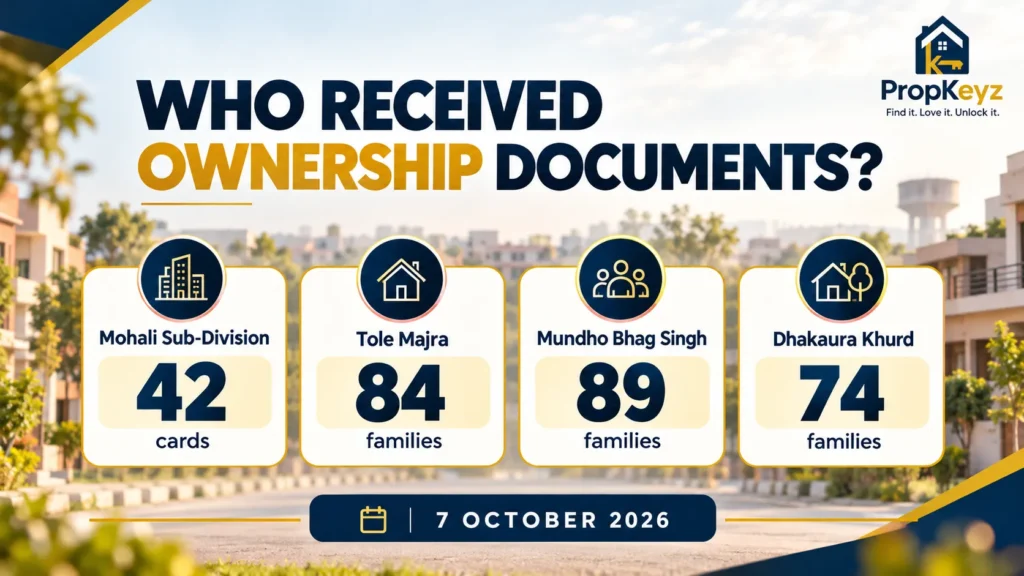
On 7 October 2026, Mohali MLA Kulwant Singh distributed 42 property ownership cards in Mohali Sub-Division under Punjab’s Mera Ghar Mera Naam initiative.
A separate distribution programme in Kharar constituency provided ownership-related documents to:
247 families across three villages.
These families were from:
- Tole Majra — 84 families
- Mundho Bhag Singh — 89 families
- Dhakaura Khurd — 74 families
The documents were distributed under the wider Punjab ownership-record initiative for Lal Dora or Lal Lakir habitation areas.
Statewide reporting also identified approximately:
16,000 property cards distributed across 149 villages on 7 October 2026.
The programme addresses a longstanding issue in Punjab’s village-property market.
Many residential structures in traditional habitation areas have existed for generations, while individual property identification, boundaries and proprietary records have not always been maintained in a way comparable with modern plotted urban developments.
This can create practical difficulties when owners want to:
- sell a house;
- transfer property to children;
- establish inheritance rights;
- divide a family property;
- apply for a bank loan;
- resolve a boundary dispute;
- rent out a house;
- manage property while living abroad.
The scheme aims to improve documentation of existing rights through surveying, mapping and legally prescribed record preparation.
However, the most important question is not simply:
“Lal Dora property card mil gaya — ab registry ho jayegi?”
The correct questions are:
What rights are actually recorded, whether those rights are disputed, which legal procedures still apply, and whether the specific property can lawfully be sold, financed, rented or transferred.
That distinction matters particularly in Mohali and Kharar, where traditional village houses, plotted colonies, builder floors, apartment projects, private developments and authority-controlled properties operate under different legal and administrative frameworks.
This PropKeyz guide examines the 7 October distribution, the 2026 legal position, property-card verification, registration, inheritance, banking and actual property-market implications.
PropKeyz Property Rule
A property card can strengthen documentary clarity. But clear documentation, lawful title, approved construction and physical possession remain separate questions.
Key Takeaways
- The Mohali Lal Dora Property Card 2026 update concerns 42 cards distributed in Mohali Sub-Division on 7 October.
- The Mohali distribution function was reported in Hussainpur village.
- 247 families in Kharar constituency received ownership-related documents.
- The Kharar beneficiaries were from Tole Majra, Mundho Bhag Singh and Dhakaura Khurd.
- The programme is associated with Punjab’s Mera Ghar Mera Naam/Mera Ghar Mera Maan initiative.
- Approximately 16,000 cards across 149 villages were reported as distributed statewide on 7 October.
- Statewide reporting describes a wider phased exercise covering approximately 4,000 villages.
- The legal foundation includes the Punjab Abadi Deh (Record of Rights) Act, 2021.
- Punjab amended the Act in January 2026 through Punjab Act No. 3 of 2026.
- The original fixed 90-day objection period was replaced by a period to be notified by the government.
- Ownership cards may record geographical coordinates, property area, built-up area, open area and survey-unit mapping.
- A property card is not automatically conclusive proof of undisputed ownership.
- A property card does not automatically replace a registered sale deed where a conveyance is legally required.
- A property card does not automatically regularize unauthorized buildings or colonies.
- Bank-loan eligibility remains subject to lender assessment.
- The scheme may improve ownership documentation, inheritance administration and transaction confidence.
- Actual selling prices depend on property fundamentals and genuine market demand.
- Buyers must verify the exact village, property record, title history, boundaries and permitted use.
- NRI and outstation owners should monitor updated records and physical possession.
- Professional property management remains useful after the documentation process, particularly for vacant or rented houses.
PropKeyz View
The biggest opportunity is not an automatic jump in property rates. It is the possibility of more reliable, property-specific records that help families and buyers understand what is actually owned.
Mohali Lal Dora Property Card 2026: Quick Answer
The Mohali Lal Dora Property Card 2026 development concerns the latest distribution of ownership documents under Punjab’s programme for recording property rights in qualifying habitation areas.
Latest Local Distribution — 7 October 2026
| Area | Reported Distribution | Details |
|---|---|---|
| Mohali Sub-Division | 42 property cards | MLA Kulwant Singh |
| Tole Majra | 84 families | Kharar constituency |
| Mundho Bhag Singh | 89 families | Kharar constituency |
| Dhakaura Khurd | 74 families | Kharar constituency |
| Total Kharar | 247 families | Three villages |
The Mohali figure refers to property cards, while the Kharar figure refers to beneficiary families. They should not be treated as identical measurement categories without checking the underlying records.
What Is Confirmed?
The local reports establish that ownership-related documents were distributed under the government initiative.
What Is Not Automatically Established?
The distribution itself does not prove:
- every eligible property has been surveyed;
- every local ownership dispute has ended;
- every beneficiary can immediately register a sale;
- all banks will accept the property as security;
- property prices have increased;
- unauthorized development has been legalized.
Direct Answer
Punjab’s October 2026 Lal Dora distribution extends documented property-right records to more families in Mohali and Kharar. But property-card issuance and the legal validity of a particular transaction must still be assessed separately.
What Happened in Mohali on 7 October 2026?
On 7 October, MLA Kulwant Singh participated in an ownership-card distribution programme for Lal Dora properties.
The function was reported in Hussainpur village, Mohali.
According to the published reporting:
42 property ownership cards were distributed in Mohali Sub-Division.
The event was attended by local administrative and revenue officials.
What Was the Purpose?
The stated objective was to provide documented identification of property rights for residents who had historically faced difficulties establishing ownership of habitation-area properties.
What Information Did Officials Highlight?
The reports described ownership certificates containing details such as:
- longitude;
- latitude;
- covered area;
- constructed or built-up area;
- open area;
- survey-unit map.
These details can help identify a property with greater precision than an informal street description alone.
Why This Matters
Consider a village house that has passed from one generation to another.
Neighbours may recognize the property boundaries.
The family may have occupied it continuously for decades.
However, a buyer or financial institution may require more formal evidence of:
- the property’s extent;
- the recorded owner;
- the property identifier;
- relevant legal rights.
A mapped ownership record can help organize such information.
Important Limitation
A survey map is not a guarantee that no neighbouring owner can challenge a boundary.
The applicable record and dispute-resolution provisions remain relevant.
Local reporting: 5 Dariya News — Mohali Property Ownership Cards
Kharar’s 247 Families: Village-Wise Ownership-Document Distribution
A separate event in Kharar constituency concerned 247 beneficiary families across three villages.
The published report identified Parminder Singh Goldy, Chairman of the Punjab Youth Development Board, as the person presenting the documents.
Village 1 — Tole Majra
84 families
Tole Majra accounted for approximately one-third of the reported Kharar beneficiaries.
For residents receiving documents, the important next step is to preserve the issued records and verify the individual property details.
Village 2 — Mundho Bhag Singh
89 families
Mundho Bhag Singh had the highest beneficiary count among the three reported villages.
The report associated the village with the Majri block area.
Village 3 — Dhakaura Khurd
74 families
The report stated that ownership-related documents were distributed to 74 families.
Total Distribution
| Village | Families | Approximate Share |
|---|---|---|
| Tole Majra | 84 | 34.0% |
| Mundho Bhag Singh | 89 | 36.0% |
| Dhakaura Khurd | 74 | 30.0% |
| Total | 247 | 100% |
Does This Mean All Properties in These Villages Are Documented?
No.
The numbers describe the reported beneficiaries in the particular distribution event.
They do not establish:
- total houses in each village;
- total eligible properties;
- number of unresolved objections;
- number of remaining cards;
- number of pending ownership claims.
Why Buyers Should Care
A buyer looking at a village house in Kharar should check the actual property-specific record.
The fact that a village appears in a distribution report does not confirm that the particular house being offered for sale has finalized ownership documents.
Source: 247 Kharar Families Receive Ownership Documents
Punjab Statewide Rollout: Approximately 16,000 Property Cards Across 149 Villages
The Mohali and Kharar announcements were part of a larger Punjab distribution exercise.
On 7 October, reports described approximately:
16,000 property cards distributed across 149 villages.
Statewide reporting also highlighted a phased programme covering approximately:
4,000 villages through December 2026.
What Does the Statewide Programme Involve?
According to contemporary reporting, the initiative uses modern surveying and digital mapping to identify houses and plots in covered habitation areas.
The programme is intended to:
- record relevant ownership interests;
- identify property boundaries;
- support documentation;
- reduce certain ownership ambiguities;
- improve the information available for lawful property transactions.
Does the 4,000-Village Figure Mean Only 4,000 Villages Will Ever Be Covered?
No such conclusion should be drawn.
The reported figure concerns the announced implementation exercise.
The wider historical scheme and its intended coverage should not be confused with a single phase.
Next Implementation Milestones
Property owners should track:
- new village-wise distribution announcements;
- official notices about record publication;
- objection or correction periods;
- further distribution events;
- updated Punjab Land Records information.
Important
A government announcement about completing an exercise by December does not establish that every property will automatically be finalized by that date.
Individual records may involve unresolved claims or administrative steps.
Source: Times of India — Punjab Mera Ghar Mere Naam Rollout
Earlier Mohali Property-Card Distribution: April 2026
The October event was not the beginning of all Lal Dora card distribution in Mohali.
In April 2026, MLA Kulwant Singh distributed property cards to 205 beneficiaries in:
- Dairi — 160
- Thaska — 45
This earlier activity provides important context.
Why It Matters
The October announcement should be understood as another development within an ongoing implementation process.
Timeline
| Date | Reported Development |
|---|---|
| April 2026 | 205 cards in Dairi and Thaska |
| 7 October 2026 | 42 cards in Mohali Sub-Division |
| 7 October 2026 | 247 Kharar families receive documents |
| October–December 2026 | Further statewide phases announced |
These are selected reported events, not a complete cumulative beneficiary database.
Source: The Tribune — Lal Dora Property-Card Issuance Begins
What Is Lal Dora or Lal Lakir Property in Punjab?
Lal Dora, also called Lal Lakir in Punjab, generally refers to the traditionally demarcated habitation area of a village.
The legally relevant land-record terminology includes:
Abadi Deh
These are areas historically associated with village settlement and residential occupation.
What Can an Abadi Deh Area Contain?
Depending on the local records and applicable law:
- residential houses;
- courtyards;
- private plots;
- shops;
- village passages;
- common land;
- public facilities;
- other established habitation-related uses.
Why Was the Boundary Important?
Traditional revenue administration distinguished habitation areas from land recorded for agricultural and other purposes.
The red-line concept became a commonly understood way of referring to village settlement boundaries.
Important
The term Lal Dora is not a universal certificate that makes every structure inside the area lawful.
The applicable revenue record, ownership entry and land-use rules still matter.
Lal Dora Property vs Urban Property: Why the Difference Matters
Mohali’s wider property market includes several different legal categories.
Traditional Village Habitation Property
A house within a relevant Abadi Deh area may be subject to the record-of-rights framework applicable to that area.
GMADA Residential Plot
An authority-allotted or transferred plot can involve:
- allotment records;
- payment obligations;
- transfer requirements;
- authority rules;
- approved planning documents.
Private Colony Plot
A plot in a private development can require verification of:
- promoter title;
- development licence;
- layout approval;
- permitted use;
- applicable RERA registration.
Group Housing Apartment
An apartment involves a different mix of:
- promoter/project approvals;
- conveyance documentation;
- unit identification;
- common-area rights;
- society or association records.
Comparison
| Property Type | Main Legal Focus |
|---|---|
| Traditional Lal Dora house | Abadi Deh rights and records |
| GMADA plot | Authority allotment/transfer and dues |
| Private colony plot | Title, licence, layout and legal development |
| Apartment | Unit conveyance, project approvals and common rights |
| Agricultural land | Revenue title, restrictions and applicable land-use rules |
PropKeyz Rule
Same City Does Not Mean Same Ownership System.
For a related Kharar documentation issue, see:
Kharar Property NOC 2026 — Development Charges, Registry and Buyer Risks
What Is Punjab’s Mera Ghar Mera Naam Scheme?
Punjab’s programme aims to document qualifying property rights in habitation areas through surveys, mapping and preparation of ownership records.
The programme is commonly referred to as:
- Mera Ghar Mera Naam;
- Mera Ghar Mere Naam;
- Mera Ghar Mera Maan/Mann in some local reporting.
The central issue is the same:
Providing better documented ownership records for qualifying habitation-area properties.
Why Was the Scheme Needed?
Traditional village-property transactions and inheritance arrangements can be complicated by incomplete individual property documentation.
For example:
A family occupies a house built several decades ago.
The house is recognized locally.
However, its precise survey boundary may not be recorded as clearly as a modern plotted property.
The programme seeks to address such gaps.
Main Objectives
- Identify covered habitation areas.
- Survey and map property units.
- Examine relevant proprietary interests.
- Prepare records.
- Provide opportunities for objections.
- Finalize applicable entries.
- Issue ownership-related documents.
Official Programme Resource
National Portal of India — Mera Ghar Mere Naam
How Is Mera Ghar Mera Naam Connected to SVAMITVA?
SVAMITVA is a national programme administered by the Ministry of Panchayati Raj.
Its full name is:
Survey of Villages Abadi and Mapping with Improvised Technology in Village Areas.
The programme uses surveying and mapping technologies, including drones, to help create property records in rural inhabited areas.
Main Implementation Participants
The national framework involves:
- Ministry of Panchayati Raj;
- state revenue authorities;
- state Panchayati Raj departments;
- Survey of India;
- relevant local authorities.
Relationship to Punjab
Punjab’s Mera Ghar Mera Naam programme is associated with the wider SVAMITVA property-mapping and ownership-documentation framework.
But state laws determine important procedural and legal details.
What Should Not Be Assumed?
Do not assume that:
- every state follows identical objection periods;
- every card has identical legal consequences;
- every village has reached the same implementation stage;
- every state’s transfer procedures are identical.
Official Source
SVAMITVA — Ministry of Panchayati Raj
Why Were Formal Ownership Records Needed?
The underlying legal concern is not limited to obtaining another piece of paper.
The Punjab Abadi Deh legislation recognizes historical difficulties involving:
- identification of ownership rights;
- demarcation of property boundaries;
- preparation of records;
- transfer of property rights;
- disputes between parties.
Example: Inherited Family House
Suppose a house was constructed by a grandfather.
After his death, multiple children continued to use different portions.
Over time:
- one family occupies the front portion;
- another occupies the rear portion;
- a passage remains shared;
- the courtyard is used by multiple relatives.
If the rights and boundaries are unclear, selling one portion may become legally complicated.
A surveyed record may help identify the physical property.
However, inheritance and ownership interests still require legal assessment.
Example: Neighbouring Houses
Two families may disagree about the location of a common wall or courtyard boundary.
Survey data can provide relevant information.
But a disputed record may still need correction or adjudication.
PropKeyz Rule
Mapping Helps Identify the Property. The Legal Process Determines Which Rights Are Recorded.
What Information Can a Lal Dora Property Card Contain?
Published Mohali reporting describes ownership cards containing important geographical and property-identification information.
Reported Fields
- longitude;
- latitude;
- covered area;
- constructed area;
- open area;
- survey-unit map;
- ownership-related identification.
Actual fields should be verified on the card issued by the relevant authority.
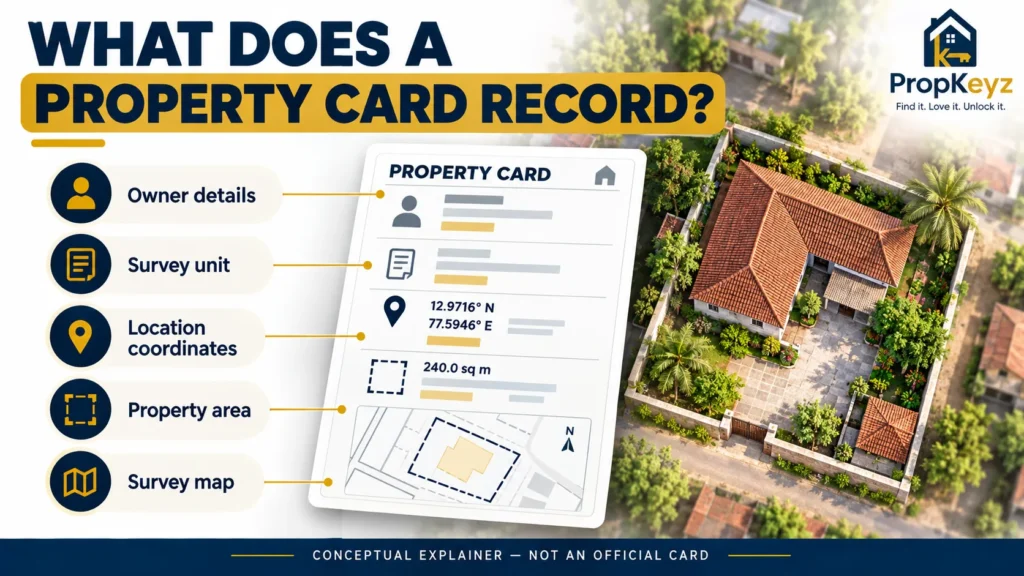
1. Proprietor Information
Identifies the person or entity recorded in relation to the survey unit.
2. Survey Unit
The property unit identified under the mapping framework.
3. Geographical Coordinates
Help locate the property within the mapped area.
4. Property Dimensions
Show relevant mapped extent or measurements.
5. Built-Up Area
Identifies the recorded constructed portion.
6. Open Area
May include relevant courtyard or other open portions.
7. Map
Shows the survey-unit representation.
Does the Map Prove Every Construction Is Approved?
No.
Ownership records and building-control approvals are different matters.
Does the Survey Replace Physical Verification?
No.
Buyers should compare the issued record with the actual property and the available official map.
Punjab Abadi Deh (Record of Rights) Act, 2021 Explained
The Punjab Abadi Deh (Record of Rights) Act, 2021 provides a statutory framework for preparing records of proprietary rights in covered habitation areas.
It is particularly relevant because it explains why the record is prepared and what legal process applies.
Section 2 — Definitions
The Act defines important terms including:
- Abadi Deh;
- common area;
- proprietary right;
- survey unit;
- relevant recording officers.
The definition of proprietary right concerns ownership interests, not merely tenancy, lease or mortgage interests.
Section 5 — Identification of Areas
The government may notify relevant Abadi Deh areas for the purposes of identifying and recording rights.
Section 6 — Survey and Mapping
Provides for surveying the notified area and identifying individual survey units.
Section 7 — Standing Record of Rights
Provides for a standing record containing proprietary entries, survey information and prescribed materials.
Section 8 — Ownership Enquiry
Provides for relevant local enquiry and participation through the prescribed framework.
Section 9 — Preparation of Records
Deals with recording proposed proprietary interests.
The Act distinguishes private interests from relevant common or public holdings.
Section 10 — Display
Provides for displaying the survey map and proposed record entries.
Section 11 — Objections and Corrections
Addresses objections concerning boundary demarcation and proprietary entries.
Section 12 — Appeals
Provides a statutory mechanism for appeals.
Section 16 — Record Maintenance
Provides for transfer of the finalized standing record into the applicable revenue-record system.
Section 18 — Partition
Contains provisions addressing partition in specified circumstances.
Section 21 — Presumption Regarding Entries
The Act provides legal evidentiary significance to properly made entries, subject to the governing law.
Critical Legal Point
The explanation under Section 11 states that recording proprietary rights in a survey unit is not conclusive proof of ownership.
The entry remains subject to correction and applicable legal proceedings.
Practical Meaning
An official entry is legally important evidence. It is not a guarantee that no competing legal claim can exist.
Primary legislation: Punjab Abadi Deh (Record of Rights) Act, 2021
Additional official resource: India Code — Punjab Abadi Deh Act
January 2026 Amendment: What Changed?
One of the most important developments for anyone researching Punjab Lal Dora property rights in 2026 is the amendment to the Abadi Deh legislation.
The amendment was published in January 2026 as:
Punjab Act No. 3 of 2026
Its formal title is:
Punjab Abadi Deh (Record of Rights) Amendment Act, 2025.
Before the Amendment
The original Section 11(1) included a fixed:
90-day objection period
following display of the relevant record.
After the Amendment
The fixed period was replaced with:
a period to be notified by the Punjab Government.
Other Changes
The amendment also changed the fixed timeframes for:
- certain Section 11(2) decisions;
- disposal of appeals under Section 12(4).
Important Distinction
The amendment did not simply remove every deadline in the legislation.
The Act’s separate 30-day appeal-filing provisions in Section 12(1) and Section 12(3) remain distinct from the amended disposal timelines.
Why Property Owners Should Care
If an ownership entry incorrectly records:
- proprietor name;
- property boundary;
- survey area;
- co-owner information;
the owner needs to know the applicable notice and deadline.
An old article repeating the original 90-day period may no longer provide correct current guidance.
PropKeyz Legal Rule
Never rely on an old objection deadline without checking the current government notification.
What Are the Current Objection and Appeal Rules?
The process has several different stages.
Stage 1 — Record Publication
The relevant proposed map and entries are displayed according to the prescribed procedure.
Stage 2 — Objections
Affected persons may raise eligible objections concerning proprietary entries or boundaries.
The filing period under Section 11(1) now depends on the government-notified timeframe.
Stage 3 — Decision
The competent authority examines the matter under the applicable statutory framework.
Stage 4 — Appeal
Section 12 contains appeal provisions, including separate filing deadlines.
Stage 5 — Further Legal Remedies
Depending on the nature of the dispute and the statute, review, revision or appropriate court proceedings may be relevant.
Which Officer Handles the Issue?
The Abadi Deh Act creates a hierarchy of recording and resolution officers, including officers functioning at different administrative levels.
The exact office for an individual matter should be determined from the applicable notice and statutory process.
Example
A family’s property record shows 150 square yards.
The family believes the correct area is 180 square yards.
The proper response is not simply to modify a photocopy or seek an informal assurance.
The family should:
- Obtain the official survey record.
- Compare boundaries and supporting evidence.
- Identify the applicable objection/correction procedure.
- File within the legally applicable time.
- Preserve the acknowledgement and decision.
Important
A genuine title dispute may require legal representation.
How Do Drone Surveys and Digital Mapping Work?
The SVAMITVA framework uses modern surveying methods to map village habitation areas.
Step 1 — Identify the Survey Area
The relevant habitation area is identified for mapping.
Step 2 — Capture Survey Information
Drone-based or other prescribed surveying techniques can collect geographic information.
Step 3 — Identify Property Units
Individual survey units are delineated.
Step 4 — Prepare Maps
Property boundaries and related physical data are processed into maps.
Step 5 — Conduct Local Enquiry
Ownership-related information is examined under the relevant procedure.
Step 6 — Display Proposed Records
Affected persons receive an opportunity to examine the relevant records.
Step 7 — Resolve Applicable Objections
Corrections and contested entries are handled through the legal process.
Step 8 — Finalize Records
The applicable standing record is finalized.
Step 9 — Issue Ownership Documentation
Cards or related records are issued in accordance with the programme.
Why Technology Helps
Modern surveying can improve the consistency of property identification.
But:
Survey Accuracy ≠ Automatic Resolution of Legal Ownership.
A drone can map a roof.
It cannot independently determine whether a person lawfully inherited the land beneath it.
Property-Card Issuance Process: Survey to Final Record
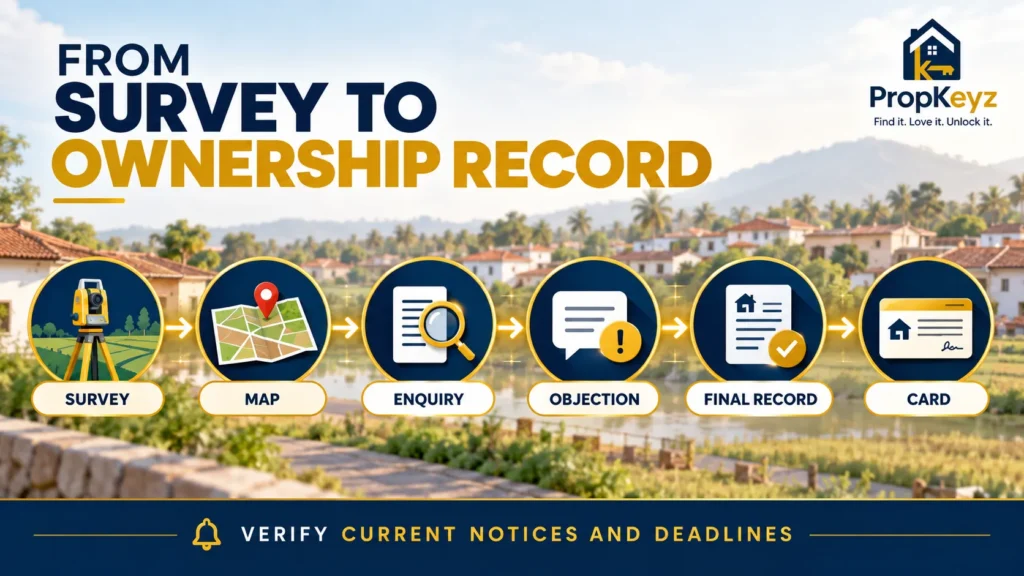
The practical process can be summarized as:
AREA IDENTIFICATION
↓
SURVEY & MAPPING
↓
OWNERSHIP ENQUIRY
↓
DRAFT RECORD
↓
OBJECTIONS / CORRECTIONS
↓
FINAL RECORD
↓
OWNERSHIP DOCUMENT
Important Implementation Distinction
A village may be:
- selected;
- surveyed;
- under enquiry;
- awaiting objection resolution;
- at record-finalization stage;
- at distribution stage.
These stages are not identical.
PropKeyz Rule
Village Surveyed ≠ Card Issued ≠ Every Title Dispute Resolved.
Who May Qualify for a Lal Dora Property Card?
Eligibility depends on:
- whether the property is within a relevant covered area;
- the applicable notifications;
- survey-unit identification;
- recorded or claimed proprietary rights;
- results of the prescribed enquiry and objection processes.
Potentially Relevant Property Types
Depending on the law and facts:
- existing residential houses;
- family dwellings;
- privately held habitation plots;
- other qualifying properties within covered areas.
What Is Not Automatically Eligible?
Do not assume that:
- every agricultural field;
- every private colony plot;
- every unauthorized construction;
- every disputed encroachment;
- every public or common area
qualifies for private ownership documentation.
What About Government or Panchayat Land?
The Act recognizes public and common-area interests.
Such land should not be treated as automatically privatized merely because it lies within a mapped habitation area.
What About Tenants?
A tenant’s lawful right to occupy a property is different from ownership.
The Act’s definition of proprietary rights distinguishes ownership from lease and tenancy interests.
How to Check Your Mohali Lal Dora Property Card 2026 Status
Owners should first identify the exact property and official jurisdiction.
Step 1 — Confirm the Village
Record the correct:
- village name;
- tehsil;
- district;
- local survey/property details.
Step 2 — Visit Punjab Land Records
Official portal:
Step 3 — Review Available MGMN Map Information
The Punjab Land Records website lists:
- View MGMN Final Map-2 Data
- View MGMN Final Map-3 Data
These resources are relevant to Mera Ghar Mera Naam mapping information.
Step 4 — Examine Available Property Records
Depending on the relevant record, users may need to consult:
- available map details;
- ownership entries;
- survey references;
- other supporting revenue records.
Step 5 — Contact the Competent Revenue Authority
Where an individual card cannot be found online, enquire through the concerned official office.
Step 6 — Ask About the Record Stage
Important questions include:
- Has the village survey been completed?
- Has the proposed record been displayed?
- Is the objection period open?
- Has the record been finalized?
- Is the ownership card ready?
- Does the owner need to provide any additional documentation?
Step 7 — Preserve Official Documents
Keep authenticated records securely.
Important Warning
The existence of an MGMN map-viewing service does not establish that every individual can download a final property card immediately.
Online availability depends on the relevant record and administrative status.
Official Reference
Punjab Land Records — Online Services
What If the Property Card Contains Incorrect Information?
Record accuracy matters because incorrect entries can create difficulties later.
Common Problems
- spelling mistakes;
- incorrect proprietor name;
- missing legal heir;
- wrong survey-unit number;
- inaccurate dimensions;
- incorrect courtyard boundary;
- neighbour’s land included in the record;
- part of a shared passage shown as private.
What Should the Owner Do?
First, obtain the official record that contains the disputed entry.
Second, collect relevant evidence.
Third, identify whether the issue is:
- clerical;
- boundary-related;
- succession-related;
- a substantive title dispute.
Fourth, use the appropriate statutory correction or challenge process.
What Evidence May Be Relevant?
Depending on the matter:
- earlier title documents;
- inheritance documents;
- revenue records;
- survey maps;
- prior official orders;
- legally relevant family records.
Why Classification Matters
A typing error is not the same as two families claiming the same courtyard.
Different disputes can require different procedures.
PropKeyz Rule
Correct the official record through the official process. Never rely on an unofficial edited certificate.
Property Card vs Registry vs Jamabandi vs Mutation
Different property documents answer different questions.
| Document | Main Function | Common Misunderstanding |
|---|---|---|
| Property card | Records property/proprietary information | Conclusive title in every situation |
| Registered sale deed | Documents a registered transfer | Guarantees seller had perfect title |
| Jamabandi | Records relevant revenue rights | Proves every possible ownership issue is settled |
| Mutation / Intkal | Updates the revenue record after an event | Creates ownership merely by entry |
| Survey map | Shows mapped property information | Independently proves ownership |
| Property tax receipt | Shows tax-related payment/assessment | Establishes title |
| Electricity bill | Shows utility account information | Proves ownership |
| Building permission | Concerns construction approval | Proves ownership of land |
Why Buyers Need Multiple Documents
A single document usually cannot establish every legal, physical and planning detail.
Example
A seller provides a property card.
However:
- one sibling claims an ownership share;
- the building extends beyond the mapped boundary;
- an old mortgage may remain outstanding.
The card is relevant evidence, but the proposed purchase requires wider examination.
PropKeyz Rule
Property Identification + Title + Possession + Transferability + Legal Compliance = Better Due Diligence.
Can a Lal Dora Property Be Sold After Receiving a Card?
A Lal Dora property may be transferable where the seller has valid transferable rights and applicable legal conditions are satisfied.
But the card alone does not establish every requirement.
Before Selling
Check:
- Correct recorded proprietor.
- Finalized ownership record.
- Applicable co-owner rights.
- Inheritance history.
- Existing encumbrances.
- Property boundaries.
- Transfer restrictions.
- Required conveyance/registration procedure.
Does a Property Card Replace the Sale Deed?
Not automatically.
The legally appropriate instrument for transferring rights must be determined under the applicable law.
What About a Family-Owned Property?
If multiple persons hold relevant rights, the person negotiating the transaction may not have authority to transfer the entire property independently.
What If the Record Is Under Challenge?
A buyer should understand the dispute before proceeding.
Practical Seller Checklist
- Obtain current records.
- Resolve known errors.
- Identify all relevant parties.
- Confirm transfer requirements.
- Obtain legal advice.
- Keep genuine transaction documentation.
PropKeyz Transaction Rule
A Card May Help Establish the Recorded Property. It Does Not Replace Verification of the Seller’s Power to Transfer.
Does a Property Card Make a House Eligible for Bank Loans?
Better documentation can help financial institutions examine a property’s ownership and identity.
This is one of the programme’s intended benefits.
Why Banks Need Property Records
Lenders may examine:
- legal title;
- property valuation;
- boundaries;
- mortgageability;
- existing charges;
- borrower repayment capacity.
What Could Improve?
A properly documented survey unit may reduce uncertainty in identifying the property.
What Remains Subject to Bank Approval?
- property acceptability;
- credit assessment;
- legal opinion;
- valuation;
- mortgage requirements;
- lending policies.
Does Every Bank Have to Approve a Loan?
No.
Can Loan Eligibility Be Assumed from a Government Announcement?
No.
The correct question to ask is:
Will the proposed lender accept this exact property and its current documentation as security?
PropKeyz Rule
Property Card Available ≠ Loan Sanctioned.
Inheritance and Partition of Lal Dora Property
Family inheritance is a major practical consideration in traditional village housing.
A house may have been passed across several generations.
Over time, the property can involve:
- children;
- grandchildren;
- multiple legal heirs;
- undivided shares;
- jointly occupied portions;
- informal family arrangements.
Can a Property Card Settle Inheritance Automatically?
No.
The relevant succession and ownership rights still matter.
What If One Legal Heir Has Been Recorded?
An entry does not necessarily defeat every valid competing claim.
What About Physical Division?
The Abadi Deh Act contains provisions concerning partition of survey units.
The exact process depends on the legal circumstances and applicable provisions.
Example
A family owns a 300-square-yard house.
Three heirs want separate portions.
A mapped record may identify the whole property.
But a lawful division may still require:
- confirmation of the heirs’ interests;
- assessment of partition eligibility;
- appropriate records;
- applicable official or judicial proceedings.
PropKeyz Rule
Survey Maps Identify Land. Succession and Partition Determine Legal Interests.
Can Lal Dora Property Be Rented Out?
A qualifying property may be rented where the landlord has the required rights and the intended use is lawful.
A property card can be relevant to establishing owner details.
But rental arrangements need their own documentation.
Before Renting a Village House
Check:
- owner authority;
- other co-owner rights;
- permitted property use;
- building condition;
- tenant identification;
- applicable police-verification requirements;
- rent agreement;
- security deposit;
- maintenance responsibilities.
What If the Property Belongs to Multiple Heirs?
The person signing the agreement should have appropriate authority.
Can an Existing Tenant Be Removed Because a New Card Was Issued?
Not automatically.
The card does not independently extinguish valid tenancy rights.
Can a House Be Converted into a Commercial Rental Property?
Not merely because a card was issued.
Commercial use may require separate permissions.
For Owners
Good rental administration involves more than possession of an ownership document.
It includes:
- tenant records;
- rent tracking;
- property inspections;
- maintenance;
- move-in and move-out documentation.
Read:
Property Management Company in Mohali 2026 — PropKeyz
Does a Lal Dora Card Regularize Unauthorized Construction?
Do not assume so.
This distinction is important in the Greater Mohali region.
Ownership Documentation
Concerns identification and recording of rights.
Construction Approval
Concerns whether development complies with applicable building rules.
Land-Use Permission
Concerns the legally permitted use of land.
Colony Approval
Concerns relevant planning and development permissions.
These are separate matters.
Example
An owner receives a property card for an existing house.
That does not automatically authorize:
- two additional floors;
- conversion to commercial premises;
- subdivision into multiple saleable units;
- an unapproved colony layout.
PropKeyz Rule
Ownership Record ≠ Construction Approval ≠ Change of Land Use.
For a detailed explanation, read:
CLU in Mohali 2026 — GMADA Process, Charges and Buyer Guide
Mohali vs Kharar: Why the Legal Property Category Matters
Mohali and Kharar contain multiple overlapping real-estate markets.
Mohali Proper
Many areas are organized into planned sectors, societies and authority-linked developments.
Kharar
The wider market includes:
- traditional villages;
- old residential areas;
- private colonies;
- builder-floor developments;
- plotted schemes;
- apartments;
- agricultural and other revenue land.
Why This Matters
A property marketed as:
“Kharar 100 Gaj House”
does not automatically tell the buyer:
- whether the land is in Abadi Deh;
- whether it belongs to an approved colony;
- whether it has valid title;
- whether the building is approved;
- whether it can be lawfully transferred.
Buyer Principle
Ask for the exact:
Village + Property Identifier + Current Title Record + Approval Status.
For additional Kharar due diligence, read:
Kharar Colony NOC 2026 — Registry, Roads and Handover Guide
What Happens to Property Boundaries Under the Scheme?
Boundary identification is one of the programme’s important functions.
Modern surveying can help create more systematic property-unit maps.
Potential Benefits
- clearer property identification;
- better mapped dimensions;
- easier record comparison;
- more structured dispute examination.
What Problems May Remain?
- disputed walls;
- shared courtyards;
- narrow passages;
- incorrect survey interpretation;
- possession extending beyond recorded boundaries;
- claims concerning common land.
Example A
Two houses have a shared wall.
The survey may help record the line of division.
Example B
One household claims exclusive use of a passage used historically by several families.
That issue may involve common-use rights rather than simple measurement.
Important
A survey map does not independently extinguish a legally valid right of passage.
PropKeyz Rule
Measured Boundaries and Legal Rights Must Be Examined Together.
Which Property Owners Could Benefit Most?
The potential benefits vary.
1. Long-Term Village House Owners
Owners who previously had incomplete individual records may benefit from improved property identification.
2. Families Planning Inheritance
Mapped information may make it easier to identify the property being discussed.
3. Owners Preparing for Sale
More complete records may help organize legal due diligence.
4. Owners Seeking Finance
Documentation may help lenders assess the property, subject to bank acceptance.
5. NRI Owners
Government records may assist remote owners in maintaining a better documentation file.
6. Owners Managing Tenants
More complete owner records can support tenancy administration.
7. Families Facing Boundary Uncertainty
Survey records may provide relevant evidence.
Who May Benefit Less Immediately?
- properties outside current coverage;
- holdings with serious unresolved title disputes;
- properties facing legal transfer restrictions;
- properties with non-compliant development;
- property owners who do not update or correct inaccurate records.
Mohali Property-Market Impact: What Could Change?
The Mohali Lal Dora Property Card 2026 announcement is important for property documentation.
But market impact should be examined through a realistic sequence.
Stage 1 — Better Property Identification
Survey records may reduce uncertainty about the property being discussed.
Stage 2 — Improved Documentary Confidence
Owners and buyers may gain better access to relevant records.
Stage 3 — More Organized Due Diligence
Transactions may become easier to examine where underlying rights are clear.
Stage 4 — Potential Finance Access
Some properties may be more readily assessed by lenders.
Stage 5 — Potential Market Participation
Owners with reliable documents may find it easier to explore lawful transactions.
Stage 6 — Actual Price Response
A price effect, if any, depends on real buyers, sellers and completed transactions.
Property-Market Mechanism
Better Records
↓
Improved Identification
↓
Greater Transaction Clarity
↓
Potential Buyer/Lender Confidence
↓
Potential Improvement in Liquidity
↓
Possible Market-Value Support
Important
Each stage depends on legal and market conditions.
It is not a guaranteed chain of results.
PropKeyz View
Documentation can reduce a property-market friction. It cannot manufacture demand where buyers, infrastructure or legal transferability are missing.
Why Lal Dora Property Prices Will Not Automatically Rise
Property prices depend on more than a newly issued certificate.
Location
A house with direct road access may have different market appeal from one reached through a narrow passage.
Building Condition
An old house requiring major structural work cannot be valued like a newly built home solely because both have ownership cards.
Local Demand
Some villages experience stronger residential demand than others.
Infrastructure
Water, drainage, electricity, roads and accessibility matter.
Permissible Use
The legal use of the property affects the pool of potential buyers.
Finance Availability
Bank lending may influence buyer affordability, but loan acceptance is property-specific.
Transaction Liquidity
Real completed transactions are more informative than optimistic asking prices.
Example
A seller says:
“Property card mil gaya. Ab rate 20% badh gaya.”
That statement requires supporting market evidence.
A buyer should ask:
- What comparable properties actually sold?
- When were those transactions completed?
- Is the property legally transferable?
- Does the new card resolve a previously relevant documentation issue?
- What is the physical condition of the house?
PropKeyz Valuation Rule
Documentary Clarity Is Valuable. A Guaranteed Percentage Increase Is Not Established.
Buying a Lal Dora House: Complete Due-Diligence Checklist

Before paying a token amount, verify the following.
Property Identity
- Exact village and location.
- Survey-unit identifier.
- Map and physical boundaries.
- Property dimensions.
Ownership
- Recorded proprietor.
- Supporting ownership history.
- Legal heirs and co-owners.
- Any pending ownership challenge.
Legal Position
- Applicable Abadi Deh record.
- Transferability.
- Existing encumbrances.
- Pending litigation or government notices.
Physical Property
- Actual possession.
- Access road and passage rights.
- Built-up area.
- Structural condition.
- Boundary encroachments.
Planning
- Relevant building permissions.
- Permissible land use.
- Development restrictions.
- Applicable local-body requirements.
Financial
- Genuine comparable sale evidence.
- Asking price.
- Loan acceptability.
- Outstanding dues.
- Transaction taxes and charges.
Transaction
- Appropriate conveyance document.
- Required registration.
- Co-owner participation or authority.
- Independent legal review.
PropKeyz Rule
Verify the property before valuing the certificate’s claimed benefit.
Red Flags Before Purchasing Lal Dora Property
Red Flag 1 — Seller Has Only a Photocopy
Ask for authentic, verifiable records.
Red Flag 2 — Name Mismatch
The seller’s identity does not match the relevant ownership entries.
Red Flag 3 — Unresolved Family Dispute
Multiple heirs claim rights over the same property.
Red Flag 4 — Map Does Not Match the Site
The boundaries or recorded area differ from the physical property.
Red Flag 5 — Common Passage Included in Sale
The offered property may include land with shared rights.
Red Flag 6 — Guaranteed Bank Loan Claim
The seller promises loan approval without lender confirmation.
Red Flag 7 — “No Registry Needed” Assurance
The transaction is proposed without examining legally required conveyancing procedures.
Red Flag 8 — Unauthorized Commercial Use
A residential property is advertised as fully approved commercial property without evidence.
Red Flag 9 — Incorrect Property Category
A privately developed colony property is described as Lal Dora to avoid discussing development approvals.
Red Flag 10 — Immediate Appreciation Guarantee
The seller adds a speculative premium solely because of the scheme.
Red Flag 11 — No Physical Access Verification
The buyer sees documents but does not inspect the exact property.
Red Flag 12 — Pressure to Pay Before Legal Review
The seller demands immediate payment before records can be checked.
PropKeyz Rule
When the paperwork and physical property do not match, investigate before paying.
NRI Property Ownership: Why This Matters
NRI and outstation owners may find the scheme particularly relevant when their families own village houses around Mohali and Kharar.
Problem 1 — Distance From the Property
The owner may not know whether a government survey or notice was issued.
Problem 2 — Family-Managed Possession
Relatives may occupy or maintain the property without a fully documented arrangement.
Problem 3 — Inheritance Documentation
Property may remain recorded in the name of a deceased family member.
Problem 4 — Boundary Changes
Physical alterations may occur while the owner is away.
Problem 5 — Limited Property Records
Important original documents may remain with different family members.
What Should NRI Owners Do?
Maintain a Title File
Preserve relevant property and succession documents.
Check Official Records
Verify available ownership and survey entries.
Control Access
Maintain a record of persons holding keys and occupying the house.
Arrange Physical Inspections
Periodically verify the property’s visible condition.
Document Occupancy
Keep written arrangements where appropriate.
Use Legal Professionals for Disputes
Ownership disputes, succession and conveyancing require qualified legal assistance.
PropKeyz NRI Rule
Remote Ownership Needs Both Reliable Documents and Reliable On-Ground Information.
Read:
Mohali NRI Property Protection 2026 — PropKeyz
For ongoing property care:
PropKeyz NRI Property Management
Property Management Opportunities After Documentation
Once an owner has organized the relevant property records, ongoing management becomes easier to structure.
Vacant Property Care
A vacant house can require:
- regular inspections;
- lock and access checks;
- maintenance monitoring;
- condition reporting.
Rental Management
Owners may need:
- tenant enquiries;
- tenant screening;
- agreement coordination;
- rent tracking;
- issue follow-up.
Maintenance Coordination
A property may require:
- plumbing repairs;
- electrical work;
- painting;
- cleaning;
- periodic servicing.
NRI Management
An overseas owner may require:
- local inspections;
- WhatsApp updates;
- photo/video reports;
- tenant coordination;
- maintenance approvals.
Where PropKeyz Fits
PropKeyz supports owner operations subject to service availability and agreed scope.
It does not replace the revenue department, legal counsel or a court.
Owner CTA
Have a vacant or rented property in Mohali, Kharar or nearby Tricity?
Share its location, type and current status with PropKeyz to discuss suitable inspection, tenant-coordination or management support.
Explore PropKeyz Property Management Services
Fact vs Assumption: Mohali Lal Dora Property Card 2026

| Confirmed / Supported | Do Not Automatically Assume |
|---|---|
| 42 cards distributed in Mohali Sub-Division | All Mohali properties have received cards |
| 247 Kharar families received documents | All Kharar properties now have clear title |
| Three beneficiary villages were reported | Every house in those villages is covered |
| Programme involves ownership documentation | Every legal dispute is permanently settled |
| Survey mapping supports property identification | The map independently proves all ownership claims |
| Punjab Abadi Deh Act governs relevant records | A card is immune from legal challenge |
| January 2026 amendment changed objection deadlines | The original 90-day period still universally applies |
| Ownership records may support loans | Banks must sanction loans |
| A property may have transferable rights | A property card automatically acts as a sale deed |
| Proper documents can assist rental administration | Every use or construction is approved |
| The programme may improve confidence | Property values must increase |
| NRI owners can check relevant records | Remote property inspections are unnecessary |
PropKeyz Analysis: What the 2026 Ownership-Card Rollout Really Means
The Mohali Lal Dora Property Card 2026 update is relevant to the wider property market for several reasons.
1. This Is an Actual Local Ownership-Documentation Development
The 42 Mohali cards and 247 Kharar beneficiary families are specific, reported distributions.
That makes the development more relevant than a general article about the history of Lal Dora.
2. The Beneficiary Figures Need Correct Interpretation
The 42 figure refers to Mohali property cards.
The 247 figure refers to Kharar beneficiary families.
They should not be combined into a claim that exactly 289 sale deeds were registered.
3. The Village Names Create Locally Useful Information
Tole Majra, Mundho Bhag Singh and Dhakaura Khurd are identifiable locations.
Owners and buyers can use the reporting as a reason to enquire about their own property records.
4. The Programme Builds on Earlier Mohali Activity
April 2026 distribution in Dairi and Thaska shows that local implementation was already underway.
October represents another reported phase.
5. The 2026 Amendment Matters More Than a Generic Scheme Explanation
The updated objection-period wording has direct consequences for someone trying to correct a draft property entry.
Outdated legal timelines can cause real problems.
6. Ownership Records and Conclusive Title Are Different
This is the central legal distinction.
The Act itself recognizes that recorded proprietary rights may remain subject to applicable correction and legal proceedings.
7. Boundary Clarity Can Reduce Some Transaction Friction
Mapped survey units may improve identification.
But legal rights over shared passages and adjoining areas may still require examination.
8. Better Records May Support Property Financing
Banks can benefit from clearer documentation when evaluating security.
However, lender acceptance remains a separate decision.
9. Kharar Requires Category-Specific Due Diligence
Traditional village property, private colonies and modern developments cannot be assessed through a single ownership rule.
10. Property Prices Should Be Evaluated Through Market Evidence
A certificate is not the same as a completed sale.
Price impact must be supported by actual transactions and market conditions.
11. NRI Owners Should Monitor the Record Process
Owners living abroad may have missed survey, notice or correction activity.
A structured review of available records is useful.
12. Property Management Continues Beyond Documentation
Even a fully documented property needs:
- maintenance;
- inspections;
- tenant oversight;
- financial tracking;
- organized records.
Final PropKeyz Analysis
The October 2026 ownership-card distribution strengthens the documentation story for qualifying habitation-area properties in Mohali and Kharar. The most meaningful immediate benefit is better property identification and access to relevant records. Longer-term benefits may include more organized transactions, improved lender assessment and reduced uncertainty in some inheritance or boundary matters. But buyers should continue to distinguish government records from perfect title, planning approval and guaranteed property appreciation.
PropKeyz Verdict: Mohali Lal Dora Property Card 2026
What Happened?
Punjab’s property-ownership documentation programme reached additional beneficiaries in Mohali and Kharar on 7 October.
How Many Cards Were Distributed in Mohali?
42 property cards were reported in Mohali Sub-Division.
How Many Kharar Families Received Documents?
247 families across three villages.
What Is the Main Legal Framework?
The Punjab Abadi Deh (Record of Rights) Act, 2021, read with the relevant 2026 amendment and applicable notifications.
Does a Card Confirm Completely Undisputed Ownership?
Not automatically.
Can It Help With Financing?
Potentially, subject to lender acceptance.
Can It Support Sale or Inheritance Administration?
It may assist documentation, but applicable legal procedures remain necessary.
Will Lal Dora Property Prices Rise?
No guaranteed increase is established.
What Should an Existing Owner Do?
Verify their individual property record and correct discrepancies through authorized channels.
What Should a Buyer Do?
Examine the exact property, ownership history, boundaries, transferability and legal compliance.
Final PropKeyz Rule
A new ownership card is a useful reason to review a property—not a reason to skip legal due diligence.
Frequently Asked Questions
1. What is the latest Mohali Lal Dora Property Card 2026 update?
On 7 October 2026, 42 property cards were reportedly distributed in Mohali Sub-Division and ownership documents were provided to 247 families across three Kharar villages.
2. Where were the 42 Mohali cards distributed?
The relevant function was reported in Hussainpur village, Mohali.
3. Which Kharar villages received ownership documents?
Tole Majra, Mundho Bhag Singh and Dhakaura Khurd.
4. How many families received documents in Tole Majra?
84 families.
5. How many families received documents in Mundho Bhag Singh?
89 families.
6. How many families received documents in Dhakaura Khurd?
74 families.
7. What is Mera Ghar Mera Naam?
It is Punjab’s initiative connected with documenting qualifying property rights in covered habitation areas.
8. What is Lal Dora?
Lal Dora commonly refers to the traditionally demarcated village habitation area.
9. What is Abadi Deh?
It is a term used in Punjab’s revenue and legal framework for qualifying habitation-area land recorded as such.
10. Is a Lal Dora property card legally relevant?
Yes. It can form part of the applicable property-right record. Its specific legal effect depends on the law and individual circumstances.
11. Is the card conclusive proof of ownership?
No. The Punjab Abadi Deh Act expressly recognizes that a recorded proprietary entry is not conclusive proof of ownership.
12. Is the objection period still 90 days?
The January 2026 amendment replaced the original fixed Section 11(1) period with a government-notified period. Owners should check the current applicable notification.
13. Can I check Mera Ghar Mera Naam details online?
The Punjab Land Records portal provides relevant services, including MGMN map-data viewing options. Individual record availability may vary.
14. Where should I check my property record?
Start with Punjab Land Records and the concerned revenue office.
15. Can I sell a Lal Dora property?
Potentially, if valid transferable rights exist and applicable transaction requirements are satisfied.
16. Does the ownership card replace a registered sale deed?
Not automatically.
17. Can I get a bank loan?
Potentially, subject to the lender’s property, title, security and borrower-eligibility requirements.
18. Can a Lal Dora property be inherited?
Relevant property rights can pass according to applicable succession law, subject to the property’s actual legal status and records.
19. Can a family divide a Lal Dora house?
Partition may be possible under applicable law and circumstances, but should not be assumed without examining the relevant rights and procedures.
20. Can a Lal Dora house be rented?
Potentially, if the landlord has appropriate rights and the proposed use complies with applicable law.
21. Does the scheme regularize unauthorized construction?
No automatic regularization follows merely from property-card issuance.
22. Can an NRI check a family house’s ownership record?
Yes, relevant records can be reviewed through available official channels, although the exact access and legal procedure depend on the property.
23. What happens if the boundary is incorrect?
The owner should obtain the official survey record and use the legally applicable correction or objection procedure.
24. Does every Kharar village house qualify?
No. Eligibility depends on the covered area, property classification and relevant process.
25. Are the Kharar 247 families the same as the Amritsar 247 beneficiaries?
No. They refer to separate reported distribution events.
26. Does a property card guarantee higher property prices?
No.
27. Does mutation independently create ownership?
No. Mutation is a revenue-record process and should not be treated as independent title creation.
28. Can PropKeyz issue an official property card?
No. The programme is administered by the relevant government authorities.
29. Can PropKeyz help manage a property after ownership documentation?
Depending on service availability and scope, PropKeyz can assist with inspections, tenant coordination, rent follow-up, maintenance coordination and owner updates.
30. What should buyers verify before purchasing?
At minimum:
- recorded ownership;
- legal heirs/co-owners;
- survey map;
- boundaries;
- possession;
- encumbrances;
- permitted use;
- lawful transfer procedure.
Continue Your Mohali Property Research
Mohali NRI Property Protection 2026
Understand ownership documentation, occupancy monitoring, tenant records and remote-owner safeguards.
Read Mohali NRI Property Protection 2026
Property Management Company in Mohali 2026
Explore tenant coordination, rent management, property inspections and maintenance services.
Read Property Management Company in Mohali 2026
Kharar Property NOC 2026
Understand why colony status, NOC, registry and municipal handover are different issues.
CLU in Mohali 2026
Learn about ownership, land use, development permission and buyer verification.
Cheapest Property in Mohali 2026
Compare lower-budget property markets including Kharar, Kurali and Banur.
Read Cheapest Property in Mohali 2026
Mohali Real Estate Future 2026
Understand regional development, housing demand, infrastructure and investment risks.
Read Mohali Real Estate Future 2026
Property Research & Owner Support Through PropKeyz
PropKeyz helps property owners across selected Mohali and Tricity markets through organized property-management and coordination services.
Own a House in Mohali or Kharar?
Whether your property is:
- vacant;
- rented;
- inherited;
- owned by an NRI;
- managed by relatives;
- awaiting tenant placement;
the most important operational questions remain:
Who Has Possession?
What Condition Is the Property In?
Which Records Support the Owner’s Position?
Who Is Responsible for Local Follow-Up?
PropKeyz Services
NRI Property Management
Local inspections, updates and coordination for owners living abroad.
Tenant Placement and Coordination
Rental enquiries, screening and move-in support.
Rent Management
Rent reminders, tracking and owner reporting.
Property Inspections
Visible-condition checks, photos and videos.
Maintenance Coordination
Vendor follow-up, repair updates and owner approvals.
Vacant Property Care
Periodic observation and property-condition reporting.
What Should You Share?
- Exact property location;
- village/sector/locality;
- property type;
- size/BHK;
- vacant or rented;
- whether you are in India or abroad;
- service required.
PropKeyz can review operational suitability and service availability.
Contact PropKeyz
Call / WhatsApp: +91 80534 69929
Email: contact@propkeyz.com
Working Hours: Monday–Saturday, 10 AM–7 PM IST
Explore Property Management Services
PropKeyz
Find it. Love it. Unlock it.
Your Property. Our Responsibility.
Sources & Verification
Last Fact-Checked: 9 October 2026
1. Mohali Property-Card Distribution — 7 October 2026
Used to verify:
- Kulwant Singh distribution event;
- 42 Mohali Sub-Division property cards;
- Lal Dora property-right documentation;
- certificate identification details.
5 Dariya News — Kulwant Singh Distributes Ownership Cards
Kaumimarg — Mohali Ownership-Card Distribution
2. Kharar Distribution — 247 Families
Used to verify:
- 247 beneficiary families;
- three village names;
- 84/89/74 breakdown;
- Parminder Singh Goldy’s participation.
News 7 World — Kharar Ownership Documents
3. Punjab Statewide Rollout
Used for the reported distribution of approximately 16,000 cards in 149 villages and the wider phased exercise.
Times of India — Mera Ghar Mere Naam Scheme
The Tribune — 16,000 Ownership Cards
4. Earlier Mohali Distribution
Used for the April 2026 Dairi and Thaska beneficiary figures.
The Tribune — Issuance of Property Cards Begins
5. Punjab Abadi Deh Act, 2021
Primary legal framework for:
- survey;
- records;
- proprietary entries;
- objections;
- appeals;
- partition;
- legal effect of recorded rights.
Punjab Abadi Deh Act — PRS Legislative Research
6. January 2026 Amendment
The appended Gazette reproduces Punjab Act No. 3 of 2026, modifying specified statutory timelines.
Punjab Abadi Deh Act with 2026 Amendment
7. SVAMITVA
Official national framework for rural habitation-area surveys and property-right documentation.
Ministry of Panchayati Raj — SVAMITVA
8. Mera Ghar Mere Naam
Government information explaining the Punjab initiative.
National Portal of India — Mera Ghar Mere Naam
9. Punjab Land Records
Official portal for relevant records and MGMN map-data access.
10. Punjab Revenue Administration
Official department context.
Government of Punjab — Land Records
Disclaimer
This article is published by the PropKeyz Editorial Team for property research, local market intelligence and public education.
It is not:
- a government ownership certificate;
- an official revenue notice;
- a legally binding title opinion;
- a property valuation;
- bank-loan approval;
- construction approval;
- investment advice;
- a guarantee of appreciation.
The reported beneficiary figures reflect the identified news reports.
The legal discussion explains selected provisions of the Punjab Abadi Deh legislation and does not determine the rights of any specific person or property.
Government notifications, administrative rules, document availability and property-market conditions can change.
Before buying, selling, mortgaging, partitioning or otherwise transferring a Lal Dora/Abadi Deh property, independently verify:
Exact Property → Applicable Record → Recorded Rights → Boundaries → Objections/Disputes → Legal Transferability → Required Transaction Procedure.
Your Property. Our Responsibility.