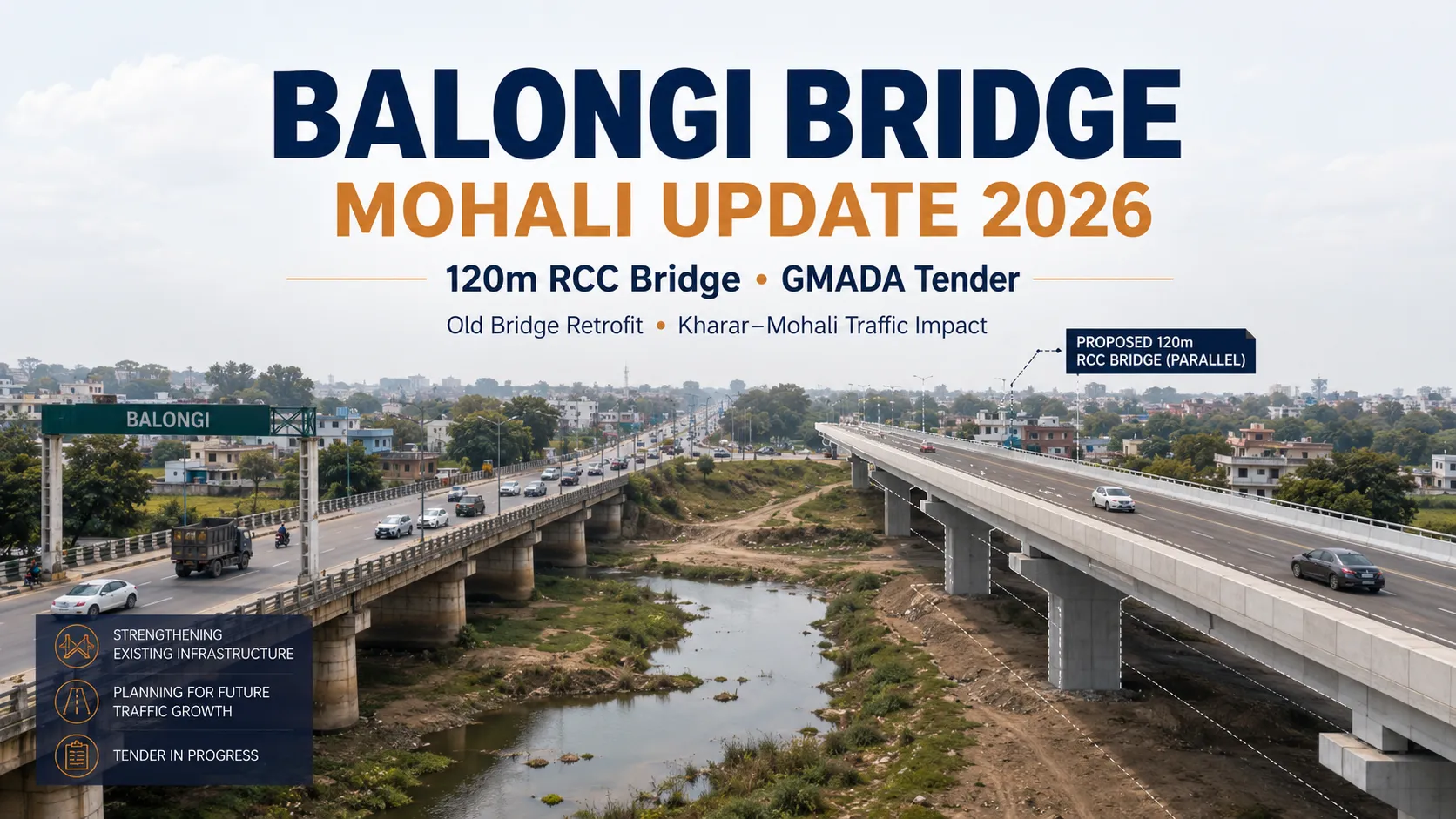
The Balongi bridge Mohali update 2026 has become an important infrastructure development after GMADA issued a fresh tender for a 120-metre high-level RCC bridge near Balongi on a 100-ft-wide road.
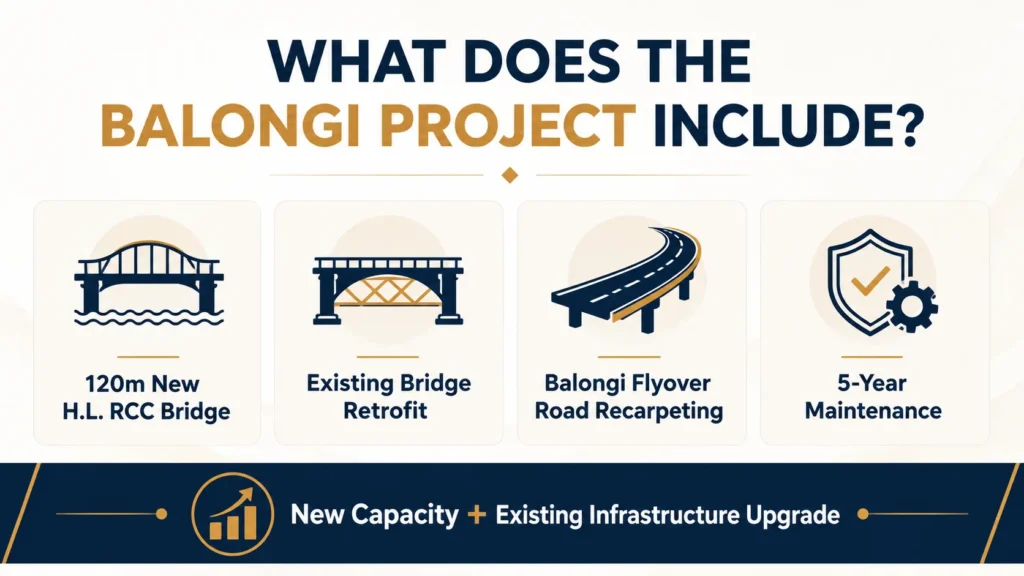
The project is more comprehensive than simply constructing another bridge. The reported scope includes a new 120-metre high-level RCC bridge, strengthening and retrofitting of the existing bridge over Patiala Ki Rao, recarpeting of the dual carriageway from Balongi flyover toward the proposed bridge approach, and five years of maintenance after completion.
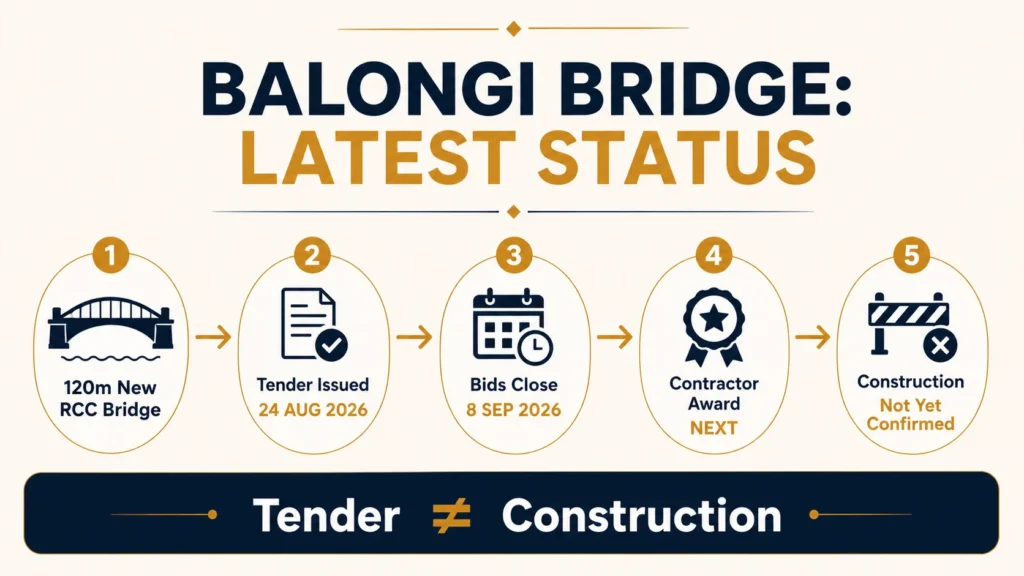
GMADA issued the tender on 24 August 2026, with bids scheduled to close on 8 September 2026 at 11:00 AM.
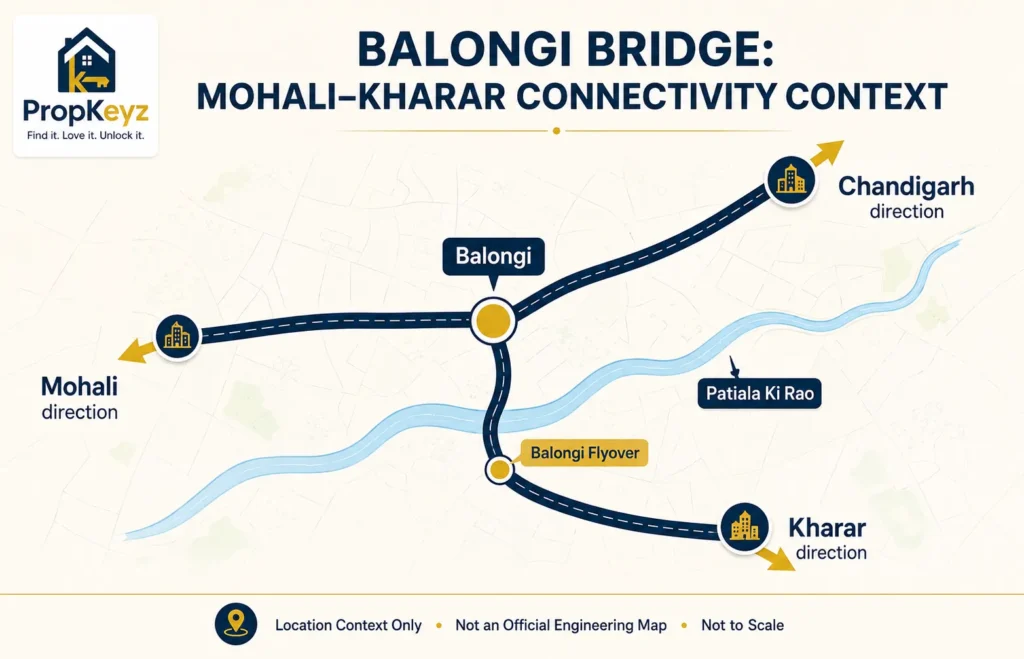
Balongi is an important entry and movement point connecting parts of Mohali, Kharar and Chandigarh-side traffic. That makes the project important not only for nearby property owners but also for thousands of everyday commuters.
However, buyers and investors need to understand the current stage correctly.
Tender Issued → Bid Evaluation → Contractor Award → Site Mobilisation → Construction → Bridge Opening → Traffic Response → Property Impact
At present, the project is still at the tender and procurement stage.
PropKeyz View
A bridge at a city gateway creates value primarily by removing daily travel friction—not by creating a speculative property headline.
Balongi Bridge Mohali Update 2026: Quick Answer
The Balongi bridge Mohali update 2026 involves a fresh GMADA tender for a proposed 120-metre high-level RCC bridge near Balongi.
The project is intended to improve an already important urban road corridor rather than create an entirely new greenfield connectivity route.
Latest Verified Position
| Factor | Position as of 28 August 2026 |
|---|---|
| Authority | GMADA |
| Location | Balongi, SAS Nagar |
| New Bridge | 120-metre H.L. RCC bridge |
| Road Width Referenced | 100 ft |
| Watercourse | Patiala Ki Rao |
| Existing Bridge | Retrofitting / strengthening included |
| Road Work | Dual-carriageway recarpeting included |
| Connection Referenced | Balongi flyover to proposed bridge approach |
| Tender Issued | 24 August 2026 |
| Bid Deadline | 8 September 2026, 11:00 AM |
| Maintenance | Five years |
| Contractor Award | Not yet confirmed |
| Physical Construction Start | Not yet confirmed |
| Operational Bridge | No |
| Current Stage | Tender / procurement |
| Main Potential Benefit | Traffic flow, safer movement and better road reliability |
| Property Appreciation | Not guaranteed |
Current reporting also states that more than 30,000 people use this bridge or route daily, which reinforces why the project should primarily be viewed as an urban mobility improvement rather than a speculative property trigger.
PropKeyz View
The tender is an execution signal. The mobility benefit starts only when the bridge becomes usable.
What Exactly Has GMADA Tendered at Balongi?
The project consists of several infrastructure components that need to be understood separately.
1. New 120-Metre High-Level RCC Bridge
The main component is a proposed:
120-metre-span High-Level Reinforced Cement Concrete bridge
near Balongi.
This is intended as permanent urban road infrastructure rather than a temporary crossing.
2. Retrofitting the Existing Patiala Ki Rao Bridge
GMADA is not simply planning to build a second bridge while ignoring the existing structure.
The project also includes:
retrofitting, rehabilitation and strengthening of the existing bridge over Patiala Ki Rao.
This means the broader project combines:
New Capacity + Existing Infrastructure Rehabilitation
That is more significant than simply saying that “Balongi is getting a new bridge.”
3. Recarpeting the Existing Dual Carriageway
The bridge approach is also part of the project.
The reported tender scope includes recarpeting of the existing dual carriageway from Balongi flyover toward the proposed bridge approach.
This is important because a bridge can only function efficiently when the surrounding road network also supports traffic movement.
PropKeyz View
A good bridge with a poor approach road simply moves the bottleneck rather than solving it.
4. Five Years of Maintenance
The project also includes five years of maintenance after construction.
Long-term bridge usability depends on much more than the condition of the structure on inauguration day.
It also depends on:
- road-surface maintenance,
- bridge joints,
- drainage,
- markings,
- approach roads,
- structural upkeep.
Where Exactly Is the Balongi Bridge?
The project is planned near Balongi, an important traditional entry area into Mohali.
Earlier planning references identified the new bridge as being proposed parallel to the existing bridge over Patiala Ki Rao.
The latest tender context describes the project on a 100-ft-wide road, with strengthening of the existing bridge also included.
Its broader traffic relevance comes from movement involving:
- Balongi,
- Mohali,
- Kharar,
- Chandigarh-side traffic,
- nearby residential areas and villages.
Balongi therefore functions as more than a local neighbourhood crossing.
It is part of a wider urban gateway.
PropKeyz View
Infrastructure value depends on network position. A modest bridge at a major gateway can matter more than a larger structure on a lightly used road.
Why Is a New Balongi Bridge Needed?
The infrastructure problem is not new.
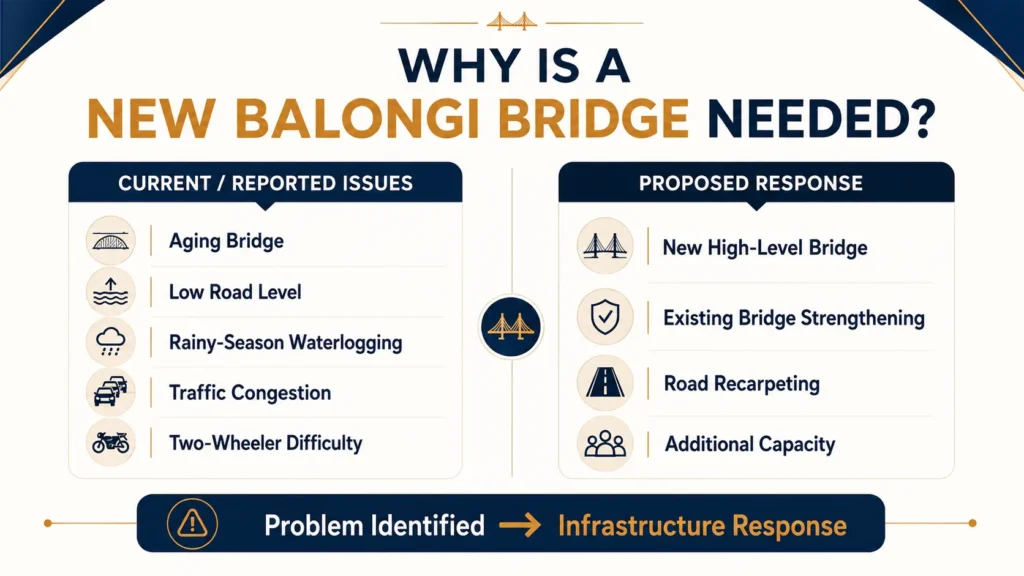
Earlier reporting highlighted problems with several Mohali entry-point bridges, with Balongi specifically associated with:
- deterioration,
- traffic congestion,
- road-level issues,
- rainy-season waterlogging,
- difficulties for cyclists and two-wheeler users.
The existing bridge was reported to sit at a lower level than adjoining four-lane roads, contributing to water accumulation during rainy periods.
This means the project potentially addresses three different problems:
Capacity + Reliability + Safety
PropKeyz View
A bridge project can create value in three ways: capacity, reliability and safety.
Why Does Bridge Height Matter During the Monsoon?
A low bridge or poorly integrated road crossing can become vulnerable when:
- surrounding roads are at different elevations,
- storm-water drainage is weak,
- water accumulates,
- the nearby watercourse carries higher monsoon flows.
Earlier reports connected Balongi’s existing bridge level with rainy-season waterlogging.
A high-level bridge can potentially improve crossing reliability, but investors should not interpret that as a guarantee that every drainage or flooding issue in the wider area will disappear.
Actual performance will depend on:
- final bridge elevation,
- approach-road levels,
- drainage design,
- Patiala Ki Rao flow,
- long-term maintenance.
What Is Patiala Ki Rao?
Patiala Ki Rao is an important natural drainage and seasonal watercourse system affecting parts of the Chandigarh–Mohali region.
The existing Balongi bridge crosses this watercourse, and the new bridge is planned within the same broad crossing context.
Bridge infrastructure around a seasonal watercourse must consider:
- monsoon flow,
- hydraulic capacity,
- drainage,
- approach-road protection,
- structural durability.
For property buyers, this also provides an important due-diligence lesson.
Infrastructure near a choe or seasonal watercourse should be evaluated for drainage and flood behaviour—not only road width and connectivity.
What Changed in August 2026?
The most important current development is that:
GMADA has issued a fresh tender.
The tender was issued on 24 August 2026, and bids are currently scheduled to close on:
8 September 2026 at 11:00 AM
This is a meaningful procurement milestone.
But a tender is not yet:
- contractor appointment,
- work order,
- site mobilisation,
- bridge construction,
- project completion.
PropKeyz Infrastructure Rule
Tender = intent to procure execution. Award = contractor selected. Construction = physical execution. Opening = actual user benefit.
Why Is the Fresh Tender Important Given the Earlier 2025 Announcement?
This is one of the most important lessons from the Balongi bridge story.
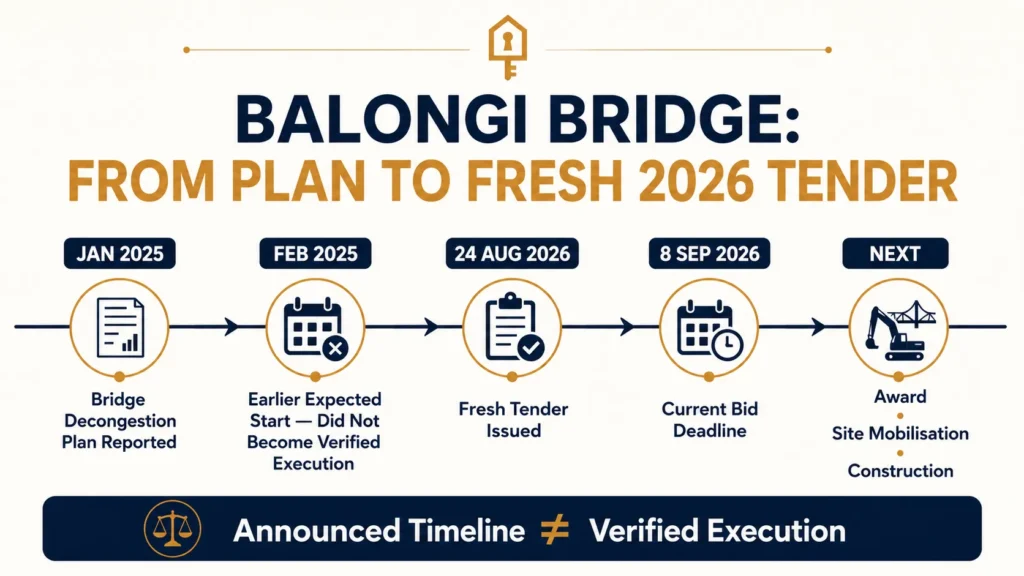
In January 2025, GMADA officials had indicated that bridge work could begin around February 2025.
The same period also carried an estimated cost of approximately ₹9 crore for the Balongi bridge.
Yet a fresh tender has now been issued in August 2026.
That tells buyers something important about infrastructure timelines:
Projected start dates can change materially.
Therefore a statement such as:
“Bridge next month start ho jayega”
should never be valued in the same way as:
an awarded contract with actual machinery and manpower on site.
PropKeyz View
An announced construction month is not the same as a verified construction start.
Balongi Bridge Timeline: 2025 to August 2026
January 2025 — Existing Problems Highlighted
Balongi’s existing bridge was publicly discussed in connection with:
- poor condition,
- congestion,
- waterlogging,
- safety concerns.
January 2025 — New Parallel Bridge Plan Reported
GMADA’s wider bridge-decongestion programme included a new bridge proposed parallel to the existing Patiala Ki Rao crossing.
At that time, officials expected work to begin shortly.
February 2025 — Earlier Expected Start
Construction had been expected to begin around February 2025.
That projected timeline did not turn into verified operational infrastructure.
24 August 2026 — Fresh Tender Issued
GMADA initiated the current procurement process for:
- the 120-metre H.L. RCC bridge,
- existing bridge retrofit,
- approach-road recarpeting,
- five-year maintenance.
8 September 2026 — Current Bid Deadline
The current tender is scheduled to close at:
11:00 AM on 8 September 2026
What Comes Next?
The next major milestone is:
Contractor Award → Work Order → Site Mobilisation
not simply another announcement.
Has Construction of the New Balongi Bridge Started?
As of 28 August 2026, the safest answer is:
No verified physical construction start for the new 120-metre bridge has yet been established.
The project should currently be described as being at:
tender / procurement stage.
Therefore:
“GMADA has tendered a proposed 120-metre bridge”
is safer than:
“GMADA is building the new Balongi bridge”
if the latter suggests active construction is already taking place.
What Happens After the 8 September Tender Deadline?
The project still needs to pass through several stages.
Bid Submission
Contractors submit bids.
Bid Evaluation
GMADA evaluates technical and financial proposals.
Contractor Selection
A successful bidder may be identified.
Award / Agreement
The contract is formally awarded.
Site Mobilisation
Construction machinery, workers and traffic arrangements begin appearing.
Construction
Physical bridge work begins.
Existing Bridge Retrofit
The current structure undergoes strengthening and rehabilitation.
Road Recarpeting
The Balongi flyover-to-bridge approach is upgraded.
Bridge Opening
The new crossing becomes usable.
Maintenance Period
The five-year maintenance obligation follows completion.
PropKeyz View
For search news, the tender date matters. For property value, the operational date matters more.
How Much Will the Balongi Bridge Cost?
This is currently one of the areas where buyers should be careful.
Some current tender-monitoring databases show a tender value around:
₹1.85–₹1.86 crore
However, an earlier January 2025 statement from a GMADA engineering official placed the Balongi bridge estimate at approximately:
₹9 crore
That is a substantial difference.
There may be reasons such as:
- a changed scope,
- separate BOQ packages,
- project restructuring,
- engineering revisions.
But without complete current tender documentation, these possibilities should not be presented as confirmed facts.
PropKeyz therefore does not recommend treating either number as the definitive full current project cost until the current award or complete BOQ clarifies the position.
PropKeyz Research Rule
When two project stages show materially different cost figures, publish the discrepancy and wait for the current award before declaring a final cost.
Is the New Bridge the Same as Balongi Flyover?
No.
This is an important distinction.
Balongi Flyover
The Balongi flyover is existing highway infrastructure forming part of the wider Chandigarh–Kharar road network.
New Balongi RCC Bridge
The 2026 project involves:
- a proposed 120-metre H.L. RCC bridge,
- existing Patiala Ki Rao bridge strengthening,
- recarpeting from the Balongi flyover toward the bridge approach.
The infrastructure is connected.
But the flyover and bridge are not the same structure.
PropKeyz Rule
Flyover ≠ bridge. Existing bridge ≠ proposed parallel bridge.
Why Is the Balongi Flyover Approach Included?
A bridge does not operate independently from its connecting roads.
The current project includes recarpeting between the Balongi flyover side and the bridge approach.
The wider movement chain can therefore be understood as:
Balongi Flyover → Approach Road → New / Existing Bridge System → Local Road Network
If one part remains inefficient, the bottleneck can simply shift somewhere else.
PropKeyz View
Transport networks create value through continuity, not individual infrastructure monuments.
How Many People Use the Balongi Bridge?
Current reporting states that:
more than 30,000 people use the route daily.
This should be treated as a reported figure rather than an independently verified PropKeyz traffic count.
Even so, it indicates that the bridge is a meaningful everyday commuting asset.
A road used by tens of thousands of people each day has a different impact from infrastructure designed mainly to unlock undeveloped land.
Could the New Bridge Improve Mohali–Kharar Traffic?
Potentially.
Balongi sits on an important movement interface involving:
- Mohali,
- Kharar,
- Chandigarh-side traffic,
- nearby villages,
- residential catchments.
A successful new parallel high-level bridge, along with rehabilitation of the existing structure, could potentially provide:
- more crossing capacity,
- improved route reliability,
- better directional movement,
- reduced bottleneck pressure,
- stronger monsoon usability.
But real traffic benefits should be measured only after the bridge becomes operational.
PropKeyz View
A bridge can remove one bottleneck. It cannot by itself solve every congestion point on the Mohali–Kharar network.
Could the Bridge Reduce Commute Time?
Possibly for travellers whose normal route uses this crossing.
The actual benefit will depend on:
- peak-hour traffic,
- lane configuration,
- junction design,
- surrounding road congestion,
- Balongi flyover traffic,
- Kharar-side bottlenecks.
Therefore it would be premature to claim a specific travel-time saving.
A responsible statement is:
The project may reduce delay at an existing bottleneck once completed.
Could the Bridge Improve Road Safety?
Potentially.
Earlier reports raised concerns around:
- bridge condition,
- traffic congestion,
- waterlogging,
- difficulties for cyclists and scooter riders.
A new high-level bridge plus strengthening of the existing structure could improve overall conditions.
However, safety also depends on:
- lighting,
- road markings,
- drainage,
- approach geometry,
- junction design,
- lane discipline,
- maintenance.
PropKeyz View
Infrastructure creates the opportunity for safer movement. Design, maintenance and driver behaviour determine the result.
Could the New Bridge Improve Monsoon Reliability?
Potentially.
The existing crossing has previously been associated with rainy-season waterlogging.
A higher bridge and upgraded road approaches could make the route more dependable during wet weather.
But buyers should not convert this into a claim that:
“Balongi flooding will end permanently.”
Drainage and flood behaviour depend on a much wider system than one bridge.
Is This a New Growth Corridor or an Existing-Corridor Upgrade?
This is primarily:
an existing-corridor upgrade.
That distinction matters for property analysis.
Balongi, Mohali and Kharar already have:
- existing residential development,
- businesses,
- road connectivity,
- large commuter flows.
The bridge is therefore mainly intended to improve:
- road reliability,
- traffic movement,
- safety,
- existing connectivity quality.
PropKeyz View
Greenfield infrastructure can create a new market. Urban infrastructure often improves the quality of an existing market.
What Does the Bridge Mean for Property Buyers?
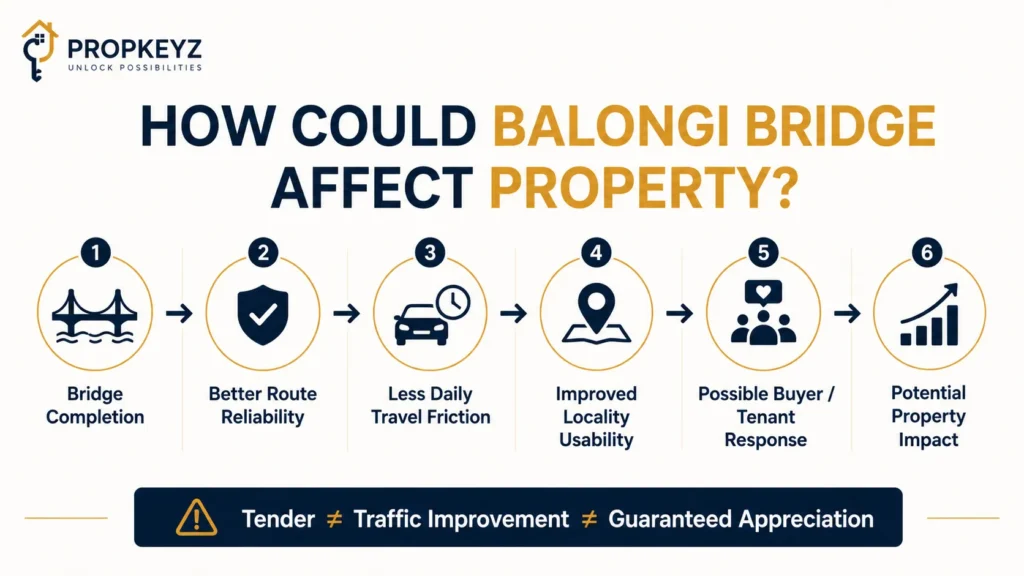
Better infrastructure can support:
- easier daily travel,
- improved locality perception,
- greater commute reliability,
- better buyer confidence,
- stronger resale convenience.
But infrastructure alone does not determine value.
A property still needs to be evaluated on:
- exact location,
- title,
- approvals,
- current price,
- current access,
- condition,
- rental demand,
- competing supply.
PropKeyz Rule
Infrastructure should strengthen a good property thesis—not replace one.
Could Balongi Property Benefit?
Potentially.
Improved bridge infrastructure could strengthen the usability and perception of the Balongi gateway.
That may help:
- residents,
- commuters,
- businesses,
- property owners.
But properties immediately adjacent to heavy traffic infrastructure can also face disadvantages such as:
- road noise,
- congestion,
- restricted access,
- temporary construction disruption.
Therefore:
Closer to the bridge is not automatically better.
Could Kharar Property Benefit?
Potentially, but indirectly.
Kharar is a large property market.
Its investment story depends on much more than one bridge, including:
- affordability,
- Chandigarh and Mohali employment access,
- project quality,
- internal roads,
- rental demand,
- traffic,
- competing inventory.
The Balongi bridge should therefore be treated as:
one supporting connectivity factor
rather than:
the main reason to buy property in Kharar.
Could Mohali Residential Sectors Benefit?
The strongest direct benefit is likely to go to properties whose residents actually use the Balongi route regularly.
The right question is not:
“Which property is geographically closest to the bridge?”
It is:
“Does this property’s normal commute actually depend on this corridor?”
PropKeyz Rule
Infrastructure proximity matters less than infrastructure usability.
Could Rental Demand Increase?
Possibly, but any effect is likely to be indirect.
Tenants generally choose homes based on:
- rent,
- commute,
- furnishing,
- property quality,
- neighbourhood,
- job location.
If bridge completion makes daily commuting more reliable, some rental locations could become more attractive.
But there is no basis today for assuming a guaranteed rent increase.
Could Commercial Property Benefit?
Some commercial properties may benefit from:
- smoother traffic,
- better road reliability,
- easier access.
But investors must distinguish:
traffic
from:
commercial footfall.
A high-traffic road does not automatically make every retail unit viable.
Retail success still depends on:
- stopping access,
- parking,
- frontage,
- visibility,
- service roads,
- pedestrian catchment,
- legal commercial use.
PropKeyz View
High traffic is useful only when customers can actually reach the business.
Balongi Bridge vs Sector 62–63 Mohali Bridge
These are two separate GMADA bridge projects.
Sector 62–63 Bridge
The Sector 62–63 project involves:
- a 52-metre RCC bridge,
- an established inner-Mohali bottleneck,
- a 100-ft sector-dividing road,
- retrofit of the existing adjacent bridge.
Read our complete Sector 62–63 Mohali Bridge Update 2026.
Balongi Bridge
The Balongi project involves:
- a 120-metre high-level RCC bridge,
- Patiala Ki Rao,
- existing bridge strengthening,
- road recarpeting,
- Mohali–Kharar gateway traffic.
PropKeyz View
Sector 62–63 addresses an inner-city bottleneck. Balongi strengthens a major city-entry corridor.
Balongi Bridge vs PR-6 Mohali Road
These projects are also different.
PR-6
PR-6 is a long-pending:
- 200-ft Master Plan road,
- land-acquisition story,
- litigation-linked infrastructure project,
- future road-connectivity corridor.
Read our detailed PR-6 Mohali Road Update 2026.
Balongi Bridge
Balongi is an existing-corridor bridge-capacity and rehabilitation project currently at tender stage.
PropKeyz View
PR-6 is about completing a missing network road. Balongi is about improving a heavily used existing crossing.
How Does PR-7 / Airport Road Fit Into the Balongi Story?
PR-7 / Airport Road is a separate major Mohali arterial corridor.
It should not be confused with the Balongi bridge.
However, city traffic functions as a network.
Improvements across:
- Airport Road,
- Kharar-side approaches,
- Master Plan roads,
- Balongi gateway
can collectively improve Mohali’s mobility.
For a wider connectivity analysis, read our PR-7 Airport Road Mohali Investment Guide and Mohali Airport Road Latest Update 2026.
How Is This Different From Sector 124’s 200-Ft Road?
The Sector 124 road is another completely separate infrastructure development.
That project concerns a different road alignment and recent GMADA/revenue-side land and site verification.
It is not the Balongi bridge.
Read our Sector 124 Mohali 200-Ft Road Update 2026.
PropKeyz Infrastructure Rule
Never group every 200-ft road, bridge and flyover into one Mohali infrastructure story. Exact project identity matters.
The Bigger Mohali Infrastructure Picture
Mohali is seeing several types of infrastructure development simultaneously.
Existing Road Upgrades
Example: Balongi bridge and approach-road rehabilitation.
New Urban Bridge Capacity
Example: Sector 62–63 bridge.
Master Plan Roads
Example: PR-6.
Regional Arterials
Example: PR-7 / Airport Road.
Greenfield Regional Connectivity
New highway projects can reshape longer-distance regional movement.
Each type of infrastructure affects property differently.
PropKeyz View
“Infrastructure coming” is not enough. Buyers should ask: what infrastructure, what stage, what access and what actual demand does it create?
How Should an Investor Value the Balongi Bridge Today?
Separate the analysis into two parts.
Current Property Value
Evaluate using:
- today’s road access,
- current neighbourhood,
- current market price,
- existing rental demand,
- title and approvals,
- property condition,
- current resale liquidity.
Future Bridge Upside
Add cautious weight for:
- the fresh GMADA tender,
- 120-metre new structure,
- old bridge strengthening,
- approach-road recarpeting,
- recognised traffic bottleneck.
Do Not Fully Price Yet
Do not pay as though these outcomes have already occurred:
- contractor award,
- completed bridge,
- reduced congestion,
- improved monsoon reliability,
- property appreciation.
PropKeyz View
Buy today’s property at today’s fundamentals. Let successful infrastructure execution create tomorrow’s upside.
Strong vs Weak Balongi Infrastructure Investment Thesis
Stronger Thesis
Verified Property
Good Current Access
Reasonable Entry Price
Existing Demand
Long-Term Holding Capacity
Future Balongi Bridge Upside
Weaker Thesis
Overpriced Property
Weak Current Access
Entire Investment Based on New Bridge
Short Holding Period
Assumed Immediate Appreciation
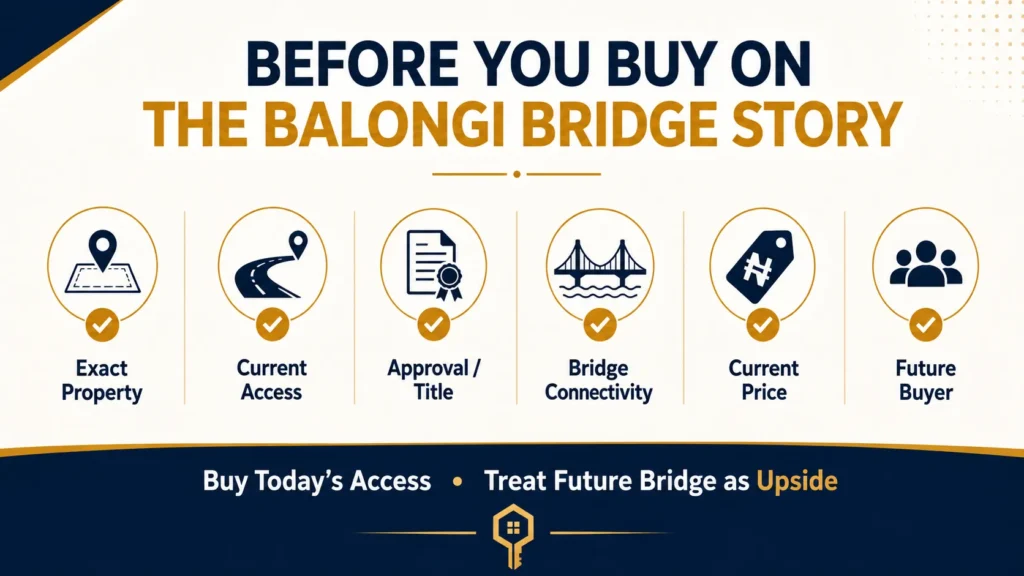
What Should Property Buyers Verify Before Investing?
Exact Property Location
Do not rely only on:
“Balongi bridge ke paas.”
Verify the exact site.
Current Access
Can the property be accessed properly today?
Title and Approval
Verify:
- ownership,
- land use,
- project approval,
- Punjab RERA where applicable.
Actual Bridge Dependency
Ask:
Will occupants of this exact property regularly use the Balongi crossing?
Current Market Price
Compare similar properties based on:
- size,
- age,
- approvals,
- current access,
- property type.
Construction Disruption
A major bridge project may temporarily cause:
- diversions,
- dust,
- congestion,
- changing access.
Future Exit Buyer
Ask:
Who will realistically buy this property from me later?
A property should not depend entirely on a bridge headline for its resale story.
What Should Investors Track Next?
The next important developments are:
Tender Result
What happens after 8 September 2026?
Contractor Award
Has GMADA selected a bidder?
Awarded Project Cost
This may help clarify the current cost discrepancy.
Work Order
Has formal execution been authorised?
Site Mobilisation
Is equipment appearing on site?
Traffic Diversion Plan
How will traffic be managed during construction?
Structural Construction
Have bridge foundations or structural works started?
Existing Bridge Retrofit
When does strengthening begin?
Road Recarpeting
When does the Balongi flyover-side road work begin?
Bridge Opening
When does the public actually gain new capacity?
Traffic Performance
Does congestion and monsoon reliability genuinely improve?
The PropKeyz Bridge-to-Property Framework
Stage 1 — Existing Problem
Congestion, waterlogging and bridge-condition issues.
Historically confirmed
Stage 2 — Engineering Plan
New parallel high-level bridge proposed.
Confirmed
Stage 3 — Tender
Contractors invited.
Current stage
Stage 4 — Award
Contractor selected.
Track
Stage 5 — Construction
Physical works begin.
Track
Stage 6 — Existing Bridge Retrofit
Old infrastructure strengthened.
Future execution
Stage 7 — Operational Bridge
Users gain additional crossing capacity.
Future
Stage 8 — Traffic Response
Congestion and reliability can be measured.
Future
Stage 9 — Locality Response
Daily commute perception may change.
Future
Stage 10 — Property Response
Buyer and tenant behaviour can be evaluated.
Future
PropKeyz Rule
Do not give Stage-10 property value to Stage-3 infrastructure.
What Is Confirmed vs Still Unconfirmed?
| Question | Status as of 28 August 2026 |
|---|---|
| New Balongi bridge project exists | Confirmed |
| GMADA is the authority | Confirmed |
| New bridge span is 120 metres | Confirmed |
| High-level RCC bridge is planned | Confirmed |
| 100-ft road is referenced | Confirmed |
| Existing Patiala Ki Rao bridge retrofit included | Confirmed |
| Balongi flyover-side recarpeting included | Confirmed |
| Five-year maintenance included | Confirmed |
| Tender issued 24 August 2026 | Confirmed |
| Bid deadline 8 September 2026 | Confirmed |
| 30,000+ daily users | Reported |
| Contractor awarded | Not yet confirmed |
| Physical construction started | Not yet confirmed |
| Bridge opening date | Not confirmed |
| ₹1.85–1.86 crore is definitive full project cost | Not safely confirmed |
| Earlier ₹9 crore estimate existed | Confirmed in earlier reporting |
| Guaranteed traffic reduction | No |
| Guaranteed property appreciation | No |
| Guaranteed rental growth | No |
Biggest Mistakes Buyers Should Avoid
Saying “Bridge Construction Has Started”
The project is currently at tender stage.
Confusing Balongi Flyover With Balongi Bridge
They are different structures.
Calling ₹1.85 Crore the Definitive Full Project Cost
The latest displayed tender amount differs significantly from the earlier estimate.
Assuming the February 2025 Start Date Happened
Projected dates and verified execution are different.
Assuming Every Kharar Property Benefits Equally
Impact depends on actual route usage.
Paying a Completed-Bridge Premium Today
The bridge is not yet operational.
Assuming Infrastructure Guarantees Appreciation
Property demand also depends on:
- current price,
- legality,
- rental demand,
- property quality,
- jobs,
- resale buyers.
Is Balongi a Better Property Story After the New Bridge Tender?
The tender improves the infrastructure credibility of the Balongi gateway.
That is positive.
But it does not automatically make every nearby property a good investment.
The better question is:
Does this exact property already make sense before the new bridge opens?
If the answer is yes, successful bridge execution can become additional upside.
If the answer is no, the investor may be paying too much for a future milestone.
Stronger Thesis
Good Current Property + Sensible Price + Usable Access + Existing Demand + Future Bridge Upside
Weaker Thesis
Weak Property + High Premium + Bridge Dependency + Short-Term Speculation
PropKeyz Verdict: Balongi Bridge Mohali Update 2026
The Balongi bridge Mohali update 2026 is a meaningful infrastructure development because GMADA has issued a fresh tender for a 120-metre high-level RCC bridge near one of Mohali’s important traditional entry points.
The tender was issued on 24 August 2026, and bids are scheduled to close on 8 September 2026 at 11:00 AM.
The project covers more than the new bridge.
It also includes:
- strengthening of the existing Patiala Ki Rao bridge,
- recarpeting of the road from Balongi flyover toward the bridge approach,
- five years of maintenance.
The infrastructure problem itself is well established.
Earlier reporting highlighted:
- bridge-condition concerns,
- low road levels,
- rainy-season waterlogging,
- traffic congestion,
- difficulties for two-wheeler users.
However, the project’s previous timeline is also an important reminder.
GMADA officials had earlier expected work to begin around February 2025, yet the fresh August 2026 tender shows that:
announced timeline and actual execution are not the same thing.
There is also a notable cost discrepancy between current tender-monitoring figures of around ₹1.85–₹1.86 crore and an earlier approximately ₹9 crore bridge estimate.
Until current official award documents clarify the final figure, neither should be presented as the unquestioned total project cost.
For commuters, a completed bridge could potentially improve:
- crossing capacity,
- road reliability,
- safety,
- Mohali–Kharar movement.
For property investors, however, the correct interpretation is more measured.
This is primarily:
an upgrade to an already important urban gateway
rather than:
a new greenfield corridor creating an entirely new property market.
Final PropKeyz View
A new bridge does not create property value merely by being tendered. It creates value when it becomes usable, reduces daily friction and improves how people actually move through the area.
The correct sequence is:
Tender → Award → Construction → Opening → Traffic Improvement → Better Locality Usability → Demand Response → Property Impact
And remember:
Buy today’s property for today’s fundamentals. Treat the Balongi bridge as future infrastructure upside until execution turns the tender into an operational crossing.
Frequently Asked Questions
What is the latest Balongi bridge Mohali update 2026?
GMADA issued a fresh tender on 24 August 2026 for a new 120-metre high-level RCC bridge near Balongi. The project also includes strengthening the existing bridge, road recarpeting and five years of maintenance. Bids are currently scheduled to close on 8 September 2026.
How long will the new Balongi bridge be?
The proposed new bridge is approximately 120 metres long.
Who is developing the Balongi bridge?
The project is being progressed by the Greater Mohali Area Development Authority — GMADA.
Where will the new Balongi bridge be built?
It is planned near Balongi within the existing Patiala Ki Rao bridge corridor on a 100-ft road.
Is there already a bridge at Balongi?
Yes. The current project includes strengthening and retrofitting the existing bridge while proposing additional bridge capacity.
Is Balongi bridge the same as Balongi flyover?
No. The existing Balongi flyover and the proposed 120-metre RCC bridge are different structures.
When was the latest tender issued?
The latest tender was issued on 24 August 2026.
When is the tender deadline?
The current bid-submission deadline is 8 September 2026 at 11:00 AM.
Has construction started?
No verified physical construction start has yet been confirmed. The project is currently at the tender/procurement stage.
Why is a new bridge required?
Earlier reporting highlighted congestion, bridge-condition concerns, rainy-season waterlogging, road-level issues and commuter-safety concerns at the existing crossing.
Will the old bridge be demolished?
The current project description instead includes retrofitting and strengthening of the existing structure.
Will the Balongi flyover-side road also be repaired?
Yes. Recarpeting from the Balongi flyover side toward the proposed bridge approach forms part of the reported project scope.
Is maintenance included?
Yes. The project includes five years of maintenance after completion.
How much does the Balongi bridge project cost?
Current tender-monitoring portals show approximately ₹1.85–₹1.86 crore, while an earlier 2025 GMADA estimate cited approximately ₹9 crore for the Balongi bridge. Because the figures differ substantially, the current final project cost should be verified from complete award or tender documents.
How many people use Balongi bridge daily?
Current reporting states that more than 30,000 people use this crossing or route daily. This is a reported figure rather than an independent PropKeyz traffic count.
Could the bridge improve Mohali–Kharar traffic?
Potentially. The new bridge could improve capacity and reliability at an existing bottleneck, although overall travel time will also depend on surrounding roads and junctions.
Will Balongi property prices increase?
Better infrastructure can support locality usability, but property appreciation is not guaranteed.
Could Kharar property benefit?
Some Kharar properties whose occupants rely on the Balongi route may benefit from improved connectivity, but the impact will vary by exact location and current access.
What should investors track next?
The most important next milestones are:
- tender result,
- contractor award,
- awarded project value,
- work order,
- physical construction,
- traffic diversions,
- existing bridge retrofit,
- final opening.
Explore Property in Mohali
Infrastructure is only one part of a strong property decision.
Before buying in Mohali or the wider Kharar–Mohali belt, compare:
- exact location,
- present connectivity,
- approvals,
- current asking price,
- rental demand,
- future infrastructure,
- resale competition.
Compare Mohali & Kharar Property Options With PropKeyz
If you are considering:
- Mohali,
- Kharar,
- Airport Road,
- Sector 117,
- new launches,
- resale properties,
- plots,
- commercial property,
PropKeyz can help you compare:
- current asking prices,
- approval status,
- exact road access,
- infrastructure relevance,
- rental potential,
- investment horizon,
- resale demand.
Compare Mohali & Kharar Property Options on WhatsApp
Looking for New Launch Property?
A bridge tender represents future infrastructure.
If your objective is to compare properties and projects actually available in today’s market, explore our latest project research.
Explore New Launch Projects in Mohali 2026
Buying for Investment? Think Beyond the Purchase
Buying an investment property is only one stage of ownership.
For eligible NRI, outstation and local owners across selected Mohali and Tricity locations, PropKeyz may also support:
- tenant coordination,
- property inspections,
- maintenance coordination,
- rent follow-up,
- move-in / move-out support,
- ongoing owner updates.
Explore NRI Property Management
Continue Your Mohali Infrastructure Research
Sector 62–63 Mohali Bridge Update 2026
Understand the separate 52-metre GMADA bridge project addressing an inner-Mohali traffic bottleneck.
Read Sector 62–63 Mohali Bridge Update 2026
PR-6 Mohali Road Update 2026
Understand the long-pending 200-ft Master Plan road, land acquisition and High Court-related execution issues.
Read PR-6 Mohali Road Update 2026
Sector 124 Mohali 200-Ft Road Update 2026
Understand the separate Sector 124 road story and its potential property impact.
Read Sector 124 Mohali 200-Ft Road Update 2026
PR-7 Airport Road Mohali Investment Guide
Understand how PR-7 fits into Mohali’s wider regional road network.
Read PR-7 Airport Road Mohali Investment Guide
Mohali Airport Road Latest Update 2026
Track the wider Airport Road infrastructure story.
Read Mohali Airport Road Latest Update 2026
Sources & Verification
This article was last fact-checked on 28 August 2026.
The latest tender scope, bridge length, tender date, bid deadline, existing-bridge retrofit, road recarpeting and maintenance period are based on current reporting around GMADA’s August 2026 Balongi tender.
The earlier bridge-condition, congestion, waterlogging and commuter-safety context comes from January 2025 reporting on Mohali’s entry-point bridges.
The earlier GMADA bridge programme, approximate ₹9 crore historical estimate and expected February 2025 start are also based on January 2025 reporting.
Current tender-monitoring sources show a substantially lower tender value of around ₹1.85–₹1.86 crore. Because this differs materially from the earlier estimate, PropKeyz has deliberately not presented either figure as the definitive current full project cost without complete current tender or award documentation.
Disclaimer
This article is intended for general real-estate information, infrastructure research and educational purposes only.
It does not constitute:
- engineering advice,
- financial advice,
- legal advice,
- investment advice,
- valuation advice.
Infrastructure tenders can change in:
- scope,
- contractor,
- cost,
- timeline,
- bid deadline,
- design,
- execution.
PropKeyz does not guarantee:
- successful tender award,
- bridge construction start,
- bridge opening date,
- traffic reduction,
- elimination of flooding or waterlogging,
- property appreciation,
- rental growth.
Property buyers should independently verify:
- exact property location,
- title,
- project approval,
- Punjab RERA where applicable,
- current road access,
- current asking price,
- total acquisition cost,
- latest bridge and tender status.
Your Property. Our Responsibility.