

Last Updated: 28 September 2026
Fact-Checked: 28 September 2026
The NRI Rental Income TDS 2026 rules are especially important for Mohali landlords who live abroad but continue to earn monthly rent from a:
- flat,
- independent house,
- builder floor,
- villa,
- apartment,
- other Indian property.
A major tax-law transition took effect on:
1 April 2026.
The familiar Income-tax Act, 1961 framework was replaced for current payment/credit events by the:
Income-tax Act, 2025.
For rental payments to a non-resident landlord, this means many older online guides using only:
Section 195 + Form 27Q + Form 16A
are now using legacy section/form terminology.
Under the current framework, the key references include:
Section 393(2) → Form 144 → Form 131
with Sections 395 and 397 also becoming important for:
- lower deduction,
- proportionate taxable amount,
- TAN and reporting compliance.
The Income Tax Department confirms that the old TDS provisions have been consolidated under Sections 392 and 393, with Section 393 covering non-salary payments. Its transition FAQ also says payments or credits arising on or after 1 April 2026 are governed by the new Act.
Read the Income Tax Department’s TDS Transition Guidance
For NRI property owners, this is not just a tax article.
It is also a:
property-management issue.
A remotely managed rental property can involve:
- monthly rent follow-up,
- tenant communication,
- TDS deduction,
- payment tracking,
- TDS certificate collection,
- maintenance,
- society dues,
- inspection,
- agreement renewal,
- tenant verification.
The biggest operational mistake is to treat:
“Rent Received”
as the only monthly metric.
For an NRI owner, a stronger system is:
Rent Due → TDS Compliance → Net Payment → Rent Ledger → Certificate → Property Status
PropKeyz’s NRI Property Management service is designed around operational coordination such as:
- rent tracking,
- tenant follow-up,
- inspections,
- maintenance coordination,
- owner reporting.
Tax-rate determination, TDS return preparation and tax advice should remain with:
the tenant/deductor and a qualified CA or tax professional.
Explore PropKeyz NRI Property Management
Key Takeaways
- The Income-tax Act, 2025 applies to relevant payments/credits occurring on or after 1 April 2026.
- Old Section 195 terminology belongs to the Income-tax Act, 1961.
- Current non-salary TDS provisions are primarily consolidated under Section 393.
- General taxable payments to non-residents can fall under Section 393(2), Table Sl. No. 17.
- That provision applies at the rates in force.
- Do not apply the resident-landlord ₹50,000-per-month rule automatically to an NRI landlord.
- A tenant paying rent to a non-resident should establish the landlord’s tax residential status first.
- Citizenship and tax residency are not the same question.
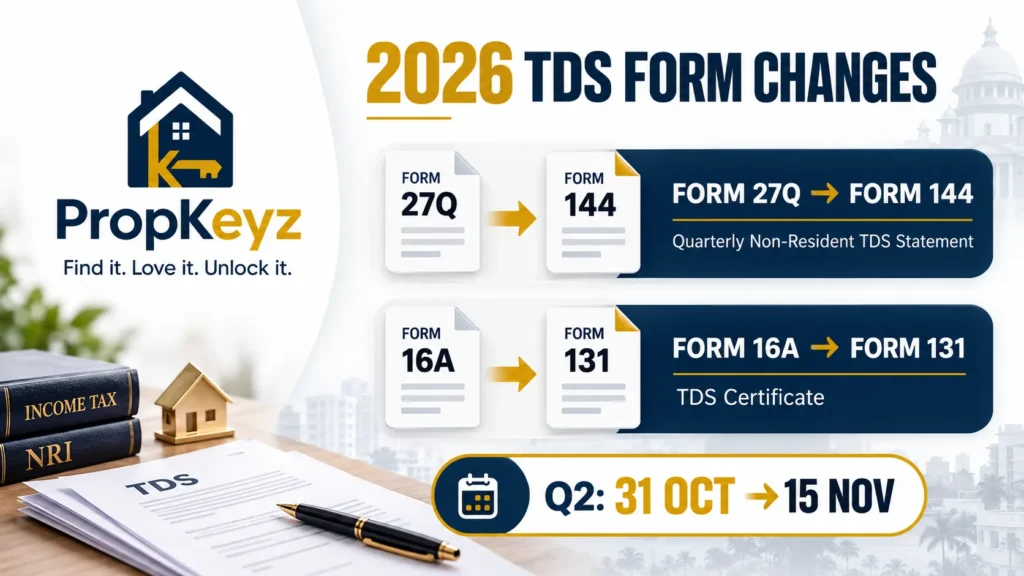
- The current quarterly non-resident TDS statement is Form 144.
- Form 144 replaces old Form 27Q.
- The current non-salary TDS certificate is Form 131.
- Form 131 replaces old Form 16A.
- For July–September 2026, Form 144 is due 31 October 2026.
- The corresponding Q2 Form 131 certificate is due 15 November 2026.
- The official Form 144 workflow requires a valid TAN.
- Form 141, which includes the current resident-rent challan-cum-statement route, is not available where the deductee is non-resident.
- The current rate schedule generally places a non-resident individual’s “other income” at a 30% base rate, subject to applicable surcharge/cess and legally available lower/proportionate treatment.
- Do not market 31.2% as a universal NRI rent rate.
- Section 395 allows lower/nil deduction certificates and determination of the chargeable proportion in appropriate cases.
- Property managers can coordinate rent records and owner reporting.
- A property manager should not pretend to replace:
- the tenant as deductor,
- a CA,
- the Income Tax Department.
- NRI rental compliance should be integrated with:
- written tenancy,
- tenant verification,
- rent ledger,
- inspection,
- maintenance records.
PropKeyz View
For an NRI owner, good property management should track not only whether rent was paid, but whether the payment trail is documented properly enough for the owner to understand gross rent, TDS and actual net receipt.
NRI Rental Income TDS 2026: Quick Answer
The NRI Rental Income TDS 2026 framework should not be confused with the simpler resident-landlord rent rules.
From 1 April 2026, relevant non-resident rental payments fall within the Income-tax Act, 2025 framework.
For a typical taxable payment to a non-resident landlord, an important current provision is:
Section 393(2), Table Sl. No. 17
covering:
any other sum chargeable under the Act, other than salary
paid to a non-resident.
The provision requires deduction at:
rates in force.
The current non-resident quarterly TDS statement is:
Form 144
and the corresponding non-salary TDS certificate is:
Form 131.
Current Quick Status
| Question | Current Position |
|---|---|
| Current Act | Income-tax Act, 2025 |
| Effective for current payments | 1 April 2026 onward |
| Legacy non-resident section | Section 195 |
| Current main provision | Section 393(2) |
| Relevant general entry | Table Sl. No. 17 |
| Resident ₹50k rent rule automatically applies? | No |
| TDS rate | Rates in force |
| Common base rate for non-resident individual’s other income | 30%, subject to applicable adjustments |
| Quarterly non-resident return | Form 144 |
| Old equivalent | Form 27Q |
| TDS certificate | Form 131 |
| Old equivalent | Form 16A |
| Q2 Form 144 deadline | 31 October 2026 |
| Q2 Form 131 deadline | 15 November 2026 |
| TAN required for Form 144 | Yes |
| Form 141 for non-resident landlord? | No |
| Lower/nil certificate route | Section 395 |
| Lower/nil application | Form 128 |
| Payer’s proportion-determination route | Section 395(2) |
| Payer application | Form 129 |

Direct Answer
If the owner is a non-resident for Indian tax purposes, the tenant should not simply use the normal resident-landlord rent-TDS process. The current non-resident route should be reviewed under Section 393(2), with the applicable rate, TAN, Form 144 reporting and Form 131 certificate process properly configured.
What Changed From 1 April 2026?
The Income Tax Department describes the 2026 transition as primarily a:
simplification and consolidation
rather than a wholesale change in TDS policy.
Under the old Act, taxpayers were used to individual provisions such as:
- Section 194-I,
- Section 194-IB,
- Section 195.
Under the Income-tax Act, 2025:
Section 392
Primarily covers:
salary TDS.
Section 393
Primarily covers:
other TDS payments.
The Department’s official guidance says:
TDS obligations triggered on or after 1 April 2026 should use the new Act and relevant Section 393 table entry.
Read the Official TDS Transition FAQ
PropKeyz Rule
Old terminology may still be useful for Google searches. Current compliance should follow the current Act.
Section 195 vs Section 393 — What Changed?

Up to 31 March 2026
NRI-payment guides commonly referred to:
Section 195
of the Income-tax Act, 1961.
From 1 April 2026
For current payment/credit events:
Section 393(2)
contains the non-resident TDS table.
For general taxable payments not otherwise covered by a more specific item, Table Sl. No. 17 covers:
any interest not covered by specified earlier entries or any other sum chargeable under the Act, excluding salary.
The official current Section 393 can be read here:
Income Tax Department — Section 393
Why Old Articles Still Say Section 195
Because:
- the old law existed for decades;
- taxpayers still search the old number;
- older rent agreements and CA guides use it.
Best SEO / Legal Practice
Mention:
“Old Section 195 / current Section 393(2)”
when educating readers.
But use the new law for current compliance.
Does Rent Paid to an NRI Attract TDS?
Where rent represents an amount chargeable to tax in India and is paid to a non-resident, the non-resident withholding framework becomes relevant.
Income from:
property situated in India
can be taxable in India for a non-resident.
The Income Tax Department’s own non-resident guidance confirms that income from house property located in India is taxable in India even where the owner is non-resident.
Income Tax Department — Taxation of Non-Residents
Important
The tenant should not decide:
“Owner lives abroad, therefore deduct X%.”
The sequence should be:
Tax Residential Status → Nature of Payment → Applicable Section → Applicable Rate / Certificate → Deduction
Who Has to Deduct TDS?
Under Section 393(2), the obligation generally applies to:
the person responsible for paying
the taxable amount to the non-resident.
For an ordinary residential tenancy, this usually means:
the tenant / payer.
Example
NRI owner owns:
3BHK in Mohali.
Tenant pays:
monthly rent.
The tenant should establish the correct withholding process rather than transferring the entire gross rent and asking the owner to “handle tax later.”
What About PropKeyz?
PropKeyz can support operational coordination such as:
- tracking whether rent is due;
- tenant follow-up;
- monthly rent-status reporting;
- organising copies of TDS certificates supplied by the deductor.
But:
PropKeyz does not automatically become the tenant’s statutory deductor or tax adviser merely because it manages the property.
See PropKeyz Property Management Services
Resident Landlord vs NRI Landlord
This distinction should be made before anyone calculates TDS.
| Issue | Resident Landlord | Non-Resident Landlord |
|---|---|---|
| Current framework | Section 393(1) | Section 393(2) |
| Specific resident-rent provisions | Yes | Different route |
| ₹50,000/month threshold relevant to resident rent entries | Yes | Do not automatically import it |
| Form 141 route potentially relevant | Yes, specified resident transactions | No |
| Quarterly Form 144 | No for ordinary resident rent | Relevant non-resident statement |
| TAN | Special resident route may use PAN-only process | Form 144 process requires TAN |
| Rate | Specific resident-rent rate | Rates in force / applicable non-resident treatment |
| Tax residency check critical? | Yes | Essential |
PropKeyz Rule
Do Not Calculate Rent TDS Until You Know Whether the Landlord Is Resident or Non-Resident for Tax Purposes.
Does the ₹50,000 Monthly Threshold Apply to NRI Rent?
This is one of the most common online mistakes.
The current Section 393(1) resident-rent table contains:
₹50,000 per month or part of a month
thresholds for specified resident-rent provisions.
But NRI/non-resident payments are in:
Section 393(2).
The general non-resident entry at Table Sl. No. 17 does not simply copy the resident ₹50,000 monthly threshold.
Therefore
Do not say:
“Rent ₹45,000 hai, NRI owner ko TDS nahi lagega.”
only because the amount is below ₹50,000.
PropKeyz Rule
₹50,000 Resident-Rent Threshold ≠ Universal NRI-Rent Threshold
What Rate Applies to NRI Rent?
Section 393(2), Table Sl. No. 17 says:
rates in force.
The current rate schedule generally places:
the whole of other income of a non-resident individual at a 30% base income-tax rate
where no more specific rate applies.
But that does not mean every tenant should blindly use:
30%
or:
31.2%
without review.
Why?
The actual withholding can be affected by:
- surcharge;
- health & education cess;
- lower/nil deduction certificate;
- determination of the amount actually chargeable;
- applicable tax-treaty considerations;
- recipient details.
Practical Owner Rule
Before tenancy begins, ask a qualified CA/tax professional to confirm:
the rate the tenant should use for this owner for the current tax year.
Is NRI Rent TDS Always 31.2%?
No.
You may see:
31.2%
online because:
30% income tax + 4% cess on that tax = 31.2%
where:
- 30% base applies;
- no surcharge changes the calculation.
But this should be treated as:
a common arithmetic example
not:
a universal statutory fixed rent rate.
Why the Final Withholding May Differ
- surcharge may apply;
- a lower certificate may exist;
- Section 395 determination may apply;
- only an appropriate chargeable portion may be determined;
- other facts can affect treatment.
PropKeyz Rule
Never Put “31.2% NRI TDS” Into a Rent Agreement Without Tax Review.
When Should TDS Be Deducted?
Section 393(2) generally applies at the earlier of:
- credit of the amount to the payee;
- actual payment.
This means monthly rental compliance should not be postponed until:
the end of the year.
Example
Rent due:
5 October.
If payment/credit triggers the TDS obligation in October:
the tenant should follow the applicable October withholding and deposit process.
Monthly Property-Management Implication
The owner rent ledger should ideally distinguish:
| Item | Example |
|---|---|
| Gross rent | ₹50,000 |
| TDS | As legally applicable |
| Net paid | Gross less TDS |
| Payment date | Recorded |
| TDS deposit status | Tracked |
| Certificate | Collected quarterly |
What Is Form 144?
From the 2026-27 tax year, Form 144 is the quarterly statement for TDS on:
non-salary payments made to non-residents.
It replaces:
Form 27Q
under the previous Act.
The Income Tax Department describes it as a quarterly statement that must be filed by a deductor making taxable non-salary payments to:
- NRIs;
- foreign companies;
- other non-resident persons.
Income Tax Department — Form 144 FAQ
Form 144 Is Not Filed by the NRI Owner
It is filed by:
the deductor.
For normal rent:
usually the tenant/payer.
Current Form 144 Due Dates
| Quarter | Period | Form 144 Due Date |
|---|---|---|
| Q1 | Apr–Jun | 31 July |
| Q2 | Jul–Sep | 31 October |
| Q3 | Oct–Dec | 31 January |
| Q4 | Jan–Mar | 31 May following the tax year |
Current Immediate Deadline
For:
July–September 2026
the Form 144 filing deadline is:
31 October 2026.
This is particularly relevant for tenants currently paying rent to NRI landlords.
What Is Form 131?
Form:
131
is the current non-salary TDS certificate under the Income-tax Act, 2025.
It replaces:
Form 16A.
The deductor provides it to the non-resident owner as evidence that:
- TDS was deducted;
- the amount was reported/deposited.
The Income Tax Department says Form 131 is generated through TRACES after the relevant TDS statement is processed.
Income Tax Department — Form 131 FAQ
Q2 2026 Deadline
For July–September 2026:
- Form 144 due: 31 October 2026
- Form 131 due: 15 November 2026
Why NRI Owners Should Keep It
Form 131 can support:
- TDS-credit reconciliation;
- tax-return records;
- owner accounting.
PropKeyz Rental File
An NRI owner’s quarterly rental file can include:
Rent Ledger + Bank Credits + Form 131 + Maintenance Ledger
Does a Tenant Need TAN?
Under the current ordinary non-resident quarterly reporting process:
yes, the Form 144 filing workflow requires a valid TAN.
The official Form 144 User Manual lists:
valid TAN registered on the e-Filing portal
as a prerequisite.
This differs from certain simplified resident-rent/payment processes that use a:
PAN login / challan-cum-statement.
PropKeyz Rule
Do Not Tell an NRI-Landlord Tenant to Use the Resident PAN-Only Rent Form.
Why Form 141 Is Not the NRI Rent Form
Form 141 is the new consolidated challan-cum-statement that replaces old:
- Form 26QB;
- Form 26QC;
- Form 26QD;
- Form 26QE
for specified transactions.
But the Income Tax Department explicitly says:
Form 141 cannot be filed where the deductee is non-resident.
Income Tax Department — Form 141 FAQ
That means a tenant should not think:
“Old 26QC tha, ab Form 141 bhar denge even though owner is NRI.”
The non-resident route is different.
Section 395: Can an NRI Owner Get Lower or Nil TDS?
Potentially, where justified under the law.
Section 395 provides certificate mechanisms for:
lower or nil deduction
in appropriate cases.
The Assessing Officer can issue a certificate where the recipient’s expected tax position justifies a lower rate or no deduction.
Income Tax Department — Section 395
Why This Can Matter
The default withholding on gross payments can materially reduce monthly cash flow.
An owner may ultimately have:
- deductible house-property treatment;
- other tax attributes;
- lower actual liability.
A lower-deduction certificate can align withholding more closely with expected liability where legally justified.
Important
PropKeyz should not advise:
“Apply and your rate will definitely fall.”
The certificate depends on:
Income Tax authority approval.
What Is Form 128?
Current:
Form 128
replaces old:
Form 13
for the lower/nil deduction certificate application under Section 395(1).
The notified form permits an eligible taxpayer to request:
- lower deduction;
- nil deduction
subject to the statutory conditions.
Income Tax Rules 2026 — Form 128
Owner Action
An NRI owner who believes standard withholding materially exceeds expected tax should:
discuss Form 128 with a qualified CA/tax professional.
What Is Form 129?
Section 395(2) gives the payer another important route.
Where the payer believes:
the entire sum is not chargeable to tax
the payer can apply to the Assessing Officer to determine:
the appropriate proportion of the sum that is chargeable.
The prescribed application is:
Form 129.
This replaces the logic familiar from the old non-resident appropriate-proportion process.
Why This Matters for Rent
Gross rental payment and final taxable income are not necessarily the same thing.
But:
the tenant should not invent their own taxable proportion.
A formal Section 395 process may be required where relevant.
Citizenship vs Tax Residency
One of the most important NRI property-management distinctions is:
Indian Citizen ≠ Automatically Resident Taxpayer
and:
Foreign Address ≠ Automatically Non-Resident Taxpayer
Tax residential status is determined under:
Section 6
and related statutory tests.
The Income Tax Department confirms that the basic residency framework continues under the Income-tax Act, 2025.
Income Tax Department — Non-Resident FAQs
Why Property Managers Should Care
At tenant onboarding, the owner should clearly communicate:
- correct tax-residency position;
- PAN;
- payment instructions;
- CA contact where appropriate.
PropKeyz Rule
The Tenant Should Not Guess the Owner’s Tax Status From WhatsApp Country Code.
What Documents Should an NRI Owner Give the Tenant?
A practical onboarding package can include:
Owner
- full legal name;
- PAN;
- tax residency declaration/details as advised;
- Indian correspondence address where applicable;
- overseas contact;
- rent-payment instructions.
Property
- property address;
- rent agreement;
- owner authority/title details as appropriate;
- society/payment instructions.
TDS
- applicable withholding instruction confirmed with CA;
- TAN/process guidance for tenant;
- lower-deduction certificate if issued;
- CA contact where owner wants direct compliance coordination.
PropKeyz Rule
Make the Tax Process Clear Before the First Rent Becomes Due.
Does Rent Have to Be Paid Into an NRO Account?
NRI banking/FEMA treatment should be configured with:
- the owner’s bank;
- CA/tax adviser;
- FEMA adviser where needed.
A property manager should not make blanket promises such as:
“Every NRI rent must always be paid only to this specific account type.”
The owner should provide:
valid written bank instructions.
Important
TDS responsibility and bank-account destination are:
related operational issues but different legal questions.
Can a Property Manager Collect or Track NRI Rent?
Property management can support:
- rent reminders;
- rent-status tracking;
- tenant follow-up;
- monthly ledger;
- TDS-document follow-up;
- owner updates.
But the management model should clearly define:
who actually receives rent and who legally deducts tax.
PropKeyz’s current service model focuses on:
- rent tracking;
- follow-up;
- tenant coordination;
- reporting.
Property Management Company in Mohali
PropKeyz Rule
Property Management Can Organise the Workflow. It Should Not Blur the Taxpayer’s Legal Responsibility.
Property Manager vs CA: Who Handles What?
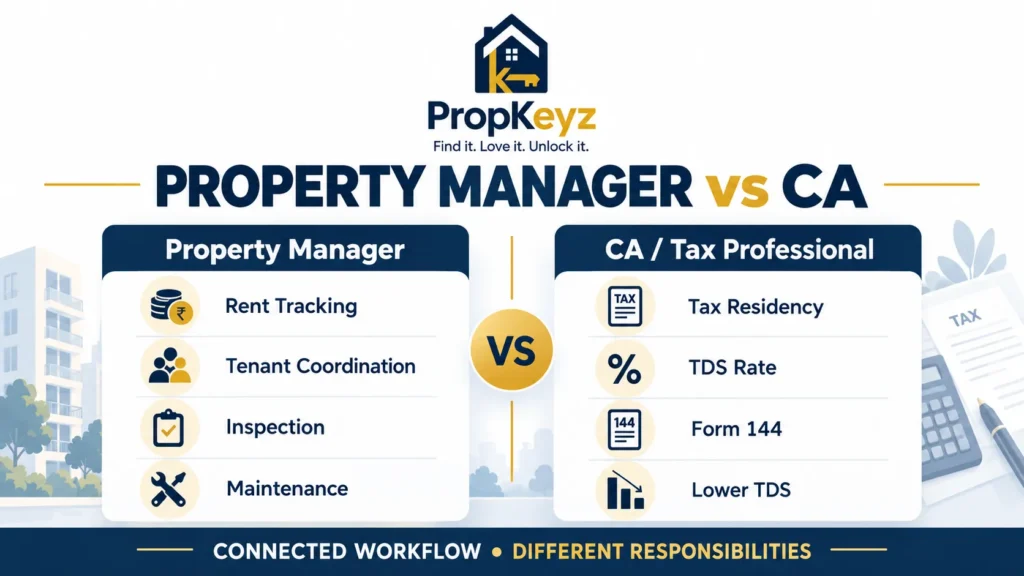
| Task | Property Manager | CA / Tax Professional |
|---|---|---|
| Rent due-date tracking | Yes | Usually no |
| Tenant follow-up | Yes | No |
| Monthly rent ledger | Yes | Can review |
| Property inspection | Yes | No |
| Maintenance coordination | Yes | No |
| Owner status update | Yes | No |
| Collect owner tax documents for coordination | Can assist | Review |
| Determine tax residency | Not final adviser | Yes |
| Determine exact TDS rate | No | Yes |
| Lower/nil certificate | Coordination only | Yes |
| Form 144 preparation | No unless qualified/engaged separately | Deductor/CA |
| Form 131 tax certificate | Track copy | Deductor/CA |
| Income-tax return | No | Owner/CA |
PropKeyz View
A professional property manager and a professional CA solve different owner problems. The best NRI workflow connects them instead of confusing their roles.
Monthly NRI Rental Management Workflow
A clean monthly system can look like this:
Before Rent Due Date
Check:
- current tenant;
- rent amount;
- due date;
- current TDS instructions;
- any arrears.
Rent Cycle
Record:
- gross rent;
- TDS;
- net payment;
- date received;
- bank reference.
Property Cycle
Track:
- maintenance request;
- society dues;
- inspection requirement;
- tenant issue.
Owner Update
Share:
Paid / Pending + TDS status + maintenance + next action
Quarterly
Confirm:
- Form 144 filing;
- Form 131 certificate;
- rent-ledger reconciliation.
For a broader explanation of how PropKeyz structures rent, tenant and maintenance workflows, see:
Property Management Services in Tricity 2026
Quarterly NRI TDS Checklist
For a non-resident landlord rental:
Deductor / Tenant
Check:
- TAN active;
- correct owner PAN;
- correct tax status;
- current TDS rate;
- monthly deduction;
- government deposit;
- Form 144;
- Form 131.
Owner
Check:
- net rent received;
- gross rent ledger;
- TDS certificate received;
- tax credit reflected;
- missing quarter followed up.
Q2 2026
Current dates:
Form 144 — 31 October 2026
Form 131 — 15 November 2026
PropKeyz Rule
Do Not Discover Missing TDS Certificates Only When the NRI Owner Starts Filing the Return.
Tenant Verification in Mohali Is a Separate Compliance Layer
Tax-compliant rent does not mean:
tenant onboarding is complete.
As of 28 September 2026, Mohali/SAS Nagar currently has a district-level tenant-information requirement reported under Section 163 BNSS.
The current order runs through:
18 October 2026
and requires landlord information regarding tenants/other covered occupants within the applicable period.
For the current police-verification process, fee and timeline, read:
Tenant Verification in Mohali 2026
PropKeyz Rule
Rent Agreement + TDS + Police Verification Are Three Separate Workflows.
Rent Agreement & NRI Eviction Planning
NRI owners should not focus only on tax.
A strong tenancy file should also record:
- landlord identity;
- tenant identity;
- rent;
- security;
- tenancy period;
- notice;
- inventory;
- repair responsibilities;
- possession/handover terms.
Punjab also has a significant 2026 High Court development affecting the special NRI-landlord eviction framework for newer tenancies.
Read:
NRI Landlord Eviction Punjab 2026
Property Management Lesson
Tax compliance does not repair a weak tenancy agreement.
Vacant vs Rented NRI Property
An NRI property can require very different management depending on whether it is:
Rented
Priority:
- tenant;
- rent;
- TDS;
- maintenance;
- renewal.
Vacant
Priority:
- inspection;
- leakage;
- electricity;
- society notices;
- access;
- security;
- cleaning.
Under Transition
Priority:
- move-out condition;
- security adjustment;
- repair;
- new tenant;
- new tax/TDS setup.
For wider remote-owner protection:
Mohali NRI Property Protection 2026
NRI Owner Document Checklist
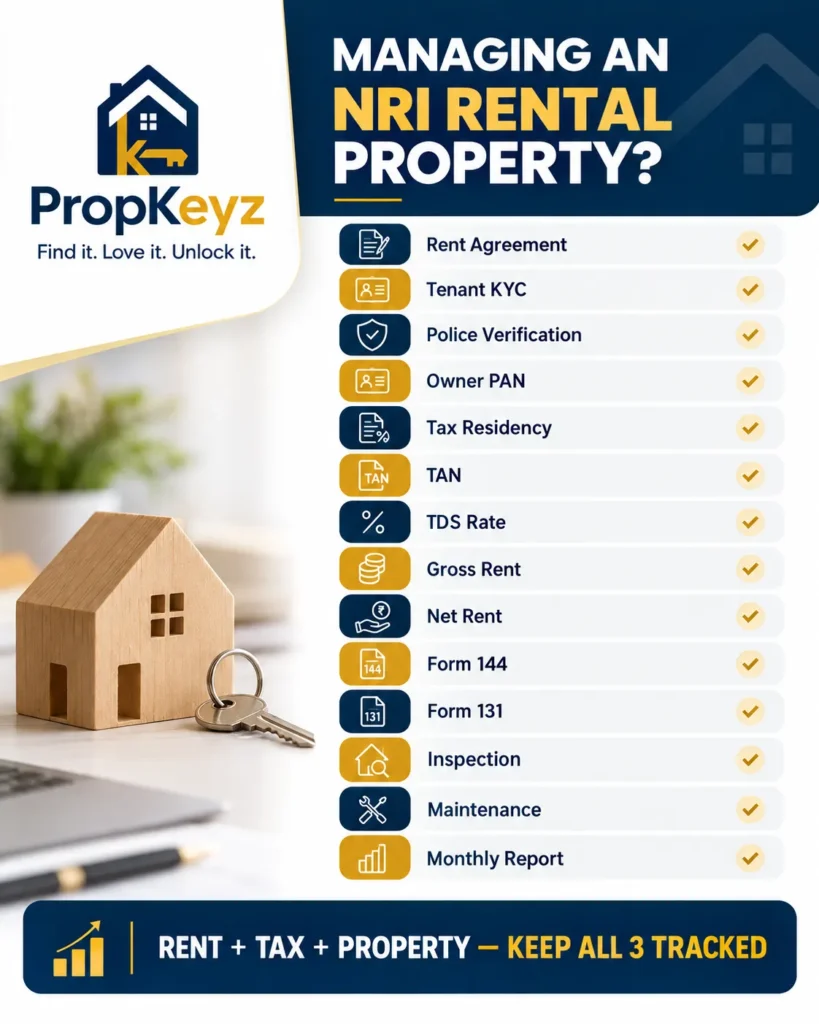
Maintain:
Identity & Tax
- PAN
- Passport
- Residential-status information
- CA contact
- Lower-deduction certificate if applicable
Property
- Sale/conveyance deed
- Authority/allotment documents where relevant
- Society details
- Insurance where maintained
Tenancy
- Rent agreement
- Tenant ID/KYC
- Police-verification record
- Move-in inventory
Rent & Tax
- Monthly rent ledger
- Bank receipts
- TDS deductions
- Form 144 status
- Form 131 certificates
Property Management
- Inspection reports
- Maintenance bills
- Owner approvals
- Move-in/move-out reports
Final Rule
NRI Property Management Should Create a Document Trail, Not Just a WhatsApp Chat History.
Common NRI Rental TDS Mistakes
Mistake 1 — Using the Resident ₹50,000 Rule
The owner is non-resident.
Different route.
Mistake 2 — Using Form 141
Official guidance says Form 141 is not available for non-resident deductees.
Mistake 3 — No TAN
Form 144 workflow requires TAN.
Mistake 4 — Sending Full Gross Rent
Without correctly handling applicable TDS.
Mistake 5 — Hard-Coding 31.2%
Without checking:
- surcharge;
- certificate;
- appropriate taxable proportion.
Mistake 6 — Forgetting Form 131
Owner needs proper TDS evidence.
Mistake 7 — Assuming “NRI” From Citizenship
Tax residency needs verification.
Mistake 8 — Asking the Property Manager to “Handle Tax”
Without appointing the appropriate tax professional/deductor workflow.
Mistake 9 — Mixing Rent TDS With NRI Property-Sale TDS
They are different transactions.
NRI Rent TDS vs Buying Property From an NRI
This distinction is extremely important.
| Issue | Rent Paid to NRI Landlord | Property Purchased From NRI Seller |
|---|---|---|
| Transaction | Recurring rent | Sale consideration |
| Current non-resident framework | Section 393(2) | Non-resident property-transfer withholding framework |
| Monthly/recurring? | Usually yes | Usually transaction milestones |
| Form 144 route | Relevant ordinary non-resident TDS statement | Current process can differ |
| TAN simplification from 1 Oct 2026 | Do not assume | Specific buyer reform applies to covered cases |
| Property manager relevance | High | Transaction coordination only |
| CA review | Strongly recommended | Strongly recommended |
PropKeyz already covers the separate sale-side change in:
Buying Property From an NRI in Mohali 2026
PropKeyz Rule
NRI Landlord Rent TDS ≠ NRI Seller Property TDS
Example: NRI-Owned Mohali Flat
Suppose:
- owner lives abroad;
- owner is confirmed non-resident for Indian tax purposes;
- Mohali flat is rented;
- monthly gross rent is ₹50,000.
Incorrect Workflow
Tenant:
“₹50,000 se zyada nahi hai, resident wala TDS nahi lagega.”
Then transfers the entire rent.
That conclusion is unsafe because:
the owner is non-resident.
Better Workflow
Before first payment:
- Confirm owner’s tax residential status.
- Obtain owner PAN.
- Confirm applicable Section 393(2) withholding treatment with tax professional.
- Tenant obtains/uses TAN as required.
- Deduct applicable tax.
- Deposit TDS.
- Transfer net rent.
- Maintain gross/net ledger.
- File Form 144 quarterly.
- Issue Form 131.
- Owner reconciles tax credit.
Property Manager Role
PropKeyz can track:
- gross rent expected;
- tenant-payment status;
- net amount;
- missing TDS certificate;
- maintenance/inspection status.
Tax filing remains with:
the deductor / qualified tax professional.
Confirmed Rules vs Dangerous Assumptions
| Confirmed / Supported | Dangerous Assumption |
|---|---|
| Income-tax Act 2025 applies from 1 Apr 2026 for current events | Old Section 195 number is the only current law |
| Section 393 consolidates non-salary TDS | Every payment uses same rate |
| Section 393(2) covers non-resident payments | Resident-rent rules apply identically |
| Form 144 replaces Form 27Q | NRI tenant can simply use Form 141 |
| Form 131 replaces Form 16A | TDS certificate no longer required |
| Form 144 needs TAN | PAN alone always works for NRI rent |
| Q2 Form 144 due 31 Oct | Filing can wait until year-end |
| Section 395 allows lower/nil route | Owner can simply ask tenant to deduct less |
| 30% is current base “other income” rate for NR individual | Exact TDS always 30% |
| 31.2% can arise without surcharge | 31.2% is universal |
| Property manager can track rent | Property manager automatically becomes tax deductor |
| Tax residency is statutory | Foreign phone number proves NRI tax status |
PropKeyz Analysis
The NRI Rental Income TDS 2026 transition matters because NRI property management is no longer only a question of:
“Tenant ne rent diya ya nahi?”
1. The Law Numbering Has Changed
Many articles still rank for:
Section 195 NRI rent.
But current payments after 1 April 2026 sit under the Income-tax Act, 2025.
Owners, tenants and property managers should update their compliance language.
2. The Resident-Rent Shortcut Can Be Dangerous
The ₹50,000 resident-rent threshold is widely known.
That familiarity can cause tenants to wrongly use it for non-resident owners.
3. Form 144 Makes the New Reporting Route Clear
The new system specifically has a quarterly form for:
non-resident non-salary payments.
4. TAN Is Still Relevant to NRI Rent
This is especially important because property buyers will soon hear:
“NRI property transaction me PAN se ho jayega.”
That October reform concerns a specific property-sale transaction.
It should not be casually imported into monthly rent.
5. Gross Rent and Net Rent Need Separate Tracking
An NRI owner may see:
₹35,000 credited
against:
₹50,000 contractual rent
and think the tenant is short-paying.
A proper ledger should show:
Gross Rent – TDS = Net Receipt
6. TDS Certificate Follow-Up Should Be Part of Rental Administration
Receiving net rent without Form 131 creates a future reconciliation problem.
7. Property Management and Tax Compliance Need Different Professionals
A property manager is best used for:
- on-ground coordination;
- inspections;
- tenant;
- maintenance;
- rent tracking.
A CA/tax professional is best used for:
- residential status;
- TDS rate;
- certificates;
- returns.
8. Lower-Deduction Planning Can Improve NRI Cash Flow
Section 395 may allow a lower/nil certificate where legally justified.
This is a meaningful issue for owners whose gross withholding significantly exceeds their final expected tax liability.
9. Tenant Onboarding Should Include Tax Setup
The correct moment to clarify:
- PAN;
- TAN;
- TDS rate;
- CA;
- certificate workflow
is:
before the first monthly rent.
10. This Creates a Better Property-Management Product
A premium NRI management system should not pretend to be the owner’s accountant.
It should ensure the operational evidence needed by both:
- owner;
- CA
is organised.
Final PropKeyz Analysis
The best NRI rental-management system separates three responsibilities clearly: the tenant handles the legally applicable deduction and reporting, the CA confirms tax treatment, and the property manager maintains the recurring operational trail—rent status, property condition, tenant coordination and documentation. Confusing these roles creates more risk, not less.
PropKeyz Verdict: NRI Rental Income TDS 2026
The most important 2026 change is:
the law and forms have moved to the new Income-tax Act framework.
Current References
Old:
Section 195 → Form 27Q → Form 16A
Current:
Section 393(2) → Form 144 → Form 131
For the Tenant
Before paying rent to an NRI/non-resident landlord:
- confirm residential status;
- obtain PAN;
- confirm applicable withholding;
- use TAN/Form 144 process where required;
- issue Form 131.
For the NRI Owner
Maintain:
- gross rent ledger;
- net bank receipt;
- TDS certificates;
- property-management records.
For the Property Manager
Coordinate:
- tenant follow-up;
- rent status;
- document follow-up;
- property inspection;
- maintenance.
Do not replace:
the CA or statutory deductor.
Final PropKeyz Rule
For an NRI rental property, “rent paid” is only half the record. The complete record is gross rent, TDS, net receipt, certificate and property status.
Frequently Asked Questions
What is NRI Rental Income TDS 2026?
It is the current withholding framework applicable where rent taxable in India is paid to a landlord who is non-resident for Indian income-tax purposes.
Is old Section 195 still the current section?
For current payment/credit events from 1 April 2026, the Income-tax Act, 2025 applies and the relevant non-resident TDS rules are primarily in Section 393(2).
Section 195 remains useful legacy terminology.
Which section applies to rent paid to an NRI?
A general taxable rent payment can fall under:
Section 393(2), Table Sl. No. 17
subject to the precise facts.
Does the ₹50,000-per-month rent threshold apply to an NRI landlord?
Do not automatically apply the resident-rent threshold to a non-resident landlord.
Is NRI rent TDS 2%?
Not under the ordinary non-resident route simply because resident rent may have a 2% provision.
Is NRI rent TDS 10%?
Do not use the resident 10% building-rent rate for an NRI landlord without determining the correct non-resident rule.
Is NRI rent TDS always 31.2%?
No.
31.2% is a commonly quoted calculation based on 30% plus 4% cess where no surcharge changes the result.
Actual withholding should be checked.
What is the current base rate?
For a non-resident individual, the current rate schedule generally shows:
30%
for “other income”, subject to applicable surcharge, cess and other legally available treatment.
Who deducts TDS from NRI rent?
Normally:
the tenant / person responsible for paying.
Does the NRI landlord deduct their own TDS?
No. TDS is a withholding by the payer/deductor.
What form is used for NRI rent TDS?
The current quarterly non-resident TDS statement is:
Form 144.
What did Form 144 replace?
Form 27Q.
What is Form 131?
It is the current non-salary TDS certificate.
What did Form 131 replace?
Form 16A.
What is the Q2 Form 144 deadline for 2026?
For July–September:
31 October 2026.
When is Q2 Form 131 due?
15 November 2026.
Does the tenant need TAN?
The current Form 144 workflow requires a valid TAN.
Can the tenant use Form 141?
No.
The Income Tax Department states Form 141 is not applicable where the deductee is non-resident.
Can an NRI owner get lower TDS?
Potentially, where legally justified through Section 395.
What is Form 128?
It is the current application corresponding to the earlier Form 13 process for lower/nil deduction.
What is Form 129?
It is the payer’s application for determination of the appropriate proportion of a non-resident payment that is chargeable to tax under Section 395(2).
Is citizenship the same as tax residency?
No.
Tax residential status is determined under the Income-tax Act.
Can an Indian citizen be non-resident for tax?
Yes, depending on the applicable statutory residency tests.
Can a property manager file the tenant’s TDS return?
Property management and tax-return preparation are separate service functions. Use a qualified tax professional for TDS filing/advice.
Can PropKeyz track rent and TDS documents?
PropKeyz’s property-management service can support rent tracking, tenant communication and documentation follow-up within the selected service scope.
Does tax compliance replace tenant police verification?
No.
Does tax compliance replace a rent agreement?
No.
What is the simplest NRI landlord rule?
Confirm tax status and TDS workflow before the first rent is paid.
Continue Your NRI Property Management Research
NRI Property Management
See how PropKeyz supports NRI owners through inspections, rent tracking, tenant coordination, maintenance and monthly reporting.
Explore NRI Property Management
Property Management Company in Mohali
For owners looking for ongoing rental and vacant-property support:
Property Management Company in Mohali 2026
Property Management Services in Tricity
For Chandigarh, Mohali, Panchkula, Zirakpur, Kharar and nearby markets:
Property Management Services in Tricity 2026
Tenant Verification in Mohali 2026
Understand the current one-week tenant-information requirement and police-verification process.
Tenant Verification in Mohali 2026
Mohali NRI Property Protection 2026
For remote inspection, illegal-occupation risks and property-record monitoring:
Mohali NRI Property Protection 2026
NRI Landlord Eviction Punjab 2026
Understand why newer Punjab tenancies need careful tenancy drafting instead of relying blindly on older NRI eviction provisions.
NRI Landlord Eviction Punjab 2026
Buying Property From an NRI in Mohali 2026
Understand the separate TDS process when the transaction is:
purchase from an NRI seller
rather than rent paid to an NRI landlord.
Buying Property From an NRI in Mohali 2026
Property Management Support Through PropKeyz
PropKeyz provides structured property-management coordination for:
- NRI owners;
- outstation owners;
- busy local owners
across selected:
- Mohali,
- Chandigarh,
- Panchkula,
- Zirakpur,
- Kharar,
- New Chandigarh,
- nearby Tricity markets.
NRI Property Care Can Include
- tenant coordination;
- rent tracking and follow-up;
- property inspections;
- monthly photo/video updates;
- maintenance coordination;
- move-in/move-out support;
- documentation follow-up.
What PropKeyz Does Not Replace
PropKeyz does not replace:
- chartered accountant;
- tax lawyer;
- Income Tax Department;
- police authority;
- court.
Need Property Management?
Share:
- property location;
- property type;
- current tenant/vacancy status;
- monthly rent if rented;
- whether owner is in India or abroad.
Your Property. Our Responsibility.
Sources & Verification
This article was last fact-checked on:
28 September 2026
Income Tax Department — TDS Compliance FAQ
Used to verify:
- 1 April 2026 transition;
- old Act vs new Act;
- Section 393 consolidation;
- TDS deposit framework.
Income Tax Department TDS Compliance
Income Tax Department — Section 393
Used for:
- resident vs non-resident tables;
- Section 393(2);
- Table Sl. No. 17;
- rates-in-force rule.
Income Tax Department — Form 144
Used for:
- Form 27Q → Form 144 transition;
- non-resident quarterly statement;
- TAN prerequisite;
- quarterly filing deadlines.
Income Tax Department — Form 131
Used for:
- Form 16A → Form 131 transition;
- non-salary TDS certificate;
- certificate deadlines.
Income Tax Department — Form 141
Used to confirm:
Form 141 cannot be filed where the deductee is non-resident.
Income Tax Department — Section 395
Used for:
- lower/nil deduction;
- appropriate proportion of taxable non-resident payment.
Income-tax Rules, 2026
Used for:
- Form 128;
- Form 129;
- TAN / certificate procedural framework.
Income Tax Department — Non-Resident FAQs
Used for:
- Section 6 residency framework;
- new Act residency transition.
Disclaimer
This article is intended for:
- general property-management education;
- NRI landlord awareness;
- rental-compliance awareness.
It does not constitute:
- income-tax advice;
- chartered-accountancy advice;
- legal advice;
- FEMA advice;
- tax-return preparation;
- an individual TDS-rate certificate.
The correct withholding treatment for an NRI landlord can depend on:
- tax residential status;
- owner classification;
- amount and nature of income;
- PAN;
- surcharge;
- cess;
- lower/nil deduction certificate;
- Section 395 determination;
- applicable treaty position;
- other tax circumstances.
Before configuring rent payments, the owner and tenant should obtain professional tax advice appropriate to their circumstances.
PropKeyz’s role is limited to the agreed property-management scope such as:
- tenant coordination;
- rent tracking;
- inspections;
- maintenance coordination;
- owner reporting;
- document follow-up.
PropKeyz does not guarantee:
- tax outcome;
- tax rate;
- refund;
- lower-deduction certificate;
- tenant payment;
- tenant behaviour.
Your Property. Our Responsibility.